



Share This Article


Kopiko Business Model Canvas: How Kopiko Competes Through Portability, Coffee Identity, and Global FMCG Scale
BMC Article No: BMC #064
Updated in 2026: This article has been refreshed with Kopiko’s latest international reach, updated Mayora corporate context, broader analysis of its coffee-candy and coffee-product portfolio, deeper examination of every BMC block, an expanded Value Proposition Canvas, a more relevant comparison with Nescafé, revised competitive advantages and risks, new strategic recommendations, and a more refined article structure.
Introduction
Kopiko is more than a traditional confectionery brand. It is an Indonesian FMCG brand built around coffee flavour, portability, accessible pricing, mass production, broad retail distribution, and international market reach.
The Kopiko Business Model Canvas matters because the company does not depend only on one candy format or one domestic market. Instead, it reaches customers through individually wrapped candy, bags, jars, multipacks, traditional stores, supermarkets, convenience outlets, distributors, importers, and digital marketplaces.
That broader structure makes Kopiko strategically interesting. Unlike an ordinary sweet, the product carries a recognisable coffee identity and can be positioned as confectionery, portable refreshment, a small indulgence, or a convenient alternative when preparing a beverage is impractical.
Produced by PT Mayora Indah Tbk, Kopiko also benefits from Mayora’s manufacturing scale, food-production experience, supplier relationships, distribution capabilities, and presence across international markets. Mayora’s 2025 annual report continued to describe Kopiko as a pioneer of coffee candy and confirmed that the company’s products are marketed domestically and exported across five continents. (Mayora Indah)
What Is Kopiko’s Business Model?
Kopiko operates a branded confectionery and coffee-product business model supported by high-volume manufacturing and extensive retail distribution. It sells coffee-flavoured candy and related coffee products in formats designed for personal use, sharing, household storage, and on-the-go consumption.
At its core, the Kopiko Business Model Canvas shows a company that earns through candy sales, larger package formats, coffee-related product extensions, distributor relationships, and international market expansion.
This design matters because Kopiko can serve several consumption occasions through one recognisable brand. A customer may purchase an individual candy for immediate use, a bag for personal storage, a jar for the office, or a multipack for household sharing.
The model also benefits from low purchasing friction. Kopiko generally does not require extensive customer consideration, product demonstration, or service interaction. Its familiar packaging, affordable portions, long shelf life, and broad availability make it suitable for both planned and impulse purchases.
What Is Business Model Canvas?
Business Model Canvas, or BMC, is a practical framework used to explain how a company creates value, delivers that value, and captures revenue. Rather than focusing only on products, the framework maps the commercial and operating logic behind the complete organisation.
For Kopiko, BMC is particularly useful because success depends on more than candy flavour. Product formulation, ingredient sourcing, manufacturing efficiency, packaging, shelf visibility, distributor capability, export management, brand communication, and retailer access all influence performance.
That is why the Kopiko Business Model Canvas provides a useful analytical lens. It shows how coffee identity, customer convenience, mass production, accessible pricing, and international distribution work together as one FMCG system.
| BMC Block | Main Question |
|---|---|
| Customer Segments | Who does the business serve? |
| Value Propositions | What value does the business offer? |
| Channels | How does the business reach customers? |
| Customer Relationships | How does the business build loyalty? |
| Revenue Streams | How does the business make money? |
| Key Resources | What assets does the business need? |
| Key Activities | What must the business do well? |
| Key Partnerships | Who helps the business operate? |
| Cost Structure | What are the major costs? |
Quick Overview of Kopiko
Kopiko was introduced in Indonesia in 1982 and became known for transforming coffee flavour into a compact candy format. The brand is owned by PT Mayora Indah Tbk, one of Indonesia’s established packaged food and beverage companies.
Kopiko’s official global website positions the brand as going beyond conventional coffee candy and emphasises coffee produced from Indonesian volcanic regions. The site also presents Kopiko as a product for consumers who want coffee flavour throughout the day. (kopikoglobal.com)
Over time, the Kopiko name has been extended across multiple coffee-related formats and markets. Product availability varies by country, but the brand commonly appears through original coffee candy, cappuccino candy, bags, jars, stick packs, and selected coffee beverage products.
Scale matters because a widely distributed FMCG product benefits from stronger brand visibility, higher production utilisation, broader retailer access, and more opportunities to adapt pack sizes to local purchasing power.
Mayora’s 2025 annual report further reinforces Kopiko’s strategic role by identifying it as one of the company’s pioneering products within a portfolio distributed across domestic and overseas markets. (Mayora Indah)
Why Kopiko Is Strategically Interesting
Kopiko is strategically interesting because it converts part of the coffee experience into a highly portable confectionery format.
A conventional cup of coffee generally requires liquid, a container, preparation time, and a suitable place for consumption. Kopiko reduces those requirements by offering coffee flavour through an individually wrapped product that can be carried, stored, shared, and consumed almost anywhere.
That creates a distinctive commercial position. Kopiko does not compete only with other candies. It can also compete indirectly with instant coffee, ready-to-drink beverages, small snacks, mints, and other products associated with refreshment or alertness.
Another advantage comes from transaction flexibility. Consumers can purchase low-cost individual portions, small bags, larger packs, or jars depending on the market and retail format.
The model remains operationally demanding despite the apparent simplicity of the product. Kopiko must maintain flavour consistency, ingredient quality, food safety, packaging integrity, retailer availability, and brand recognition across markets with different regulations and consumer preferences.
Latest Developments: What Is Changing Around Kopiko?
In 2026, the Kopiko Business Model Canvas is shaped by four visible developments.
First, Kopiko continues to operate within Mayora’s expanding international platform. Mayora’s 2025 annual reporting identifies overseas distribution across five continents and maintains Kopiko’s position as a pioneering coffee-candy product. (Mayora Indah)
Second, health awareness is affecting the wider confectionery sector. Consumers are paying closer attention to sugar, serving size, ingredients, calorie intake, and product transparency. This creates pressure for clearer labelling, controlled portions, and possible lower-sugar alternatives.
Third, digital commerce is expanding how confectionery products are discovered and purchased. Marketplaces make it easier to sell imported variants, larger jars, multipacks, bundles, and products that may not receive extensive physical shelf space.
Fourth, sustainability expectations are increasing. Individually wrapped candy depends heavily on packaging for hygiene, shelf life, and convenience, but that same design creates environmental concerns.
Together, these changes make Kopiko’s model more demanding. They also create opportunities to strengthen health-oriented innovation, digital distribution, packaging efficiency, and country-specific portfolio management.
Kopiko Business Model Canvas Summary
Before examining each block in detail, the summary below provides a quick view of how Kopiko’s business works. It offers a compact snapshot of the complete model and makes it easier to see how the main building blocks connect.
This summary also explains why Kopiko is more than a coffee-flavoured sweet. Product design, manufacturing, pricing, packaging, retail distribution, and international market access operate as one commercial system.
| BMC Block | Kopiko Application |
|---|---|
| Customer Segments | Workers, students, travellers, drivers, coffee-flavour consumers, households, offices, and value-conscious buyers |
| Value Propositions | Portable coffee flavour, convenient consumption, recognisable taste, accessible pricing, and easy storage |
| Channels | Traditional retailers, supermarkets, convenience stores, distributors, importers, marketplaces, and export channels |
| Customer Relationships | Product consistency, brand familiarity, repeated availability, digital engagement, and customer support |
| Revenue Streams | Candy sales, bags, jars, multipacks, coffee-product extensions, wholesale distribution, and international sales |
| Key Resources | Kopiko brand, formulations, factories, quality systems, packaging, distribution relationships, and Mayora capabilities |
| Key Activities | Manufacturing, procurement, quality control, packaging, distribution, marketing, innovation, and export management |
| Key Partnerships | Suppliers, packaging companies, distributors, importers, retailers, logistics providers, and digital platforms |
| Cost Structure | Ingredients, packaging, production, labour, logistics, marketing, compliance, innovation, and retailer support |
The Kopiko Business Model Canvas summary shows how a relatively simple consumer product becomes scalable when brand identity, operational efficiency, and widespread availability reinforce one another.
Kopiko BMC Diagram
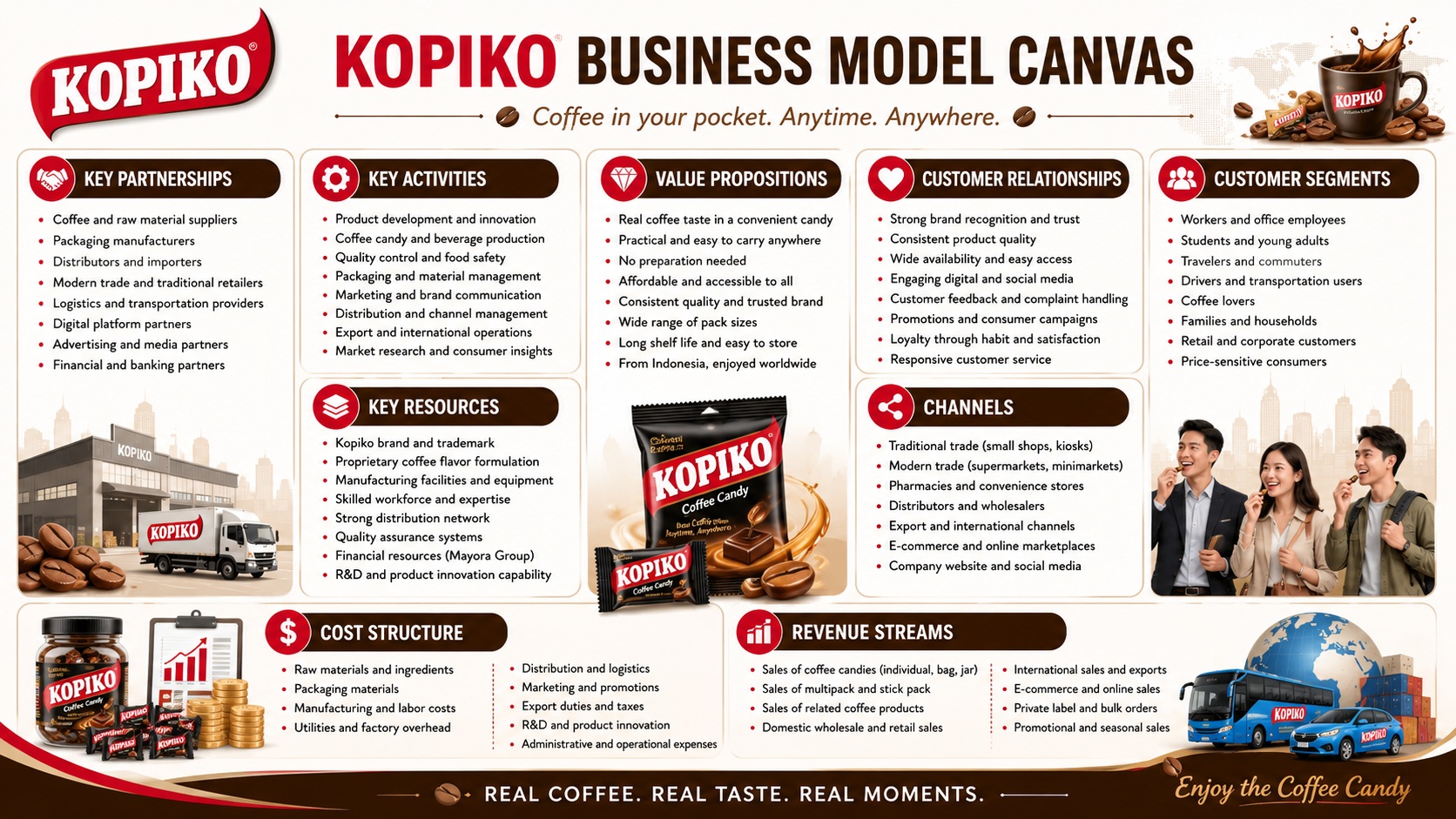
The diagram below provides a visual summary of how the main blocks of Kopiko’s business model connect in one view. It helps readers move from the written overview into a simpler strategic snapshot before continuing to the detailed block-by-block analysis.
BMC Analysis of Kopiko
The BMC analysis of Kopiko examines how the nine building blocks support the brand’s confectionery and coffee-related business. Each block represents a specific part of the model, but overall performance depends on how well product value, manufacturing, packaging, distribution, pricing, marketing, and cost control are aligned.
This analysis is especially relevant because Kopiko sells a low-unit-price product across numerous channels and markets. A small increase in ingredient or packaging cost can materially affect margins when multiplied across high production volumes. Likewise, international expansion adds sales opportunities but also introduces regulatory, logistics, currency, and distributor-management complexity.
The following sections examine each block of the Kopiko Business Model Canvas in greater detail. Together, they show how the brand creates value for consumers, delivers that value through a broad FMCG network, and captures revenue from repeated product sales.
1. Customer Segments
Customer segments explain who Kopiko serves and why those buyers matter. Kopiko targets a mass market, but its strength comes from addressing several consumption situations, age groups, purchasing budgets, and product preferences through one recognisable concept.
Workers and students may use Kopiko during long working or study periods. Travellers and drivers value products that are easy to carry and do not create spills. Coffee-flavour consumers may enjoy the taste without wanting a complete beverage.
Households and offices also represent relevant buyers because larger bags, jars, and multipacks support sharing, storage, and repeat consumption.
Kopiko Customer Segments
| Segment | Details | Why It Matters |
|---|---|---|
| Workers and students | Consumers seeking convenient refreshment during work, study, meetings, or commuting | Supports recurring daily consumption and repeat purchasing |
| Travellers and drivers | Buyers needing a compact, mess-free product that requires no preparation | Strengthens Kopiko’s portability and convenience positioning |
| Coffee-flavour consumers | Customers who enjoy coffee taste but may not want a complete beverage | Differentiates Kopiko from ordinary confectionery |
| Households and organisations | Families, offices, retailers, and groups purchasing bags, jars, or multipacks | Increases basket size and supports sharing and stocking |
Kopiko succeeds because it serves both immediate individual needs and larger shared-consumption occasions. The Kopiko Business Model Canvas is strong here because one core product can address multiple customer situations without requiring extensive operational variation.
2. Value Propositions
The value proposition explains why customers choose Kopiko repeatedly. Kopiko offers more than sweetness. It delivers recognisable coffee flavour, convenience, portability, easy storage, accessible portions, and broad availability.
That matters because low-value consumer purchases are often made quickly. Buyers may compare taste, price, familiarity, packaging, convenience, and accessibility without conducting an extensive evaluation.
Kopiko strengthens its value by reducing the preparation requirements associated with a beverage while retaining a clear coffee identity.
Kopiko Value Propositions
| Value Proposition | Details | Why It Matters |
|---|---|---|
| Portable coffee experience | Coffee flavour in a compact candy requiring no water, cup, or brewing | Creates a distinctive position between coffee and confectionery |
| Convenient consumption | Individually wrapped products are easy to carry, store, share, and consume | Expands the number of suitable consumption occasions |
| Recognisable taste | Consistent original and cappuccino-style flavour profiles across purchases | Reduces uncertainty and supports repeat buying |
| Accessible formats | Individual pieces, bags, jars, stick packs, and multipacks at different price points | Broadens market access and supports both trial and stocking |
Customers do not choose Kopiko only because they want candy. Many select it because it offers a familiar coffee-related experience in a form that is easy to purchase, transport, and consume.
3. Channels
Channels explain how Kopiko reaches consumers and converts product awareness into completed purchases. In FMCG, channel management is not merely a supporting activity. It directly affects visibility, availability, pricing, inventory turnover, and impulse buying.
Kopiko uses traditional stores, supermarkets, convenience outlets, wholesalers, importers, distributors, and digital marketplaces. This mix matters because consumers do not purchase confectionery through one uniform channel.
A customer may buy an individual piece from a neighbourhood shop, a bag from a supermarket, or a larger jar through an online marketplace.
Kopiko Channels
| Channel | Details | Why It Matters |
|---|---|---|
| Traditional retail | Grocery stores, kiosks, neighbourhood outlets, and independent retailers | Provides deep community access and supports small purchases |
| Modern retail | Supermarkets, hypermarkets, convenience stores, pharmacies, and petrol stations | Improves visibility and supports bags, jars, and promotional displays |
| Distributors and importers | Partners managing local supply, warehousing, retailer access, and replenishment | Enables international expansion without building every capability internally |
| Digital marketplaces | Online retailers, cross-border platforms, and e-commerce sellers | Expands access to larger packs, imported variants, and bundles |
Channel breadth gives Kopiko more than sales access. It creates repeated visibility across everyday shopping environments and increases the likelihood of both planned and impulse purchases.
4. Customer Relationships
Customer relationships describe how Kopiko keeps customers familiar with the brand and willing to buy again. These relationships operate through product consistency, packaging recognition, everyday availability, advertising, digital engagement, and complaint handling.
That combination matters because confectionery loyalty is rarely created by communication alone. Consumers may recognise Kopiko, but repeat purchasing still depends on flavour, freshness, price, product condition, and convenient availability.
Kopiko therefore builds relationships through both emotional familiarity and reliable execution.
Kopiko Customer Relationships
| Relationship Type | Details | Why It Matters |
|---|---|---|
| Brand familiarity | Recognisable name, colours, packaging, coffee identity, and product presentation | Helps customers identify Kopiko quickly in crowded retail environments |
| Product consistency | Predictable flavour, texture, freshness, and packaging quality | Builds trust and encourages repeat purchasing |
| Routine consumption | Association with work, study, travel, driving, sharing, and small breaks | Helps convert occasional trial into habitual use |
| Digital and service interaction | Campaigns, social media, enquiries, feedback, and complaint management | Maintains relevance and supports trust when issues arise |
Customer loyalty is not purely emotional or transactional. Kopiko must remain familiar while ensuring that products are fresh, consistently available, correctly packaged, and reasonably priced.
5. Revenue Streams
Revenue streams explain how Kopiko converts product demand, brand recognition, and distribution reach into income. Most revenue comes from packaged-product sales, but the economics vary by format, market, channel, distributor arrangement, and pack size.
Individual candy and smaller packs support affordability and volume. Bags, jars, and multipacks can raise average transaction value. International distribution provides geographic diversification but introduces freight, customs, importer margins, and regulatory expenditure.
That combination creates several complementary revenue sources.
Kopiko Revenue Streams
| Revenue Stream | Details | Why It Matters |
|---|---|---|
| Individual and small-pack sales | Low-value purchases through traditional and modern retail channels | Supports trial, affordability, impulse buying, and high transaction frequency |
| Bags, jars, and multipacks | Larger formats for households, offices, sharing, and stocking | Increases average order value and consumption volume |
| Coffee-product extensions | Selected instant coffee and ready-to-drink products offered under the Kopiko name | Expands the brand into additional coffee occasions |
| International and wholesale sales | Transactions through distributors, importers, retailers, and cross-border channels | Diversifies revenue and enables geographic scale |
Not all sales contribute equally to profitability. Larger formats can improve transaction value, while overseas channels may create higher logistics and partner costs. The Kopiko Business Model Canvas therefore depends on revenue quality, not only product volume.
6. Key Resources
Key resources describe the assets that make Kopiko’s model difficult to reproduce at comparable scale. The most important resources are not limited to the candy recipe. Competitive strength comes from how brand equity, formulations, manufacturing, quality systems, packaging, and distribution work together.
A smaller confectionery producer may create a coffee-flavoured candy, but it cannot quickly replicate Kopiko’s international recognition, production capability, retail relationships, and accumulated market experience.
Scale is therefore not simply output volume. It is a repeatable system of market access.
Kopiko Key Resources
| Resource | Details | Why It Matters |
|---|---|---|
| Kopiko brand | Established name, visual identity, coffee association, and customer familiarity | Reduces purchase uncertainty and strengthens retailer acceptance |
| Product and formulation knowledge | Coffee flavour profiles, ingredient specifications, texture, and shelf-life expertise | Protects differentiation and product consistency |
| Manufacturing and quality systems | Factories, production lines, technical expertise, food safety, and quality controls | Enables high-volume output and reliable product standards |
| Mayora distribution capabilities | Procurement scale, logistics relationships, corporate resources, and international market presence | Supports expansion and creates capabilities smaller rivals may lack |
These resources create barriers that are difficult to replicate quickly. A competitor may imitate a flavour, but building equivalent brand recognition, manufacturing efficiency, and retail penetration is substantially harder.
7. Key Activities
Key activities explain what Kopiko must execute well for the model to remain effective. The business cannot rely on brand familiarity alone. It must coordinate production, sourcing, quality control, packaging, distribution, marketing, innovation, and regulatory compliance.
Manufacturing execution is particularly important because consumers expect every candy to deliver a consistent taste and texture. Product defects, damaged packaging, stock shortages, or inconsistent freshness can reduce trust quickly.
Portfolio development must also balance innovation with operational simplicity.
Kopiko Key Activities
| Activity | Details | Why It Matters |
|---|---|---|
| Manufacturing and quality control | Producing candy while managing flavour, texture, hygiene, safety, and consistency | Determines customer satisfaction and manufacturing efficiency |
| Ingredient and packaging procurement | Sourcing coffee extract, sugar, milk-related ingredients, wrappers, containers, and cartons | Protects product continuity, quality, and cost control |
| Distribution and retail execution | Managing inventory, warehousing, transportation, replenishment, and shelf availability | Converts production capacity into actual consumer purchases |
| Marketing and product development | Building awareness, improving packaging, developing variants, and managing campaigns | Maintains relevance and supports future growth |
Operational excellence matters because even a recognised brand can lose customers when quality, packaging, or availability becomes unreliable. The model works when production, supply, distribution, and marketing reinforce one another.
8. Key Partnerships
Key partnerships explain which external organisations help Kopiko operate at scale. Ingredient and packaging suppliers are critical because they influence quality, consistency, cost, freshness, and production continuity.
Distributors and importers provide access to local markets, while retailers determine shelf presence and consumer availability. Logistics companies support warehousing, transportation, and cross-border movement.
Digital marketplaces extend access but may also introduce pricing inconsistency and weaker control over product presentation.
Kopiko Key Partnerships
| Partner | Details | Why It Matters |
|---|---|---|
| Ingredient suppliers | Businesses providing coffee extract, sugar, milk ingredients, flavourings, and other inputs | Supports taste consistency, production continuity, and cost management |
| Packaging suppliers | Providers of wrappers, bags, jars, labels, cartons, and protective materials | Protects freshness, convenience, brand communication, and compliance |
| Distributors and importers | Partners managing inventory, local registration, retail relationships, and market entry | Accelerates geographic expansion and provides local knowledge |
| Retail, logistics, and digital partners | Stores, warehouses, transport providers, and online platforms | Converts production into availability and completed sales |
Partnership quality affects both expansion and daily operating stability. Strong coordination protects product supply, market access, packaging availability, and retailer replenishment.
9. Cost Structure
Cost structure explains the major expenses required to operate Kopiko’s confectionery and international distribution system. Ingredients, packaging, labour, utilities, logistics, marketing, regulatory compliance, and product development all influence profitability.
Different product and market formats carry different cost profiles. Individually wrapped pieces require significant packaging volume, while international markets may add freight, customs, importer margins, registration, and market-specific labelling.
Promotional intensity can also pressure returns when discounts increase sales without generating sufficient contribution.
Kopiko Cost Structure
| Cost Category | Details | Why It Matters |
|---|---|---|
| Ingredients and packaging | Coffee extract, sugar, milk inputs, flavourings, wrappers, bags, jars, and cartons | Directly affects product quality, margin, and exposure to commodity inflation |
| Manufacturing and quality | Labour, machinery, utilities, maintenance, sanitation, testing, and food-safety controls | Determines productivity, consistency, and compliance |
| Distribution and market access | Warehousing, transport, exports, customs, importer support, and retailer servicing | Enables availability but can create significant international costs |
| Marketing, compliance, and innovation | Campaigns, promotions, product development, registration, certification, and local labels | Supports demand, market entry, and long-term relevance |
Scale can distribute production, procurement, development, and marketing expenditure across large volumes. However, it does not remove pressure from ingredient inflation, packaging costs, inefficient logistics, or weak-performing markets.
Kopiko Value Proposition Canvas
Before comparing Kopiko with Nescafé, it is useful to examine how Kopiko creates fit between what customers need and what the brand delivers. That is the purpose of Value Proposition Canvas, or VPC.
While Business Model Canvas explains the overall structure of the company, VPC focuses more closely on the connection between customer requirements and Kopiko’s actual offer.
For Kopiko, this framework is especially relevant because the brand serves several consumption situations. It must balance coffee flavour, convenience, affordability, portability, easy storage, and reliable availability.
In simple terms, VPC helps explain why the Kopiko Business Model Canvas works in practice. It shows how customer jobs, pains, and gains connect with Kopiko’s products, packaging, distribution, pricing, and recognised brand.
Customer Profile
The customer profile examines what Kopiko’s target consumers are trying to accomplish, what frustrates them, and which outcomes they value most.
Since the brand serves a broad market, the profile reflects common needs across work, study, travel, driving, household, and casual snacking situations.
Customer Profile of Kopiko
| Customer Profile | Details |
|---|---|
| Customer Jobs | Enjoy coffee flavour, obtain convenient refreshment, avoid beverage preparation, carry a small snack, remain alert, and share confectionery |
| Customer Pains | Limited preparation time, difficulty carrying liquids, risk of spills, expensive café purchases, restricted coffee access, and inconvenient packaging |
| Customer Gains | Familiar flavour, easy portability, affordable portions, quick consumption, long shelf life, convenient storage, and broad availability |
This profile shows that Kopiko does not win only through sweetness. It also reduces the time, effort, equipment, and handling associated with conventional coffee consumption.
Value Map
The value map explains how Kopiko responds to customer jobs, pains, and gains. The brand uses a product-and-distribution strategy rather than depending only on one flavour.
That matters because consumers may want different benefits on different occasions. Some seek a small indulgence, others want coffee flavour during travel, while offices may require larger packs for convenient sharing.
Value Map of Kopiko
| Value Map | Details |
|---|---|
| Products and Services | Original coffee candy, cappuccino candy, individual pieces, bags, jars, stick packs, multipacks, and selected coffee products |
| Pain Relievers | No brewing is required, individual wrappers reduce mess, small portions support affordability, and compact products simplify storage |
| Gain Creators | Recognisable coffee taste, convenient consumption, varied pack sizes, easy sharing, consistent quality, and wide retail availability |
This value map shows why Kopiko retains broad commercial relevance. The brand does not rely solely on coffee flavour. It creates value by linking that flavour with portability, packaging, accessible pricing, and market availability.
How Kopiko Creates Fit
The table below shows how customer needs and Kopiko’s value offer connect more directly. This format matches customer-side requirements with company-side value creation.
| Customer Profile | Details | Matching Value Map | How Kopiko Creates Fit |
|---|---|---|---|
| Customer Jobs | Consumers want coffee flavour, refreshment, or a convenient snack without preparing a beverage | Products and Services | Kopiko provides ready-to-consume coffee candy in individual and larger formats |
| Customer Pains | Conventional coffee may require equipment, liquid handling, time, higher spending, or café access | Pain Relievers | Wrapped candy removes preparation, avoids spills, and provides an affordable alternative |
| Customer Gains | Buyers value familiar flavour, portability, quick consumption, predictable quality, and easy access | Gain Creators | Kopiko combines recognisable taste, convenient packs, consistent production, and extensive distribution |
The fit is strongest because Kopiko solves more than the desire for sweetness. It reduces preparation effort, improves portability, and gives consumers access to coffee-related flavour in situations where a beverage may be inconvenient.
Where the Fit Happens
The strongest fit occurs during commuting, work, study, driving, travel, meetings, office sharing, and situations where consumers want coffee flavour without preparing or carrying a drink.
Kopiko performs well when buyers require a small product that is affordable, familiar, easy to store, and simple to consume. Individual wrapping also allows portions to be distributed across several moments rather than consumed at once.
This is where Kopiko’s focused model matters most. A conventional candy may offer sweetness without a strong coffee association, while a coffee beverage may provide a fuller experience but require more preparation and handling.
Kopiko creates fit between those alternatives. It offers a coffee-related experience through a compact confectionery format that can travel easily across channels, markets, and everyday routines.
Kopiko VPC Diagram
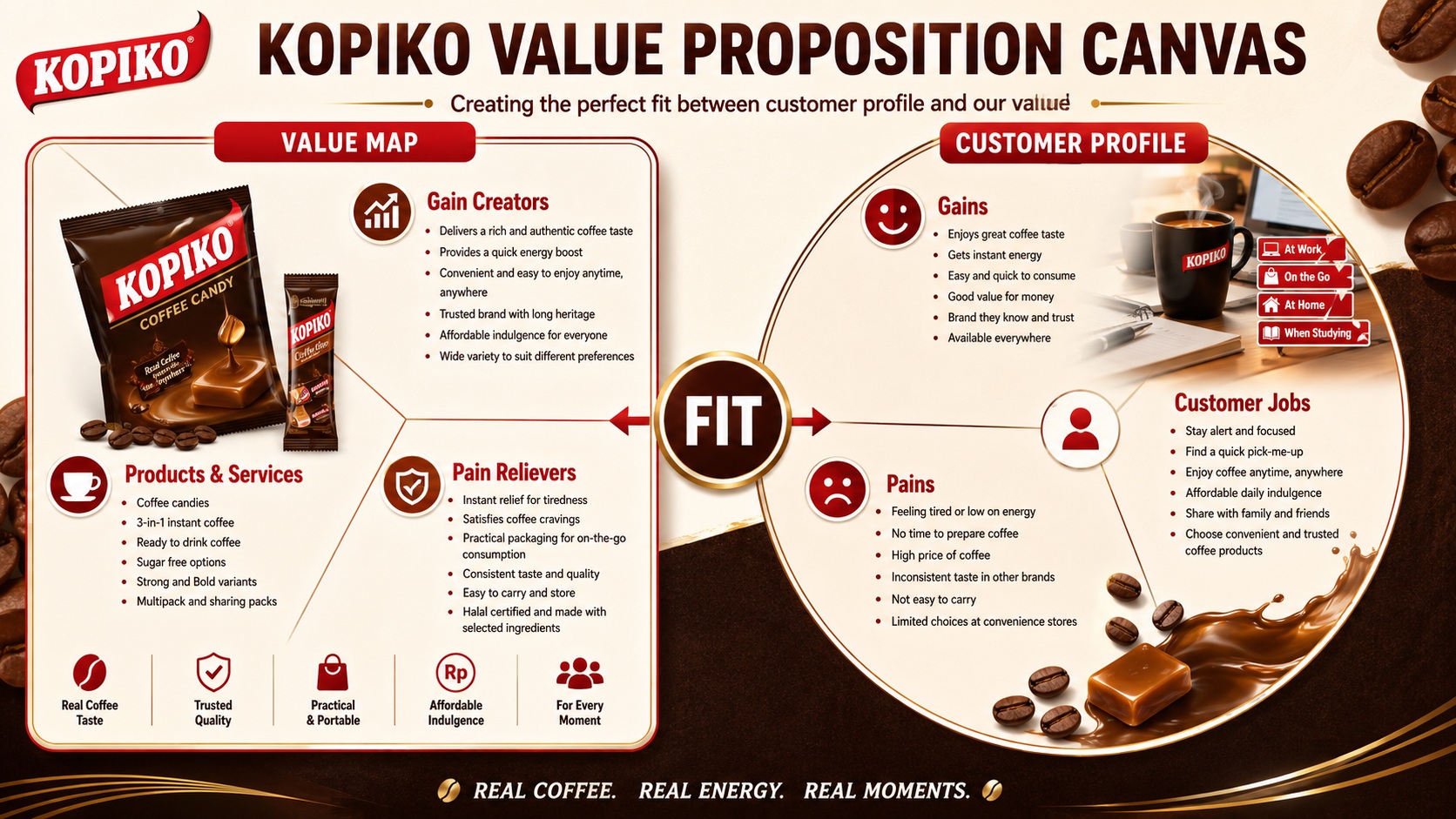
The following is the VPC diagram of Kopiko. It provides a visual view of how customer jobs, pains, and gains connect with Kopiko’s products and services, pain relievers, and gain creators.
Kopiko vs Nescafé Business Model
The Kopiko Business Model Canvas differs from Nescafé mainly in product-format heritage, category focus, customer occasions, and the role of coffee within the operating system.
Kopiko developed around coffee-flavoured confectionery and later extended into selected coffee products. Nescafé was built primarily around soluble coffee and expanded into ready-to-drink beverages, premium instant formats, capsules, and other coffee systems.
Kopiko’s core strength is portability in a low-cost candy format. Nescafé competes through a much broader coffee portfolio and participates more directly in conventional beverage consumption.
Neither structure is automatically superior. Each is optimised around different customer needs and commercial priorities.
| Dimension | Kopiko | Nescafé |
|---|---|---|
| Format logic | Coffee candy supported by selected coffee-related extensions | Soluble coffee supported by beverages, capsules, and wider coffee formats |
| Customer occasion | Work, study, driving, travel, snacking, sharing, and portable refreshment | Home brewing, workplace coffee, café-style preparation, travel, and ready-to-drink use |
| Product breadth | Focused confectionery offer with selected coffee-category participation | Broad coffee portfolio across value, mainstream, and premium segments |
| Brand positioning | Accessible coffee flavour in a portable and convenient format | Global coffee brand associated with preparation convenience and coffee expertise |
| Model strength | Distinctive category, low entry price, portability, and impulse suitability | Portfolio depth, coffee authority, product segmentation, and wide occasion coverage |
Kopiko should not simply copy Nescafé. A stronger approach is to retain its distinctive portable-coffee identity while selectively entering adjacent formats that reinforce convenience, affordability, and brand credibility.
Competitive Advantages
Kopiko has several reinforcing strengths that make the brand more defensible than many smaller confectionery competitors.
- Distinctive coffee-candy positioning gives Kopiko a recognisable space between conventional sweets and coffee beverages. This reduces direct comparability with generic candy brands.
- Portable and individually wrapped format makes the product suitable for commuting, work, study, driving, sharing, and travel without requiring preparation.
- Accessible pricing and multiple pack sizes allow consumers to purchase according to budget, occasion, and desired quantity.
- Mayora’s manufacturing and distribution capabilities provide production scale, supplier leverage, corporate resources, and international market access.
- Strong brand familiarity across multiple countries supports retailer acceptance, repeat buying, and extension into related coffee products.
These advantages work together. Portability would be less valuable without broad distribution, while international availability would be weaker without a distinctive and easily understood product concept.
Risks and Challenges
Kopiko also faces several risks that could weaken growth, profitability, or brand relevance.
- Health and sugar concerns may reduce demand for conventional confectionery or increase pressure for lower-sugar and portion-controlled alternatives.
- Ingredient and packaging inflation can compress margins because coffee extract, sugar, milk-related inputs, wrappers, jars, and cartons are central to the model.
- Portfolio dilution may occur if expansion into unrelated coffee products weakens Kopiko’s distinctive association with portable coffee candy.
- International execution complexity creates exposure to regulation, customs, exchange rates, distributor performance, local labelling, and market-specific preferences.
- Packaging sustainability pressure may intensify because individual wrapping provides convenience and hygiene but also increases material usage.
These risks are interconnected. A packaging change may reduce environmental impact but affect freshness or cost, while a healthier formulation may improve perception but weaken the taste customers expect.
Analysis
Kopiko’s main strategic strength comes from creating a recognisable category rather than competing as an undifferentiated sweet.
The company transformed coffee flavour into a product that can be stored, carried, shared, and consumed with little effort. That design expands the addressable occasion beyond traditional confectionery and gives Kopiko a clear mental position.
However, long-term growth cannot depend only on adding more distributors or entering more countries. Geographic expansion creates value when products achieve sufficient shelf visibility, consumer awareness, repeat purchasing, and distributor productivity.
Portfolio expansion also requires discipline. Coffee mixes and ready-to-drink products may increase revenue opportunities, but they place Kopiko closer to large beverage competitors with greater category depth.
The most defensible path is controlled adjacency. Kopiko should first protect its leadership in portable coffee enjoyment, then enter products that naturally reinforce the same customer need.
Operational execution remains equally important. Affordable pricing depends on high production utilisation, disciplined procurement, efficient packaging, accurate forecasting, and reliable distribution.
Recommendations
1. Protect the Portable Coffee Position
Kopiko should use its “coffee in your pocket” association as the strategic filter for product development, communication, and portfolio expansion.
New formats should reinforce convenience, recognisable coffee flavour, and portability rather than move the brand into unrelated categories.
2. Develop Health-Conscious Variants
Lower-sugar, sugar-free, and clearly portioned options can address changing consumer expectations.
Product reformulation must be tested carefully because health improvements will not create value if flavour, texture, or brand familiarity deteriorates.
3. Apply Country-Level Portfolio Discipline
Not every Kopiko format should be introduced in every country.
Market selection should consider local coffee habits, confectionery demand, consumer income, regulation, retail structure, climate, logistics, and distributor capability.
4. Improve Digital Commerce Execution
Online channels should be used for more than basic product availability.
Kopiko can develop multipacks, office jars, travel bundles, gift combinations, subscription-style replenishment, and market-specific digital promotions.
5. Strengthen Packaging Sustainability
The company should evaluate lighter materials, recyclable structures, reduced secondary packaging, and supplier innovation.
Any redesign must continue protecting hygiene, freshness, shelf life, portability, and visual recognition.
6. Build Supply-Chain Resilience
Kopiko should maintain alternative suppliers for critical ingredients and packaging materials.
Supplier risk assessment, regional inventory planning, demand forecasting, and logistics scenario testing can reduce disruption exposure.
7. Measure Market Quality, Not Only Reach
Management should assess weighted distribution, shelf availability, repeat purchasing, product profitability, distributor performance, and brand awareness.
A market with strong execution and repeat consumption may be more valuable than several countries with limited visibility and slow stock movement.
Conclusion
Overall, the Kopiko Business Model Canvas explains how an Indonesian product innovation developed into an internationally distributed FMCG brand.
Kopiko’s success does not come only from coffee flavour. Its advantage is created by combining a distinctive category position, portable packaging, affordable portions, high-volume manufacturing, extensive retail access, and the wider capabilities of PT Mayora Indah Tbk.
The brand also demonstrates how category boundaries can create commercial opportunity. Kopiko can operate as confectionery, portable coffee enjoyment, convenient refreshment, and a small everyday indulgence.
Future growth will depend on protecting that clarity while responding to health expectations, packaging sustainability, commodity inflation, digital commerce, and international execution complexity.
Kopiko can remain relevant by defending its portable-coffee identity, expanding selectively, strengthening market-level insight, improving supply-chain resilience, and ensuring that each product reinforces the brand’s central promise.
Disclaimer
This article is provided for educational and business analysis purposes only. Its content is based on publicly available information, official corporate materials, general market observations, and strategic interpretation.
The article does not constitute financial advice, investment advice, legal advice, nutritional advice, or an official statement from PT Mayora Indah Tbk, Kopiko, Nescafé, Nestlé, or any related organisation.
Readers should conduct independent research and obtain appropriate professional advice before making business, investment, distribution, product-development, or market-entry decisions.
All trademarks, logos, copyrights, brand names, product names, and related materials belong to their respective owners.
Meta Description
Explore the Kopiko Business Model Canvas, including nine BMC blocks, Value Proposition Canvas, Nescafé comparison, competitive advantages, risks, analysis, and strategic recommendations.

