



Share This Article


Gramedia Business Model Canvas: How Indonesia’s Leading Bookstore Brand Creates Value Through Retail, Publishing, and Digital Commerce
BMC Article No: BMC #048
Updated in 2026: This article has been comprehensively rewritten to reflect Gramedia’s evolving position in Indonesia’s book retail industry, growing competition from online marketplaces, changing reading habits, digital commerce, the emergence of new product categories, and the increasing importance of omnichannel retail.
The 2026 update also introduces deeper analysis of all nine BMC blocks, expanded strategic closing discussions, a detailed Value Proposition Canvas, comparisons with Periplus and Kinokuniya, competitive advantages, risks and challenges, and recommendations for strengthening Gramedia’s long-term competitiveness.
Introduction
For decades, Gramedia has been one of Indonesia’s most familiar destinations for books, educational materials, and stationery.
Established in 1970, the company grew from a modest bookstore in Jakarta into an extensive retail network serving readers, students, families, professionals, and educational institutions.
Today, Gramedia represents much more than a place to purchase printed books. Its retail ecosystem combines bookstores, online shopping, digital publications, stationery, office supplies, lifestyle merchandise, and activities that encourage reading and learning.
The Gramedia Business Model Canvas is particularly interesting because the company operates in an industry experiencing significant changes in consumer behaviour.
Digital marketplaces have made books easier to purchase online, while e-books and online learning platforms have introduced alternatives to traditional printed publications.
Nevertheless, physical bookstores continue to offer something that digital platforms cannot fully reproduce: the experience of browsing shelves, discovering unfamiliar titles, examining products, and interacting with a reading community.
Gramedia must therefore balance two different retail models.
On one side, its physical bookstores generate sales through customer visits, product availability, and in-store experiences.
On the other, digital channels provide convenience, wider geographic accessibility, and opportunities to engage consumers beyond individual store locations.
Understanding how these elements interact helps explain how Gramedia creates value, generates revenue, and competes in Indonesia’s changing retail environment.
What Is Gramedia’s Business Model?
Gramedia operates primarily as an omnichannel specialty retailer focused on books, educational products, stationery, and complementary consumer merchandise.
Unlike subscription-based technology platforms, the company’s core commercial model depends on selling physical products to individual and institutional customers.
Revenue is generated when customers purchase merchandise through bookstores and online channels.
At the centre of the Gramedia Business Model Canvas is a retail strategy that combines trusted product selection, established brand recognition, physical accessibility, and digital shopping convenience.
Three economic engines support this business.
First, bookstores attract customers through curated merchandise, convenient locations, and the opportunity to discover and examine products before purchasing.
Second, digital commerce extends Gramedia’s reach by allowing customers to search for books, compare merchandise, and order products without visiting physical locations.
Third, publishing and supplier relationships provide access to merchandise that supports the company’s broader educational and retail proposition.
These activities create a reinforcing commercial cycle.
An extensive product selection attracts readers and students. Higher customer traffic creates opportunities to sell complementary merchandise. Additional transactions contribute revenue that can support retail operations, marketing, technology, and distribution.
Meanwhile, online channels expand purchasing opportunities beyond the immediate geographic reach of individual bookstores.
Gramedia’s commercial success ultimately depends on converting customer demand into profitable merchandise sales while managing inventory, retail occupancy, and fulfilment costs.
What Is Business Model Canvas?
Business Model Canvas, commonly known as BMC, is a strategic management framework used to explain how an organisation creates, delivers, and captures value.
Developed by Alexander Osterwalder and Yves Pigneur, the framework consists of nine interconnected building blocks.
For Gramedia, BMC is particularly useful because operating a bookstore involves much more than purchasing inventory and selling merchandise.
Customer preferences determine which titles and products should be stocked, while publishers and suppliers influence merchandise availability.
Physical locations provide shopping access and product discovery, whereas digital platforms help customers purchase products remotely.
The Gramedia Business Model Canvas brings these commercial relationships together in one structured framework.
| BMC Block | Main Question |
|---|---|
| Customer Segments | Who does Gramedia serve? |
| Value Propositions | What value does Gramedia provide? |
| Channels | How does Gramedia reach customers? |
| Customer Relationships | How does Gramedia maintain loyalty and repeat purchases? |
| Revenue Streams | How does Gramedia generate revenue? |
| Key Resources | Which resources make the business model possible? |
| Key Activities | What activities must Gramedia continuously perform? |
| Key Partnerships | Which external partners strengthen the business? |
| Cost Structure | What are Gramedia’s major operating costs? |
Examining these blocks individually helps identify the company’s operating characteristics.
However, their greater strategic value comes from understanding how customer demand, merchandise selection, distribution capabilities, and financial performance influence one another.
Quick Overview of Gramedia
Gramedia began operating on 2 February 1970 as a bookstore in Jakarta and subsequently expanded across Indonesia.
Operating under PT Gramedia Asri Media within the Kompas Gramedia Group, the business has developed a strong association with books, education, and learning.
Its physical bookstores have traditionally served as accessible destinations for readers seeking printed publications, reference materials, and stationery.
Over time, the merchandise assortment expanded to include office supplies, gifts, toys, selected technology accessories, and other lifestyle-related products.
Digital commerce also became an important part of the company’s retail presence.
Through its official website and mobile shopping channels, customers can discover and purchase merchandise without being physically present at a bookstore.
Gramedia Digital provides access to electronic reading formats, extending the company’s presence beyond conventional printed publications.
The relationship between physical bookstores, complementary merchandise, and digital services gives Gramedia several ways to engage customers.
Rather than relying entirely on printed book sales, its broader positioning connects the brand with education, creativity, productivity, and everyday consumer interests.
This diversified retail proposition forms the foundation of Gramedia’s commercial strategy.
Why Gramedia Is Strategically Interesting
Gramedia illustrates how a traditional bookstore business can evolve into a broader knowledge-oriented retail platform.
Many consumers initially associate the brand with printed books, yet its commercial opportunities extend across multiple purchasing occasions.
Students may visit for textbooks and examination guides.
Parents often need stationery, school supplies, and children’s learning materials.
Professionals purchase business publications, productivity products, and office accessories.
General readers seek entertainment, personal development, and opportunities to discover new authors.
These purchasing occasions create opportunities for cross-selling.
A customer visiting for a novel may also purchase stationery or a gift, increasing the commercial value of the transaction.
The Gramedia Business Model Canvas highlights the significance of combining specialised brand positioning with complementary merchandise categories.
Physical bookstores also perform several functions simultaneously.
Beyond generating immediate sales, they provide product discovery, customer service, brand visibility, and opportunities for literary events.
Yet maintaining these locations requires significant expenditure on rental, staffing, inventory, and daily operations.
Digital shopping introduces additional reach but also exposes the company to intense price competition and rising customer expectations.
Gramedia’s long-term challenge is therefore not simply to maintain its bookstore presence.
Instead, it must ensure that physical and digital channels work together to improve customer convenience, strengthen merchandise productivity, and generate sustainable financial returns.
Latest Developments: What Is Changing Around Gramedia?
Several developments are reshaping Indonesia’s bookstore and educational retail environment in 2026.
Online marketplaces have made price comparison and product purchasing increasingly convenient, allowing customers to browse multiple sellers without visiting a physical bookstore.
Meanwhile, social media and online reading communities influence how consumers discover books.
Recommendations from creators, authors, and other readers can stimulate demand for particular titles, sometimes faster than traditional merchandising campaigns.
Digital reading is another important development.
E-books and online educational resources provide alternatives to printed publications, particularly for consumers who prioritise portability and immediate access.
Gramedia’s own digital reading offering demonstrates the relevance of electronic formats within its broader business environment.
Retail assortment diversification is also visible through merchandise categories such as stationery, toys, bags, sports-related products, and technology accessories.
Growing product variety can create additional purchasing occasions, although it also introduces more demanding inventory and category-management requirements.
Finally, omnichannel retail has become strategically important as customers increasingly move between online product discovery and physical-store purchasing.
The Gramedia Business Model Canvas must therefore be examined in the context of changing purchasing behaviour, digital competition, and the economics of physical retail.
Future performance will depend on how effectively the company adapts to these developments without weakening its established identity as a trusted destination for books and learning.
Gramedia Business Model Canvas Summary
Before examining each component, the Gramedia Business Model Canvas can be summarised as a retail system that converts customer demand for books, learning materials, and complementary merchandise into revenue through physical bookstores and digital commerce.
| BMC Block | Gramedia Application |
|---|---|
| Customer Segments | Students, parents, general readers, professionals, educational institutions, and businesses |
| Value Propositions | Trusted book selection, educational products, one-stop shopping, product discovery, and convenient access |
| Channels | Physical bookstores, official website, mobile application, digital reading services, and social media |
| Customer Relationships | In-store assistance, membership engagement, promotional campaigns, digital communication, and literary communities |
| Revenue Streams | Printed books, stationery, educational products, lifestyle merchandise, digital reading services, and institutional sales |
| Key Resources | Brand reputation, bookstore network, inventory, supplier relationships, employees, and digital platforms |
| Key Activities | Merchandise sourcing, inventory management, retail operations, digital commerce, marketing, and fulfilment |
| Key Partnerships | Publishers, authors, merchandise suppliers, property owners, logistics providers, and technology partners |
| Cost Structure | Merchandise procurement, store occupancy, employees, inventory, logistics, marketing, and digital infrastructure |
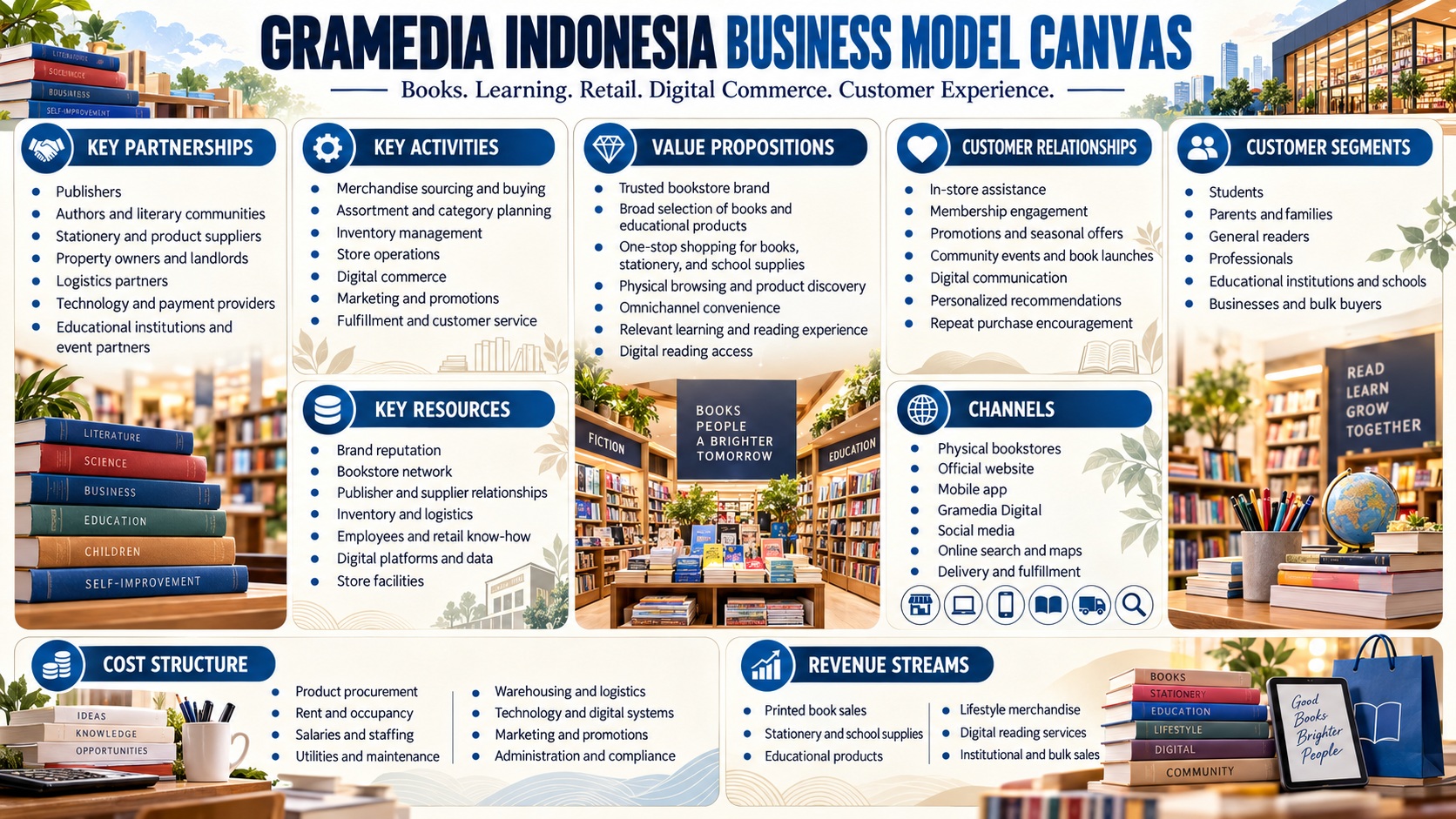
Gramedia BMC Diagram
A Gramedia BMC diagram should present all nine blocks within a single visual framework.
The central relationship involves customers, merchandise, supplier relationships, physical bookstores, digital platforms, and retail revenue.
Readers and students create demand for books and educational products.
Publishers and suppliers make merchandise available, while Gramedia selects and distributes products through its retail channels.
Customers complete purchases in stores or online, generating revenue that supports procurement, employees, property expenses, fulfilment, and technology.
A well-integrated business model ensures that every component contributes to customer value and commercial sustainability.
BMC Analysis of Gramedia
The detailed Gramedia Business Model Canvas reveals how the company’s competitive position depends on the interaction between brand reputation, merchandise selection, physical stores, customer relationships, and distribution capabilities.
No individual building block can operate effectively in isolation.
A broad selection of books attracts customers, but inventory must be managed carefully to avoid excessive stockholding.
Convenient bookstore locations improve accessibility, although occupancy costs can reduce profitability when customer traffic weakens.
Digital commerce expands market reach while introducing additional expenses associated with technology, packaging, delivery, and customer acquisition.
Strong supplier relationships can improve merchandise availability, yet the economic benefits depend on demand forecasting and product turnover.
Customer loyalty can support repeat purchases, but excessive dependence on discounts may weaken margins.
Gramedia must therefore balance customer experience, product availability, operational efficiency, and financial performance across its entire retail business.
The following sections examine each BMC block in greater depth.
1. Customer Segments
Gramedia serves several customer groups with different purchasing motivations, product requirements, and shopping preferences.
Students represent an important segment because books, reference materials, and stationery are closely connected to educational activities.
Parents and families purchase children’s books, school supplies, and learning products that support household educational needs.
General readers seek fiction, nonfiction, biographies, and other publications for entertainment or personal development.
Professionals purchase business titles, specialist references, and office-related merchandise.
Educational institutions and businesses can also represent opportunities for coordinated purchasing and larger merchandise orders.
Gramedia Customer Segments
| Segment | Details | Why It Matters |
|---|---|---|
| Students | Purchase textbooks, reference materials, stationery, and learning products | Creates education-related demand and seasonal purchasing opportunities |
| Parents and families | Buy children’s books, school supplies, and educational merchandise | Supports household purchasing and repeat visits |
| General readers | Seek fiction, nonfiction, personal development, and leisure reading | Maintains the company’s traditional bookstore identity |
| Professionals | Purchase business publications, specialist books, and office products | Diversifies demand beyond academic purchases |
| Educational institutions and businesses | Require books, stationery, and other merchandise in larger quantities | Creates opportunities for bulk purchasing and institutional relationships |
Strategic Analysis
Understanding customer differences is essential because each segment contributes differently to revenue and profitability.
Students may generate predictable seasonal demand, while leisure readers can respond strongly to new releases and recommendations.
Institutional buyers may place larger orders but require negotiated pricing, reliable stock availability, and additional service coordination.
The Gramedia Business Model Canvas therefore illustrates the importance of segment-level profitability rather than simply attracting the largest possible customer base.
Greater customer diversity can reduce dependence on any single market, although serving too many unrelated segments may complicate inventory planning and marketing.
Product assortments should consequently reflect local purchasing behaviour, store catchment areas, and demand patterns.
For example, branches near universities could prioritise academic references and stationery, while locations in family-oriented shopping centres might emphasise children’s books and gifts.
Better segmentation can improve merchandise relevance, inventory productivity, customer satisfaction, and repeat purchasing.
Ultimately, Gramedia’s advantage comes from understanding which customers it can serve most effectively and building appropriate retail experiences around their needs.
2. Value Propositions
Customers choose Gramedia for access to books, educational merchandise, product discovery, and the convenience of shopping through an established retail brand.
Unlike general marketplaces that primarily organise products around digital search and pricing, physical bookstores provide opportunities to browse shelves, compare titles, and examine merchandise directly.
Parents can purchase books and school supplies during one shopping visit.
Readers benefit from discovering unfamiliar publications, while professionals can search for relevant business and reference materials.
Digital purchasing options extend these benefits to customers who prefer shopping remotely.
Gramedia Value Propositions
| Value Proposition | Details | Why It Matters |
|---|---|---|
| Trusted bookstore brand | Established reputation in books and educational retail | Reduces uncertainty and builds customer confidence |
| Broad product selection | Books, stationery, school supplies, and complementary merchandise | Supports multiple purchasing needs |
| Physical product discovery | Customers can browse titles and examine merchandise | Creates experiences unavailable through digital-only shopping |
| Omnichannel convenience | Physical bookstores and online shopping options | Provides purchasing flexibility |
| Educational and cultural relevance | Learning materials, reading experiences, and literary engagement | Strengthens long-term relationships with readers |
Strategic Analysis
Gramedia’s underlying value proposition extends beyond the products displayed on its shelves.
Similar books may be available through competing retailers, making the entire shopping experience an important source of differentiation.
Convenient locations, curated selections, reliable merchandise availability, and knowledgeable assistance can provide reasons to choose a specialist bookstore.
However, these advantages must remain meaningful when customers can compare prices and delivery options online.
The Gramedia Business Model Canvas demonstrates why value should be measured through customer outcomes rather than product assortment alone.
A student primarily values finding the correct reference book without unnecessary delays.
Meanwhile, leisure readers may appreciate discovery, recommendations, and an enjoyable store environment.
Successful differentiation requires Gramedia to understand these distinct expectations and deliver consistently against them.
Rather than competing exclusively through price, the company can strengthen its position by making purchasing, reading, learning, and product discovery more convenient and rewarding.
3. Channels
Gramedia reaches customers through a combination of physical bookstores, digital commerce, online communication, and merchandise fulfilment services.
Retail stores provide the most direct opportunity for browsing products, receiving assistance, and completing immediate purchases.
Its official website allows customers to explore merchandise and order products remotely.
Mobile shopping applications support consumers who prefer purchasing through smartphones.
Digital reading services introduce another access channel for customers interested in electronic publications.
Social media helps promote products, reading trends, events, and customer engagement.
Gramedia Channels
| Channel | Details | Why It Matters |
|---|---|---|
| Physical bookstores | Store-based shopping, browsing, and product assistance | Provides direct customer access and physical discovery |
| Official website | Online catalogue, merchandise search, and purchasing | Extends reach beyond store locations |
| Mobile application | Smartphone-based shopping and product access | Supports mobile-first purchasing behaviour |
| Gramedia Digital | Access to electronic reading products and services | Broadens participation in digital reading |
| Social media and fulfilment | Product promotion, customer communication, and order delivery | Supports discovery and transaction completion |
Strategic Analysis
Each distribution channel serves a different role within the customer journey.
Physical bookstores offer immediate product access and browsing experiences, whereas online platforms emphasise convenience and wider shopping accessibility.
The Gramedia Business Model Canvas highlights the importance of integrating these channels rather than managing them as disconnected sales operations.
A customer might discover a title through social media, check availability online, and purchase it at a nearby branch.
Another shopper could browse a physical store before placing a digital order for home delivery.
These interactions create opportunities for stronger customer engagement and higher conversion.
Nevertheless, inconsistent inventory information or fulfilment delays can weaken the experience across channels.
Integrated product data, reliable stock visibility, and coordinated customer service should therefore become important operational priorities.
Long-term competitiveness will depend on ensuring that physical and digital distribution reinforce each other while remaining economically sustainable.
4. Customer Relationships
Maintaining strong customer relationships helps Gramedia encourage repeat purchases and differentiate itself from competing retailers.
In-store assistance remains important because customers may require help locating titles, selecting educational materials, or comparing products.
Promotional campaigns provide incentives to purchase during academic seasons, holidays, and major retail events.
Membership-related engagement creates opportunities to communicate benefits and encourage recurring visits.
Literary events, book discussions, and interactions with authors can strengthen emotional connections between customers and the bookstore brand.
Digital communication extends these relationships beyond individual transactions.
Gramedia Customer Relationships
| Relationship Type | Details | Why It Matters |
|---|---|---|
| In-store assistance | Employees help customers find and evaluate products | Improves service quality and purchasing confidence |
| Membership engagement | Customer benefits and relationship-building initiatives | Encourages repeat visits and retention |
| Promotional campaigns | Discounts, seasonal offers, and product promotions | Stimulates transactions and customer interest |
| Literary communities | Book launches, discussions, and educational activities | Builds stronger emotional relationships |
| Digital engagement | Online communication, product updates, and customer support | Maintains interaction beyond physical stores |
Strategic Analysis
Customer loyalty is particularly valuable in a market where competing sellers often offer similar merchandise.
Specialist advice, enjoyable store environments, and relevant recommendations can create relationships that are difficult to replicate through price competition alone.
Nevertheless, promotional activity must be managed carefully.
Frequent discounts may stimulate purchases but can weaken margins and encourage customers to wait for lower prices.
The Gramedia Business Model Canvas shows that sustainable relationships require a combination of convenience, trust, relevance, and customer experience.
Personalised recommendations could strengthen this approach by connecting shoppers with titles matching their interests.
Community activities may also encourage recurring visits even when customers have no immediate purchasing intention.
Over time, stronger relationships can improve purchase frequency, average customer value, and brand preference.
Gramedia should therefore treat loyalty as an ongoing relationship built around reading and learning rather than merely a mechanism for distributing discounts.
5. Revenue Streams
Gramedia generates income primarily through merchandise transactions across its physical and digital retail channels.
Printed books remain closely associated with the brand and contribute to its core retail identity.
Stationery, office supplies, educational products, and complementary merchandise create additional purchasing opportunities.
Online shopping allows merchandise sales beyond the geographic reach of individual branches.
Digital reading services provide exposure to electronic publications and related commercial models.
Institutional transactions may also contribute through larger purchases of books, stationery, and educational supplies.
Gramedia Revenue Streams
| Revenue Stream | Details | Why It Matters |
|---|---|---|
| Printed book sales | Fiction, nonfiction, reference books, and educational publications | Maintains the core bookstore business |
| Stationery and school supplies | Writing materials, notebooks, and educational accessories | Supports complementary purchases and recurring demand |
| Lifestyle and specialty merchandise | Gifts, toys, bags, and selected consumer products | Broadens commercial opportunities |
| Digital reading | Electronic books and related reading services | Provides access to changing content consumption habits |
| Institutional and bulk sales | Potential larger orders from schools, businesses, and other organisations | Creates additional revenue opportunities |
Strategic Analysis
Revenue diversification can strengthen Gramedia’s resilience when demand for particular merchandise categories weakens.
Educational materials may experience seasonal demand, while consumer books are influenced by publishing releases and reading trends.
Complementary merchandise can reduce dependence on book sales and increase average transaction value.
However, diversification must be evaluated against its operating requirements.
The Gramedia Business Model Canvas reveals that revenue growth does not necessarily translate into higher profitability.
Every product category carries different inventory costs, supplier terms, gross margins, and demand characteristics.
Slow-moving merchandise can tie up capital and occupy valuable retail space.
Digital transactions may increase reach while introducing packaging, delivery, payment processing, and customer acquisition expenses.
Gramedia should therefore prioritise merchandise categories that contribute sustainable gross profit rather than focusing exclusively on sales volume.
A balanced revenue portfolio can improve resilience when supported by disciplined category management and strong inventory turnover.
6. Key Resources
Operating a nationwide specialty retail business requires substantial physical, human, commercial, and technological resources.
Gramedia’s established brand represents an important intangible asset because consumers associate it with books, education, and trusted retail experiences.
Its bookstore network provides direct access to customers and opportunities for physical product discovery.
Relationships with publishers and merchandise suppliers support the availability of relevant products.
Inventory systems, distribution capabilities, and digital platforms enable merchandise to move through the retail network.
Employees contribute through customer service, purchasing, merchandising, technology, and daily store management.
Gramedia Key Resources
| Key Resource | Details | Why It Matters |
|---|---|---|
| Brand reputation | Long-established identity in books and educational retail | Supports recognition, trust, and customer preference |
| Physical bookstore network | Retail locations and customer-facing infrastructure | Provides market access and shopping experiences |
| Publisher and supplier relationships | Commercial connections supporting merchandise availability | Enables relevant product selection and procurement |
| Inventory and logistics capabilities | Stock, warehousing, distribution, and replenishment systems | Supports merchandise availability and fulfilment |
| Employees and digital platforms | Retail personnel, operational expertise, websites, and applications | Enables daily operations and omnichannel service |
Strategic Analysis
Resources become strategically valuable when they work together to deliver a superior retail experience.
A recognised brand can attract customers, but weak product availability may undermine their confidence.
Physical stores create accessibility, although poor location economics can reduce their commercial contribution.
Supplier relationships improve merchandise sourcing, yet their value depends on appropriate purchasing volumes and inventory management.
The Gramedia Business Model Canvas demonstrates that resource quality matters more than resource size alone.
Technology can strengthen forecasting, product discovery, and fulfilment, provided the underlying operational data is reliable.
Employees also influence customer experience through product knowledge and service standards.
Gramedia should therefore evaluate resources according to their contribution to customer satisfaction, sales productivity, and profitability.
Future investment decisions should favour capabilities that improve several aspects of the business simultaneously.
Better inventory systems, for example, can strengthen product availability while reducing excess stock and improving working-capital efficiency.
7. Key Activities
Gramedia performs numerous activities required to source, distribute, market, and sell merchandise.
Procurement ensures that books and complementary products are available from suitable publishers and suppliers.
Merchandise planning determines which titles and categories should be offered at different locations.
Inventory management coordinates replenishment, product availability, and stock movement.
Store operations involve customer service, merchandising displays, staffing, and transaction management.
Digital commerce requires maintaining product information, processing orders, supporting payments, and coordinating fulfilment.
Gramedia Key Activities
| Key Activity | Details | Why It Matters |
|---|---|---|
| Procurement and sourcing | Acquiring books and complementary products | Maintains merchandise availability |
| Merchandise planning | Selecting titles and products for different customer groups | Aligns assortment with demand |
| Inventory management | Forecasting, replenishment, and stock monitoring | Reduces shortages and excess inventory |
| Retail operations | Managing stores, employees, merchandising, and service | Delivers the physical shopping experience |
| Digital commerce and marketing | Operating online channels, promoting products, and fulfilling orders | Extends market reach and generates transactions |
Strategic Analysis
Efficient execution is critical because retail profitability depends on both sales performance and operating discipline.
Poor demand forecasting can create excess stock in one location while popular products remain unavailable elsewhere.
Inconsistent store merchandising may reduce the effectiveness of promotional campaigns.
Digital fulfilment problems can also weaken customer satisfaction despite successful online marketing.
The Gramedia Business Model Canvas illustrates how operational activities influence several other building blocks.
Better assortment planning improves the value proposition by ensuring relevant products are available.
Accurate inventory information strengthens digital channels and reduces purchasing uncertainty.
Efficient procurement can protect gross margins, while reliable fulfilment encourages repeat transactions.
Gramedia should increasingly manage these activities through integrated data and performance indicators.
Greater coordination between buying teams, stores, warehouses, and digital operations can improve responsiveness to changing customer demand.
Ultimately, disciplined operational execution transforms brand recognition and customer interest into sustainable commercial results.
8. Key Partnerships
Gramedia depends on a broad network of partners to maintain merchandise availability and operate its retail channels.
Publishers supply the books that form the foundation of the company’s identity.
Authors and literary communities contribute to launches, discussions, and activities that encourage reading.
Stationery manufacturers and other merchandise suppliers support diversification into complementary retail categories.
Property owners provide locations for physical bookstores.
Logistics providers and technology partners support digital commerce, distribution, and related operational requirements.
Gramedia Key Partnerships
| Key Partner | Details | Why It Matters |
|---|---|---|
| Publishers | Supply printed publications and support promotional activities | Ensures access to books and new releases |
| Authors and literary communities | Participate in events, discussions, and reader engagement | Strengthens discovery and cultural relevance |
| Merchandise suppliers | Provide stationery, school supplies, and consumer products | Supports assortment diversification |
| Property owners | Provide retail premises in suitable commercial locations | Enables physical market access |
| Logistics and technology partners | Support distribution, delivery, and digital systems | Improves operational reach and reliability |
Strategic Analysis
Strong partnerships help Gramedia extend its commercial capabilities beyond resources managed internally.
Publisher relationships can support merchandise availability, coordinated launches, and access to attractive titles.
Supplier collaboration may improve replenishment planning and inventory efficiency.
Property relationships influence store accessibility and occupancy costs, while logistics providers affect delivery quality and fulfilment economics.
The Gramedia Business Model Canvas highlights the importance of partnership value rather than simply the number of commercial relationships.
More suppliers do not automatically produce a better retail assortment.
Similarly, favourable procurement prices offer limited benefit when products remain unsold.
Partnership performance should therefore be evaluated using merchandise turnover, supply reliability, commercial terms, and customer outcomes.
Gramedia may also benefit from selectively coordinating capabilities within the wider Kompas Gramedia ecosystem.
Over time, partnerships that improve differentiation, operational efficiency, and customer convenience can become an important source of competitive advantage.
9. Cost Structure
Gramedia operates a business model involving merchandise procurement, physical retail infrastructure, employees, logistics, technology, and marketing expenditure.
Purchasing books and complementary products represents a major cost because merchandise must generally be sourced before customer transactions occur.
Store operations create ongoing expenses such as rental, utilities, maintenance, and staffing.
Warehousing and distribution are required to move products between suppliers, inventory facilities, stores, and customers.
Digital commerce introduces technology maintenance, payment processing, packaging, and delivery costs.
Promotional activity creates further expenditure associated with attracting customers and encouraging purchases.
Gramedia Cost Structure
| Cost Category | Details | Why It Matters |
|---|---|---|
| Merchandise procurement | Purchasing books, stationery, and complementary products | Determines cost of goods sold |
| Store occupancy | Rental, utilities, maintenance, and property-related expenses | Creates substantial fixed operating commitments |
| Employees | Salaries, benefits, training, and administration | Supports service delivery and daily operations |
| Inventory and logistics | Warehousing, distribution, packaging, and delivery | Influences product availability and fulfilment economics |
| Technology and marketing | Digital platforms, systems, promotions, and customer acquisition | Supports competitiveness and channel development |
Strategic Analysis
Cost management is particularly important because Gramedia combines the fixed commitments of physical retail with the operational requirements of digital commerce.
Rental and employee expenses continue even during periods of lower customer traffic.
Unsold inventory also creates financial pressure by tying up working capital and occupying valuable storage or display space.
The Gramedia Business Model Canvas demonstrates why profitability cannot be assessed through revenue growth alone.
Additional online sales may require delivery subsidies or marketing expenditure that reduces their net contribution.
Store expansion can increase market coverage while adding substantial occupancy commitments.
Improving productivity therefore requires measuring economic performance at the level of individual stores, merchandise categories, and distribution channels.
Relevant indicators include gross margin, inventory turnover, sales per square metre, average basket value, and fulfilment cost per order.
Gramedia’s long-term financial sustainability depends on maintaining convenient customer access while continuously improving the economics of merchandise, property, and distribution.
How Gramedia’s Business Model Works Together
The nine BMC blocks form an interconnected commercial system.
Customer segments determine demand for books, stationery, and educational merchandise.
Value propositions explain why shoppers select Gramedia rather than competing retailers.
Physical and digital channels make products accessible, while customer relationships encourage repeat purchasing.
Revenue streams capture the financial value generated through merchandise and related services.
Key resources provide the infrastructure, people, inventory, and capabilities required to operate.
Core activities transform those resources into products, transactions, and customer experiences.
Partnerships support merchandise sourcing and external operational requirements.
The cost structure determines whether these activities produce sustainable economic returns.
Problems arise when the building blocks become misaligned.
Excess inventory can weaken cash flow. High store occupancy expenses may reduce profitability. Poor fulfilment can damage customer trust. Excessive discounting may increase sales while weakening margins.
The success of the Gramedia Business Model Canvas therefore depends on maintaining balance across the entire system.
Better customer insights should improve assortment planning, while stronger inventory management should support product availability and financial performance.
An integrated retail model can reinforce these benefits by connecting purchasing behaviour, physical stores, and digital operations.
Gramedia Value Proposition Canvas
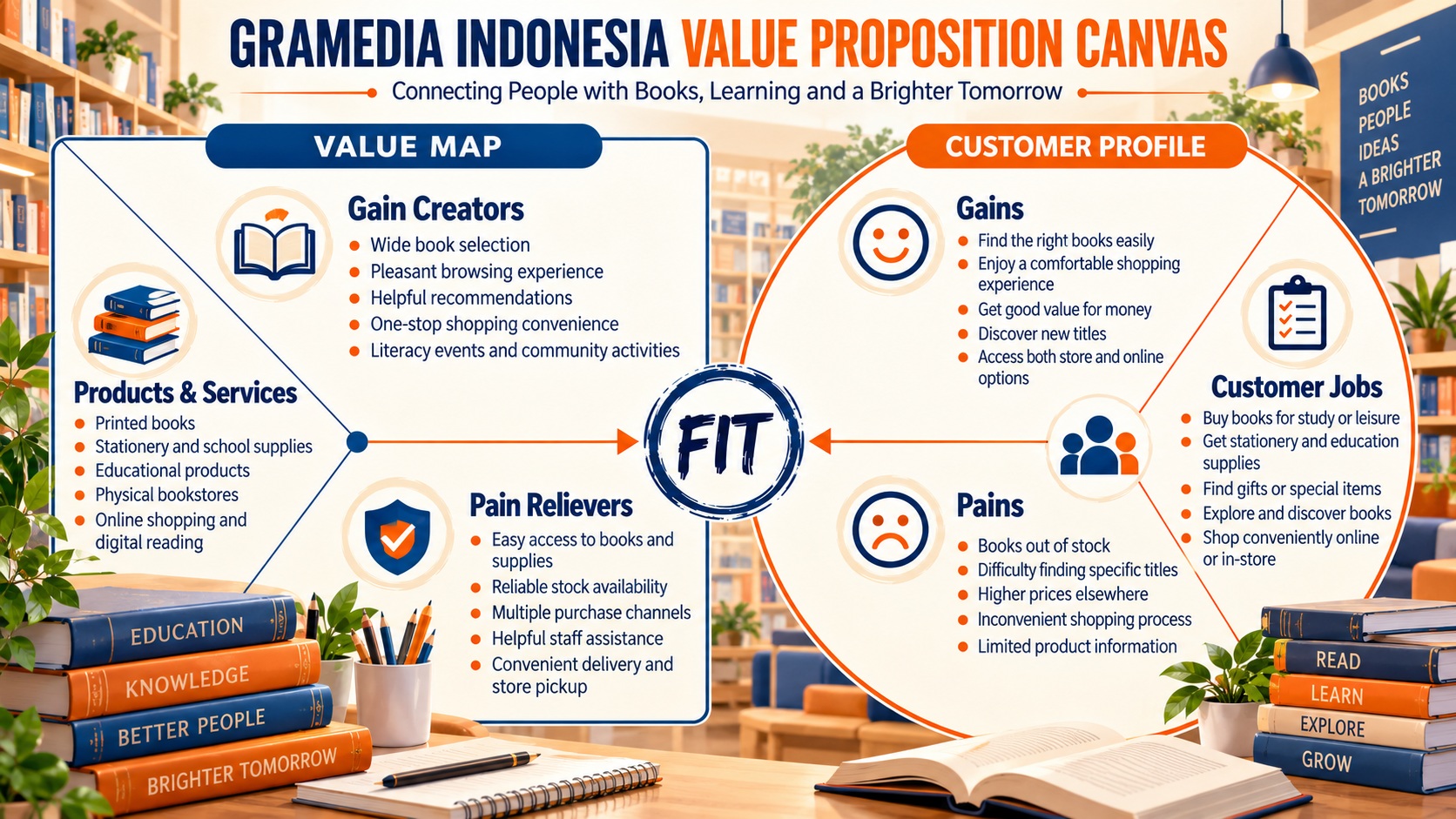
The Value Proposition Canvas provides a more detailed explanation of how Gramedia addresses customer jobs, pains, and gains.
While BMC examines the entire business system, VPC concentrates on the relationship between customer requirements and the value delivered by products and services.
The Gramedia Business Model Canvas becomes easier to understand when its primary consumer proposition is examined separately.
Customer Profile
The customer profile below focuses primarily on individual consumers purchasing books, stationery, and educational products.
Their needs extend beyond simply completing a retail transaction.
Many customers want access to relevant publications, convenient shopping, reliable merchandise availability, attractive prices, and opportunities to discover new products.
Customer Profile of Gramedia
| Customer Profile | Details |
|---|---|
| Customer Jobs | Purchase books, obtain learning materials, buy stationery, discover new titles, compare products, and find gifts |
| Customer Pains | Unavailable titles, inconvenient travel, high prices, limited product information, delivery delays, and difficulty locating suitable merchandise |
| Customer Gains | Convenient purchasing, trusted product selection, reliable availability, enjoyable browsing, relevant recommendations, and attractive offers |
Gramedia must address these expectations across customers with different purchasing motivations.
Students often prioritise availability and affordability, while leisure readers may place greater importance on discovery and selection.
Parents may value the ability to purchase multiple school-related products in one location.
The challenge lies in meeting these diverse requirements without creating excessive merchandise complexity.
Value Map
Gramedia responds to customer needs through a combination of physical retail, digital commerce, merchandise selection, and reading-related experiences.
Its products and services help customers obtain relevant books and supplementary merchandise.
Convenient shopping channels reduce purchasing difficulties, while curated selections and physical browsing create additional benefits.
Value Map of Gramedia
| Value Map | Details |
|---|---|
| Products and Services | Printed books, stationery, educational products, lifestyle merchandise, bookstores, online shopping, and digital reading |
| Pain Relievers | Multiple purchasing channels, merchandise selection, customer assistance, product information, and fulfilment options |
| Gain Creators | Book discovery, convenient shopping, complementary products, reading experiences, promotions, and literary engagement |
Gramedia’s value proposition combines the benefits of physical retail with the convenience of digital access.
Bookstores allow customers to examine merchandise and discover unfamiliar titles.
Online channels provide an alternative when visiting a branch is inconvenient.
Complementary product categories create opportunities for customers to satisfy several purchasing needs within one retail relationship.
Nevertheless, value depends on dependable execution.
A wide product selection offers limited benefit when popular titles are unavailable or inventory information is inaccurate.
How Gramedia Creates Fit
| Customer Profile | Details | Matching Value Map | How Gramedia Creates Fit |
|---|---|---|---|
| Customer Jobs | Purchase books and educational products | Products and Services | Provides publications, stationery, and related merchandise |
| Customer Pains | Difficulty finding suitable products and convenient purchasing options | Pain Relievers | Offers multiple shopping channels, curated assortments, and customer assistance |
| Customer Gains | Enjoyable discovery, reliable selection, and convenient access | Gain Creators | Combines bookstore experiences with digital shopping and complementary merchandise |
The primary objective is to match the right products and purchasing experiences with customers’ most important needs.
Reliable product availability reduces frustration, while relevant recommendations help shoppers discover suitable publications.
Physical browsing can create enjoyment beyond the immediate transaction.
Digital access complements these experiences by removing some geographic and time-related barriers.
Stronger value proposition fit can increase customer satisfaction, repeat purchasing, and long-term loyalty.
This company should therefore monitor customer feedback, purchase patterns, search behaviour, and service quality to identify opportunities for improvement.
Gramedia vs Periplus vs Kinokuniya Business Models
This company competes with other bookstore retailers, including Periplus and Kinokuniya.
Although all three companies participate in the book retail industry, their customer positioning and product priorities differ.
Periplus is particularly associated with imported and English-language books.
Kinokuniya has an internationally recognised bookstore identity supported by foreign-language publications, Japanese titles, manga, and curated specialist merchandise.
Gramedia serves a broader Indonesian customer base with a strong emphasis on locally relevant books, educational products, and complementary merchandise.
These differences influence how each company attracts customers and competes.
Business Model Canvas Comparison
The following table compares only the BMC blocks that most clearly distinguish the three retailers.
| Relevant BMC Block | Gramedia | Periplus | Kinokuniya |
|---|---|---|---|
| Customer Segments | Indonesian readers, students, families, professionals, and educational institutions | Readers seeking English-language and imported books | International readers, specialist book buyers, and manga enthusiasts |
| Value Propositions | Accessible books, educational merchandise, and broad shopping convenience | International publications and imported-book selection | Curated international books, specialist titles, and bookstore discovery |
| Channels | Physical bookstore network, official website, mobile application, and digital reading services | Physical bookstores and online purchasing | Selected retail locations and market-specific purchasing channels |
| Revenue Streams | Printed books, stationery, educational merchandise, lifestyle products, and digital reading services | Primarily books and complementary merchandise | Books, magazines, stationery, and specialist merchandise |
| Key Resources | Local brand recognition, retail network, supplier relationships, and digital capabilities | Imported-book sourcing expertise and international title selection | International brand, specialist sourcing, and global publishing relationships |
The most important strategic difference concerns market positioning.
Gramedia has developed a broad retail proposition around Indonesian readers, students, and families.
Periplus focuses more strongly on international and English-language publications.
Kinokuniya differentiates through specialist selections, international appeal, and a curated bookstore environment.
The Gramedia Business Model Canvas suggests that Gramedia should build on its strengths rather than compete exclusively through imported-book selection.
Its advantages in local market understanding, education-oriented merchandise, and physical accessibility provide opportunities for differentiation.
A stronger omnichannel experience could reinforce these advantages by connecting product discovery, availability, purchasing, and fulfilment.
Ultimately, each retailer’s competitiveness depends on how effectively its business model serves its chosen customer segments.
Competitive Advantages
Gramedia retains several advantages that support its position in Indonesia’s book retail industry.
- Established brand reputation: Decades of market presence have created strong associations with books, reading, education, and trustworthy specialty retail.
- Extensive physical presence: A broad bookstore network provides product visibility, purchasing convenience, and physical experiences that online-only competitors cannot fully reproduce.
- Diversified merchandise assortment: Books, stationery, educational supplies, and complementary products create additional purchasing occasions and cross-selling opportunities.
- Publishing and supplier relationships: Connections with publishers and the wider Kompas Gramedia ecosystem support merchandise sourcing, promotional opportunities, and industry knowledge.
- Omnichannel capabilities: Combining bookstores, online commerce, mobile shopping, and digital reading provides several ways to reach and serve customers.
These advantages reinforce one another.
Brand familiarity encourages customers to consider Gramedia, while merchandise selection provides reasons to visit.
Physical stores support discovery and immediate purchasing, whereas digital channels extend accessibility.
Stronger supplier relationships can improve assortment relevance and product availability.
The challenge is maintaining these strengths as consumer expectations and retail competition continue to change.
Gramedia must consistently convert its established market position into superior customer experiences, efficient operations, and sustainable profitability.
Risks and Challenges
Despite its established position, Gramedia faces several challenges that could affect future competitiveness.
- Digital reading substitution: E-books, online educational resources, and other digital content can reduce demand for selected categories of printed publications.
- Marketplace price competition: Online retailers offer extensive selections, transparent pricing, promotional discounts, and convenient delivery, creating pressure on margins and customer retention.
- High physical-store operating costs: Rent, staffing, utilities, and maintenance create financial commitments that become more difficult to absorb when store productivity declines.
- Inventory and working-capital pressure: Slow-moving books, changing reading trends, and seasonal purchasing patterns can increase stockholding expenses and markdown risk.
- Changing consumer discovery behaviour: Social media recommendations, online communities, and mobile-first shopping increasingly influence purchasing decisions outside traditional bookstores.
These risks are interconnected.
Increasing online competition can reduce store traffic while pressuring retail prices.
Lower sales productivity makes occupancy expenses more difficult to cover.
Inventory mismatches can weaken cash flow, while customers may become less loyal when competing sellers offer better availability or convenience.
The Gramedia Business Model Canvas therefore needs to evolve around stronger inventory management, effective omnichannel operations, and differentiated customer experiences.
Maintaining brand recognition alone will not be sufficient.
Long-term resilience requires adapting the commercial model to changing purchasing behaviour while protecting operational efficiency and profitability.
Strategic Recommendations
Gramedia has several opportunities to strengthen its business model while maintaining the distinctive advantages of a trusted bookstore brand.
The following recommendations focus on improving customer experience, increasing retail productivity, strengthening digital capabilities, and developing additional revenue opportunities.
Each initiative should be evaluated against customer demand, investment requirements, operational feasibility, and potential economic returns.
1. Strengthen Omnichannel Integration
Gramedia should create a more connected purchasing experience across physical bookstores and digital channels.
Accurate inventory visibility could allow customers to confirm whether a particular title is available at a nearby branch.
Convenient collection options may also reduce delivery expenses and encourage additional in-store purchases.
For example, a student could reserve an examination guide online and collect it from the nearest bookstore.
Such integration would improve convenience while making physical stores more valuable within digital customer journeys.
2. Introduce More Personalised Book Discovery
Relevant recommendations could help customers identify publications that match their reading interests, educational needs, and purchasing history.
Digital search behaviour and customer preferences may provide useful insights, subject to appropriate consent and privacy safeguards.
Someone purchasing entrepreneurship books might receive suggestions for related business titles, biographies, or newly released publications.
Better discovery could encourage additional purchases while improving customer satisfaction.
Personalisation should focus on usefulness rather than excessive promotional messages.
3. Develop Bookstores as Community Destinations
Physical locations offer opportunities to create experiences beyond ordinary merchandise transactions.
Author discussions, children’s reading activities, educational workshops, and community events could encourage customers to return regularly.
These initiatives may also strengthen relationships with publishers and local educational organisations.
A bookstore that becomes a recognised community destination can compete through experiences that online marketplaces cannot easily reproduce.
Commercial performance should nevertheless be monitored to ensure that activities contribute to customer engagement and purchasing behaviour.
4. Improve Inventory and Category Management
Merchandise planning should increasingly reflect store-level demand patterns and customer preferences.
Branches near universities may require larger selections of academic publications and stationery.
Family-oriented locations could prioritise children’s books, educational products, and selected gifts.
Improved forecasting can reduce excess stock while ensuring popular merchandise remains available.
Stronger inventory turnover would also release working capital for investment in higher-performing categories.
5. Expand Institutional and Educational Sales
Schools, universities, training providers, and corporate organisations present opportunities for coordinated purchasing.
Specialised procurement arrangements could simplify the supply of textbooks, reference books, stationery, and learning materials.
For instance, educational institutions might purchase recommended reading packages for specific programmes.
These relationships may generate larger transactions and more predictable demand.
Institutional expansion should be supported by disciplined pricing and reliable fulfilment to protect commercial margins.
6. Strengthen Customer Loyalty Through Relevant Benefits
Membership engagement could become more effective by offering benefits that reflect different customer needs.
Students may appreciate educational promotions, while regular readers might value personalised book recommendations or access to literary events.
Families could respond positively to children’s learning activities and seasonal school-related offers.
Customer retention should not depend exclusively on discounts.
Relevant experiences, dependable service, and targeted benefits can encourage repeat purchases without unnecessarily weakening profitability.
7. Optimise Store-Level Profitability
Gramedia should continuously evaluate the economic contribution of individual retail locations.
Metrics such as sales per square metre, gross margin, inventory turnover, average basket value, and operating contribution can help identify underperforming stores.
Some locations may justify larger experiential formats, while others could benefit from smaller footprints and stronger fulfilment integration.
Property decisions should reflect local demand, customer accessibility, and long-term profitability.
The objective is not simply to expand the number of bookstores but to establish a productive retail network supported by effective digital capabilities.
Conclusion
Overall, the Gramedia Business Model Canvas explains how a traditional bookstore business has developed into a broader retail platform connecting books, education, merchandise, physical stores, and digital commerce.
Its underlying economic model remains relatively straightforward.
Gramedia sources relevant products from publishers and suppliers, distributes merchandise through its shopping channels, and earns revenue when customers make purchases.
The complexity emerges from operating this model across different customer segments, product categories, and retail environments.
Physical bookstores provide accessibility and discovery but require substantial operating expenditure.
Digital channels extend market reach while introducing additional fulfilment requirements and competitive pressure.
Supplier relationships support merchandise availability, whereas inventory management determines how efficiently products are converted into sales and cash.
Customer loyalty strengthens recurring demand, although maintaining that loyalty requires continuous improvements in convenience, product relevance, and purchasing experiences.
Future competitiveness will depend on how effectively these components reinforce one another.
Rather than relying solely on its longstanding reputation, the company must continue developing stronger customer insights, disciplined merchandise management, integrated retail channels, and economically productive stores.
Technology should support these objectives by improving product discovery, inventory visibility, fulfilment, and customer engagement.
Ultimately, Gramedia’s greatest opportunity lies in remaining relevant to how Indonesians learn, read, discover products, and purchase educational merchandise.
By combining the strengths of physical bookstores with digital convenience and a deeper understanding of customer needs, the business can continue creating value despite changes in retail technology and consumer behaviour.
Disclaimer
This article is provided solely for educational, informational, and business-analysis purposes.
The content reflects publicly available company information, general industry observations, and independent strategic interpretation at the time of writing.
Nothing presented constitutes investment, financial, legal, regulatory, or professional advice.
Readers should conduct their own research and seek appropriate professional guidance before making investment, commercial, or strategic decisions.
This analysis is not an official statement, endorsement, publication, or representation of Gramedia, PT Gramedia Asri Media, Kompas Gramedia, Periplus, Kinokuniya, or any other organisation mentioned.
Company operations, products, commercial arrangements, technologies, and market conditions may change over time.
Certain observations and strategic recommendations represent analytical assessments rather than confirmed company initiatives.
All trademarks, logos, copyrights, company names, product names, and other intellectual-property rights belong to their respective owners.
References to these materials are used solely for identification, educational discussion, and comparative business analysis.
Meta Description
Explore the Gramedia Business Model Canvas, including nine BMC blocks, Value Proposition Canvas, competitor comparison, challenges, and 2026 strategies.

