



Share This Article


Flower Chimp Indonesia Business Model Canvas: How Online Flower Delivery Turns Special Occasions into a Digital Business
BMC Article No: BMC #041
Updated in 2026: This article has been comprehensively rewritten to reflect the changing dynamics of Indonesia’s online flower and gifting industry, including digital commerce, same-day delivery expectations, personalised gifting, customer retention, logistics coordination, and the economics of perishable products.
The 2026 update also introduces deeper analysis of all nine Business Model Canvas blocks, expanded strategic insights, a Value Proposition Canvas, comparisons with two relevant competitors, five competitive advantages, five business risks and challenges, and actionable recommendations for sustainable growth.
Introduction
Flowers have always been associated with human emotions. A bouquet can communicate love, appreciation, sympathy, congratulations, or an apology without requiring many words.
However, purchasing and delivering flowers traditionally involved visiting a florist, selecting an arrangement, arranging payment, and coordinating delivery. For customers managing busy schedules or sending gifts across cities, this process could be inconvenient.
Flower Chimp recognised an opportunity to make flower gifting more accessible through digital commerce.
Established in 2016, Flower Chimp developed an online flower and gifting business that connects customers with floral products and delivery services. Its Indonesian operations form part of a broader regional business focused on making thoughtful gifting easier and more convenient.
The Flower Chimp Indonesia Business Model Canvas demonstrates how a traditional, emotionally driven product can be commercialised through an e-commerce platform, coordinated fulfilment, supplier relationships, and customer-focused services.
Unlike conventional flower shops that depend heavily on physical storefronts and walk-in customers, Flower Chimp uses digital channels to connect demand with fulfilment capabilities.
Its commercial opportunity extends beyond selling flowers. The company addresses the customer’s need to express emotions, celebrate important moments, and maintain personal relationships even when distance or time creates obstacles.
Understanding this distinction is central to analysing the business.
What Is Flower Chimp Indonesia’s Business Model?
Flower Chimp Indonesia operates primarily through a digital-first flower and gifting retail model.
Customers browse products online, select suitable arrangements, provide delivery details, and complete their purchases digitally. The business then coordinates order preparation and fulfilment through its operating and delivery arrangements.
Rather than relying exclusively on traditional retail foot traffic, the model brings together online customer acquisition, curated products, floral supply, and last-mile delivery.
The Flower Chimp Indonesia Business Model Canvas can be understood through three interconnected commercial activities.
First, the business generates demand by making flower and gift purchasing convenient, particularly for birthdays, anniversaries, celebrations, and other meaningful occasions.
Second, it converts that demand into orders through digital product catalogues, pricing, checkout functionality, and delivery options.
Third, it fulfils those orders through sourcing, floral preparation, quality management, and delivery coordination.
This structure enables Flower Chimp to compete on convenience, product presentation, gifting experience, and delivery reliability.
However, online flower retail also presents economic challenges. Fresh flowers are perishable, customer demand fluctuates around special occasions, and delivery failures can damage customer trust.
The business must therefore balance marketing effectiveness with operational discipline.
Its success depends not simply on attracting online orders, but on delivering a positive gifting experience at a commercially sustainable cost.
What Is Business Model Canvas?
The Business Model Canvas (BMC) is a strategic management framework used to explain how a business creates, delivers, and captures value.
Developed by Alexander Osterwalder and Yves Pigneur, the framework organises a business model into nine interconnected building blocks.
For an online gifting business, these blocks reveal how customer needs, product offerings, digital channels, operational resources, and financial performance interact.
| BMC Block | Main Question |
|---|---|
| Customer Segments | Who purchases flowers and gifts? |
| Value Propositions | Why do customers choose Flower Chimp? |
| Channels | How does the business reach customers and deliver orders? |
| Customer Relationships | How are customers acquired, supported, and retained? |
| Revenue Streams | How does the business generate income? |
| Key Resources | What assets and capabilities support operations? |
| Key Activities | Which activities create and deliver customer value? |
| Key Partnerships | Which external organisations support the business? |
| Cost Structure | What are the major operating expenses? |
The framework becomes especially useful when evaluating how digital convenience depends on physical fulfilment.
A successful online ordering experience creates little value if flowers arrive late, damaged, or inconsistent with customer expectations.
Consequently, the nine blocks must function as a coordinated business system rather than independent operational components.
Quick Overview of Flower Chimp Indonesia
Flower Chimp entered the online flower delivery industry in 2016, building its proposition around convenient digital ordering and professionally presented floral gifts.
Its business operates in a market where emotional significance, product appearance, affordability, and delivery timing strongly influence purchasing decisions.
The Indonesian market offers a broad range of gifting occasions, including birthdays, anniversaries, graduations, weddings, religious celebrations, corporate events, and expressions of sympathy.
Online shopping allows customers to arrange gifts without necessarily visiting a physical florist.
Flower Chimp’s product proposition extends beyond conventional bouquets to include complementary gifting options, with product selection and delivery availability varying by location.
Its operating model combines digital storefront capabilities with the physical requirements of floral sourcing, preparation, packaging, and distribution.
The Flower Chimp Indonesia Business Model Canvas illustrates how these capabilities can be coordinated to serve both individual and business customers.
Unlike digital businesses selling downloadable products, flower delivery companies cannot eliminate physical operating costs.
Every completed transaction involves tangible products, handling requirements, and delivery execution.
This makes operational reliability a central determinant of customer satisfaction and financial performance.
Why Flower Chimp Indonesia Is Strategically Interesting
Flower Chimp offers a useful example of how digital commerce can modernise a traditional retail category without changing the fundamental emotional purpose of the product.
Customers are not simply purchasing flowers. They are purchasing an outcome: making someone feel appreciated, remembered, celebrated, or supported.
This creates an opportunity for differentiation beyond product specifications and price.
A bouquet that arrives on time with an appropriate message may deliver greater perceived value than a larger arrangement delivered late.
The Flower Chimp Indonesia Business Model Canvas also highlights an important distinction between digital scalability and operational scalability.
An e-commerce platform can potentially accept additional orders at relatively low incremental technology cost.
However, every additional bouquet still requires flowers, labour, packaging, coordination, and delivery.
As demand increases, fulfilment capacity must expand accordingly.
The business therefore faces a strategic balancing act: grow order volume while maintaining product quality, delivery reliability, and acceptable unit economics.
This interaction makes Flower Chimp an instructive case for entrepreneurs considering online retail businesses involving perishable or time-sensitive products.
Latest Developments: What Is Changing in the Online Flower and Gifting Industry?
Several market developments are influencing how online flower delivery businesses compete in 2026.
Digital shopping has made customers more accustomed to browsing products, comparing prices, making electronic payments, and arranging delivery without visiting physical stores.
At the same time, consumer expectations surrounding delivery visibility, responsiveness, and order accuracy continue to shape online retail experiences.
Social media has become particularly important for visually appealing categories such as flowers and gifts. Product photography, customer testimonials, short-form videos, and seasonal campaigns can influence purchase decisions.
Personalised gifting also presents opportunities for product differentiation. Customers increasingly encounter options such as customised messages, gift bundles, occasion-specific collections, and premium packaging.
However, rising competitive intensity creates pressure on customer acquisition costs and pricing.
Delivery operations remain another critical factor. Same-day services require reliable fulfilment capacity, realistic ordering cut-offs, and coordination between preparation and transportation.
The Flower Chimp Indonesia Business Model Canvas must therefore be evaluated against five strategic priorities: digital conversion, fulfilment reliability, product differentiation, customer retention, and cost efficiency.
These are industry-level considerations rather than claims that Flower Chimp has implemented every emerging capability.
Flower Chimp Indonesia Business Model Canvas Summary
Before examining each component in detail, the business model can be summarised as an online retail system that transforms gifting intentions into purchasable products and coordinated deliveries.
The Flower Chimp Indonesia Business Model Canvas brings together nine elements supporting this process.
| BMC Block | Flower Chimp Indonesia Application |
|---|---|
| Customer Segments | Individual gift buyers, couples, families, corporate customers, and event-related buyers |
| Value Propositions | Convenient flower ordering, attractive arrangements, gifting personalisation, and delivery options |
| Channels | E-commerce website, search engines, social media, digital campaigns, and delivery networks |
| Customer Relationships | Online self-service, customer support, occasion-based engagement, and repeat-purchase marketing |
| Revenue Streams | Flower bouquets, floral arrangements, gift products, bundles, and applicable delivery charges |
| Key Resources | Brand, e-commerce technology, product catalogue, floral supply, fulfilment capabilities, and customer relationships |
| Key Activities | Product sourcing, arrangement preparation, digital marketing, order management, quality control, and delivery coordination |
| Key Partnerships | Flower suppliers, florists, logistics providers, payment providers, and complementary gift suppliers |
| Cost Structure | Flowers, labour, packaging, logistics, marketing, technology, customer service, and administration |
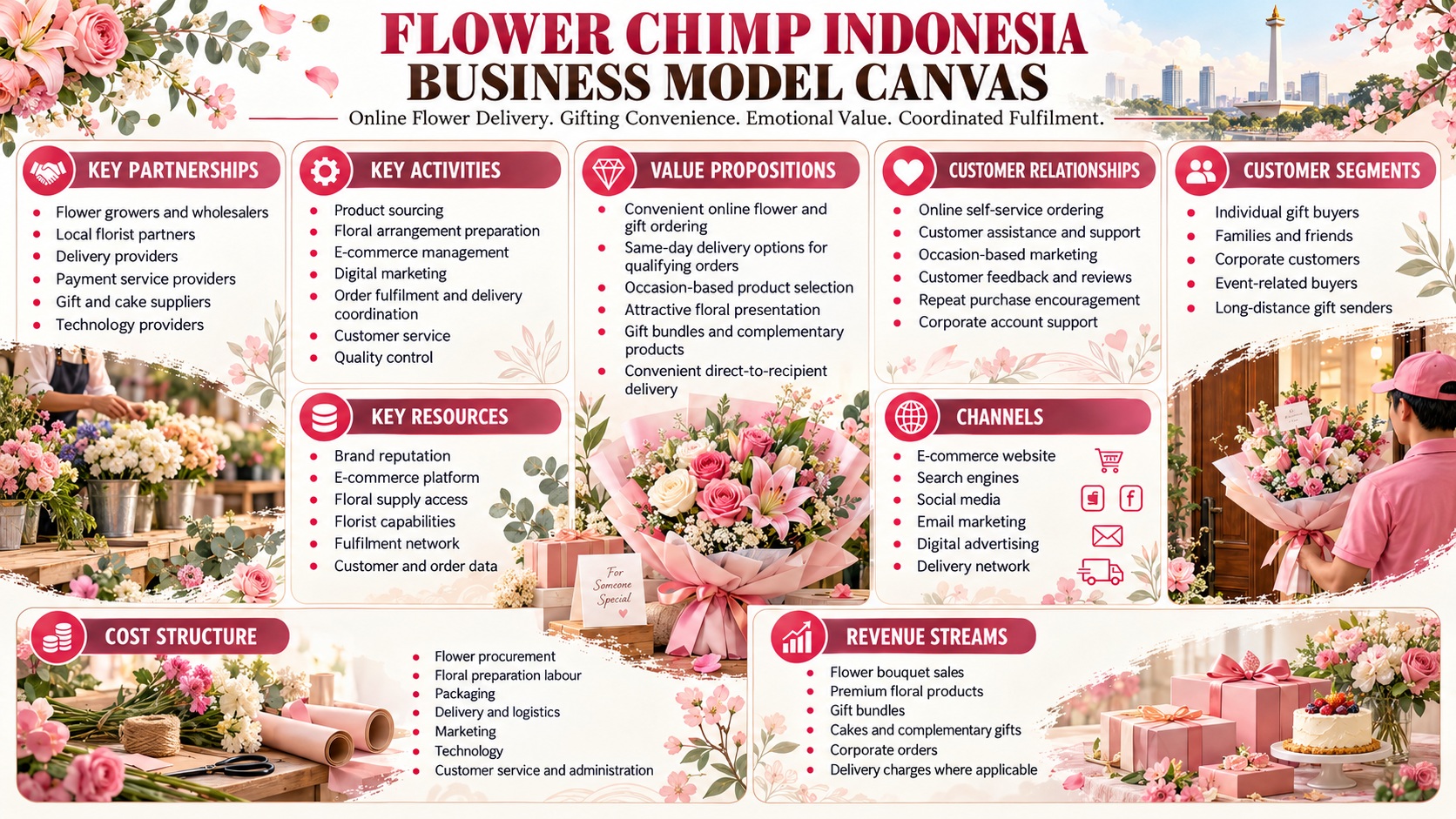
Flower Chimp Indonesia BMC Diagram
A BMC diagram should display all nine blocks in a single visual framework.
The central relationship is between the customer’s gifting occasion, the product selection process, the fulfilment network, and the final delivery experience.
Digital marketing attracts customers. The online storefront converts their interest into purchases. Suppliers and fulfilment capabilities provide the physical products, while delivery coordination completes the customer experience.
Revenue from completed orders must cover acquisition, sourcing, preparation, and delivery costs.
The business becomes stronger when these activities generate satisfied customers who return for future occasions.
BMC Analysis of Flower Chimp Indonesia
The detailed Flower Chimp Indonesia Business Model Canvas reveals that the company’s competitive position depends on more than the convenience of ordering flowers online.
Its value proposition must be supported by product quality, effective supplier coordination, digital visibility, and dependable delivery.
An attractive website can increase conversions, but poor fulfilment can quickly undermine customer confidence.
Similarly, faster delivery may increase customer satisfaction while creating additional operational expenses.
The following analysis examines each block and explains how it contributes to the overall business model.
1. Customer Segments
Flower Chimp serves customers who want to send flowers or gifts conveniently, often to mark emotionally significant occasions.
Individual consumers form a major segment, including people purchasing bouquets for partners, friends, family members, and colleagues.
Corporate buyers represent another opportunity, particularly for employee appreciation, business congratulations, client recognition, and professional events.
Demand can also originate from customers arranging weddings, graduations, and other celebrations.
Flower Chimp Customer Segments
| Customer Segment | Customer Needs | Strategic Importance |
|---|---|---|
| Individual gift buyers | Birthdays, anniversaries, romance, and appreciation | Generates occasion-driven retail orders |
| Families and friends | Celebrations, sympathy, and personal milestones | Expands gifting occasions |
| Corporate customers | Employee recognition, client gifts, and business events | Potential for larger and repeat orders |
| Event-related buyers | Weddings, graduations, and ceremonies | Creates opportunities for higher-value purchases |
| Long-distance gift senders | Sending gifts to recipients in other locations | Reinforces the value of online ordering and delivery |
Strategic Analysis
The Flower Chimp Indonesia Business Model Canvas shows how customer segmentation can influence product selection, pricing, marketing, and fulfilment.
Individual consumers may purchase infrequently, but their orders can be emotionally significant. Corporate customers, by comparison, may provide opportunities for repeat purchases and more predictable demand.
The strategic challenge is that these segments have different expectations. Personal buyers may prioritise appearance and convenience, while corporate customers may require invoicing, consistency, and coordinated delivery.
A stronger segmentation strategy would therefore distinguish customers by occasion, purchasing frequency, order value, and service requirements.
Rather than treating every visitor as an identical buyer, Flower Chimp can use these differences to improve product recommendations, marketing efficiency, and customer lifetime value.
2. Value Propositions
The company’s primary value proposition is making flower and gift delivery convenient, accessible, and emotionally meaningful.
Customers can explore arrangements online, choose products suited to specific occasions, and arrange delivery without physically visiting a florist.
Flower Chimp’s Indonesian website also promotes same-day delivery for qualifying orders placed before its published cut-off time, along with delivery-slot selection and a broad range of gift products.
Flower Chimp Value Propositions
| Value Proposition | Customer Benefit | Business Value |
|---|---|---|
| Online convenience | Purchase flowers remotely | Expands potential customer reach |
| Same-day delivery | Supports urgent gifting needs | Differentiates the service |
| Occasion-based selection | Easier discovery of suitable gifts | Improves purchase relevance |
| Floral presentation | Attractive, ready-to-give arrangements | Supports perceived quality |
| Gift bundles | Combine flowers with complementary products | Creates upselling opportunities |
| Delivery coordination | Send gifts directly to recipients | Reduces customer effort |
Strategic Analysis
Flowers are emotionally significant products, making the recipient’s experience central to customer satisfaction.
A bouquet delivered successfully on an important date can generate strong perceived value. Conversely, a late delivery may disappoint customers even when the flowers themselves are attractive.
The Flower Chimp Indonesia Business Model Canvas therefore highlights the importance of delivering an experience rather than merely supplying a physical product.
Convenience attracts customers, but reliability creates confidence. Attractive presentation supports premium positioning, while gifting bundles can increase average order value.
These benefits must remain consistent across locations and occasions.
Sustainable differentiation depends on ensuring that the promise communicated through the website matches the actual product and delivery experience.
3. Channels
Flower Chimp uses digital channels to connect with customers, communicate its product offerings, and facilitate transactions.
Its e-commerce website functions as a central sales channel where customers can browse arrangements, compare products, and place orders.
Search engines, social platforms, and digital promotions provide additional opportunities to attract customers researching flowers or gifts.
Physical delivery completes the channel system by transferring the purchased product to its recipient.
Flower Chimp Channels
| Channel | Primary Function | Strategic Contribution |
|---|---|---|
| E-commerce website | Product discovery and checkout | Direct sales and transaction control |
| Search engines | Capture gifting-related searches | Attracts customers with purchase intent |
| Social media | Product visibility and engagement | Builds awareness and interest |
| Email marketing | Promotions and occasion reminders | Supports repeat purchases |
| Digital advertising | Customer acquisition | Generates targeted website traffic |
| Delivery network | Physical order fulfilment | Completes the value proposition |
Strategic Analysis
A digital-first distribution strategy offers advantages over a model dependent entirely on physical stores.
Online channels allow customers to shop beyond normal retail hours and explore products without travelling.
However, customer acquisition through paid advertising can become expensive, especially during highly competitive gifting periods.
The Flower Chimp Indonesia Business Model Canvas illustrates why channel effectiveness should be measured beyond website traffic.
Conversion rate, customer acquisition cost, average order value, repeat-purchase rate, and delivery success are more meaningful indicators of commercial performance.
Organic search and customer retention can also reduce dependence on paid advertising.
The most effective channel strategy connects marketing performance with fulfilment capacity, ensuring that successful campaigns generate profitable orders rather than overwhelming operational resources.
4. Customer Relationships
Customer relationships in flower delivery are different from those in everyday retail.
Many customers purchase flowers only when an important occasion arises, creating long intervals between transactions.
Flower Chimp must therefore provide an excellent initial experience while remaining relevant when the next gifting opportunity appears.
Its digital storefront supports self-service ordering, while customer assistance helps address enquiries, delivery concerns, and special requests.
Flower Chimp Customer Relationships
| Relationship Type | Application | Strategic Value |
|---|---|---|
| Online self-service | Independent browsing and ordering | Convenient, scalable transactions |
| Customer assistance | Product and delivery enquiries | Builds confidence |
| Occasion-based marketing | Relevant seasonal promotions | Encourages repeat purchases |
| Customer feedback | Reviews and service evaluation | Identifies improvement opportunities |
| Corporate account relationships | Support for repeat business orders | Potentially increases customer value |
Strategic Analysis
Flower delivery involves considerable emotional expectations, particularly when gifts are intended for important personal milestones.
Customers need confidence that their orders will arrive correctly and on time.
A reliable service experience can strengthen trust and make future purchases more likely.
The Flower Chimp Indonesia Business Model Canvas demonstrates that customer relationships should extend beyond transaction completion.
Occasion reminders, personalised recommendations, and relevant follow-up communication could help convert occasional buyers into repeat customers.
For example, a customer purchasing anniversary flowers may appreciate an optional reminder before the following year’s celebration.
Such engagement must be permission-based and respectful of customer privacy.
Long-term growth becomes more sustainable when the company improves customer lifetime value instead of continually paying to acquire new buyers.
5. Revenue Streams
Flower Chimp generates revenue primarily through the sale of flowers and complementary gifting products.
Its online catalogue includes bouquets, floral arrangements, cakes, gift bundles, and other occasion-based products.
The company also displays different price points, allowing customers to select products according to budget and gifting preferences.
Delivery charges may apply depending on checkout conditions and service requirements.
Flower Chimp Revenue Streams
| Revenue Stream | Description | Commercial Significance |
|---|---|---|
| Flower bouquet sales | Individual floral arrangements | Core product revenue |
| Premium floral products | Larger or more elaborate arrangements | Supports higher transaction values |
| Gift bundles | Flowers combined with other gifts | Increases basket size |
| Cakes and complementary gifts | Non-floral gifting products | Broadens purchase occasions |
| Corporate orders | Business-related gifting purchases | Potential for repeat and bulk revenue |
| Delivery charges, where applicable | Charges associated with fulfilment | May contribute to delivery cost recovery |
Strategic Analysis
The business relies substantially on transaction-based revenue rather than guaranteed recurring subscriptions.
Demand is influenced by occasions, seasonal celebrations, product attractiveness, and customer purchasing power.
The Flower Chimp Indonesia Business Model Canvas highlights the importance of increasing revenue per customer without undermining affordability.
Gift bundles provide one opportunity because customers may prefer purchasing flowers, chocolates, or cakes in a single transaction.
Premium arrangements can also generate higher sales values, although their profitability depends on procurement and fulfilment costs.
Corporate contracts and recurring gifting arrangements represent potential opportunities rather than verified major revenue sources.
Revenue growth alone is not sufficient.
The company must evaluate contribution margin after flowers, packaging, payment processing, delivery, and customer acquisition costs to determine which products and customer segments create sustainable economic value.
6. Key Resources
Flower Chimp’s business requires a combination of digital, physical, human, and relationship-based resources.
Its website provides the customer-facing purchasing interface, while the brand helps attract customers seeking flower and gift delivery.
Floral sourcing, preparation capabilities, and fulfilment coordination are equally important because the products must meet freshness and presentation expectations.
Customer information, supplier relationships, and operational knowledge also contribute to the company’s ability to manage demand.
Flower Chimp Key Resources
| Key Resource | Role in Operations | Strategic Importance |
|---|---|---|
| Brand reputation | Builds customer recognition and confidence | Supports acquisition and retention |
| E-commerce platform | Enables product discovery and transactions | Supports digital scalability |
| Floral supply access | Provides flowers and materials | Maintains product availability |
| Florist capabilities | Produces attractive arrangements | Supports product quality |
| Fulfilment network | Coordinates preparation and delivery | Enables service reliability |
| Customer and order data | Supports operational planning | Creates opportunities for optimisation |
Strategic Analysis
Digital technology makes the ordering process scalable, but physical resources determine whether the customer promise can be fulfilled.
The Flower Chimp Indonesia Business Model Canvas shows that supplier quality, florist capability, and fulfilment coordination are as strategically important as website functionality.
Unlike products that can remain in warehouses for extended periods, fresh flowers have limited shelf lives.
This makes sourcing flexibility, demand planning, and inventory discipline particularly valuable.
Brand reputation is another critical asset because customers often purchase gifts for someone else and may not personally inspect the finished product.
Trust reduces uncertainty.
As the business grows, investment in integrated order information, quality standards, supplier performance monitoring, and demand forecasting could strengthen its operational capabilities and reduce avoidable costs.
7. Key Activities
Flower Chimp must coordinate several activities to convert customer orders into successful gifting experiences.
Digital marketing generates demand, while product management ensures that customers can find suitable arrangements.
Order processing, floral sourcing, preparation, packaging, and delivery coordination then transform the online purchase into a physical gift.
Customer support and quality management help resolve problems and maintain service standards.
Flower Chimp Key Activities
| Key Activity | Operational Purpose | Business Impact |
|---|---|---|
| Product sourcing | Secure flowers and gifting materials | Supports availability and freshness |
| Floral preparation | Produce arrangements matching expectations | Determines product quality |
| E-commerce management | Maintain product listings and ordering | Supports conversion |
| Digital marketing | Generate customer demand | Drives sales opportunities |
| Order fulfilment | Coordinate preparation and dispatch | Supports delivery reliability |
| Customer service | Resolve enquiries and complaints | Protects customer trust |
Strategic Analysis
The operational complexity of flower delivery increases when customers expect rapid fulfilment.
An order may require confirmation of product availability, florist capacity, recipient details, and delivery timing within a short period.
The Flower Chimp Indonesia Business Model Canvas illustrates how marketing and fulfilment must operate together.
A successful promotional campaign can generate significant order volume, but insufficient preparation capacity may cause delays or inconsistent product quality.
Demand forecasting becomes particularly important around Valentine’s Day, Mother’s Day, and other seasonal occasions.
Operational performance should therefore be measured through order accuracy, preparation time, on-time delivery, complaints, and product waste.
Improving these indicators can strengthen customer satisfaction while reducing rework, refunds, and unnecessary fulfilment expenses.
8. Key Partnerships
Flower Chimp depends on external relationships to support product availability, service coverage, and delivery execution.
Floral suppliers and participating florists are particularly important because they provide the physical products and arrangement capabilities required to fulfil orders.
Logistics providers support delivery, while payment service providers enable online transactions.
Complementary gift suppliers expand the product range beyond flowers.
Flower Chimp Key Partnerships
| Key Partner | Contribution | Strategic Value |
|---|---|---|
| Flower growers and wholesalers | Supply fresh flowers | Supports product availability |
| Local florist partners | Floral preparation and fulfilment | Provides local operating capacity |
| Delivery providers | Last-mile transportation | Supports delivery coverage |
| Payment service providers | Digital transaction processing | Enables convenient checkout |
| Gift and cake suppliers | Complementary products | Expands the catalogue |
| Technology providers | E-commerce and operational tools | Supports business continuity |
Strategic Analysis
Partnerships allow an online flower delivery business to coordinate resources beyond those it owns directly.
A distributed florist network can potentially support geographical expansion without requiring identical physical infrastructure in every location.
However, external dependence introduces quality and performance risks.
The Flower Chimp Indonesia Business Model Canvas shows that partner management is central to the customer experience.
Customers typically judge the Flower Chimp brand, regardless of which supplier prepares an arrangement or which courier delivers it.
Consequently, service standards, product specifications, delivery expectations, and complaint-resolution procedures should be clearly established.
Supplier diversification can also reduce disruption when particular flowers become scarce or seasonal demand increases.
The most valuable partnerships are not simply those offering the lowest prices, but those capable of consistently meeting quality, availability, and fulfilment requirements.
9. Cost Structure
Flower Chimp’s cost structure combines digital business expenses with the physical costs of preparing and delivering perishable products.
Flower procurement, florist labour, packaging, and delivery represent important transaction-related costs.
Marketing, technology, customer support, and administration contribute additional operating expenses.
Seasonal fluctuations can also affect sourcing costs, staffing requirements, and delivery capacity.
Flower Chimp Cost Structure
| Cost Category | Main Expenses | Financial Implication |
|---|---|---|
| Flower procurement | Fresh flowers and floral materials | Variable product costs |
| Floral preparation | Arrangement labour and handling | Cost per completed order |
| Packaging | Wrapping, boxes, ribbons, and cards | Product presentation costs |
| Delivery | Transportation and last-mile fulfilment | Influences contribution margin |
| Marketing | Advertising, promotions, and content | Customer acquisition costs |
| Technology | Website, software, and payment processing | Platform operating costs |
| Customer service and administration | Support staff and management | Operating overhead |
Strategic Analysis
The Flower Chimp Indonesia Business Model Canvas reveals that profitability depends heavily on controlling variable costs while maintaining product and service quality.
Fresh flowers create inventory risk because unsold products may lose commercial value quickly.
Delivery expenses can also vary according to distance, order concentration, traffic conditions, and urgency.
Meanwhile, advertising costs may rise during peak gifting periods.
A company can therefore increase sales while experiencing weaker margins if fulfilment and acquisition expenses grow faster than revenue.
Better demand forecasting, supplier negotiations, product standardisation, and delivery coordination could improve cost efficiency.
Product-level contribution margin should be monitored alongside total revenue.
This would help identify whether premium bouquets, gift bundles, corporate orders, or particular delivery locations generate stronger financial returns after their directly attributable costs.
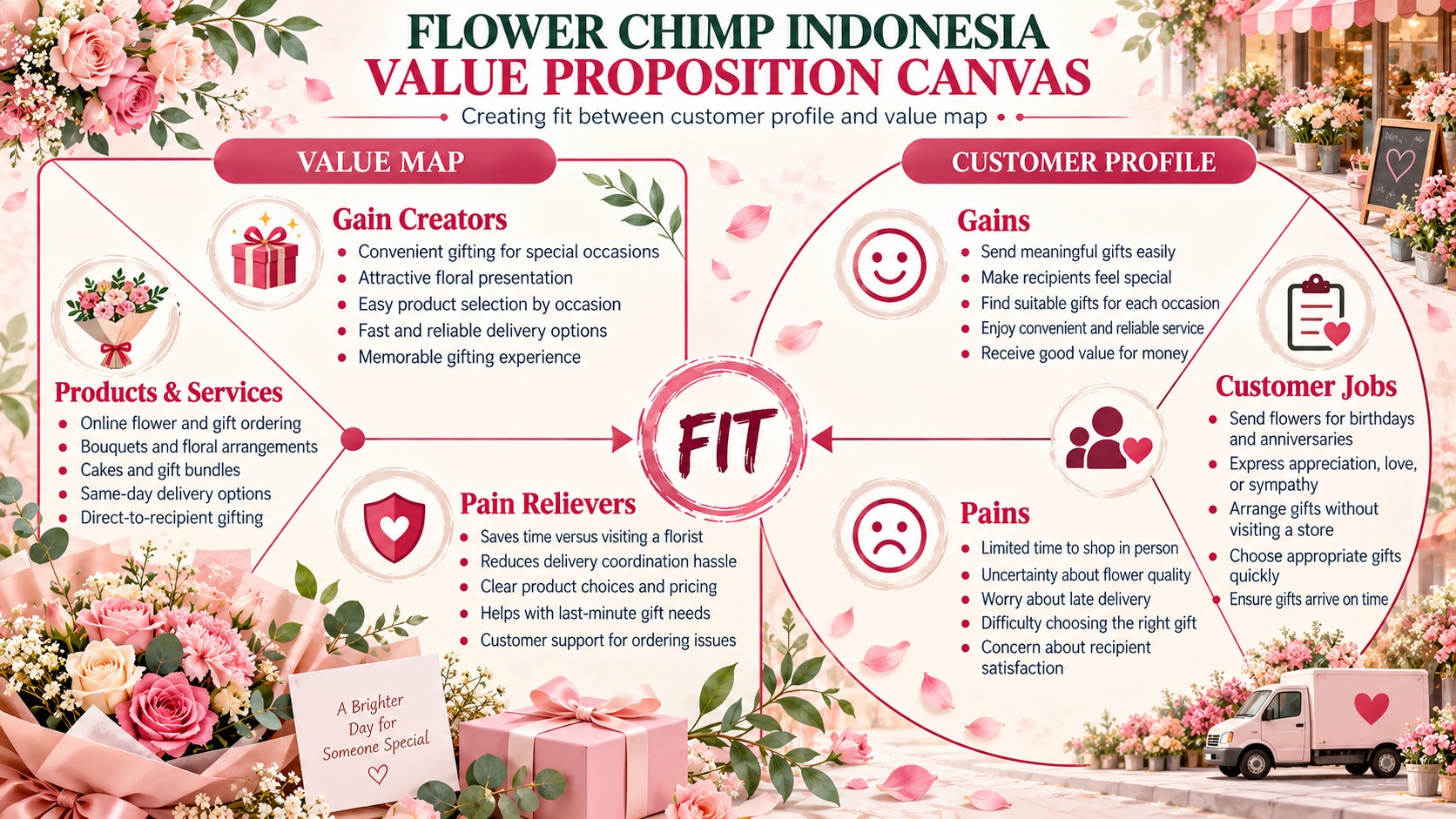
Flower Chimp Indonesia Value Proposition Canvas
The Value Proposition Canvas (VPC) provides a deeper understanding of how Flower Chimp’s products and services address customer needs.
While the Business Model Canvas examines the overall business, the VPC focuses on the relationship between customer expectations and the value delivered.
For Flower Chimp, this relationship is particularly important because purchasing flowers is frequently driven by emotional needs rather than functional necessity.
The Flower Chimp Indonesia Business Model Canvas becomes more meaningful when viewed alongside the customer experience, from deciding to send a gift to receiving confirmation that it has arrived.
1. Customer Profile
The customer profile identifies what buyers want to accomplish, the difficulties they experience, and the outcomes they hope to achieve.
| VPC Element | Customer Perspective |
|---|---|
| Customer Jobs | Send gifts, celebrate milestones, express appreciation, maintain relationships, and recognise important occasions |
| Customer Pains | Limited shopping time, uncertainty about flower quality, delivery delays, high prices, and difficulty choosing suitable gifts |
| Customer Gains | Convenient ordering, attractive flowers, timely delivery, meaningful personalisation, and positive recipient reactions |
Customers may have both practical and emotional objectives.
For example, someone sending anniversary flowers wants the delivery process to be convenient, but also hopes the recipient feels valued and remembered.
This means customer satisfaction depends on more than product quality alone.
2. Value Map
The value map explains how Flower Chimp’s products and services can address these customer requirements.
| VPC Element | Flower Chimp’s Value Offering |
|---|---|
| Products and Services | Bouquets, floral arrangements, cakes, gift bundles, online ordering, and delivery services |
| Pain Relievers | Remote purchasing, occasion-based collections, delivery options, and customer assistance |
| Gain Creators | Attractive presentation, gift combinations, convenient gifting, and memorable recipient experiences |
The company’s website supports this value proposition through occasion-based collections and delivery services.
3. Value Proposition Fit
The strongest value proposition fit occurs when the business successfully connects convenience with emotional satisfaction.
Customers want to express their feelings without managing complicated purchasing and delivery arrangements.
Flower Chimp addresses this need by combining product selection, online transactions, and coordinated fulfilment.
However, the value proposition remains vulnerable when the delivered product does not match expectations.
A beautiful bouquet displayed online creates an expectation of comparable quality upon delivery.
The strategic implication is that customer satisfaction depends on the consistency between marketing promises and actual fulfilment.
Strong value proposition fit can encourage repeat purchases, recommendations, and greater willingness to purchase premium gifts.
Competitive Comparison: Flower Chimp vs Outerbloom vs FlowerAdvisor
Indonesia’s online flower delivery industry includes competitors offering similar products but emphasising different aspects of the gifting experience.
Two relevant competitors are Outerbloom and FlowerAdvisor.
Outerbloom promotes premium gifting, personalised products, same-day delivery, and a presence in selected physical retail locations. FlowerAdvisor emphasises domestic and international flower delivery, including service coverage across more than 100 countries.
The following comparison focuses on selected BMC blocks where differences are strategically meaningful.
Business Model Comparison
| Relevant BMC Block | Flower Chimp Indonesia | Outerbloom | FlowerAdvisor |
|---|---|---|---|
| Customer Segments | Individual and corporate gift buyers | Personal gifting, premium buyers, corporate customers | Domestic and international gift senders |
| Value Propositions | Convenient online gifting, floral variety, same-day options | Premium presentation, personalised gifting, surprise-oriented features | Domestic and international gifting convenience |
| Channels | E-commerce website and digital channels | Website, mobile app, and selected physical retail locations | Website, mobile apps, and international ordering channels |
| Revenue Streams | Flowers, gift bundles, cakes, and complementary products | Flowers, preserved flowers, personalised gifts, and hampers | Flowers, gifts, hampers, and international delivery orders |
| Key Partnerships | Florists, floral suppliers, and delivery providers | Suppliers, florists, and delivery partners | Domestic and international florist and fulfilment networks |
Comparison based on publicly advertised offerings and operating characteristics, not independently verified market share or financial performance.
Strategic Comparison Analysis
The Flower Chimp Indonesia Business Model Canvas suggests that Flower Chimp competes primarily through digital convenience, product accessibility, and coordinated delivery.
Outerbloom differentiates through premium gifting experiences and features such as personalised message cards and surprise-oriented delivery.
FlowerAdvisor offers a different advantage through its international delivery network, which can appeal to customers sending gifts across national borders.
These differences illustrate three possible competitive positions: convenient gifting, premium gifting experiences, and international gifting accessibility.
No single approach is automatically superior.
The most attractive strategy depends on customer preferences, operating costs, service reliability, and the company’s ability to defend its differentiation.
For Flower Chimp, maintaining a clear proposition around convenience and dependable fulfilment may be more sustainable than competing solely through discounts.
Flower Chimp Indonesia’s Competitive Advantages
Flower Chimp benefits from several characteristics that can strengthen its position in online flower and gift delivery.
However, these advantages must be continuously maintained because competing businesses can offer similar products and services.
- Digital-first accessibility. Online ordering enables customers to browse and purchase flowers without visiting a physical florist, supporting convenience and wider customer reach.
- Occasion-based product selection. Organising products around birthdays, anniversaries, graduations, and other occasions simplifies customer decision-making and improves purchasing relevance.
- Same-day delivery proposition. Qualifying same-day delivery options help address urgent gifting requirements, although availability depends on location, ordering deadlines, and operational capacity.
- Broad gifting catalogue. Combining flowers with cakes, chocolates, and other complementary gifts creates opportunities for cross-selling and larger transaction values.
- Florist and fulfilment coordination. Access to participating florists and delivery capabilities supports the ability to serve customers across multiple locations without depending entirely on a single retail storefront.
These advantages are valuable because they address practical customer needs while supporting the emotional purpose of gifting.
Nevertheless, the company’s competitive position ultimately depends on execution.
Convenience attracts customers, but consistent product quality, delivery performance, and customer service determine whether those customers return.
Risks and Challenges
Online flower delivery involves several structural challenges that can affect profitability, customer satisfaction, and long-term competitiveness.
The Flower Chimp Indonesia Business Model Canvas highlights five particularly important risks.
- Perishable inventory and flower wastage. Fresh flowers have limited shelf lives, creating potential losses when demand forecasts are inaccurate or products remain unsold.
- Delivery delays and fulfilment failures. Traffic congestion, incorrect addresses, preparation delays, and courier limitations can affect timely delivery, particularly during major gifting occasions.
- Rising customer acquisition costs. Competition for search traffic, social media attention, and paid advertising can reduce marketing efficiency and pressure contribution margins.
- Seasonal demand fluctuations. Sales may increase sharply during Valentine’s Day, Mother’s Day, and other celebrations, creating operational peaks followed by quieter periods.
- Price competition and limited differentiation. Customers can compare bouquets and gift products across competing websites, making it difficult to maintain premium pricing without clear differences in quality or service.
These risks are interconnected.
For example, aggressive discounting may generate additional orders but reduce the resources available to maintain service quality.
Similarly, expanding delivery coverage without sufficient fulfilment capabilities can increase sales opportunities while exposing the business to operational failures.
Effective risk management therefore requires balancing growth, customer experience, and financial discipline.
Strategic Recommendations for Flower Chimp Indonesia
The company’s digital-first model provides a foundation for further growth, but sustainable expansion requires improvements across customer retention, product differentiation, fulfilment, and profitability.
The following recommendations represent potential strategic initiatives rather than confirmed company plans.
1. Develop an Occasion-Based Customer Retention Programme
Flower Chimp could encourage repeat purchases through optional birthday reminders, anniversary notifications, and personalised gifting recommendations.
Instead of relying exclusively on customer acquisition campaigns, the company could build relationships around recurring personal milestones.
For example, customers who purchase birthday flowers could receive an optional reminder before the same occasion the following year.
Expected benefit: Higher repeat-purchase rates, stronger customer lifetime value, and reduced dependence on paid acquisition.
2. Expand Corporate Gifting Solutions
Corporate customers represent an opportunity to create more structured purchasing relationships.
Flower Chimp could develop dedicated packages for employee birthdays, work anniversaries, client appreciation, corporate celebrations, and festive gifting.
Features such as account management, consolidated invoicing, scheduled deliveries, and volume-based packages could make the service more attractive to businesses.
Expected benefit: More predictable order demand, larger customer accounts, and potential recurring revenue.
3. Improve Demand Forecasting and Fulfilment Efficiency
Fresh flower inventory and last-mile delivery create significant operational complexity.
The company could strengthen forecasting using historical orders, seasonal demand patterns, product popularity, and delivery-location data.
Better visibility into florist capacity and supplier availability could also support more accurate fulfilment planning.
Expected benefit: Lower product wastage, improved delivery reliability, and stronger contribution margins.
4. Introduce More Distinctive Personalised Gifting Experiences
Product differentiation could extend beyond bouquet design.
Potential enhancements include personalised digital greeting cards, curated gift bundles, recipient-specific recommendations, and premium packaging options.
The objective would be to make the gifting experience more memorable rather than competing only on price.
Expected benefit: Higher perceived value, increased average order value, and stronger brand differentiation.
5. Strengthen Product-Level Profitability Management
Not every product, customer segment, or delivery location generates the same financial return.
Flower Chimp could evaluate contribution margins by product category, acquisition channel, delivery zone, and customer segment.
This analysis would help identify which offerings create sustainable profitability after accounting for sourcing, preparation, packaging, delivery, and marketing expenses.
Expected benefit: Better pricing decisions, more efficient marketing investment, and improved operating profitability.
Conclusion: Turning Emotional Moments into Sustainable Digital Commerce
The Flower Chimp Indonesia Business Model Canvas demonstrates how a traditional retail category can be transformed through digital convenience, customer-focused products, and coordinated fulfilment.
Flower Chimp’s business is built around a simple customer need: helping people express emotions and celebrate important moments through flowers and gifts.
However, the commercial model supporting that promise is considerably more complex.
Digital marketing attracts customers, the e-commerce platform facilitates transactions, and floral suppliers and fulfilment partners help deliver the final product.
Each component must operate effectively for the overall business to succeed.
The Value Proposition Canvas reinforces the importance of understanding both the practical and emotional dimensions of gifting.
Customers want convenience, but they also expect meaningful presentation, reliable delivery, and positive recipient experiences.
Competitive pressure from businesses such as Outerbloom and FlowerAdvisor means that online accessibility alone is unlikely to provide lasting differentiation.
Flower Chimp must continue strengthening its value proposition through customer retention, product quality, fulfilment reliability, and disciplined cost management.
The broader business lesson is that digital transformation does not eliminate the importance of operational excellence.
Technology makes purchasing easier, but customer trust is earned through successful delivery.
Ultimately, sustainable growth in online gifting depends on combining emotional customer value with efficient and profitable execution.
Disclaimer
This article is published by Gerbang Bisnes for educational, informational, and business analysis purposes only.
It is an independent analysis and does not represent official information, statements, financial disclosures, or endorsements from Flower Chimp Indonesia or its affiliated companies.
The Business Model Canvas, Value Proposition Canvas, competitive comparisons, strategic interpretations, and recommendations are based on publicly available information and independent analytical assumptions. They should not be interpreted as verified internal company strategies or financial performance.
This article does not constitute investment advice, financial advice, or a recommendation to purchase or sell any securities or business interests.
All company names, trademarks, logos, product names, images, and copyrighted materials belong to their respective owners. Any references are used solely for identification, commentary, educational analysis, and comparative purposes.
Readers should independently verify information before making business, commercial, or investment decisions.

