Quipper Business Model Canvas
Explore the Quipper Business Model Canvas, nine BMC blocks, Value Proposition Canvas, Ruangguru and Pahamify comparison, competitive advantages, risks, and strategic recommendations.
Learn the Bluebird Business Model Canvas with detailed analysis of customer segments, value propositions, channels, revenue streams, resources, risks, and strategic recommendations.
BMC Article No: BMC #038
Updated in 2026: This article has been updated in 2026 to reflect Bluebird’s latest business context, recent performance, digital mobility developments, expanded strategic analysis across all BMC blocks, refreshed risks and challenges, and new strategic recommendations.
Bluebird is one of Indonesia’s most recognised transportation brands. The company started in 1972 with 25 Holden Torana taxis in Jakarta, and it became known for metered fares, reliable service, and a centralised dispatch system.
Today, Bluebird operates across taxi, executive taxi, rental car, bus, shuttle, logistics, and mobility services. Its current model must balance traditional taxi strength with digital mobility competition.
This canvas is useful because Bluebird is not only a taxi company. It is a managed mobility company built around trust, fleet control, driver discipline, corporate demand, digital booking, and service reliability.
This article explains how Bluebird creates value, reaches customers, earns revenue, manages costs, and protects its position in a market shaped by Grab, Gojek, private cars, public transport, and changing customer expectations.
Bluebird’s business model is built around safe, reliable, and professionally managed transportation services. The company serves individual passengers, corporate clients, hotels, airports, tourists, government users, and logistics customers.
Unlike pure ride-hailing platforms, Bluebird owns and manages a large operating system. Vehicles, drivers, call centres, maintenance routines, digital booking, customer service, corporate contracts, and partner channels work together under one brand.
This gives the company stronger control over service quality. Technology is now a core part of the model. MyBluebird, digital payments, fixed-price booking, ride tracking, and app-based partnerships help Bluebird compete with platform-based mobility players.
This model shows a company moving from traditional taxi operations into integrated mobility. Its strength comes from combining physical fleet reliability with digital access and long-standing customer trust.
Business Model Canvas, or BMC, is a practical tool used to explain how a business works. It shows how a company creates value, delivers that value to customers, and captures revenue from the market.
Instead of looking only at products, BMC looks at the full business system. It connects customers, value propositions, channels, relationships, revenue, resources, activities, partners, and costs in one view.
For Bluebird, BMC is useful because the company competes in a complex mobility market. Customers compare price, safety, convenience, availability, app experience, driver quality, and trust before choosing a ride.
This analysis helps explain why Bluebird still matters in Indonesia’s transport market. It shows how brand reputation, fleet ownership, driver training, corporate accounts, airport access, and digital channels support the company’s strategy.
| BMC Block | Main Question |
|---|---|
| Customer Segments | Who does Bluebird serve? |
| Value Propositions | What value does Bluebird offer? |
| Channels | How does Bluebird reach customers? |
| Customer Relationships | How does Bluebird build loyalty? |
| Revenue Streams | How does Bluebird make money? |
| Key Resources | What assets does Bluebird need? |
| Key Activities | What must Bluebird do well? |
| Key Partnerships | Who helps Bluebird operate? |
| Cost Structure | What are the major costs? |
Bluebird Group is an Indonesian land transportation company with a long history in urban mobility. Its official history records that 25 Bluebird Holden Torana taxis began operating in Jakarta in 1972. The company also introduced metered taxi payment and radio-supported order deployment early in its development.
Over time, Bluebird expanded beyond regular taxis. Its portfolio includes Bluebird taxis, Silverbird executive taxis, Goldenbird rental cars, Bigbird buses, Cititrans shuttle services, and Ironbird logistics.
Recent performance also shows continued demand. In the first quarter of 2026, Blue Bird recorded revenue growth to Rp1.45 trillion, although profit declined because direct expenses increased. The report also noted growth in MyBluebird users and fixed-price feature usage.
This context matters because Bluebird operates in a market where mobility is becoming more digital, competitive, and cost-sensitive. The company must keep its trusted brand while improving convenience, pricing flexibility, and asset productivity.
Bluebird is strategically interesting because it represents the transformation of a traditional taxi operator into a modern mobility company. Many transport businesses lose relevance when digital platforms arrive.
Bluebird survived by protecting trust while adopting technology. Customers still use Bluebird when they want safer rides, professional drivers, clearer accountability, corporate billing, airport convenience, and more predictable service.
Corporate clients also make the model stronger. Companies, hotels, airports, and institutions often need transport partners that can provide reliability, invoicing, service standards, and operational accountability.
The Bluebird Business Model Canvas shows a company using brand trust as the base, fleet control as the operating engine, and digital channels as the growth bridge. That combination helps Bluebird defend premium mobility segments while still competing in app-based transport.
Bluebird’s business model is changing in three important ways.
First, digital adoption is becoming more important. Customers increasingly expect app booking, fixed prices, cashless payment, real-time tracking, and fast customer support.
Second, non-taxi mobility is gaining strategic weight. Car rental, executive transport, shuttle, bus, logistics, and corporate mobility can reduce dependence on street-hail taxi trips.
Third, cost pressure is rising. Fuel, driver costs, vehicle maintenance, depreciation, technology investment, and electric vehicle transition can affect profitability even when revenue grows.
These changes make the canvas more important. Bluebird must protect its trusted taxi identity while building a broader mobility platform around corporate services, digital access, sustainable fleet upgrades, and better asset utilisation.
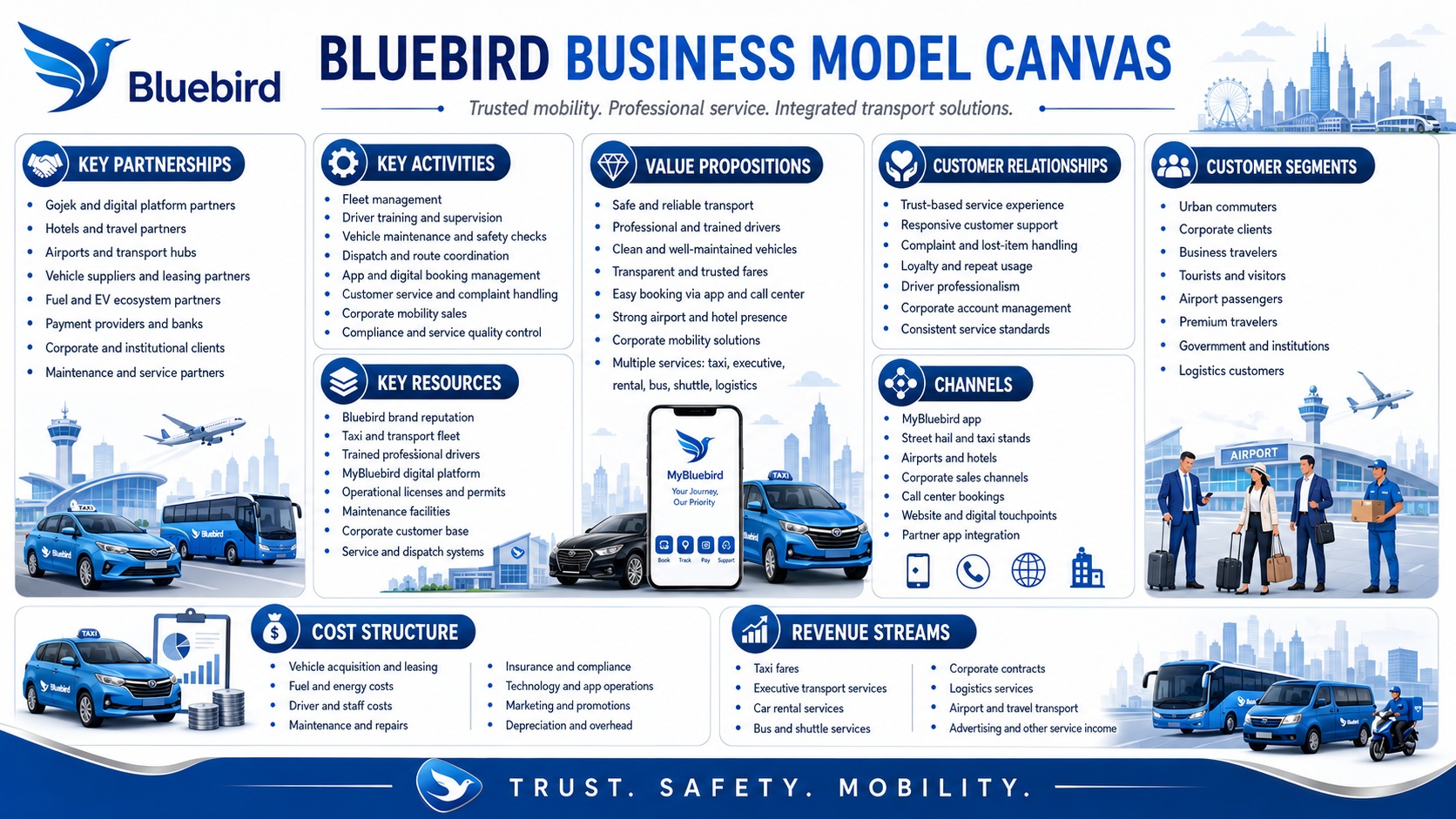
Before analysing each block, the summary below gives a quick view of how Bluebird’s model works. It shows who the company serves, what value it offers, how it reaches customers, and what resources keep the business running.
| BMC Block | Bluebird Application |
|---|---|
| Customer Segments | Urban passengers, corporate clients, tourists, hotels, airports, government users, logistics customers, and premium travellers. |
| Value Propositions | Safe rides, reliable drivers, clean vehicles, transparent fares, corporate mobility, airport access, and digital booking. |
| Channels | Street hailing, taxi stands, airports, hotels, call centres, MyBluebird, Gojek integration, corporate accounts, and websites. |
| Customer Relationships | Trust-based service, driver professionalism, customer support, loyalty features, corporate account management, and complaint handling. |
| Revenue Streams | Taxi fares, executive taxi, rental cars, bus charters, shuttle services, logistics, corporate contracts, and fleet advertising. |
| Key Resources | Brand reputation, vehicle fleet, trained drivers, operating licences, dispatch systems, app technology, maintenance facilities, and corporate accounts. |
| Key Activities | Fleet operations, driver training, vehicle maintenance, dispatching, digital platform management, customer service, sales, and compliance. |
| Key Partnerships | Gojek, hotels, airports, vehicle suppliers, payment providers, corporate clients, government bodies, and maintenance partners. |
| Cost Structure | Vehicle acquisition, fuel, driver costs, maintenance, insurance, depreciation, technology, marketing, operations, and compliance. |
Bluebird BMC Diagram:
Customer segments describe who Bluebird serves. The company serves a broad market, but its strongest appeal is among customers who value safety, reliability, professionalism, and accountability.
Individual passengers use Bluebird for daily commuting, airport transfers, business meetings, family travel, and late-night transport. Corporate clients use it for employee travel, executive movement, visitor transport, and account-based billing.
Hotels, airports, and tourism operators use Bluebird because visitors often prefer a recognised and trusted transport provider. This segment mix reduces dependence on one type of customer.
| Customer Segment | What They Need | How Bluebird Serves Them |
|---|---|---|
| Urban commuters | Safe and available transport for daily movement. | Provides regular taxis, app booking, and street-hail access. |
| Corporate clients | Reliable transport, billing, and service accountability. | Offers corporate accounts and managed mobility services. |
| Tourists and travellers | Trusted rides from airports, hotels, and city locations. | Serves airport, hotel, and tourism-related demand. |
| Premium passengers | Comfort, privacy, and executive service. | Provides Silverbird and rental car options. |
| Logistics customers | Delivery and transport support. | Offers logistics and cargo-related services. |
The Bluebird Business Model Canvas shows that Bluebird does not depend only on one passenger type. Its customer base includes individual, corporate, travel, premium, and logistics segments. This gives the company more resilience because different segments behave differently during economic cycles, travel seasons, and mobility shifts.
The value proposition explains why customers choose Bluebird. At the simplest level, Bluebird offers safe, reliable, and professionally managed transport in a crowded mobility market.
Trust is the strongest part of Bluebird’s value proposition. Customers know the brand, recognise the vehicles, expect trained drivers, and associate the company with accountability.
This matters in cities where passengers may worry about safety, fare certainty, route behaviour, and service complaints. Convenience is also part of the offer.
| Value Proposition | Customer Benefit | Business Impact |
|---|---|---|
| Safety and reliability | Passengers feel more secure during rides. | Protects trust and premium positioning. |
| Professional drivers | Customers receive better service discipline. | Differentiates Bluebird from informal supply. |
| Transparent fares | Riders understand pricing before or during trips. | Reduces anxiety and complaint risk. |
| Multi-channel access | Customers can book through several options. | Expands reach across age and user groups. |
| Corporate mobility | Businesses receive managed transport solutions. | Creates recurring and higher-quality revenue. |
Bluebird’s value is not only the vehicle. It is the confidence that the ride will be safer, cleaner, more professional, and easier to manage. This is why Bluebird can defend customers who care about trust, even when cheaper alternatives exist.
Channels explain how Bluebird reaches customers. This block is important because transport demand is location-based, time-sensitive, and increasingly digital.
Bluebird uses both physical and digital channels. Physical channels include street hailing, taxi stands, hotels, airports, malls, office areas, and transport hubs.
Digital channels include MyBluebird, online platforms, call centres, and partner app access. The combination matters because not every customer behaves the same way.
| Channel | Examples | Strategic Role |
|---|---|---|
| Street and taxi stands | Roads, malls, office areas, transport hubs. | Captures immediate urban demand. |
| Airports and hotels | Airport queues, hotel concierge, travel points. | Serves higher-trust passenger needs. |
| MyBluebird app | Booking, tracking, fixed price, payment. | Competes with digital ride-hailing behaviour. |
| Call centres | Phone-based booking and support. | Serves traditional and assisted users. |
| Partner platforms | Gojek integration and other collaborations. | Extends digital reach beyond owned channels. |
Strong channels make Bluebird more accessible. Physical presence helps the brand remain visible, while digital channels protect relevance among app-based users. This dual-channel model allows Bluebird to serve both traditional taxi customers and modern digital passengers.
Customer relationships describe how Bluebird keeps people coming back. The company’s relationship model is built on trust, service consistency, support, loyalty, and corporate account management.
A passenger’s relationship with Bluebird often starts with confidence. Customers choose the brand because they expect the driver, vehicle, fare, and complaint process to follow clear standards.
Corporate relationships are deeper. Business clients need account management, invoicing, transport planning, service-level expectations, and reliable supply.
| Relationship Driver | How It Works | Example |
|---|---|---|
| Trust-based usage | Customers return because the brand feels safe. | A family chooses Bluebird for night travel. |
| Service support | Complaints, lost items, and ride issues are handled. | A passenger contacts support after leaving an item. |
| Driver professionalism | Training shapes customer experience. | A driver follows route and service standards. |
| Loyalty features | Rewards and promotions encourage repeat use. | Frequent users collect benefits through the app. |
| Corporate account care | Dedicated service supports business clients. | A company manages staff rides through account billing. |
The Bluebird Business Model Canvas shows that relationships are built before, during, and after the ride. Trust attracts customers, driver behaviour shapes the experience, and customer support protects loyalty after problems occur. This relationship model is central to Bluebird’s premium positioning.
Revenue streams show how Bluebird makes money. The company earns revenue from several mobility activities rather than relying only on regular taxi fares.
Passenger fares remain central. Regular taxi rides, executive taxi services, rental cars, buses, shuttle services, and logistics all contribute to the revenue mix.
Corporate contracts add more predictable income because businesses may use Bluebird repeatedly for employees, executives, guests, and operational transport. Fleet advertising can also create additional income.
| Revenue Stream | Description | Why It Matters |
|---|---|---|
| Taxi fares | Passenger payments for regular taxi rides. | Forms the core revenue base. |
| Executive transport | Premium rides through Silverbird and related services. | Supports higher-value customers. |
| Car rental and charter | Goldenbird rentals and Bigbird buses. | Expands revenue beyond point-to-point trips. |
| Corporate contracts | Business accounts and managed transport. | Creates repeat and more stable demand. |
| Logistics and advertising | Cargo services and fleet-based media. | Adds extra monetisation options. |
The Bluebird Business Model Canvas shows a revenue model that is shifting from single-trip fares to broader mobility income. This matters because taxi demand can fluctuate. A stronger mix of corporate, rental, shuttle, bus, logistics, and premium services can improve resilience.
Key resources are the assets required to deliver Bluebird’s business model. For Bluebird, the most important resources are brand reputation, vehicle fleet, trained drivers, technology systems, operating licences, maintenance capability, and corporate relationships.
The brand is a major resource because transport involves personal safety. Customers must trust the company before entering a vehicle.
Bluebird’s long history gives it a reputational asset that new entrants cannot build quickly. Fleet ownership and management are also important.
| Key Resource | Role in the Business Model | Strategic Value |
|---|---|---|
| Brand reputation | Builds trust before purchase. | Supports loyalty and premium demand. |
| Vehicle fleet | Delivers taxi, rental, bus, and logistics services. | Enables scale and service coverage. |
| Trained drivers | Shape safety and service experience. | Differentiates Bluebird from informal transport. |
| Digital systems | Supports booking, tracking, pricing, and payment. | Keeps Bluebird relevant in app-based mobility. |
| Corporate accounts | Connects Bluebird with recurring business clients. | Improves revenue predictability. |
Together, these resources make Bluebird more than a taxi operator. The company combines physical assets, human capability, brand equity, and digital infrastructure. Competitors can copy an app faster than they can copy decades of trust and disciplined operations.
Key activities are the things Bluebird must do well to keep the model working. These include fleet operations, driver training, vehicle maintenance, dispatching, pricing, digital platform management, customer service, corporate sales, and compliance.
Operational discipline is the core activity. A transport company fails when vehicles are unavailable, drivers behave poorly, maintenance is weak, or customer complaints are ignored.
Digital execution is now equally important. Customers expect app reliability, accurate estimated arrival times, fixed-price options, payment flexibility, and responsive support.
| Key Activity | What It Involves | Why It Matters |
|---|---|---|
| Fleet management | Allocating, monitoring, and renewing vehicles. | Protects availability and service coverage. |
| Vehicle maintenance | Inspections, repairs, cleaning, and safety checks. | Supports reliability and passenger trust. |
| Driver training | Service, safety, route, and compliance standards. | Improves ride quality and brand consistency. |
| Digital operations | Managing MyBluebird and payment systems. | Competes with ride-hailing platforms. |
| Corporate sales | Winning and retaining business accounts. | Builds repeat revenue and stronger margins. |
The Bluebird Business Model Canvas shows that Bluebird’s simple promise depends on complex execution. Customers see a ride, but the business must manage vehicles, drivers, systems, partners, pricing, and service recovery behind the scenes.
Key partnerships help Bluebird expand reach, improve convenience, and strengthen operating capability. These partnerships include technology platforms, hotels, airports, vehicle suppliers, payment providers, corporate clients, government bodies, and maintenance partners.
The Gojek partnership is strategically important because it connects Bluebird’s trusted taxi supply with a large digital user base. This helps Bluebird remain visible to customers who prefer app-based booking.
Hotel and airport partnerships also matter. Travellers often want transport that feels official, safe, and easy to find.
| Partner Type | Examples | Contribution to the Model |
|---|---|---|
| Digital platforms | Gojek and related app integrations. | Expands access to app-based users. |
| Hotels and airports | Hospitality and travel locations. | Captures trusted transport demand. |
| Vehicle suppliers | Automotive brands and fleet providers. | Supports fleet availability and renewal. |
| Payment providers | Banks, wallets, and card networks. | Enables cashless and flexible payments. |
| Corporate clients | Businesses and institutions. | Creates repeat mobility demand. |
These partnerships reduce friction. They help Bluebird reach customers, maintain fleet quality, support digital payments, and serve business accounts. Partnership management is therefore strategic, not only operational.
Cost structure explains the major costs required to run Bluebird. The company’s cost base reflects fleet ownership, driver operations, maintenance, fuel, insurance, depreciation, technology, customer service, marketing, and compliance.
Vehicle-related costs are especially important. A large fleet requires acquisition capital, repairs, inspections, tyres, parts, cleaning, insurance, and eventual replacement.
Depreciation can pressure profit even when demand improves. People costs also matter because Bluebird’s value proposition depends on trained drivers, dispatch staff, maintenance teams, call centre teams, customer service, and corporate sales employees.
| Cost Area | Examples | Business Impact |
|---|---|---|
| Fleet costs | Vehicle purchases, leasing, depreciation, and renewal. | Creates high fixed and capital costs. |
| Operating costs | Fuel, maintenance, cleaning, insurance, and parts. | Affects margin and service reliability. |
| People costs | Drivers, trainers, dispatchers, support, and sales teams. | Supports quality but raises cost base. |
| Technology costs | App, booking, payment, tracking, and data systems. | Maintains digital competitiveness. |
| Marketing and compliance | Promotions, licences, safety rules, and reporting. | Protects brand visibility and legal operation. |
Bluebird’s cost structure supports its quality promise. Spending on fleet, drivers, maintenance, technology, and support is not optional. These costs protect safety, reliability, and trust, but they also make price competition with asset-light platforms difficult.
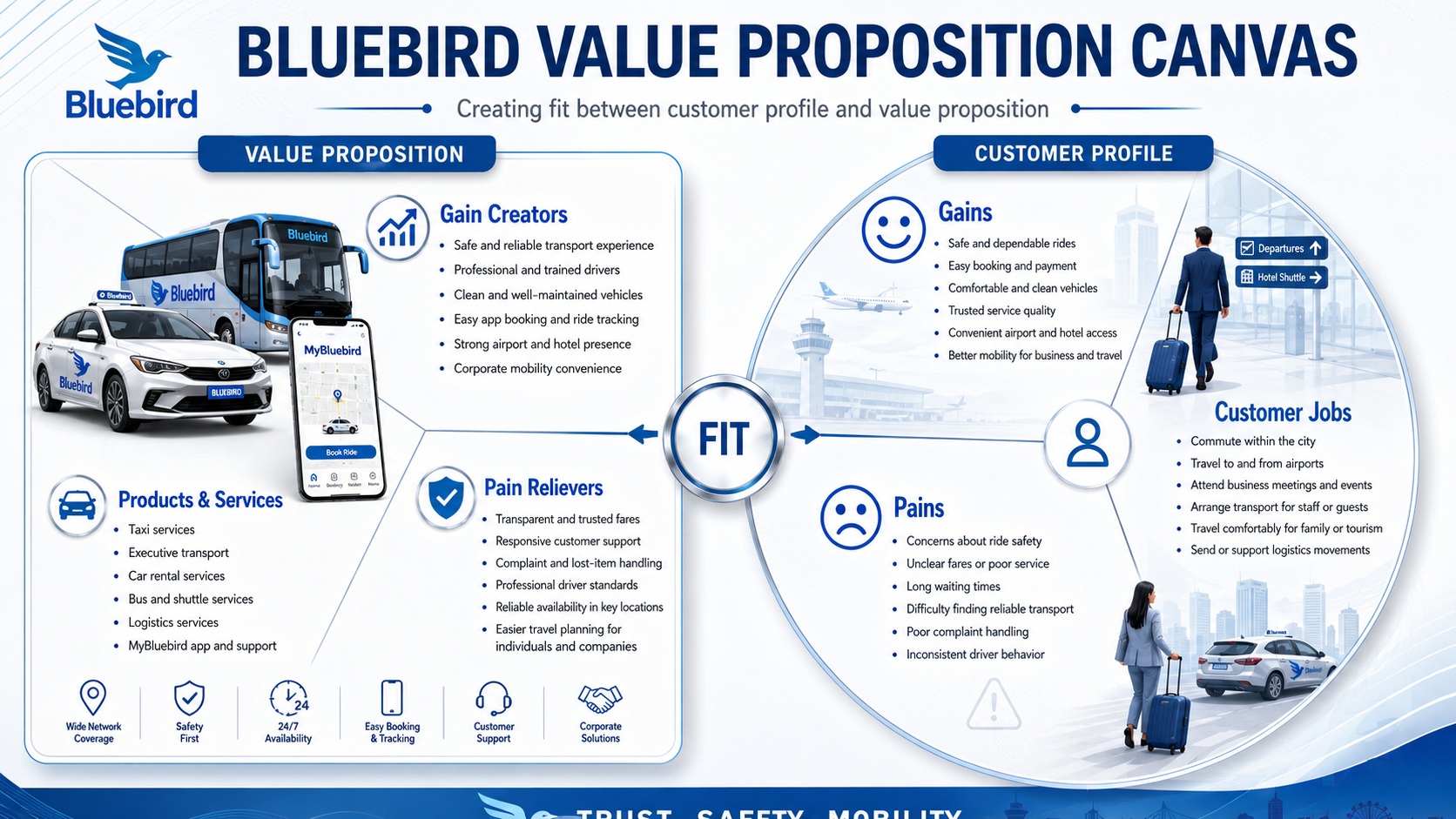
The Value Proposition Canvas helps explain how well Bluebird’s offer fits customer needs. It connects customer jobs, pains, and gains with Bluebird’s products, pain relievers, and gain creators.
For Bluebird, the fit is clear when customers need transport that feels safe, predictable, and accountable. A passenger may want a trusted ride from the airport.
A company may need monthly transport billing. A hotel may need a reliable mobility partner for guests. Customers are not only buying distance travelled. They are buying confidence, convenience, and reduced uncertainty.
The customer profile explains what Bluebird customers are trying to achieve, what problems they want to avoid, and what benefits they expect.
Many customers want to move safely across busy Indonesian cities. They need transport for work, travel, meetings, airport transfers, family trips, tourism, events, and logistics.
Corporate users also need billing, accountability, and service consistency. Common pains include unsafe rides, unclear pricing, poor driver behaviour, lack of complaint handling, limited availability, and inconsistent app experience.
| Customer Profile | Analysis |
|---|---|
| Customer Jobs | Customers want safe rides, airport transfers, business transport, tourism mobility, and delivery support. |
| Pains | They face safety concerns, uncertain fares, poor service, weak accountability, and app-based competition. |
| Gains | They want trust, comfort, availability, transparent pricing, easy booking, and professional service. |
Bluebird Value Map explains how the company responds to the customer profile. It shows the products and services offered, the pain relievers that reduce customer frustration, and the gain creators that add benefits.
Products and services include taxis, executive taxis, rental cars, buses, shuttle services, logistics, MyBluebird, call centres, and corporate accounts. These offers serve both individual and institutional mobility needs.
Pain relievers include trained drivers, recognised branding, customer support, transparent fares, vehicle standards, and digital tracking. Gain creators include corporate convenience, airport access, premium comfort, app booking, cashless payment, and trusted service.
| Value Map Element | Analysis |
|---|---|
| Products and Services | Taxis, Silverbird, Goldenbird, Bigbird, Cititrans, logistics, MyBluebird, and corporate mobility. |
| Pain Relievers | Driver training, transparent fares, support channels, vehicle standards, tracking, and brand accountability. |
| Gain Creators | Trust, comfort, corporate billing, airport access, digital booking, premium options, and service consistency. |
The fit happens when Bluebird reduces uncertainty in urban transport. Customers need to reach destinations safely, pay fairly, and trust the driver.
Bluebird responds with recognised vehicles, trained drivers, support systems, and digital booking. This fit becomes stronger in high-trust situations.
Airport passengers, business travellers, parents, tourists, hotel guests, and corporate users may prefer Bluebird because service quality matters more than the lowest fare.
The Bluebird Business Model Canvas becomes stronger when viewed with this fit. Bluebird wins when customers believe the ride will be safer, more predictable, and easier to manage than lower-cost alternatives.
| Customer Profile | Details | Matching Value Map | How Bluebird Creates Fit |
|---|---|---|---|
| Customer Jobs | Customers need commuting, airport rides, business travel, tourism transport, and logistics. | Products and Services | Bluebird offers taxis, executive cars, rentals, buses, shuttles, logistics, and app booking. |
| Pains | Customers worry about safety, fares, driver behaviour, complaint handling, and reliability. | Pain Relievers | Training, vehicle standards, transparent pricing, support, and tracking reduce these concerns. |
| Gains | Customers want trust, comfort, speed, availability, and professional service. | Gain Creators | Brand reputation, airport access, corporate accounts, app features, and premium options create added value. |
VPC Diagram:
Bluebird has several competitive advantages that support its long-term position. These advantages work together as one system, where trust attracts customers, fleet control supports service quality, and digital access improves relevance.
These advantages reinforce each other. Brand trust brings customers in, operating discipline protects the experience, and digital access keeps Bluebird relevant in modern mobility.
Bluebird also faces several risks that may affect future growth. These risks matter because the company operates in a market shaped by price competition, digital platforms, cost pressure, and changing urban mobility habits.
These risks do not mean Bluebird’s model is weak. They show that a trusted mobility brand must keep improving price competitiveness, digital convenience, asset use, and service consistency.
Bluebird should protect its trusted brand while making the model more digital, flexible, and asset-efficient. Safety and reliability remain the base, but customers now also expect speed, price clarity, and app convenience.
The company should strengthen MyBluebird as a daily-use mobility platform. Better booking speed, fixed-price transparency, loyalty integration, corporate dashboards, and customer support can increase repeat usage.
Corporate mobility should become a bigger growth engine. Bluebird can offer staff transport, executive travel, visitor transport, event mobility, airport packages, and subscription-style corporate plans.
Fleet strategy should also improve asset productivity. More data-driven vehicle allocation, demand forecasting, maintenance planning, and selective electric vehicle deployment can reduce waste and improve margins.
Partnerships need sharper segmentation. Gojek can help reach digital users, while hotels, airports, companies, and tourism partners can support premium and recurring demand.
The Bluebird Business Model Canvas suggests one clear priority: Bluebird must remain the most trusted managed mobility brand in Indonesia while becoming easier, faster, and more competitive to use.
Bluebird’s business model is powerful because it combines brand trust, managed fleet operations, trained drivers, corporate relationships, physical channels, and digital access. The company does not only sell taxi rides. It sells confidence in mobility.
The taxi business remains important, but future growth will depend on broader mobility services. Executive transport, rental cars, buses, shuttles, logistics, corporate accounts, digital booking, and sustainable fleet initiatives can strengthen the model.
The Bluebird Business Model Canvas shows that Bluebird’s real advantage is not only its fleet. Its advantage is the operating system behind the fleet: drivers, standards, service, relationships, technology, and trust.
Future success will depend on how well Bluebird manages digital competition, cost pressure, customer expectations, and mobility diversification. If those areas are handled well, Bluebird can remain one of Indonesia’s most trusted transportation brands.
This article is for educational and business analysis purposes only. It is based on publicly available information, general market observation, and strategic interpretation. It is not financial advice, investment advice, legal advice, or an official statement from PT Blue Bird Tbk. Readers should conduct their own research before making business, investment, or strategic decisions.
Explore the Quipper Business Model Canvas, nine BMC blocks, Value Proposition Canvas, Ruangguru and Pahamify… Read More
Explore the CARPUT Business Model Canvas, nine BMC blocks, Value Proposition Canvas, competitor comparison, competitive… Read More
Explore the Boost Business Model Canvas, nine BMC blocks, Value Proposition Canvas, competitor comparison, advantages,… Read More
Explore the Domino's Pizza Business Model Canvas, nine BMC blocks, Value Proposition Canvas, Pizza Hut… Read More
Explore the Mie Gacoan Business Model Canvas, including its customer segments, value propositions, revenue streams,… Read More
Restaurant Business Model Canvas: A Practical Guide to Designing, Evaluating, and Improving Restaurant Business Models… Read More