Agoda Business Model Canvas
Explore the Agoda Business Model Canvas, covering all nine BMC blocks, Value Proposition Canvas, Booking.com and Expedia comparison, competitive advantages, risks and strategic recommendations for 2026.
Explore the AirAsia X Business Model Canvas, including all nine BMC blocks, Value Proposition Canvas, Scoot and Cebu Pacific comparison, competitive advantages, risks and strategic recommendations updated for 2026.
BMC Article No: BMC #018
This article reflects the transformation of AirAsia X from primarily a medium- and long-haul low-cost airline into the listed aviation platform consolidating AirAsia-branded short- and medium-haul operations. The AirAsia X Business Model Canvas incorporates the January 2026 acquisition of AirAsia Berhad and AirAsia Aviation Group Limited, greater integration between narrowbody and widebody networks, an enlarged ASEAN hub structure, fleet modernisation, Fly-Thru connectivity, new international markets, ancillary-revenue development and the ambition to create a global low-cost network carrier.
The article also provides deeper analysis of all nine BMC blocks, substantially expanded closing analysis for each block, a Value Proposition Canvas, comparison with Scoot and Cebu Pacific, five competitive advantages, five major risks and challenges, strategic recommendations and an examination of how the overall business model works as an interconnected system.
AirAsia X historically represented the longer-range component of the wider AirAsia aviation ecosystem. Its original strategic role was relatively straightforward: extend the low-cost airline concept beyond short-haul Southeast Asian routes into markets such as Australia, North Asia and other medium- to long-haul destinations.
That position changed significantly following aviation consolidation.
In January 2026, AirAsia X completed the acquisition of AirAsia Berhad and AirAsia Aviation Group Limited, bringing AirAsia-branded airlines in Malaysia, Thailand, Indonesia, the Philippines and Cambodia under a single aviation platform. The enlarged group now combines narrowbody and widebody aircraft with short-, medium- and longer-range routes.
The AirAsia X Business Model Canvas is therefore no longer best understood as the model of one long-haul airline alone. It increasingly represents an integrated low-cost network system built around large-scale passenger traffic, multiple ASEAN hubs, low fares, high aircraft utilisation, digital distribution, ancillary revenue and connecting traffic.
This transformation substantially increases AirAsia’s strategic possibilities. It also makes execution, financing, fleet management and network optimisation considerably more complex.
AirAsia X operates within a low-cost aviation model designed to make regional and international air travel accessible to a broad market while maintaining disciplined unit economics.
The underlying commercial proposition begins with competitively priced base fares. Customers can then purchase additional services according to their individual requirements, including checked baggage, meals, preferred seats, priority services and other travel-related products.
At the centre of the AirAsia X Business Model Canvas is therefore a combination of low base fares, high passenger volumes and ancillary monetisation.
Following the 2026 aviation consolidation, another economic engine has become increasingly important: network connectivity.
Short-haul services can feed passengers into medium- and longer-haul routes, while larger aircraft can bring international passengers into ASEAN hubs where they connect to regional destinations. AirAsia reported that Fly-Thru traffic had already become an important part of its network strategy before the consolidation was completed.
The resulting model increasingly resembles a low-cost network carrier rather than a conventional point-to-point budget airline.
Scale allows aircraft, routes, customer traffic and distribution infrastructure to reinforce one another. However, profitability still depends heavily on keeping aircraft productive, filling seats, controlling fuel and operating costs, generating ancillary spending and selecting routes capable of producing acceptable returns.
The Business Model Canvas, commonly called BMC, is a strategic framework for examining how an organisation creates value, delivers that value to customers and captures economic returns.
Nine interconnected blocks form the framework.
| BMC Block | Main Question |
|---|---|
| Customer Segments | Who does AirAsia serve? |
| Value Propositions | What value does AirAsia provide? |
| Channels | How does AirAsia reach and serve customers? |
| Customer Relationships | How does the airline attract and retain passengers? |
| Revenue Streams | How does the airline generate revenue? |
| Key Resources | Which assets make operations possible? |
| Key Activities | What activities must be executed continuously? |
| Key Partnerships | Which external organisations support the model? |
| Cost Structure | What are the major costs? |
For aviation, examining individual blocks is useful, but interactions between them are considerably more important.
Fleet strategy affects routes. Routes determine customer segments. Passenger volume influences ancillary revenue. Aircraft utilisation affects unit costs, while fuel prices can quickly change route economics.
The AirAsia X Business Model Canvas helps make these relationships visible.
AirAsia X began operations in 2007 as the longer-haul extension of the AirAsia low-cost model.
Its initial proposition was based on a relatively unconventional idea at the time: passengers did not necessarily require traditional full-service airline economics to travel longer distances.
A simplified service model, dense aircraft configuration, direct digital distribution and optional ancillary products could potentially reduce fares while making previously expensive destinations accessible to more travellers.
Modern AirAsia X is considerably broader.
Following the completion of the aviation consolidation in January 2026, the group (AirAsia Group Berhad) describes itself as an integrated low-cost airline group operating short- and medium-haul services across ASEAN and beyond. Its network extends across more than 150 destinations and approximately 300 routes, supported by multiple strategic hubs. The combined fleet includes narrowbody Airbus A320 and A321-family aircraft together with Airbus A330 widebody aircraft.
This integrated structure fundamentally changes the strategic potential of the business.
AirAsia can increasingly optimise passengers across a network rather than evaluating every flight exclusively as an isolated point-to-point service.
AirAsia X is strategically interesting because it attempts to combine two airline concepts that historically involve different economics.
Traditional low-cost carriers generally emphasise relatively short flights, rapid aircraft turnaround, simplified operations and high aircraft utilisation.
Longer-haul aviation introduces additional complexity.
Fuel represents a larger portion of trip economics. Aircraft remain airborne longer, schedule disruption becomes more consequential, crew planning becomes more complicated and passenger expectations can increase.
The enlarged AirAsia platform adds another dimension.
Instead of maintaining distinct short-haul and medium-haul systems, management can increasingly connect passengers across the wider AirAsia network.
A traveller from a secondary ASEAN city might take a narrowbody aircraft into Kuala Lumpur or Bangkok before continuing towards Japan, Australia, Central Asia, the Middle East or eventually Europe.
The strategic significance of the AirAsia X Business Model Canvas therefore lies in network economics.
More destinations create additional connection possibilities. Better connections potentially increase passenger volumes. Greater volume can support additional routes, which can further improve the attractiveness of the network.
Nevertheless, network effects in aviation are expensive.
Aircraft, airport slots, crew, maintenance and fuel must be committed before revenue is certain. Expansion only creates value when additional connectivity produces sufficient traffic and commercial returns to justify those investments.
Several major developments are reshaping the business in 2026.
The most significant is aviation consolidation. AirAsia X completed the acquisition of AirAsia Berhad and AirAsia Aviation Group Limited in January 2026, placing multiple AirAsia-branded airlines within one aviation platform known as AirAsia Group Berhad.
Network strategy is also becoming more ambitious.
AirAsia expanded towards Central Asia and Türkiye through destinations such as Almaty, Tashkent and Istanbul. Management has also discussed using new hubs and longer-range aircraft to improve connectivity between ASEAN, the Middle East and Europe.
Fleet architecture is evolving simultaneously.
The enlarged group uses A320 and A321-family narrowbody aircraft alongside A330 widebodies, while A321LR aircraft are expected to support longer thin routes without requiring widebody economics. The company has also outlined significant future aircraft requirements.
Commercial partnerships are becoming more important as well. In September 2026, AirAsia announced its first codeshare agreement with Pegasus Airlines, extending potential connectivity between Asia and European destinations through Istanbul.
However, elevated fuel prices and foreign-exchange pressure have become major industry challenges during 2026.
The AirAsia X Business Model Canvas must therefore balance ambitious network expansion with strict financial and operational discipline.
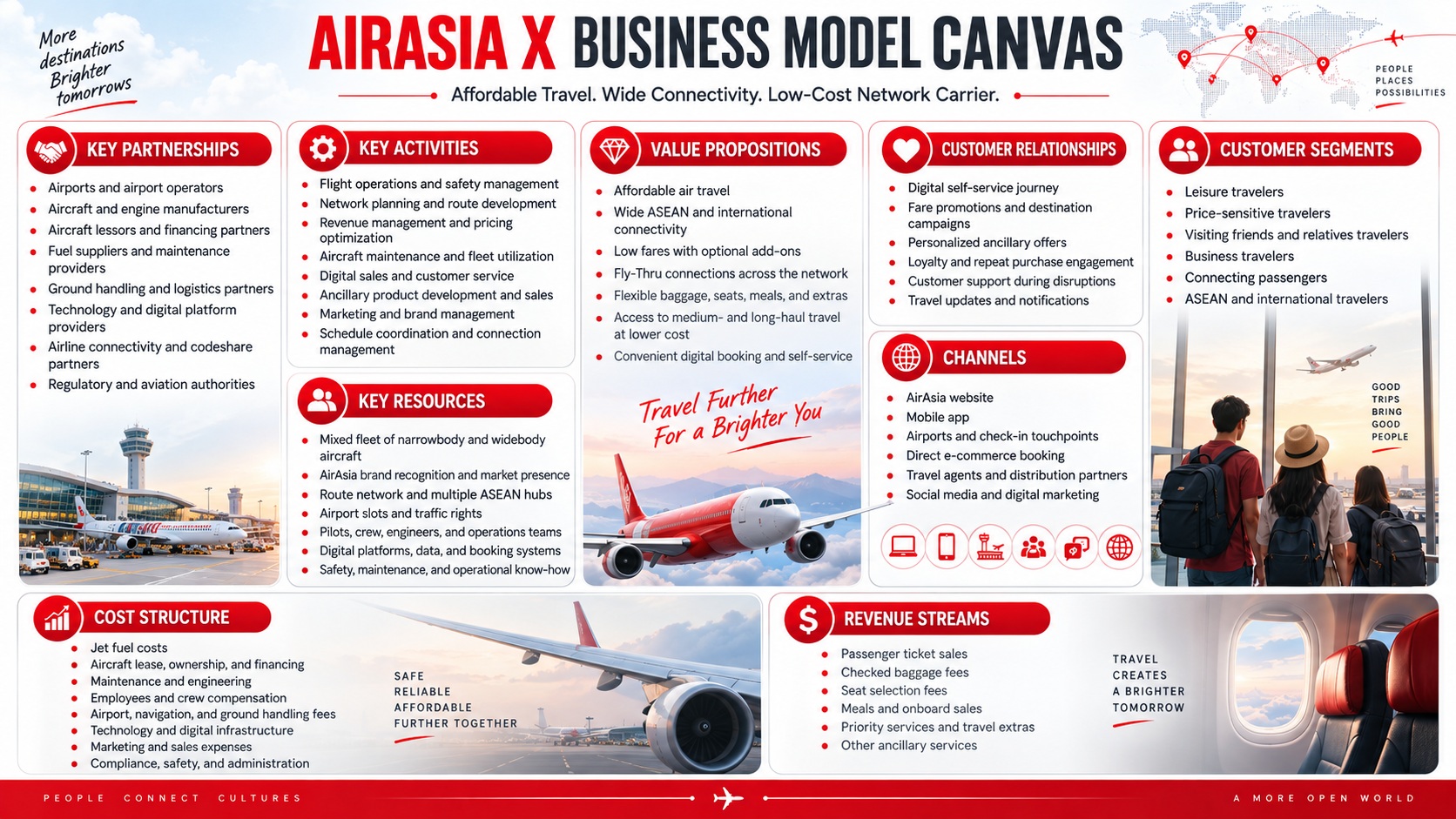
Before analysing the nine components individually, the AirAsia X Business Model Canvas can be summarised as an integrated low-cost aviation system that attracts passengers through affordable fares, connects them across a wide network and increases revenue through optional products and services.
| BMC Block | AirAsia X Application |
|---|---|
| Customer Segments | Leisure travellers, price-sensitive passengers, VFR travellers, business travellers and connecting passengers |
| Value Propositions | Affordable fares, broad connectivity, flexible add-ons, ASEAN network access and low-cost long-range travel |
| Channels | AirAsia digital platforms, mobile app, website, airports, travel agents and distribution partners |
| Customer Relationships | Digital self-service, loyalty ecosystem, personalisation, promotions and customer support |
| Revenue Streams | Passenger fares, baggage, seats, meals, priority services and other ancillary products |
| Key Resources | Aircraft fleet, brand, network, airport slots, digital systems, employees and operating licences |
| Key Activities | Flight operations, network planning, revenue management, maintenance, sales and safety management |
| Key Partnerships | Airports, aircraft manufacturers, lessors, fuel suppliers, maintenance providers and airline partners |
| Cost Structure | Fuel, aircraft ownership, maintenance, employees, airports, financing and technology |
An AirAsia X BMC diagram should present the nine components as a connected aviation system rather than nine independent categories.
Customers create passenger demand.
The network transforms that demand into flight traffic.
Aircraft and employees provide capacity.
Digital systems sell and manage that capacity.
Ancillary products increase revenue per passenger.
Partners provide airports, aircraft, fuel, maintenance and additional connectivity.
Cost discipline determines whether the revenue generated by those activities ultimately produces sustainable returns.
A detailed AirAsia X Business Model Canvas reveals that the group’s competitive position increasingly depends on the interaction between network scale, fleet flexibility, low-cost operations, digital distribution and ancillary monetisation.
No single BMC component is sufficient.
Cheap fares can attract passengers but destroy profitability when pricing fails to cover operating costs.
More aircraft can support expansion but create financial pressure when utilisation is weak.
Additional destinations can improve network connectivity, yet underperforming routes reduce fleet productivity.
Ancillary products can increase margins but excessive fees may undermine perceptions of value.
The following sections examine each BMC block in greater depth.
AirAsia serves a broad passenger market, although price sensitivity remains a common characteristic across many segments.
Leisure travellers are particularly important because attractive fares can stimulate discretionary trips that might otherwise not occur.
Visiting-friends-and-relatives passengers represent another valuable segment. Migrant workers, expatriates, students and internationally dispersed families often require recurring travel between ASEAN and destinations throughout Asia, Australia and beyond.
Business travellers can also use AirAsia when price, schedule and destination are more important than traditional premium-service benefits.
Connecting passengers are becoming strategically more significant as the enlarged network creates more Fly-Thru combinations.
| Segment | Details | Why It Matters |
|---|---|---|
| Leisure travellers | Holidaymakers seeking affordable international travel | Supports high passenger volumes |
| VFR travellers | People visiting friends and relatives | Provides recurring travel demand |
| Price-sensitive travellers | Customers prioritising fare affordability | Core market for low-cost aviation |
| Business travellers | Cost-conscious professional travellers | Broadens demand beyond leisure |
| Connecting passengers | Travellers transferring across AirAsia routes | Strengthens network economics |
AirAsia’s expanded network allows several customer groups to use the same physical capacity.
A flight from Kuala Lumpur can contain tourists, students, migrant workers, business passengers and customers connecting from another ASEAN city.
This diversification can reduce dependence on one source of demand.
The deeper strategic opportunity comes from connecting traffic. A destination that appears marginal based only on local passengers could become commercially attractive when traffic from multiple AirAsia origins is aggregated through a hub.
Greater network breadth therefore expands the potential addressable market for each aircraft departure.
However, customer diversity also complicates pricing and service design. AirAsia must preserve affordability for highly price-sensitive travellers while providing sufficient flexibility, reliability and convenience to attract customers willing to pay more.
AirAsia’s fundamental promise remains affordable air travel.
Low base fares allow customers to purchase transportation without automatically paying for every service traditionally bundled into a full-service ticket.
Passengers then customise the journey through optional baggage, meals, preferred seating, priority products and other additions.
Network reach has become an increasingly important proposition after the aviation consolidation.
| Value Proposition | Details | Why It Matters |
|---|---|---|
| Affordable fares | Low-cost access to domestic and international travel | Stimulates price-sensitive demand |
| Broad network | Extensive destinations across ASEAN and beyond | Increases travel possibilities |
| Flexible add-ons | Customers select additional services individually | Supports choice and monetisation |
| Connecting travel | Fly-Thru links short- and longer-haul routes | Expands origin-destination combinations |
| Accessible long-range travel | Lower-cost access to distant destinations | Differentiates from short-haul LCCs |
The AirAsia X Business Model Canvas creates value by separating transportation from many optional components of the journey.
That approach gives budget-conscious customers greater control over what they pay for while allowing customers with higher willingness to pay to purchase additional convenience.
Network integration strengthens the proposition considerably.
Low fares are valuable, but cheap travel becomes more powerful when customers can reach a larger number of destinations through coordinated connections.
Aircraft diversity reinforces that proposition because narrowbody and widebody aircraft can be deployed according to route distance and demand.
The main strategic tension concerns value perception.
A low advertised fare can attract customers, yet excessive additional charges, inconvenient schedules or unreliable operations may weaken satisfaction.
Long-term advantage therefore depends on delivering an affordable total journey rather than merely producing the lowest headline ticket price.
AirAsia relies heavily on direct digital distribution.
Web and mobile platforms allow passengers to search destinations, compare fares, make reservations, purchase ancillary products, check in and manage bookings without requiring traditional travel-agent infrastructure.
Digital distribution reduces transaction costs while also giving the company additional opportunities to personalise offers.
Airports remain essential physical channels because aviation ultimately requires check-in, baggage handling, security processing, boarding and passenger assistance.
| Channel | Details | Why It Matters |
|---|---|---|
| Mobile application | Search, booking, check-in and trip management | Creates direct digital access |
| Website | Flight discovery and transaction platform | Supports global direct sales |
| Airports | Physical check-in, boarding and operations | Completes service delivery |
| Travel intermediaries | Agents and distribution partners | Extends market reach |
| Digital marketing | Promotions, social media and performance marketing | Stimulates demand |
Direct digital channels are strategically valuable because airlines operate a perishable inventory model.
An unsold seat cannot be stored after departure.
AirAsia therefore needs channels capable of stimulating demand quickly, changing prices dynamically and promoting unsold capacity.
Digital ownership can also increase ancillary conversion.
A customer purchasing a flight can subsequently be offered baggage, meals, seats, insurance or other services at relevant points in the booking journey.
Nevertheless, airport channels remain operationally critical.
Passengers may experience the brand digitally for weeks before departure, but a poor airport experience can quickly undermine satisfaction.
AirAsia’s challenge is consequently to integrate digital efficiency with dependable physical execution.
The strongest channel strategy makes travel feel continuous: discovery, purchase, preparation, airport processing, flight and post-travel engagement should function as parts of one customer journey.
AirAsia’s customer relationships are predominantly digital, transactional and increasingly data-driven.
Many passengers require little human interaction during a normal journey.
They search flights, make reservations, purchase additional services, check in and receive travel notifications through digital channels.
Promotional campaigns encourage repeat purchasing, while loyalty mechanisms can strengthen retention across frequent travellers.
Customer support becomes more important when disruptions occur.
| Relationship Type | Details | Why It Matters |
|---|---|---|
| Digital self-service | Customers manage most transactions independently | Supports low operating costs |
| Personalised offers | Relevant fares and add-ons based on customer context | Increases conversion |
| Loyalty ecosystem | Rewards repeat engagement and purchasing | Supports retention |
| Promotional engagement | Fare campaigns and destination marketing | Stimulates recurring demand |
| Customer support | Assistance during booking or disruptions | Protects customer trust |
The economic attractiveness of self-service is substantial.
Millions of customers can interact with digital systems without requiring corresponding growth in sales or service personnel.
Automation therefore supports the cost structure of the low-cost model.
Aviation, however, differs from purely digital businesses because service failures can carry significant consequences.
Flight cancellations, baggage problems, missed connections or schedule changes often require rapid intervention. Customers who accept limited human interaction during routine transactions may expect considerably stronger assistance during disruption.
Relationship quality therefore depends on more than low fares.
Customers need confidence that the airline can provide accurate information and practical solutions when travel does not proceed according to plan.
AirAsia should consequently preserve automation for routine activity while strengthening responsive support for higher-impact situations.
Trust can become an important source of repeat demand in a market where competing airlines can often offer similar prices.
Passenger fares remain the fundamental revenue source.
However, the low-cost model deliberately separates many services from the base ticket, allowing AirAsia to generate additional revenue after the initial seat purchase.
Ancillary products can include checked baggage, seat selection, meals, priority services and other travel-related options.
AirAsia reported continued focus on product personalisation, bundled offerings and ancillary spending as part of its commercial strategy.
| Revenue Stream | Details | Why It Matters |
|---|---|---|
| Passenger fares | Base revenue from transporting passengers | Provides core airline income |
| Checked baggage | Charges for baggage allowance | Raises revenue per passenger |
| Seat selection | Fees for preferred seating | Monetises differentiated preferences |
| Food and beverages | Pre-booked and onboard purchases | Adds incremental margin |
| Other ancillary services | Priority products and travel-related services | Diversifies passenger revenue |
Revenue management is central to airline profitability because every departure contains a fixed number of seats and continuously changing demand.
Selling every seat cheaply can produce a high load factor but weak profitability.
Pricing every seat too aggressively may generate stronger yield but leave excessive capacity unsold.
The AirAsia X Business Model Canvas therefore depends on optimising both load factor and revenue per passenger.
Ancillary monetisation helps resolve part of this tension.
A low fare can attract highly price-sensitive travellers while passengers requiring additional convenience contribute more revenue through optional services.
Network expansion can add another benefit by increasing connecting traffic and supporting more sophisticated origin-and-destination pricing.
Nevertheless, management must avoid treating ancillary revenue as unlimited.
When additional charges become too complicated or create unexpectedly high total trip costs, customers may compare the final price against full-service competitors rather than the advertised base fare.
Aircraft are the most visible physical resource in AirAsia’s business model.
The enlarged group operates a combination of Airbus narrowbody and widebody aircraft, allowing different aircraft types to serve different mission lengths and passenger volumes. Its published fleet structure includes A320 and A321-family aircraft together with A330 widebodies.
The AirAsia brand is another important resource.
Years of regional presence have created broad recognition around low-cost travel.
| Key Resource | Details | Why It Matters |
|---|---|---|
| Aircraft fleet | Narrowbody and widebody aircraft | Provides route capacity |
| AirAsia brand | Widely recognised low-cost airline identity | Reduces customer-acquisition friction |
| Route network | Extensive ASEAN and international connectivity | Creates network value |
| Airport rights and slots | Access to strategically important airports | Enables commercially valuable schedules |
| People and technology | Crew, operations teams and digital systems | Supports safe scalable operations |
Network scale becomes increasingly valuable as more operations are consolidated.
A fleet is not simply a collection of aircraft.
It becomes more productive when aircraft types can be allocated to routes based on distance, demand, airport characteristics and economics.
Likewise, airport slots and operating rights become strategic resources when they support connections across multiple services.
Human capability remains indispensable despite high levels of automation.
Pilots, engineers, cabin crew, dispatchers, safety professionals, network planners and operational teams collectively determine whether aircraft can actually produce revenue safely and reliably.
AirAsia must therefore manage its resources as one integrated portfolio.
Adding aircraft without sufficient crew, maintenance capacity, financing or profitable routes would create little strategic value.
The strongest resource base is one in which fleet, network, employees, technology and brand capacity expand in a coordinated manner.
Safe and reliable flight operations form the operational foundation of the business.
Every scheduled flight requires coordinated aircraft planning, crew availability, dispatch, ground handling, air traffic management, passenger processing and regulatory compliance.
Network planning determines where aircraft should fly.
Revenue management decides how capacity should be priced over time.
Maintenance ensures that fleet availability remains sufficient to support scheduled operations.
| Key Activity | Details | Why It Matters |
|---|---|---|
| Flight operations | Operate scheduled services safely and reliably | Delivers the core product |
| Network planning | Select routes, frequencies and aircraft deployment | Determines network economics |
| Revenue management | Optimise fares and seat inventory | Improves revenue per flight |
| Aircraft maintenance | Maintain fleet safety and availability | Protects reliability and capacity |
| Sales and ancillary management | Sell seats and optional products | Drives commercial performance |
Integration creates additional activities.
AirAsia must increasingly coordinate schedules between multiple hubs and operating entities so that short-haul and longer-range services reinforce rather than compete with one another.
Connection design becomes especially important.
A theoretically attractive route network can deliver poor customer experience if transfer times are inconvenient or schedules are poorly synchronised.
Operational reliability also has greater network consequences.
When one point-to-point flight is delayed, primarily its passengers are affected.
Within a connecting system, one delayed arrival can disrupt multiple onward journeys.
AirAsia’s operational model must therefore evolve as network complexity increases.
Cost efficiency will remain essential, but punctuality, schedule coordination and disruption recovery become increasingly important commercial capabilities.
Successful integration depends on achieving synergies without allowing organisational complexity to undermine the simplicity that historically supported AirAsia’s low-cost economics.
Airlines operate through extensive external ecosystems.
Airports provide runways, terminals, gates and passenger infrastructure.
Aircraft manufacturers supply fleet capacity, while engine manufacturers and maintenance providers support aircraft availability.
Fuel suppliers provide one of the airline’s most economically significant inputs.
Aircraft lessors and financial institutions influence capital availability.
| Key Partner | Details | Why It Matters |
|---|---|---|
| Airports | Provide infrastructure, slots and ground facilities | Enable network operations |
| Aircraft and engine manufacturers | Supply fleet and propulsion systems | Determine capacity and efficiency |
| Lessors and financiers | Provide aircraft and funding solutions | Support capital requirements |
| Fuel and maintenance providers | Support continuous aircraft operations | Affect cost and reliability |
| Airline and connectivity partners | Extend network beyond own-operated routes | Expands customer reach |
Partnership strategy becomes increasingly important as AirAsia extends beyond ASEAN.
The September 2026 Pegasus codeshare illustrates the potential role of external airline relationships in expanding connectivity without requiring AirAsia to operate every onward European route itself.
Such arrangements can improve capital efficiency.
Rather than deploy aircraft across dozens of thin routes, AirAsia can concentrate capacity on strategic gateways while partners provide onward connectivity.
However, dependency creates risk.
Aircraft delivery delays can constrain expansion. Engine availability can reduce fleet utilisation. Airport congestion can damage punctuality. Fuel suppliers influence operating costs, while financing conditions affect aircraft economics.
Partnerships must therefore be evaluated not simply by purchasing price.
Reliability, flexibility and strategic alignment are equally important.
A low-cost airline can only operate efficiently when suppliers and partners support predictable utilisation of expensive aircraft assets.
Diversifying critical dependencies can consequently become as important as negotiating lower unit costs.
Airlines operate with substantial fixed and variable costs.
Fuel represents one of the most volatile expenses and can rapidly alter the economics of routes that appeared attractive when schedules were planned.
Aircraft ownership or lease expenses create significant capital commitments.
Maintenance costs increase with fleet size and utilisation.
Employees, airport charges, navigation fees, ground handling, technology and distribution contribute additional expenditure.
| Cost Category | Details | Why It Matters |
|---|---|---|
| Fuel | Jet fuel consumed across the network | Major volatile operating expense |
| Aircraft | Lease, ownership, financing and depreciation | Creates substantial fixed commitments |
| Maintenance | Airframe, engine and component maintenance | Protects safety and fleet availability |
| Employees | Flight crew, engineering and support personnel | Required for operations |
| Airports and operations | Landing, navigation, handling and technology | Enables network delivery |
The low-cost model does not mean operating with low absolute costs.
Airlines spend enormous amounts of money.
Competitive advantage instead comes from reducing cost per available seat kilometre and extracting greater productivity from aircraft, employees and infrastructure.
High utilisation is therefore critical.
An aircraft generates economic value primarily when it is flying passengers. Extended grounding still creates ownership, maintenance and financing obligations without producing equivalent revenue.
Fuel volatility introduces another challenge.
In 2026, sharply higher jet-fuel prices created substantial pressure across Southeast Asian low-cost airlines, demonstrating how quickly external shocks can alter industry economics.
Cost control must consequently extend beyond straightforward expense reduction.
Newer fuel-efficient aircraft, stronger scheduling, better route economics, productive crew deployment and disciplined capacity allocation can improve structural efficiency.
The critical objective is maintaining sufficiently low unit cost without compromising safety, reliability or the customer proposition that generates passenger demand.
The AirAsia X Business Model Canvas becomes most useful when all nine components are viewed as one economic system.
Customer segments provide demand.
Value propositions attract passengers through low fares, choice and connectivity.
Digital and physical channels convert that interest into bookings and completed journeys.
Customer relationships encourage repeat purchasing while supporting passengers when problems occur.
Revenue then emerges from fares and ancillary services.
Those revenues fund aircraft, employees, maintenance, technology and network operations.
Key resources allow the airline to perform essential activities.
Partners provide infrastructure, fuel, aircraft, financing and additional network connectivity.
The cost structure ultimately determines whether the combined system generates sustainable economic returns.
Several reinforcing loops can emerge.
More destinations can attract more customers.
Additional traffic can support higher frequencies.
Higher frequencies make connections more convenient.
Improved connectivity can attract more passengers from additional origin markets.
Greater passenger volume can increase both ticket and ancillary revenue.
Problems also propagate through the system.
Poor reliability weakens customer satisfaction.
Weak demand reduces aircraft utilisation.
Low utilisation increases unit costs.
Higher costs can force fare increases.
Higher fares may reduce demand further.
AirAsia therefore cannot maximise individual BMC blocks independently.
Sustainable performance requires network growth, fleet capacity, customer demand, operational reliability and financial resources to remain aligned.
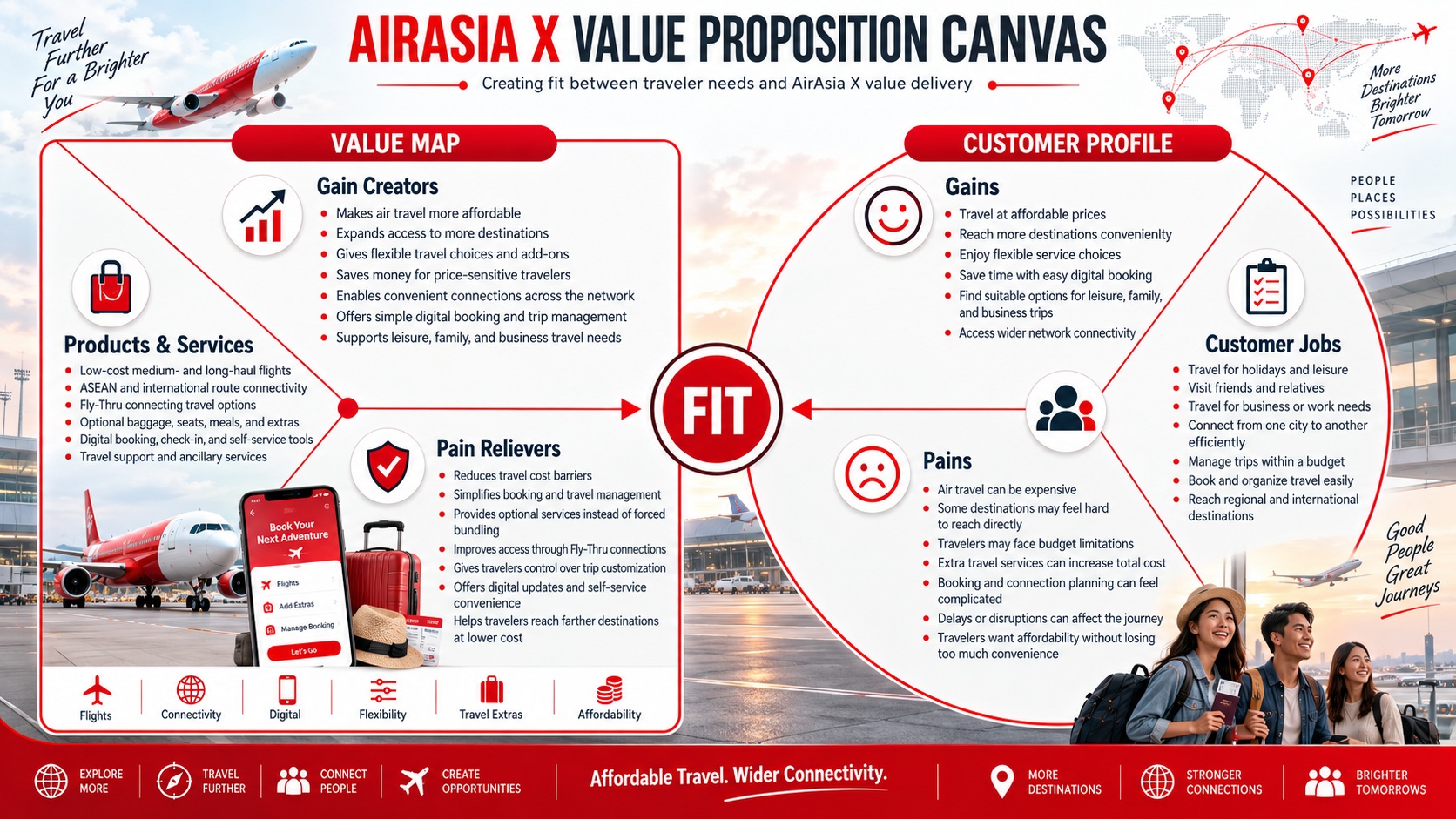
The Value Proposition Canvas provides a more customer-focused perspective than the broader Business Model Canvas.
For the AirAsia X Business Model Canvas, the most relevant customer profile is the price-conscious traveller who wants to reach domestic, regional or international destinations without paying for unnecessary premium services.
Customers are not merely purchasing an aircraft seat.
They are attempting to reach a destination economically, conveniently and reliably while managing trade-offs between price, schedule, comfort and additional services.
| Customer Profile | Details |
|---|---|
| Customer Jobs | Travel for holidays, work, family visits, education and international connections |
| Customer Pains | Expensive fares, complicated connections, delays, hidden total costs and inconvenient schedules |
| Customer Gains | Affordable travel, wider destination choice, simple booking, flexible add-ons and convenient connections |
Low fares address only part of the customer’s problem.
A cheap flight that involves excessive disruption, unsuitable departure times or difficult connections may create limited overall value.
Customers increasingly evaluate the complete journey.
AirAsia must therefore balance affordability with reliability and network convenience.
The strongest customer fit occurs when travellers believe they are receiving genuine value rather than simply purchasing the cheapest advertised fare.
AirAsia responds to these customer requirements by combining low-cost transportation, extensive route coverage and optional travel products.
| Value Map | Details |
|---|---|
| Products and Services | Domestic, regional and international flights, Fly-Thru connections, baggage, meals, seating and priority products |
| Pain Relievers | Affordable fares, digital booking, integrated connections, self-service tools and flexible service choices |
| Gain Creators | Wider network access, customisable travel, ASEAN connectivity and opportunities to travel farther at lower cost |
The principal strength of the value map is modularity.
Customers who only want transportation can keep the service relatively simple.
Travellers requiring baggage, meals, preferred seating or additional convenience can purchase those options.
Network integration creates another gain.
A passenger does not need every city pair to be served directly when practical connections are available through AirAsia hubs.
This allows a wider virtual network to be created from the same physical routes.
| Customer Profile | Details | Matching Value Map | How AirAsia Creates Fit |
|---|---|---|---|
| Customer Jobs | Reach destinations economically | Products and Services | Low-cost flights provide transportation |
| Customer Pains | High fares and difficult connections | Pain Relievers | Lower pricing and Fly-Thru improve accessibility |
| Customer Gains | Choice, convenience and wider reach | Gain Creators | Network breadth and optional services increase flexibility |
Value fit improves when affordability, connectivity and operational reliability reinforce one another.
Customers may tolerate fewer bundled services because they deliberately selected a low-cost proposition.
Tolerance for operational failure is considerably lower.
The airline must therefore distinguish between eliminating unnecessary service costs and reducing service quality in areas that materially affect the passenger journey.
The AirAsia X Business Model Canvas shares many characteristics with Scoot and Cebu Pacific.
All three compete primarily around affordable air travel, high aircraft productivity, digital distribution and ancillary monetisation.
Their network architectures nevertheless differ.
Scoot benefits from its position within the Singapore Airlines Group and operates short-, medium- and long-haul services using regional jets, Airbus narrowbodies and Boeing 787 widebodies. Its network exceeded 80 destinations in 2026.
Cebu Pacific has a particularly strong Philippine domestic position combined with international services and multiple operating platforms.
AirAsia’s enlarged structure is more geographically distributed across ASEAN and is increasingly designed around multiple hubs and integrated short-to-long-range connectivity.
| Relevant BMC Block | AirAsia X / AirAsia | Scoot | Cebu Pacific |
|---|---|---|---|
| Customer Segments | ASEAN travellers, international leisure passengers, VFR and connecting traffic | Singapore-origin, regional and connecting leisure travellers | Philippine domestic, regional and international travellers |
| Value Proposition | Large ASEAN network, low fares and integrated short-to-long-range connectivity | Low-cost travel integrated with the wider SIA network | Affordable travel with strong Philippine network coverage |
| Channels | AirAsia digital ecosystem, direct booking and multiple ASEAN hubs | Scoot digital channels and Singapore Changi hub | Direct digital channels and Philippine hubs |
| Revenue Streams | Fares plus substantial ancillary monetisation | Fares plus optional ancillary services | Fares plus baggage, seats and other ancillary services |
| Key Resources | Multi-country ASEAN network and mixed narrowbody/widebody fleet | SIA Group connectivity and diverse fleet | Strong Philippine domestic network and fleet scale |
| Key Partnerships | Airports, manufacturers, suppliers and connectivity partners | Singapore Airlines Group and aviation partners | Airports, suppliers, aircraft partners and travel ecosystem |
AirAsia’s strongest structural distinction is its multi-hub ASEAN footprint.
Scoot benefits from operating from Singapore Changi and integration with the wider Singapore Airlines network.
Cebu Pacific possesses significant strength in the large Philippine domestic market.
AirAsia’s challenge is converting its broader geographic footprint into genuine network advantages without allowing organisational complexity to increase unit costs.
AirAsia possesses several advantages that can strengthen its position as the enlarged aviation group develops.
These advantages reinforce one another.
Brand recognition stimulates demand.
The network gives customers more destinations.
Aircraft diversity allows more routes to be served economically.
Connecting passengers improve traffic density.
Higher passenger volumes create additional ancillary opportunities.
The important issue is execution.
A large network does not automatically constitute a competitive advantage.
It becomes advantageous only when schedules are coordinated, aircraft remain productive, connections operate reliably and the resulting passenger traffic produces acceptable margins.
Despite substantial growth opportunities, the enlarged aviation model faces significant risks.
Several of these risks can occur simultaneously.
Fuel prices may rise while currencies weaken.
Maintenance problems may reduce available aircraft just as demand increases.
Network expansion may require additional financing precisely when capital markets become less attractive.
Resilience therefore depends on financial capacity, fleet flexibility and disciplined decision-making rather than growth alone.
AirAsia should preserve the affordability and operating discipline that created the original low-cost model while extracting greater value from the newly enlarged network.
The objective should not simply be to become larger.
Strategy should focus on making each additional aircraft, destination and connection strengthen the economics of the overall system.
AirAsia should evaluate routes not only based on direct passenger demand but also on their contribution to wider network flows.
A route may produce considerable strategic value when it supplies passengers into several onward services.
Management should therefore model origin-and-destination profitability alongside traditional route profitability.
Schedule coordination between ASEAN hubs and medium-haul flights can create network advantages without requiring every city pair to have direct service.
Integration should create scale economies without introducing unnecessary organisational complexity.
Common procurement, fleet planning, digital systems and commercial capabilities can reduce duplication.
Operational processes should remain standardised wherever regulations permit.
Management needs to distinguish between valuable integration and bureaucracy.
The enlarged organisation should ideally achieve lower unit costs rather than simply becoming a larger corporate structure.
AirAsia should increasingly match aircraft economics to route characteristics.
High-density narrowbodies can serve core regional markets.
Long-range narrowbodies can open thinner routes that may not justify widebody capacity.
A330 aircraft can support higher-volume medium- and longer-haul markets.
This portfolio approach can lower the risk of entering new destinations with excessive capacity.
Ancillary growth should increasingly come from relevance rather than simply adding more fees.
Families may value baggage bundles.
Business passengers may prioritise preferred seating and faster airport processing.
Longer-haul travellers may have greater willingness to pay for meals, comfort and additional services.
Digital personalisation can present these products at appropriate moments and increase revenue without weakening the core low-fare proposition.
As connecting traffic increases, punctuality becomes more economically important.
A delay affecting one flight can disrupt several onward itineraries.
AirAsia should therefore evaluate on-time performance, aircraft availability and disruption recovery as revenue-protection capabilities rather than purely operational metrics.
Reliable connections can also increase customer willingness to book more complex journeys within the network.
AirAsia does not need to operate aircraft to every destination it wants customers to reach.
Codeshares and other connectivity partnerships can extend the virtual network while limiting capital requirements.
The Pegasus agreement demonstrates the potential of this approach in Europe.
Similar partnerships could allow strategic gateways to feed a much larger number of destinations.
Ambitious fleet and network plans should remain subordinate to financial resilience.
Aircraft orders, leases and new hubs create long-duration commitments.
Management should therefore stress-test expansion against fuel spikes, weaker currencies, recession scenarios and lower-than-expected passenger demand.
Growth that preserves liquidity and financing flexibility is more sustainable than expansion dependent on continuously favourable capital markets.
AirAsia X has undergone one of the most significant strategic changes since its establishment.
What began as a longer-range extension of a Southeast Asian low-cost airline has increasingly become the corporate platform for a much broader integrated AirAsia aviation network.
Its fundamental economic principles remain familiar.
Competitive fares stimulate passenger demand.
Digital distribution reduces selling costs.
Optional services increase revenue per traveller.
Efficient aircraft utilisation reduces unit costs.
A strong brand supports market entry.
However, consolidation adds a new strategic engine: network connectivity.
Short-haul passengers can feed medium- and longer-haul services, international arrivals can connect onward throughout ASEAN, and multiple hubs can generate origin-and-destination combinations far beyond the routes operated directly.
The opportunity is substantial.
The difficulty lies in converting scale into economic value.
A larger fleet increases capacity but also capital requirements.
A wider network creates connections but adds operating complexity.
More passengers generate revenue but place greater pressure on reliability.
Aggressive expansion can strengthen competitive positioning while simultaneously increasing financial exposure.
Long-term success therefore depends on disciplined integration.
AirAsia must combine the cost efficiency of a low-cost carrier with the schedule coordination, network optimisation and operational reliability normally associated with sophisticated network airlines.
If the company can achieve that balance while maintaining financial resilience, its enlarged aviation platform could create a distinctive model: a genuinely integrated low-cost network connecting ASEAN with increasingly distant global markets.
This article is provided solely for educational, informational and business-analysis purposes.
The content is based on publicly available company information, industry developments and strategic interpretation available at the time of writing. It is an independent analysis and does not represent official information, statements, endorsement or views from AirAsia X Berhad, AirAsia, Capital A Berhad, Scoot, Singapore Airlines, Cebu Pacific or any other company mentioned.
Nothing contained in this article constitutes investment advice, financial advice, legal advice or any other form of professional advice. Readers should conduct their own research and obtain appropriate professional advice before making investment, business or financial decisions.
Airline strategies, ownership structures, routes, fleets, financial performance, partnerships, fares and market conditions may change over time.
All company names, trademarks, logos, service marks, copyrights and other intellectual-property rights belong to their respective owners. Any names, trademarks or logos referenced in this article are used solely for identification, commentary and educational purposes.
Explore the AirAsia X Business Model Canvas, including all nine BMC blocks, Value Proposition Canvas, Scoot and Cebu Pacific comparison, competitive advantages, risks and strategic recommendations updated for 2026.
Explore the Agoda Business Model Canvas, covering all nine BMC blocks, Value Proposition Canvas, Booking.com… Read More
Explore the FedEx Business Model Canvas, nine BMC blocks, Value Proposition Canvas, UPS and DHL… Read More
Explore the Quipper Business Model Canvas, nine BMC blocks, Value Proposition Canvas, Ruangguru and Pahamify… Read More
Explore the CARPUT Business Model Canvas, nine BMC blocks, Value Proposition Canvas, competitor comparison, competitive… Read More
Explore the Boost Business Model Canvas, nine BMC blocks, Value Proposition Canvas, competitor comparison, advantages,… Read More
Explore the Domino's Pizza Business Model Canvas, nine BMC blocks, Value Proposition Canvas, Pizza Hut… Read More