


Maxis Business Model Canvas: How Malaysia’s Telecom Giant Creates Value Through Connectivity, Digital Services and Enterprise Solutions
BMC Article No: BMC #035
Updated in 2026: This article has been comprehensively revised to reflect Maxis Berhad’s transition from a traditional mobile telecommunications operator into an integrated connectivity and digital solutions provider. The update incorporates FY2025 financial results, developments reported through Q2 2026, the expansion of 5G and fibre connectivity, growing enterprise ICT services, AI-powered customer engagement, and intensifying competition in Malaysia’s telecommunications industry.
The revised Maxis Business Model Canvas also includes deeper analysis of all nine BMC blocks, expanded strategic interpretations, a Value Proposition Canvas, comparisons with CelcomDigi and Telekom Malaysia, five competitive advantages, five major risks and challenges, and strategic recommendations for sustainable growth.
Introduction
Telecommunications has become an essential foundation of modern economic activity. From mobile communications and online banking to cloud computing and digital commerce, businesses and individuals depend on reliable connectivity to participate in the digital economy.
Among Malaysia’s established telecommunications providers, Maxis Berhad has built its business around mobile services, home broadband, enterprise connectivity and digital solutions.
However, the economics of telecommunications are changing.
Consumers increasingly expect faster internet, extensive coverage, affordable packages and seamless digital experiences. Businesses demand more than network access, seeking integrated solutions involving cloud connectivity, cybersecurity, Internet of Things (IoT) and managed services.
These developments create both opportunities and competitive pressures for established operators.
The Maxis Business Model Canvas provides a structured way to understand how the company serves different customer segments, generates recurring revenue, manages network infrastructure and creates opportunities beyond conventional telecommunications.
More importantly, it reveals how Maxis attempts to balance three strategic priorities: maintaining a profitable consumer business, expanding enterprise solutions and improving operational efficiency.
What Is Maxis’s Business Model?
Maxis operates an integrated telecommunications business model built around connectivity subscriptions, digital services, device sales and enterprise solutions.
Unlike digital platforms that can expand primarily through software, telecommunications companies require substantial physical infrastructure, spectrum access, network capacity and continuous investment.
Their business economics depend on acquiring customers, maintaining service quality, encouraging long-term subscriptions and spreading infrastructure costs across a large customer base.
The Maxis Business Model Canvas highlights three interconnected economic engines.
First, consumer connectivity generates recurring revenue through postpaid mobile subscriptions, prepaid services, fibre broadband and wireless home connectivity.
Second, enterprise solutions provide businesses with mobile and fixed connectivity, managed services, cloud-related solutions and other ICT capabilities.
Third, devices and complementary services support customer acquisition, increase customer value and create additional revenue opportunities.
The company’s strategy increasingly combines these activities through converged offerings.
For example, a household may subscribe to mobile plans and home broadband, while a business may purchase connectivity alongside managed network and cloud services.
This integration creates opportunities to increase customer lifetime value and strengthen retention.
Nevertheless, telecommunications remains capital-intensive. Sustainable profitability requires Maxis to grow service revenue while controlling network, acquisition and operating costs.
What Is Business Model Canvas?
The Business Model Canvas (BMC) is a strategic management framework that explains how an organisation creates, delivers and captures value.
It consists of nine interconnected components covering customers, products, operations, partnerships and financial economics.
For telecommunications companies, the framework is especially useful because customer experience, network investment and financial performance are closely linked.
The Maxis Business Model Canvas examines the following nine blocks.
| BMC Block | Main Question |
|---|---|
| Customer Segments | Who does Maxis serve? |
| Value Propositions | What benefits does Maxis deliver? |
| Channels | How does Maxis reach and serve customers? |
| Customer Relationships | How does Maxis retain customers? |
| Revenue Streams | How does Maxis generate income? |
| Key Resources | What assets support its operations? |
| Key Activities | What must Maxis continuously perform? |
| Key Partnerships | Which external organisations enable its services? |
| Cost Structure | What are the major costs of operating the business? |
Understanding these components individually provides valuable insights. However, the greatest strategic benefit comes from examining how they work together to support customer satisfaction, operational efficiency and long-term profitability.
Quick Overview of Maxis
Maxis began commercial operations in 1995 and has since become one of Malaysia’s major integrated telecommunications providers.
The company serves individual consumers, households, small and medium enterprises, large corporations and public-sector organisations.
Its consumer portfolio includes mobile connectivity, home broadband, devices and complementary digital services.
Meanwhile, its enterprise business provides connectivity and ICT solutions designed to support business operations and digital transformation.
Maxis operates in a highly regulated and capital-intensive industry where network quality, customer experience, infrastructure investment and pricing remain important competitive factors.
Maxis at a Glance
| Category | Details |
|---|---|
| Company | Maxis Berhad |
| Established | 1995 |
| Headquarters | Kuala Lumpur, Malaysia |
| Industry | Telecommunications and ICT |
| Main markets | Malaysia |
| Core customers | Consumers, households, SMEs and enterprises |
| Main offerings | Mobile, fibre, wireless broadband, enterprise ICT and digital solutions |
| Business model | Recurring connectivity revenue, device sales and enterprise services |
| FY2025 total revenue | RM10.64 billion |
| FY2025 service revenue | RM8.91 billion |
| FY2025 profit after tax | RM1.56 billion |
Why Maxis Is Strategically Interesting
The telecommunications industry illustrates a fundamental business challenge: companies must continuously invest in infrastructure while customers increasingly expect more services at competitive prices.
Maxis demonstrates how an established operator can respond by expanding beyond traditional connectivity.
Its mobile business provides scale and recurring customer relationships. Home broadband creates opportunities to deepen household engagement, while enterprise solutions allow the company to address more complex and potentially higher-value customer requirements.
The Maxis Business Model Canvas is particularly interesting because network infrastructure serves multiple customer segments simultaneously.
Investment in fibre connectivity, for example, can support residential broadband, business connectivity and mobile network infrastructure.
Similarly, improvements in customer-service automation can benefit both consumers and enterprise customers.
This creates opportunities for operational synergies.
However, the same business model also faces structural constraints. Infrastructure investment is expensive, regulatory requirements are significant and customers can compare competing packages relatively easily.
The strategic challenge is therefore not simply to attract more subscribers.
Maxis must generate greater economic value from its existing network, improve customer retention and develop differentiated services that customers are willing to pay for.
Latest Developments: What Is Changing Around Maxis?
Several developments are reshaping Maxis’s operating environment in 2026.
5G and network modernisation continue to influence service quality, customer expectations and infrastructure investment. Faster connectivity creates opportunities for new applications but does not automatically guarantee higher revenue per subscriber.
Fibre and home connectivity are becoming increasingly important as households demand reliable broadband for entertainment, remote work, learning and connected devices.
Enterprise digital solutions represent another growth opportunity. Businesses require managed connectivity, cloud integration, IoT and other ICT services rather than purchasing telecommunications products independently.
Artificial intelligence is improving opportunities for customer-service automation, network operations and business efficiency. Maxis has introduced an AI-powered assistant within its customer application.
Competitive pricing remains a challenge, particularly in prepaid mobile and home broadband markets.
The Maxis Business Model Canvas must account for these changes because future growth increasingly depends on service integration, differentiated customer experiences and operational productivity.
Recent Financial Performance
FY2025 total revenue
RM10.64B
0.9% YoY
FY2025 profit after tax
RM1.56B
11.8% YoY
Q2 2026 service revenue
RM2.25B
2.2% YoY
Q2 2026 profit after tax
RM436M
9.5% YoY
Sources: Maxis FY2025 and Q2 2026 financial announcements.
The figures suggest that profitability improvements are being supported by operational discipline alongside modest revenue growth. This distinction matters because margin improvement and revenue expansion are different sources of shareholder value.
Maxis Business Model Canvas Summary
Before examining the individual components, the Maxis Business Model Canvas can be summarised as an integrated telecommunications model that monetises network infrastructure through recurring connectivity services and complementary digital solutions.
| BMC Block | Maxis Application |
|---|---|
| Customer Segments | Consumers, households, SMEs, enterprises and public-sector customers |
| Value Propositions | Reliable connectivity, convenience, converged services and enterprise ICT solutions |
| Channels | Retail stores, digital platforms, sales teams, distributors and service partners |
| Customer Relationships | Subscription management, digital self-service, support and enterprise account management |
| Revenue Streams | Mobile subscriptions, prepaid services, broadband, enterprise solutions and device sales |
| Key Resources | Network infrastructure, spectrum rights, technology platforms, employees, brand and customer base |
| Key Activities | Network operations, service development, sales, customer support and digital transformation |
| Key Partnerships | Network providers, technology vendors, infrastructure partners, distributors and ICT providers |
| Cost Structure | Network operations, infrastructure investment, technology, personnel, marketing and customer acquisition |
Maxis BMC Diagram
A visual representation should place the nine components in their standard Business Model Canvas arrangement.
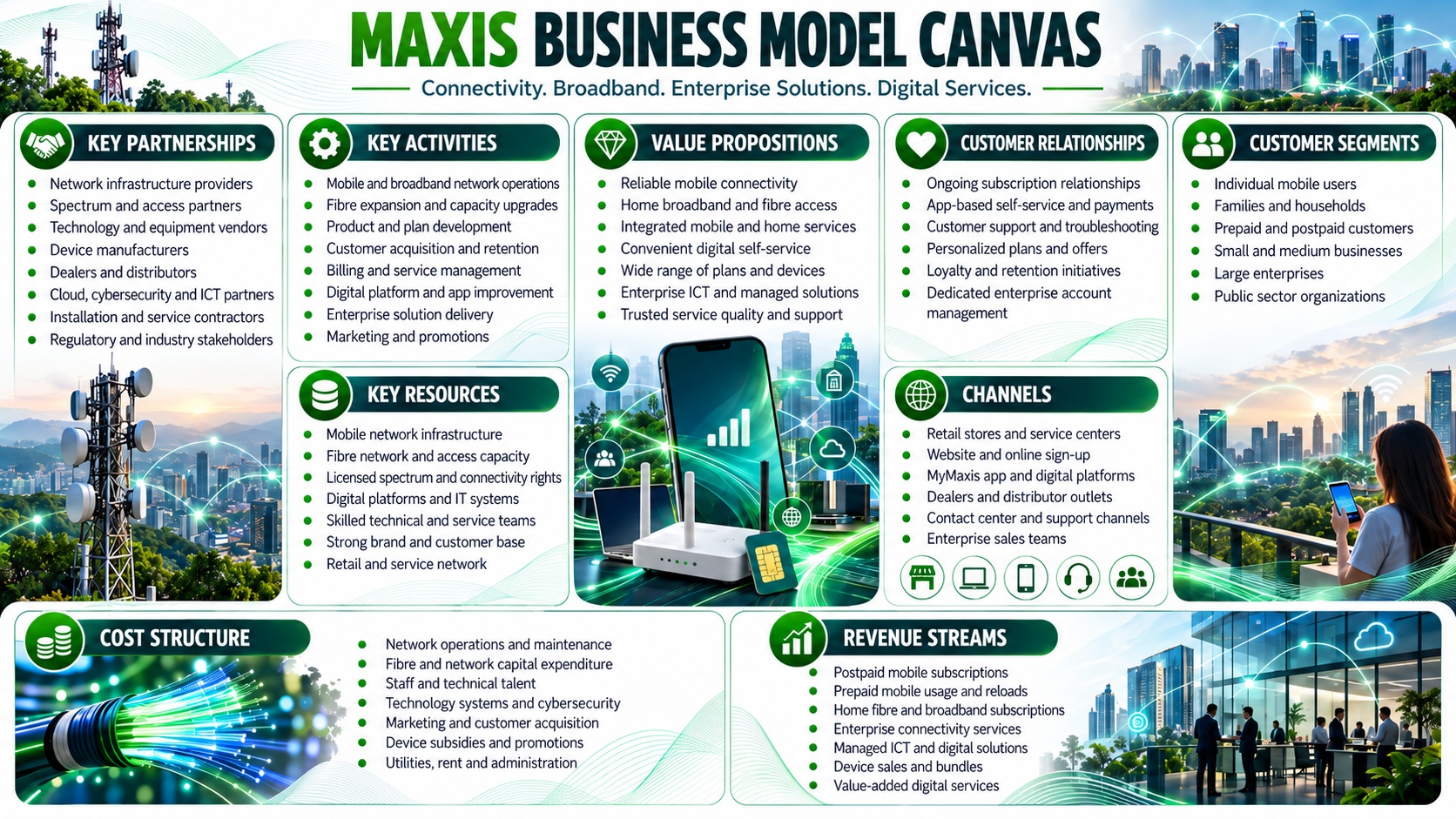
The central value proposition is integrated connectivity supported by digital solutions. Customer segments and channels explain how services reach the market, while resources, activities and partnerships illustrate the infrastructure required to deliver them.
Revenue streams and cost structure reveal the financial implications of operating a telecommunications business.
BMC Analysis of Maxis
A detailed examination reveals that Maxis’s competitive position depends on more than the size of its subscriber base.
Its business model combines infrastructure economics, recurring revenue, customer relationships and complementary digital services.
Strong network coverage can attract customers, but competitive pricing may limit revenue growth. Enterprise solutions can improve service differentiation, although they introduce additional delivery complexity and technical requirements.
Similarly, digital automation can reduce operating costs, but maintaining customer satisfaction requires effective support when automated systems cannot resolve complex problems.
The following nine sections examine how these trade-offs shape the company’s business model.
1. Customer Segments
Maxis serves a broad customer base with different connectivity requirements, spending patterns and service expectations.
Individual consumers represent an important market through prepaid and postpaid mobile services. Households purchase broadband connectivity, while business customers require more sophisticated communications and ICT capabilities.
The Maxis Business Model Canvas demonstrates how serving multiple segments creates opportunities for revenue diversification and cross-selling.
Maxis Customer Segments
| Customer Segment | Details | Why It Matters |
|---|---|---|
| Individual consumers | Prepaid and postpaid mobile subscribers | Generates recurring and usage-based revenue |
| Households | Fibre and wireless home broadband customers | Expands subscription relationships |
| SMEs | Business connectivity, cloud and digital solutions | Creates opportunities for service bundling |
| Large enterprises | Managed connectivity, ICT, IoT and cloud solutions | Supports higher-value contracts |
| Public-sector organisations | Government connectivity and digital infrastructure requirements | Provides opportunities for complex projects and long-term contracts |
The diversity of Maxis’s customer base allows the company to serve different price points and levels of technological sophistication.
Consumer subscriptions provide scale, while enterprise relationships can generate additional value through customised solutions and recurring service contracts.
However, each segment requires a different operating approach.
Price-sensitive prepaid users prioritise affordability and coverage. Postpaid subscribers may value convenience, service reliability and device bundles. Enterprise customers often place greater importance on security, technical support, service-level commitments and business continuity.
Maxis must therefore balance standardisation with customisation.
Its consumer business benefits from efficient, repeatable service delivery, whereas enterprise solutions require consultative selling and specialised technical capabilities.
The strategic opportunity lies in increasing revenue per relationship rather than relying exclusively on subscriber growth. Strong segmentation also allows Maxis to direct investment toward customers and services that offer sustainable profitability.
2. Value Propositions
Connectivity remains the foundation of Maxis’s value proposition, but customer expectations have evolved beyond basic mobile voice and internet access.
Consumers increasingly expect reliable digital experiences across multiple devices and locations. Businesses require connectivity that supports productivity, resilience and digital transformation.
The Maxis Business Model Canvas highlights how Maxis combines network capabilities with convenience, service integration and complementary solutions.
Maxis Value Propositions
| Value Proposition | Details | Why It Matters |
|---|---|---|
| Reliable connectivity | Mobile, fibre and wireless broadband services | Supports everyday digital activities |
| Converged services | Integrated mobile, broadband and device offerings | Improves convenience and retention |
| Digital convenience | Account management, billing and support through digital platforms | Reduces customer effort |
| Enterprise ICT solutions | Managed services, cloud connectivity and IoT | Supports business digitalisation |
| Service assurance | Technical support and service management | Builds confidence and long-term relationships |
A strong telecommunications value proposition must deliver both functional and economic benefits.
For consumers, reliable connectivity reduces frustration and supports communication, entertainment, education and work.
For businesses, network reliability has a more direct commercial impact. Poor connectivity can interrupt transactions, reduce employee productivity and affect customer service.
Consequently, Maxis’s enterprise value proposition extends beyond internet speed to operational continuity and business performance.
The company also benefits from bundling complementary services.
A household purchasing mobile and broadband services from one provider may appreciate simplified billing and support. An enterprise combining connectivity with managed services can reduce coordination across multiple vendors.
Nevertheless, differentiation must remain meaningful.
Competitors can replicate data allowances and promotional pricing relatively quickly. Maxis’s longer-term advantage depends on service reliability, customer experience, integration capabilities and its ability to solve problems that basic connectivity cannot address.
3. Channels
Maxis reaches customers through a combination of physical retail locations, digital platforms, distribution partners and direct sales activities.
Unlike purely digital businesses, telecommunications providers must support both service transactions and physical requirements such as device purchases, SIM activation and equipment installation.
Its distribution model therefore combines convenience with operational reach.
Maxis Channels
| Channel | Details | Why It Matters |
|---|---|---|
| Retail stores | Product consultation, device sales and service registration | Supports physical customer engagement |
| Website | Plan information, online subscriptions and support | Enables digital customer acquisition |
| Maxis app | Account management, payments and customer assistance | Encourages self-service |
| Dealers and distributors | Third-party sales and distribution | Extends market coverage |
| Enterprise sales teams | Direct engagement and solution consultation | Supports complex B2B opportunities |
Each channel contributes differently to customer acquisition, service delivery and retention.
Retail stores remain useful for customers requiring personal assistance, particularly when purchasing devices or comparing service packages.
Digital channels can handle routine transactions more efficiently, reducing dependence on physical outlets.
Enterprise sales teams operate differently because large organisations often require technical consultation, solution design, procurement coordination and contractual negotiations.
The strategic challenge is integrating these channels into a consistent customer journey.
For example, a customer should ideally be able to research a plan online, complete registration digitally and obtain support through the app without repeating information.
Greater digital adoption can lower service costs, but eliminating human assistance would disadvantage customers with complex requirements.
Maxis should therefore continue developing an omnichannel model that combines efficient self-service with accessible specialist support.
The commercial benefit extends beyond convenience: smoother customer journeys can improve conversion, reduce servicing costs and strengthen customer loyalty.
4. Customer Relationships
Telecommunications is fundamentally a relationship-driven business because customers depend on continuous service rather than occasional product purchases.
Maxis must maintain customer satisfaction throughout the subscription lifecycle, from initial registration to billing, troubleshooting, upgrades and renewal.
The Maxis Business Model Canvas illustrates how relationship management directly influences retention and customer lifetime value.
Maxis Customer Relationships
| Relationship Type | Details | Why It Matters |
|---|---|---|
| Subscription relationships | Ongoing mobile and broadband services | Supports predictable revenue |
| Digital self-service | App-based account management and support | Improves convenience and efficiency |
| Customer assistance | Contact centres and technical support | Resolves service problems |
| Personalised offers | Relevant plans, upgrades and bundles | Encourages retention and cross-selling |
| Enterprise account management | Dedicated engagement for business customers | Strengthens long-term commercial relationships |
Customer retention is especially important because acquiring subscribers involves marketing expenditure, promotional incentives and sometimes device subsidies.
When customers remain longer, Maxis has more opportunities to recover acquisition costs and generate additional contribution margin.
Service quality plays a central role in this relationship.
Network interruptions, billing disputes and unresolved complaints can encourage customers to switch providers, even when pricing remains competitive.
Maxis has also invested in digital support, including an AI-powered conversational assistant introduced in 2025.
Automation can improve response speed and reduce operating costs, but it must be supported by effective escalation for complicated issues.
Enterprise relationships require additional attention because business customers evaluate providers on technical competence, service reliability and contractual performance.
Ultimately, Maxis’s relationship strategy should focus on reducing avoidable customer effort.
A customer who experiences reliable connectivity, transparent billing and efficient support has fewer reasons to switch providers. This improves retention economics and creates opportunities for sustainable cross-selling.
5. Revenue Streams
Maxis generates revenue through recurring telecommunications services, device sales and enterprise solutions.
The company’s financial model depends heavily on service revenue, which provides a relatively predictable foundation for operations and infrastructure investment.
Device sales and complementary solutions contribute additional income but have different economic characteristics.
Maxis Revenue Streams
| Revenue Stream | Details | Why It Matters |
|---|---|---|
| Postpaid mobile | Monthly consumer subscriptions | Provides recurring service revenue |
| Prepaid mobile | Reloads and prepaid service purchases | Serves price-sensitive customers |
| Home connectivity | Fibre and wireless broadband subscriptions | Expands recurring household revenue |
| Enterprise services | Business mobile, fixed connectivity and ICT solutions | Supports revenue diversification |
| Device sales | Smartphones and connected devices | Supports customer acquisition and bundling |
FY2025 Revenue Composition
RM million. Consumer categories and enterprise revenue are service revenue; device revenue is shown separately.

Source: Maxis Integrated Annual Report 2025.
FY2025 total revenue reached RM10.64 billion, including RM8.91 billion in service revenue and RM1.72 billion from devices.
Postpaid service revenue increased, while prepaid revenue declined amid migration to postpaid plans and competitive pricing. Enterprise revenue grew 3.4% to RM1.67 billion
These results illustrate the importance of revenue quality.
Recurring subscriptions generally support more predictable cash flow than one-time device transactions, although profitability also depends on network costs, subsidies and servicing expenses.
Enterprise solutions offer opportunities to increase customer value beyond basic connectivity.
However, revenue diversification should not be confused with profit diversification. Complex ICT projects may introduce additional implementation costs and delivery risks.
Maxis must therefore evaluate growth based on contribution margins, cash generation and customer lifetime value rather than revenue alone.
6. Key Resources
Maxis relies on a combination of physical infrastructure, telecommunications rights, technological capabilities, skilled employees and customer relationships.
These resources create the foundation for service delivery and determine the company’s ability to compete.
Unlike businesses that can scale primarily through digital distribution, telecommunications providers must continuously maintain and upgrade network assets.
Maxis Key Resources
| Key Resource | Details | Why It Matters |
|---|---|---|
| Network infrastructure | Mobile sites, fibre networks and supporting equipment | Enables connectivity delivery |
| Spectrum and network access | Licensed spectrum and access arrangements | Supports mobile service capacity |
| Technology platforms | Billing, CRM, network management and digital systems | Enables efficient operations |
| Human capital | Engineers, ICT specialists, sales and support teams | Supports service quality and innovation |
| Brand and customer base | Established market presence and subscriber relationships | Supports acquisition and retention |
Maxis’s FY2025 integrated report identified more than 11,800 mobile network sites and a fibre network footprint exceeding 23,000 kilometres.
These assets provide substantial operating capacity but also create ongoing maintenance and capital requirements.
Network infrastructure represents an important barrier to entry because new competitors cannot easily replicate nationwide coverage.
However, physical ownership alone does not guarantee differentiation.
Service quality depends on effective network planning, capacity management, equipment performance and integration with external infrastructure providers.
Human capital is equally important.
Engineers maintain network performance, ICT specialists develop enterprise solutions and customer-facing teams translate technical capabilities into commercially valuable services.
Digital platforms also influence productivity by automating routine processes and improving customer interactions.
The central strategic question is how effectively Maxis uses its existing resources.
Higher network utilisation can improve capital efficiency, while stronger digital capabilities can reduce operating costs.
Future competitiveness will depend on extracting greater value from infrastructure without allowing investment requirements to grow disproportionately to revenue.
7. Key Activities
Maxis must perform several interconnected activities to maintain service reliability, acquire customers and develop new revenue opportunities.
Network operations remain essential, but the company’s expanding portfolio requires additional capabilities in software, enterprise solutions and digital service management.
Maxis Key Activities
| Key Activity | Details | Why It Matters |
|---|---|---|
| Network operations | Monitoring, maintenance and performance optimisation | Maintains service reliability |
| Infrastructure expansion | Fibre deployment and mobile network upgrades | Supports coverage and capacity |
| Product development | Connectivity packages and digital solutions | Addresses evolving customer needs |
| Customer management | Sales, billing, retention and technical support | Protects recurring revenue |
| Enterprise solution delivery | Design, implementation and management of ICT services | Supports business growth |
Telecommunications operations require continuous coordination between technical performance and commercial demand.
For example, increased mobile data consumption can create network congestion unless capacity investment keeps pace with usage.
Similarly, fibre expansion must be supported by effective customer acquisition to generate attractive investment returns.
Maxis’s enterprise activities add another dimension.
Managed connectivity and ICT services require solution architecture, implementation, integration, monitoring and ongoing customer support.
These activities may create higher-value relationships but introduce delivery complexity compared with standard consumer subscriptions.
Digitalisation can help manage this complexity.
AI-supported service processes, automated monitoring and integrated operational platforms can improve productivity and shorten resolution times.
Nevertheless, automation should strengthen operational accountability rather than obscure it.
Maxis’s long-term performance depends on how effectively these activities reinforce one another.
Reliable networks support customer satisfaction. Strong customer relationships protect revenue. Efficient operations generate cash that can fund further investment.
The company must maintain this cycle while ensuring that expansion into new services does not weaken execution in its core connectivity business.
8. Key Partnerships
No telecommunications operator can deliver every component of its services independently.
Maxis depends on a broader ecosystem involving infrastructure providers, technology vendors, device manufacturers, distributors and digital solution partners.
These relationships enable the company to access specialised capabilities while managing investment requirements.
Maxis Key Partnerships
| Partner Category | Details | Why It Matters |
|---|---|---|
| Network infrastructure providers | Mobile access, towers, fibre and supporting infrastructure | Extends network capabilities |
| Technology vendors | Telecommunications equipment and software platforms | Supports network modernisation |
| Device manufacturers | Smartphones, routers and connected devices | Enables product bundling |
| Distribution partners | Retailers, dealers and resellers | Expands customer reach |
| Enterprise technology partners | Cloud, cybersecurity and ICT solution providers | Supports integrated business solutions |
Partnerships allow Maxis to offer services without owning every component of the technology value chain.
For example, infrastructure-sharing arrangements can reduce duplication of capital investment, while enterprise technology partnerships can accelerate the introduction of specialised solutions.
However, external dependencies introduce commercial and operational risks.
Service quality may depend partly on partner performance, network availability and contractual arrangements.
Technology vendors can also influence upgrade costs, integration requirements and implementation schedules.
The company must therefore distinguish between capabilities that provide strategic differentiation and those that can be sourced efficiently.
Core customer relationships, service management and solution integration remain particularly important areas of control.
A successful partnership strategy should combine cost efficiency with operational resilience.
Supplier diversification, contractual service commitments, security assurance and clear accountability can reduce concentration risks.
Maxis’s competitive advantage ultimately depends not on the number of partnerships it establishes, but on its ability to combine external capabilities into reliable and commercially attractive customer solutions.
9. Cost Structure
Telecommunications companies operate with substantial fixed costs and recurring infrastructure commitments.
Maxis must invest continuously in network quality, capacity, customer acquisition, technology platforms and service operations.
The challenge is maintaining profitability while responding to rising customer expectations and competitive pricing.
Maxis Cost Structure
| Cost Category | Details | Why It Matters |
|---|---|---|
| Network operations | Maintenance, utilities and infrastructure-related expenses | Supports service availability |
| Capital expenditure | Fibre expansion, equipment and network upgrades | Enables future capacity |
| Personnel | Technical, commercial and administrative employees | Supports operations and delivery |
| Customer acquisition | Marketing, commissions and promotional incentives | Drives subscriber growth |
| Technology and systems | IT platforms, cybersecurity, automation and digitalisation | Improves efficiency and resilience |
During FY2025, Maxis recorded capital expenditure of RM986 million, EBITDA of RM4.33 billion and operating free cash flow of RM3.58 billion.
These figures highlight the importance of managing both operating expenditure and long-term investment.
A telecommunications network involves significant upfront costs, but the incremental cost of serving additional customers may be relatively low when sufficient capacity already exists.
This creates operating leverage.
However, capacity constraints eventually require additional investment, and aggressive pricing can weaken the financial benefits of subscriber growth.
Digitalisation offers opportunities to improve cost efficiency through automated customer support, predictive maintenance and better resource allocation.
Enterprise expansion also requires disciplined financial management because complex solutions can carry additional implementation and support costs.
The Maxis Business Model Canvas reveals that cost efficiency is inseparable from competitive strategy.
Sustainable performance depends on generating sufficient revenue and cash flow from existing assets while investing selectively in future capabilities.
The objective should not be to minimise expenditure indiscriminately, but to allocate capital toward activities that improve service quality, customer retention and long-term economic returns.
How the Nine BMC Blocks Work Together
The nine components form an interconnected business system rather than nine independent operational categories.
Customer segments determine the services Maxis must provide. Value propositions influence pricing, retention and competitive positioning.
Channels and customer relationships determine how efficiently the company acquires and serves customers.
Meanwhile, infrastructure, technology, employees and partnerships enable service delivery.
Revenue streams must ultimately cover operating costs, fund infrastructure investment and provide acceptable financial returns.
The Maxis Business Model Canvas demonstrates an important telecommunications principle: network scale becomes economically valuable only when supported by sufficient customer demand and effective monetisation.
For example, expanding fibre coverage creates potential capacity, but that capacity generates attractive returns only when customers subscribe and remain satisfied.
Similarly, enterprise solutions can increase revenue per customer, but additional service complexity must be managed carefully.
A well-balanced business model therefore requires simultaneous improvements in customer experience, network utilisation, revenue quality and operational productivity.
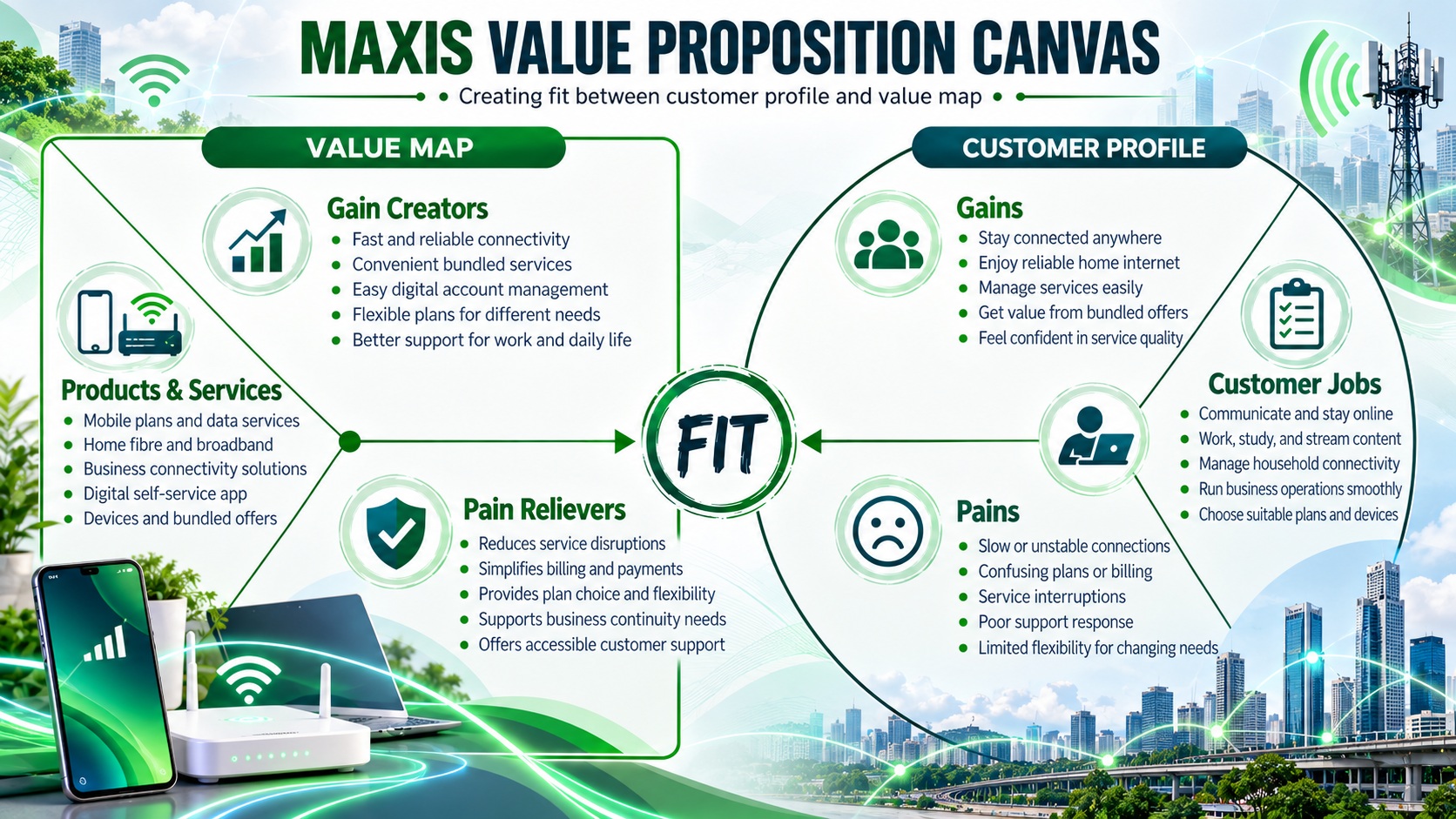
Maxis Value Proposition Canvas
The Value Proposition Canvas (VPC) examines how a company’s products and services address specific customer needs.
While the BMC describes the overall business system, the VPC focuses on customer jobs, pains and desired gains.
The Maxis Business Model Canvas becomes more meaningful when its connectivity value proposition is examined from the customer’s perspective.
Customer Profile
The following profile focuses primarily on individual consumers and households.
These customers generally seek reliable connectivity, convenient service management and predictable monthly expenditure.
Customer Profile of Maxis
| Customer Profile | Details |
|---|---|
| Customer Jobs | Communicate, work, study, stream content, conduct transactions and connect devices |
| Customer Pains | Poor coverage, slow speeds, outages, unexpected charges, complicated plans and slow support |
| Customer Gains | Reliable connectivity, affordable packages, convenient billing, responsive support and seamless digital experiences |
Customer needs vary by location, usage patterns and financial circumstances.
A student may prioritise affordable data, while a household with multiple users may require stable broadband capacity.
Remote workers often place greater importance on connection reliability than headline download speeds.
These differences demonstrate why a single telecommunications proposition cannot satisfy every customer equally.
Value Map
Maxis addresses customer requirements through mobile connectivity, home broadband, digital service channels and complementary offerings.
Value Map of Maxis
| Value Map | Details |
|---|---|
| Products and Services | Postpaid, prepaid, fibre broadband, wireless broadband, devices and digital account services |
| Pain Relievers | Network improvements, service support, account visibility, troubleshooting and package options |
| Gain Creators | Converged bundles, convenient account management, digital assistance and flexible connectivity choices |
The value map shows how Maxis can reduce customer friction while creating additional convenience.
Reliable connectivity addresses essential functional needs, while service integration reduces the effort required to manage multiple subscriptions.
Digital support can further improve accessibility when customers need assistance.
However, these benefits depend on consistent execution.
An attractive package loses value when network performance is unreliable or customer support fails to resolve problems.
Value Proposition Fit
Value proposition fit occurs when the company’s offerings directly address important customer jobs, pains and gains.
| Customer Need | Matching Maxis Offering | How Value Is Created |
|---|---|---|
| Stay connected | Mobile and broadband services | Supports everyday digital activities |
| Avoid service disruption | Network operations and technical support | Improves reliability |
| Manage expenses | Different plans and packages | Provides spending choices |
| Simplify subscriptions | Converged services and digital account management | Reduces administrative effort |
| Obtain assistance | App, retail and customer-support channels | Improves problem resolution |
The strongest fit occurs when customers perceive Maxis as providing dependable connectivity with minimal inconvenience.
For households, combining mobile and broadband services can increase convenience.
For enterprise customers, the same principle extends to integrated connectivity, managed services and technical support.
Nevertheless, value proposition fit is dynamic.
As competitors introduce better pricing or service quality, customer expectations change.
Maxis must therefore continuously validate whether its products, pricing and customer experiences remain aligned with what customers actually value.
Maxis vs CelcomDigi vs Telekom Malaysia Business Models
The Maxis Business Model Canvas shares several characteristics with CelcomDigi Berhad and Telekom Malaysia Berhad.
All three companies compete in connectivity and digital services, but their infrastructure positions and strategic emphasis differ.
Maxis combines consumer mobile, home connectivity and enterprise ICT solutions.
CelcomDigi has substantial mobile-market scale, while Telekom Malaysia possesses an extensive fixed-line and fibre infrastructure business alongside consumer and enterprise services.
These differences influence the BMC blocks that are most strategically relevant.
BMC Block Comparison
| Relevant BMC Block | Maxis | CelcomDigi | Telekom Malaysia |
|---|---|---|---|
| Customer Segments | Consumers, households, SMEs and enterprises | Mobile consumers, households and businesses | Broadband consumers, enterprises, government and wholesale customers |
| Value Propositions | Integrated mobile, home connectivity and ICT solutions | Mobile connectivity, digital services and converged offerings | Fibre connectivity, broadband, enterprise ICT and infrastructure services |
| Channels | Retail, app, website, dealers and enterprise sales | Retail, digital platforms, dealers and business sales | Unifi channels, digital platforms and enterprise sales |
| Revenue Streams | Mobile, home broadband, enterprise services and devices | Mobile services, broadband, enterprise solutions and devices | Fixed broadband, enterprise solutions, wholesale and infrastructure services |
| Key Resources | Mobile network, fibre footprint, brand and customer relationships | Mobile network assets, spectrum, distribution and subscriber base | Extensive fibre infrastructure, fixed network assets and data centres |
Telekom Malaysia’s 2025 disclosures identify more than 750,000 kilometres of domestic fibre cables, illustrating the scale of its fixed-network infrastructure.
The comparison highlights different competitive foundations.
CelcomDigi’s mobile scale creates opportunities for network efficiency and broad customer reach.
Telekom Malaysia benefits from extensive fixed infrastructure and multiple wholesale and enterprise relationships.
Maxis’s strategic opportunity lies in combining mobile connectivity, home services and enterprise solutions into a differentiated customer experience.
Rather than competing exclusively on the lowest price, Maxis can emphasise reliability, service integration and customer value.
However, convergence is not unique to Maxis. All three providers have incentives to expand across adjacent services.
Consequently, sustainable differentiation will depend on execution quality, customer retention and the economics of each service portfolio.
Competitive Advantages
Maxis possesses several capabilities that support its position in Malaysia’s telecommunications market.
-
Established brand and customer relationships: Decades of market presence provide brand familiarity, distribution reach and an existing subscriber base that can support retention and cross-selling.
-
Integrated connectivity portfolio: Mobile, home broadband and enterprise services allow Maxis to address multiple customer requirements through a common commercial relationship.
-
Recurring revenue foundation: Postpaid, prepaid usage, broadband and enterprise contracts create ongoing revenue opportunities rather than relying exclusively on one-time transactions.
-
Network and technical capabilities: Established infrastructure, spectrum access, network operations and skilled personnel create substantial operational barriers for new entrants.
-
Enterprise growth opportunities: Managed connectivity, cloud-related services and digital solutions enable Maxis to compete beyond traditional mobile subscriptions.
These advantages reinforce one another.
Established customer relationships create opportunities to introduce additional services, while infrastructure and technical capabilities support delivery.
Enterprise solutions can increase customer value, and recurring revenue provides a foundation for continued investment.
However, these strengths are not permanently protected.
Competitors can improve network quality, introduce comparable bundles and invest in enterprise capabilities.
Maxis must therefore continuously convert its existing advantages into measurable customer outcomes and financial performance.
Risks and Challenges
Despite its established position, Maxis operates in a highly competitive and technologically demanding industry.
-
Intense price competition: Aggressive mobile and broadband pricing can pressure average revenue per user, customer acquisition economics and margins.
-
High infrastructure investment requirements: Network upgrades, fibre expansion and future technologies require continuous capital allocation without guaranteed revenue increases.
-
Regulatory and infrastructure dependencies: Spectrum assignments, telecommunications regulation and third-party network arrangements can influence operating flexibility and costs.
-
Customer churn and service expectations: Poor network experiences, unresolved complaints and attractive competing offers can weaken retention and lifetime customer value.
-
Cybersecurity and technology disruption: Network attacks, data breaches, system failures and rapid technological changes can create operational, financial and reputational consequences.
These risks are interconnected.
For example, aggressive pricing may encourage customer acquisition but reduce the cash available for infrastructure investment.
Insufficient investment can subsequently weaken service quality and increase churn.
Similarly, expanding into enterprise ICT solutions creates growth opportunities while increasing cybersecurity, delivery and technical support requirements.
The company’s long-term resilience depends on managing these trade-offs rather than treating each risk independently.
Strategic Recommendations
Maxis should build on its existing strengths in connectivity, customer relationships and enterprise services while improving the economics of its operating model.
The Maxis Business Model Canvas suggests that sustainable growth will increasingly depend on creating more value from established infrastructure rather than relying solely on subscriber expansion.
The following recommendations focus on differentiation, customer lifetime value, enterprise growth and capital efficiency.
1. Strengthen Mobile and Home Connectivity Convergence
Maxis should further integrate mobile and home broadband propositions around household needs.
Bundled plans, simplified billing, coordinated support and relevant device offerings can increase convenience while encouraging customers to maintain multiple services.
For example, a family package could combine several mobile lines with home broadband under a unified account experience.
The strategic objective should be improved retention and lifetime value, not simply larger promotional discounts.
2. Accelerate Higher-Value Enterprise Solutions
Enterprise growth should focus on solutions that address specific business outcomes.
Managed connectivity, secure networking, cloud integration, IoT and industry-specific services offer opportunities beyond basic telecommunications.
Maxis could develop packaged solutions for sectors such as manufacturing, retail, logistics and professional services.
For example, a retail chain may require connectivity, managed networking and centralised monitoring across multiple branches.
Standardised industry solutions could improve sales efficiency and reduce implementation complexity.
3. Make Customer Experience a Measurable Differentiator
Maxis should prioritise the customer journeys that most directly influence satisfaction and churn.
These include onboarding, billing transparency, network troubleshooting, service changes and complaint resolution.
AI-assisted support can improve efficiency, but customers should retain access to effective human escalation.
Performance measures should include first-contact resolution, service restoration time, customer effort, complaint recurrence and retention.
Better customer experiences can create economic benefits through lower support costs and stronger customer loyalty.
4. Improve Network Investment Productivity
Infrastructure investment should be evaluated against customer demand, network utilisation and expected financial returns.
Maxis should prioritise expansion where connectivity demand, service differentiation and commercial opportunities justify additional capacity.
Predictive analytics and AI-supported network management can help identify congestion, anticipate failures and improve maintenance planning.
The objective is not merely to build a larger network.
Capital allocation should strengthen service quality while generating sustainable returns over the investment lifecycle.
5. Expand Digital Services Without Losing Strategic Focus
Complementary services can increase customer value, but diversification should remain connected to Maxis’s core capabilities.
Cloud connectivity, managed networking, cybersecurity-related services and IoT solutions are natural extensions of its infrastructure and enterprise relationships.
By contrast, unrelated digital products may introduce complexity without creating meaningful competitive advantage.
Maxis should evaluate new opportunities against customer demand, delivery capabilities, recurring revenue potential and expected margins.
Disciplined diversification can improve growth while preserving operational focus.
6. Use AI to Improve Operational Economics
AI should be deployed where it can produce measurable improvements in productivity and customer outcomes.
Potential applications include network fault prediction, customer support, service recommendations, demand forecasting and internal workflow automation.
For example, predictive maintenance could reduce avoidable network disruptions, while intelligent service routing could shorten complaint resolution times.
However, AI initiatives should be assessed against implementation costs, data governance requirements and actual operational benefits.
Technology adoption should serve commercial objectives rather than become an objective in itself.
7. Strengthen Cybersecurity and Service Resilience
As Maxis expands digital and enterprise services, cybersecurity becomes increasingly important to its customer value proposition.
Security controls should cover network infrastructure, customer information, enterprise platforms, third-party integrations and operational systems.
Business continuity, incident response, supplier assurance and service recovery capabilities should receive consistent attention.
Enterprise customers may increasingly evaluate telecommunications providers on their ability to maintain secure and resilient operations.
Strong cybersecurity can therefore support both risk reduction and commercial differentiation.
Conclusion
The Maxis Business Model Canvas illustrates how an established telecommunications operator can create value by combining network infrastructure, recurring subscriptions, customer relationships and digital services.
At its foundation, Maxis provides connectivity.
However, the company’s broader economic model extends beyond selling mobile data or broadband subscriptions.
Its consumer business generates recurring revenue and customer scale. Home connectivity creates opportunities to deepen household relationships, while enterprise services provide pathways into more complex and potentially higher-value ICT solutions.
These activities are supported by substantial infrastructure, technical expertise, digital platforms and external partnerships.
The nine BMC blocks reveal how closely these components depend on one another.
Network infrastructure enables service delivery, but customer acquisition and retention determine whether that infrastructure generates attractive economic returns.
Value propositions influence pricing and loyalty, while customer relationships affect churn and lifetime value.
Enterprise diversification creates growth opportunities, but additional technical complexity requires stronger capabilities and disciplined delivery.
Financial performance also demonstrates the importance of operational efficiency.
Maxis’s FY2025 results showed modest revenue growth alongside stronger profit growth, suggesting that cost management and productivity improvements are important contributors to financial performance.
Looking ahead, the company’s greatest strategic opportunity may lie in extracting more value from its existing customer relationships and infrastructure.
This means improving convergence between mobile and home services, expanding commercially attractive enterprise solutions and using technology to deliver better customer experiences at lower operating costs.
Competitive pressure will remain significant.
CelcomDigi and Telekom Malaysia possess substantial infrastructure, customer relationships and financial resources, while changing technology and regulatory requirements will continue influencing the industry’s economics.
Maxis should therefore avoid competing solely on price or network expansion.
A more sustainable position would combine reliable connectivity, integrated services, strong customer relationships, cybersecurity and operational excellence.
Ultimately, long-term success will depend on how effectively the company converts its network capabilities into differentiated customer value and sustainable cash generation.
The broader business lesson is applicable beyond telecommunications: owning valuable infrastructure creates opportunity, but the ability to monetise that infrastructure efficiently determines long-term business performance.
Disclaimer
This article is intended solely for educational, informational and business-analysis purposes. It is an independent interpretation based on publicly available information, company disclosures and industry observations.
The content is not official information, a statement, endorsement or representation from Maxis Berhad, CelcomDigi Berhad, Telekom Malaysia Berhad or any other organisation mentioned.
Nothing in this article constitutes investment, financial, legal, technical or professional advice, nor should it be interpreted as a recommendation to buy, sell or hold any securities.
Business models, financial performance, products, technologies and market conditions may change. Readers should independently verify relevant information and seek appropriate professional advice before making decisions.
All company names, brands, trademarks, logos, copyrights and other intellectual-property rights belong to their respective owners. References to these materials are made solely for identification, educational and analytical purposes.
Meta Description
Explore the Maxis Business Model Canvas, nine BMC blocks, Value Proposition Canvas, competitors, risks and strategies, updated for 2026.

