CARPUT Business Model Canvas
Explore the CARPUT Business Model Canvas, nine BMC blocks, Value Proposition Canvas, competitor comparison, competitive advantages, risks and strategic recommendations.
Explore Traveloka’s Business Model Canvas, updated in 2026, with deeper analysis of its customer segments, value proposition, revenue model, risks, competitive advantages, and strategy.
BMC Article No: BMC #042
Updated in 2026: This article has been refreshed with newer company scale, wider product scope, updated market footprint, stronger loyalty and support features, and clearer analysis of how Traveloka combines travel bookings, local experiences, and payment flexibility into one platform.
Traveloka started as a flight search platform in 2012 and grew into one of Southeast Asia’s leading travel platforms. Over time, it expanded beyond simple flight comparison into a broader digital travel ecosystem that now serves users across Indonesia, Thailand, Vietnam, Singapore, Malaysia, Australia, and the Philippines. Its offering now covers flights, accommodation, ground transport, attractions, and payment options, giving users a more complete way to plan and manage trips in one place.
The Traveloka Business Model Canvas is useful because Traveloka is not just selling tickets. It is building a digital travel marketplace where discovery, booking, payment, support, and repeat usage all happen inside one ecosystem. That makes the company strategically interesting, because its value comes not only from transactions, but also from how well it connects different travel needs, reduces user friction, and encourages customers to return for future bookings.
Traveloka runs a platform-based business model focused on helping users search, compare, book, pay, and manage travel in one place. The company connects demand from travellers with supply from airlines, hotels, activity operators, car rental providers, airport transfer partners, and other travel merchants.
Revenue does not come from one source alone. Traveloka can earn from booking commissions, merchant fees, advertising or promotional placements, service fees, and selected financial-service related activity depending on market and product. This creates a model that balances volume, convenience, and repeat usage.
What makes the model stronger is bundling. A user may book a flight first, then add a hotel, airport transfer, attraction tickets, or flexible payment options. That raises basket size and makes the platform more valuable over time. The Traveloka Business Model Canvas shows how the company turns fragmented travel demand into a more connected digital journey.
Business Model Canvas, or BMC, is a practical tool used to explain how a business creates value, delivers that value, and captures revenue. Instead of looking only at products, it maps the full operating logic of the company.
BMC is useful for Traveloka because the company sits between travellers and travel suppliers. That means its success depends on trust, inventory quality, app experience, pricing, payments, support, partnerships, and repeat bookings working together.
Instead of seeing Traveloka as only a booking app, BMC shows the wider system behind its growth.
| BMC Block | Main Question |
|---|---|
| Customer Segments | Who does the business serve? |
| Value Propositions | What value does the business offer? |
| Channels | How does the business reach customers? |
| Customer Relationships | How does the business build loyalty? |
| Revenue Streams | How does the business make money? |
| Key Resources | What assets does the business need? |
| Key Activities | What must the business do well? |
| Key Partnerships | Who helps the business operate? |
| Cost Structure | What are the major costs? |
The Traveloka Business Model Canvas helps explain how user demand, supplier inventory, payment access, and service reliability come together in one regional platform. It also shows why Traveloka’s model is stronger when these elements reinforce one another, rather than operating as separate parts of the business. That wider view makes the platform easier to understand from both a customer and strategy perspective.
Traveloka was founded in Indonesia in 2012 and later expanded across major Southeast Asian markets as well as Australia. On its official company page, Traveloka describes itself as a leading Southeast Asian travel platform with nearly 140 million app downloads, nearly 50 million monthly active users, over 20 products, more than 250 airline partners, over 2.2 million accommodation listings, more than 90,000 travel activities, and 50+ payment methods.
That scale matters because travel platforms become stronger when they combine broad supply, strong consumer traffic, and frequent repeat use. Bigger inventory improves relevance. More users improve merchant value. Better product breadth improves cross-sell opportunities.
The Traveloka Business Model Canvas is therefore about scale with convenience. Growth comes not only from selling more bookings, but also from becoming the default app for trip planning, booking management, and travel add-ons.
Traveloka is strategically interesting because it solves several travel problems at once. Travellers often face scattered information, uncertain pricing, limited local payment options, weak after-sales support, and too many separate booking steps.
Instead of asking users to manage flights, stays, transfers, and activities across many websites, Traveloka puts them inside one interface. That lowers search friction and improves conversion.
Another important point is localisation. Travel behaviour differs across Southeast Asia. Payment habits, trust signals, language needs, and transport options vary by country. Traveloka’s model is stronger because it adapts to those local conditions instead of using a one-size-fits-all global approach.
Traveloka’s model is evolving in four important ways, and each one strengthens its position in a competitive regional market.
First, product breadth is getting wider. The platform now goes beyond flights and hotels into attractions, car rental, airport transfer, cruises, and other travel services. This matters because broader product coverage gives users more reasons to stay within the Traveloka ecosystem instead of switching between different apps and websites.
Second, loyalty and retention matter more. Traveloka Priority, app-only deals, and easier booking management help the company increase repeat usage. These features also support stronger customer habits, which can reduce dependence on expensive acquisition activity over time.
Third, customer experience is becoming more operational. Refunds, rescheduling, support, and booking retrieval are no longer side issues. They shape brand trust directly. In travel, users often judge a platform most strongly when something goes wrong, so service quality during disruption has become a major competitive factor.
Fourth, flexible payments remain important in a price-sensitive region. Payment access can influence whether a booking is completed, delayed, or abandoned, which means convenience at checkout remains central to conversion performance.
The Traveloka Business Model Canvas is stronger in 2026 because the company is not just competing on inventory. It is competing on convenience, retention, support, and local market fit. That shift makes the model more defensible, because it depends less on simple listing volume and more on delivering a smoother, more trusted customer journey across the full travel experience.
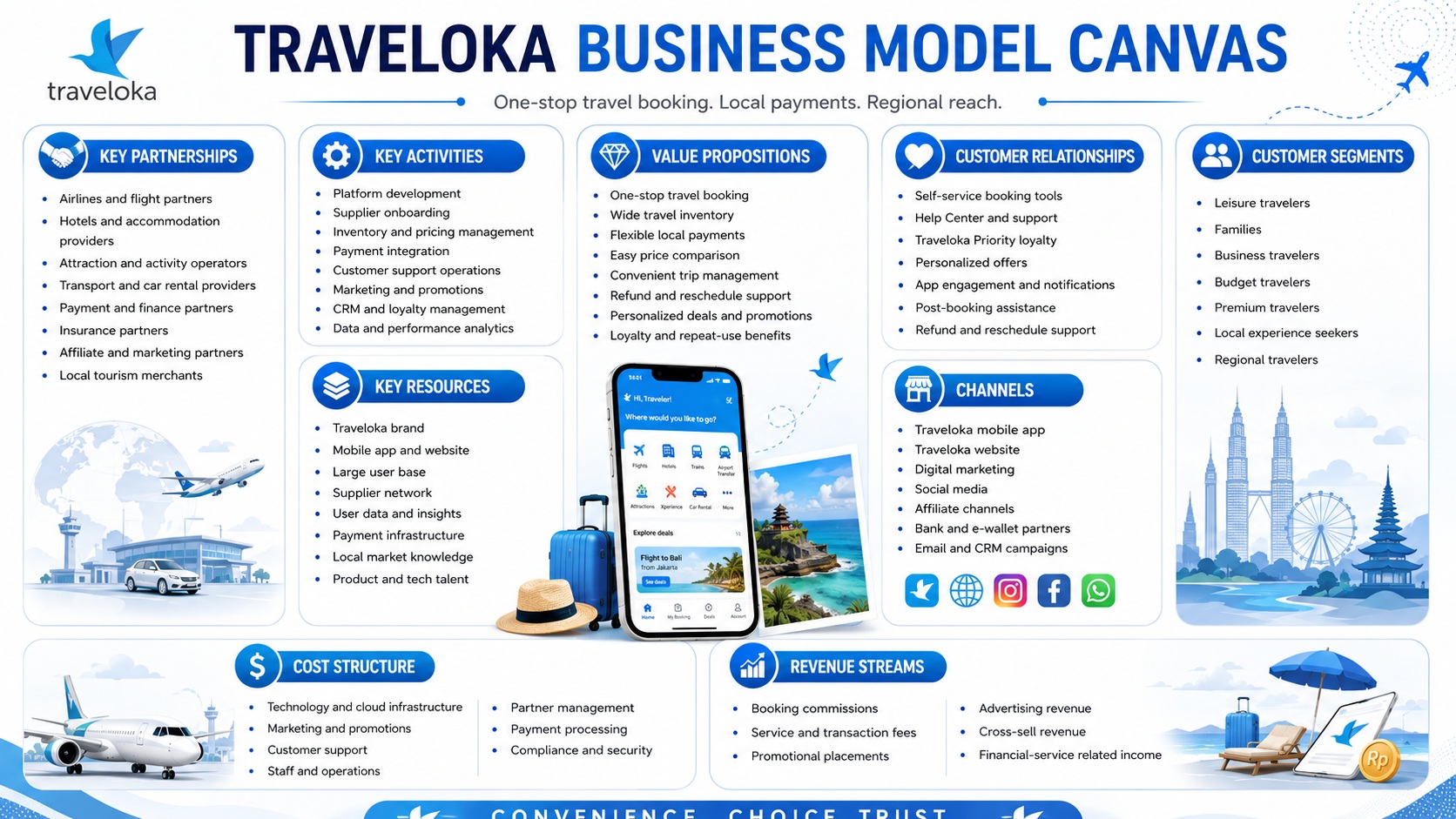
Before going into each block in detail, the summary below gives a quick view of how Traveloka’s business works. It provides a simple snapshot of the full model before we move into deeper analysis, making it easier to see how the main building blocks connect. This quick summary also helps readers understand the overall logic of the business before looking at each section one by one.
| BMC Block | Traveloka Application |
|---|---|
| Customer Segments | Leisure travellers, families, business travellers, budget users, premium users, and travel merchants. |
| Value Propositions | One-stop booking, broad inventory, flexible payment, localised support, and easier travel management. |
| Channels | Mobile app, website, digital marketing, partnerships, affiliates, and supplier integrations. |
| Customer Relationships | Self-service tools, loyalty programme, support, personalised offers, and booking management. |
| Revenue Streams | Booking commissions, merchant fees, promotions, advertising placements, and service-related fees. |
| Key Resources | Brand, app platform, user base, supplier network, payment access, data, and local market knowledge. |
| Key Activities | Product development, supplier onboarding, pricing display, customer support, payments, and marketing. |
| Key Partnerships | Airlines, hotels, activity operators, transport providers, payment partners, insurers, and affiliates. |
| Cost Structure | Technology, people, marketing, support, incentives, partner management, and compliance. |
The diagram below gives a visual summary of how the main blocks of Traveloka’s business model connect in one view. It helps readers move from the written analysis into a more practical visual format before continuing to the detailed block-by-block discussion.
Customer segments explain who Traveloka serves and why those users matter. Traveloka serves a broad travel market, but its strongest position is among digitally active travellers who want convenience, price visibility, flexible payment, and reliable support in one place.
These customers are not all booking for the same reason. A leisure traveller may want the best holiday package. A family may care more about convenience and coordination. A business traveller may focus on speed and reliability. A budget user may compare promotions closely before booking. Travel merchants, meanwhile, use Traveloka to reach demand they may struggle to capture directly.
This mix gives Traveloka more than volume. It gives the company multiple demand pools across trip purpose, spending level, and booking frequency. That makes the platform less dependent on one narrow type of traveller.
| Customer Segment | What They Need | How Traveloka Serves Them |
|---|---|---|
| Leisure travellers | Easy holiday planning and price comparison | Flights, hotels, activities, transfers, and bundled booking options |
| Families | Convenience, clarity, and flexible arrangements | Broad accommodation choices and easier trip planning in one app |
| Business travellers | Reliable booking and time-saving tools | Fast search, itinerary access, and trip management |
| Budget users | Deals and payment flexibility | Promotions, app-only offers, and multiple payment options |
| Travel merchants | Demand generation and digital reach | Access to user traffic, listings, and booking demand |
The real strength of this block is diversity with overlap. One user can move across segments over time, from budget booking to family travel to premium travel experiences. The Traveloka Business Model Canvas shows that serving both travellers and merchants strengthens network effects, improves monetisation opportunities, and creates a broader base for long-term growth.
The value proposition explains why users choose Traveloka over booking directly with airlines, hotels, or competing platforms. Traveloka’s core promise is simple: make travel planning easier, more flexible, and more manageable in one digital environment.
That value is especially important in Southeast Asia, where users often face fragmented supplier options, varying payment habits, language differences, and post-booking uncertainty. Traveloka reduces that friction by combining broad inventory, localised checkout options, support tools, and cross-category booking in one app.
Its proposition is not only about finding a lower fare or room. The wider value comes from reducing hassle before, during, and after booking.
| Value Proposition | Customer Benefit | Business Impact |
|---|---|---|
| One-stop travel booking | Reduces time and complexity | Increases conversion and basket size |
| Broad inventory | Gives users more choice | Improves match rate and booking relevance |
| Local payment flexibility | Makes booking easier for more users | Expands addressable demand |
| Booking support tools | Reduces stress after purchase | Builds trust and repeat usage |
| Personalised offers | Helps users find better deals | Improves retention and cross-sell |
This matters because travel is a high-anxiety purchase. Customers worry about dates, prices, refund rules, confirmation quality, and service responsiveness. Traveloka becomes more valuable when it does not only help people buy, but also helps them feel more confident throughout the journey. That is where the Traveloka Business Model Canvas becomes especially strong.
Channels explain how Traveloka reaches users and turns interest into bookings. The company depends heavily on digital channels, especially its mobile app, but the full channel model is broader than one app screen.
Traveloka uses its website, digital marketing, search visibility, affiliate or partner exposure, promotions, and supplier listings to reach customers at different stages of the booking journey. Some users arrive ready to buy. Others are still comparing prices, dates, and travel ideas.
That matters because travel decisions rarely happen in one step. Discovery, comparison, evaluation, and purchase often happen across several sessions.
| Channel | Examples | Strategic Role |
|---|---|---|
| Mobile app | Main booking and account platform | Drives repeat use and stronger retention |
| Website | Search and booking access | Captures broader traffic and comparison users |
| Digital marketing | Search ads, social campaigns, promotions | Acquires demand and supports campaigns |
| Partnerships | Banks, wallets, affiliates, merchants | Expands distribution and conversion |
| Supplier presence | Listings and deals on platform | Increases inventory visibility and choice |
An app-first channel strategy is important because repeat travel users prefer speed, saved preferences, and easier booking retrieval. At the same time, the website remains important for search-driven traffic and first-time discovery. The Traveloka Business Model Canvas shows that strong channels do more than create awareness. They support conversion, retention, and cross-sell across the full customer journey.
Customer relationships describe how Traveloka keeps users engaged after the first booking. In travel, relationship quality is shaped less by brand messaging alone and more by whether the platform remains helpful when plans change, prices shift, or problems appear.
Traveloka builds these relationships through self-service tools, loyalty benefits, personalised offers, and support access. That means the platform is trying to reduce friction not only before checkout, but also during post-booking moments that often determine trust.
This is critical because poor after-sales experience can damage repeat usage very quickly.
| Relationship Driver | How It Works | Example |
|---|---|---|
| Self-service tools | Users manage trips directly | Booking retrieval, status checks, account access |
| Support access | Users can seek help when issues appear | Help Center and contact channels |
| Loyalty programme | Rewards repeat transactions | Traveloka Priority tiers and perks |
| Personalised offers | Promotions fit user behaviour | App deals and targeted campaigns |
| Post-booking service | Supports changes after purchase | Refund and reschedule processes |
This block is more strategic than it first appears. A travel platform can attract users through promotions, but it keeps them through reliability and convenience. Traveloka strengthens long-term retention when customers see that support continues after payment. That trust makes future bookings easier and lowers dependence on constant discounting.
Revenue streams explain how Traveloka captures value from the activity happening on its platform. The business is marketplace-like, so transaction volume, conversion rate, merchant participation, and customer repeat usage all matter.
Traveloka does not rely on one single revenue source. It can earn from supplier commissions, transaction-related fees, promotional placements, advertising exposure, and selected finance-linked activity depending on product and market.
That mix matters because a broader revenue structure makes the platform more flexible and more resilient.
| Revenue Stream | How It Works | Strategic Importance |
|---|---|---|
| Booking commissions | Suppliers pay for completed bookings | Core monetisation engine |
| Merchant or service fees | Fees may apply on selected transactions or services | Improves margin per booking |
| Promotional placements | Merchants pay for visibility or campaigns | Monetises supplier demand |
| Advertising-related income | Sponsored exposure on platform | Adds higher-margin revenue |
| Financial-service related activity | Flexible payment and related services in some markets | Expands monetisation beyond booking only |
The Traveloka Business Model Canvas shows why this block is important. A platform with several revenue levers can improve profitability without relying only on higher transaction volume. Over time, stronger retention, better supplier tools, and better monetisation of visibility can lift revenue quality as well as revenue scale.
Key resources explain what Traveloka must possess to keep the model running. Unlike traditional travel operators, its most important assets are not aircraft, hotels, or vehicles. They are digital, commercial, and trust-based resources.
Brand recognition matters because travel bookings involve money, timing, and service risk. Platform capability matters because users expect accurate listings, smooth search, and reliable booking flows. Supplier access matters because the platform is only valuable when it offers broad and relevant inventory.
Taken together, these resources make Traveloka scalable.
| Key Resource | Why It Matters | Example |
|---|---|---|
| Brand trust | Travel bookings require confidence | Known regional travel platform |
| Digital platform | Enables search, booking, and support | App and website infrastructure |
| Supplier network | Creates inventory breadth | Airlines, hotels, attractions, transport |
| User base and data | Improves targeting and retention | Search patterns and booking behaviour |
| Payment access | Removes friction at checkout | Wallets, cards, transfers, PayLater |
These resources reinforce one another. Strong inventory attracts users. More users attract more merchants. Better data improves relevance and conversion. Trusted payment access removes friction at checkout. The Traveloka Business Model Canvas makes clear that competitive strength comes from the system formed by these resources, not from any one asset alone.
Key activities describe what Traveloka must do exceptionally well to make the platform work at scale. Since travel demand is dynamic and fulfilment depends on many external suppliers, execution quality matters just as much as product design.
Traveloka must keep improving the platform, managing suppliers, enabling smooth payments, supporting customers, and driving traffic through marketing and CRM. Each activity affects the others. Weak supplier quality hurts conversion. Next, weak support damages retention. Weak product experience reduces repeat use.
This means operational discipline is central to the business model.
| Key Activity | What It Involves | Why It Matters |
|---|---|---|
| Platform development | App, website, UX, and feature updates | Keeps booking smooth and competitive |
| Supplier management | Onboarding, pricing, and inventory quality | Protects supply depth and reliability |
| Customer support | Service during changes or disruption | Protects trust and retention |
| Payment integration | Checkout options and settlement flows | Reduces drop-off and widens access |
| Marketing and growth | Campaigns, promotions, CRM | Brings traffic and repeat bookings |
The challenge is consistency under pressure. Travel can be disrupted by schedule changes, cancellations, pricing shifts, and service issues. Traveloka therefore needs strong execution not only when the booking journey is easy, but also when conditions become complicated. That is a defining feature of the Traveloka Business Model Canvas.
Key partnerships explain who helps Traveloka deliver value. Because Traveloka does not own most of the inventory sold on its platform, partnerships are fundamental to how the model operates.
The company depends on airlines, hotels, attractions providers, transport operators, payment companies, and other commercial partners to supply availability, pricing, fulfilment, and payment functionality. Without this network, the platform would have little value to end users.
Partnership breadth also affects how complete the customer journey can become.
| Partner Type | Role | Strategic Value |
|---|---|---|
| Airlines | Flight inventory and ticket fulfilment | Core transport supply |
| Accommodation partners | Rooms and property listings | Breadth and price range |
| Activity operators | Experiences and attractions | Higher cross-sell potential |
| Transport providers | Car rental and airport transfer services | End-to-end trip coverage |
| Payment and finance partners | Checkout and flexible payment options | Better conversion and accessibility |
The quality of these partnerships shapes user experience directly. If availability is weak, pricing is inconsistent, or post-booking fulfilment fails, Traveloka carries the reputational impact. The Traveloka Business Model Canvas therefore shows partnerships not as supporting details, but as a core source of service quality, conversion strength, and ecosystem breadth.
Cost structure explains where Traveloka spends money to keep the model operating and growing. Even though the business is asset-light compared with airlines or hotel groups, it still carries meaningful operating costs.
Technology investment is necessary to keep the platform stable, secure, and scalable. Marketing is needed to win traffic in a highly competitive market. Customer support is essential because travel problems do not disappear after payment. People, partner management, and compliance costs also rise as the company expands across markets and product lines.
This means scale alone does not guarantee strong profitability.
| Cost Category | What It Covers | Why It Matters |
|---|---|---|
| Technology | Engineering, cloud, data, and security | Keeps platform stable and scalable |
| Marketing | Ads, promos, and campaigns | Drives traffic and bookings |
| Customer support | Service teams and case handling | Protects trust and retention |
| People and operations | Product, commercial, and market teams | Supports execution across countries |
| Partner management | Supplier onboarding and account management | Maintains inventory quality |
The strategic issue is cost quality, not just cost size. If Traveloka can increase repeat bookings, supplier monetisation, and cross-sell faster than support and acquisition costs rise, the model becomes stronger over time. The Traveloka Business Model Canvas highlights that efficiency will depend on retention, automation, and better monetisation of the existing user base.
Value Proposition Canvas, or VPC, is a practical tool used to explain how a company’s offer matches what customers actually need. It is built around two connected sides. One side focuses on the customer profile, including customer jobs, pains, and gains. The other side focuses on the value map, including products and services, pain relievers, and gain creators. When these two sides align well, the business creates a stronger reason for customers to choose, trust, and return.
Traveloka is a useful case because travel purchases often involve uncertainty, comparison, and service risk. That makes the link between customer needs and value delivery especially important. A good VPC section helps show not only what Traveloka sells, but why its offer fits the real problems and expectations of travellers.
Before looking at where the fit happens, it helps to separate the two sides of the Value Proposition Canvas. One side explains the customer profile. The other explains the value map. When both sides align well, the business creates a stronger reason for customers to choose, trust, and return to the platform.
The customer profile explains what Traveloka’s users are trying to get done, what frustrates them, and what outcomes they hope to achieve. In this case, the customer is not only buying a flight or hotel room. The customer is trying to plan, book, manage, and complete a trip with less friction.
Travel customers usually want convenience, confidence, and flexibility. They want to compare options quickly, book using trusted payment methods, and feel supported if something changes. At the same time, they often face scattered information, unclear fees, refund stress, and too many booking steps across multiple platforms.
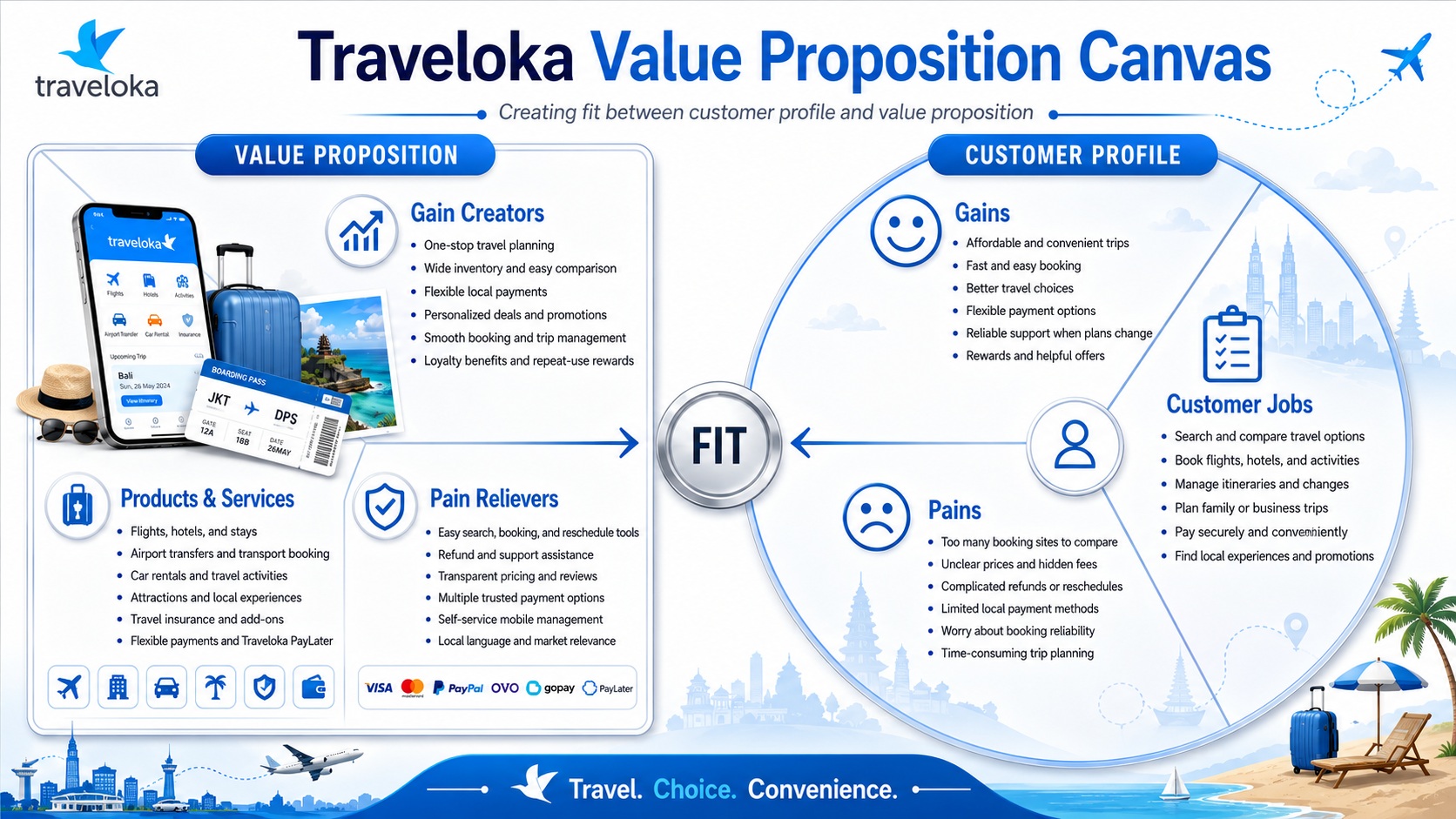
| Customer Profile | Details |
|---|---|
| Customer Jobs | Search and compare travel options, book flights and stays, manage itineraries, plan family or business trips, and pay securely. |
| Pains | Too many sites to compare, unclear pricing, refund or reschedule stress, limited payment options, and time-consuming trip planning. |
| Gains | Better prices, smoother booking, more convenience, reliable support, flexible payment, and helpful rewards or promotions. |
This profile matters because travel is both emotional and practical. Users want efficiency, but they also want confidence. That means the platform must reduce stress as much as it improves convenience.
The value map explains how Traveloka responds to those customer jobs, pains, and gains. This includes the products and services it offers, the pain relievers it provides, and the gain creators that make the experience more attractive.
Traveloka’s value map is broader than a standard booking app. It combines flights, hotels, attractions, transport, payment flexibility, loyalty tools, and post-booking support in one ecosystem. That gives the company more ways to solve customer problems while also increasing cross-sell and repeat usage.
| Value Map Element | Details |
|---|---|
| Products & Services | Flights, hotels, transport booking, airport transfers, attractions, local experiences, insurance add-ons, and flexible payment options. |
| Pain Relievers | Easy search and booking, refund and reschedule support, transparent pricing, user reviews, trusted payment access, and self-service management tools. |
| Gain Creators | One-stop planning, broad inventory, easier comparison, personalised deals, loyalty benefits, and smoother trip management. |
The strength of this value map is integration. Traveloka does not solve only one part of the trip. It connects several travel needs into one digital journey, which increases convenience for the user and commercial value for the platform.
The fit happens when Traveloka matches real traveller problems with a simpler digital solution. Customers want choice, easy comparison, trusted booking, flexible payment, and support when something changes. Traveloka responds with broad travel inventory, one interface, loyalty tools, and post-booking assistance.
| Customer Profile | Details | Matching Value Map | How Traveloka Creates Fit |
|---|---|---|---|
| Customer Jobs | Plan trips, compare options, book transport and stays | Integrated travel platform | Combines search, booking, and management in one app |
| Pains | Too many sites, unclear pricing, refund stress, payment limits | Simple UX, support tools, multiple payments | Reduces friction before and after booking |
| Gains | Better prices, convenience, rewards, confidence | Deals, loyalty, broad inventory, local relevance | Increases value and makes repeat use more likely |
This company creates fit when the app reduces travel complexity. That fit becomes stronger when users return not only for one booking, but for the next trip as well.
The diagram below gives a visual summary of how Traveloka’s customer profile and value map connect in one structured view. It helps readers see more clearly how customer jobs, pains, and gains are matched with Traveloka’s products, pain relievers, and gain creators before moving to the final synthesis of fit.
The Traveloka Business Model Canvas highlights several advantages that support long-term growth, and these strengths matter because they make the platform more scalable, more relevant to users, and more resilient in a competitive travel market:
These strengths reinforce one another. Better inventory attracts users, more users attract suppliers, and stronger retention improves monetisation. In practice, that means Traveloka’s advantage is not based on one feature alone. Its real edge comes from how localisation, inventory depth, payments, app engagement, and supplier coverage work together as one coordinated regional platform.
Traveloka also faces several risks and challenges, and these issues matter because they can affect growth quality, customer trust, operating efficiency, and the platform’s ability to sustain long-term competitiveness:
These risks do not make the model weak. They show that execution quality is as important as platform scale. They also highlight why Traveloka must balance growth with service reliability, supplier control, cost discipline, and customer trust. A travel platform can scale quickly, but sustaining that scale requires strong operational control across many moving parts.
Traveloka should deepen its position as a travel super app, not just a booking engine. That means improving cross-sell logic between flights, hotels, activities, and transfers so each booking journey becomes more connected.
The company should also keep investing in support excellence. In travel, trust is tested during disruption. Faster refund handling, clearer policy communication, and stronger service recovery can create real differentiation.
Another priority is margin quality. Traveloka can grow more sustainably by balancing promotions with higher-value products, supplier tools, advertising income, and loyalty-driven retention.
Finally, Traveloka should keep strengthening local market fit. Payment partnerships, local language support, and country-specific travel products remain important competitive tools in Southeast Asia.
Traveloka has built a strong regional platform by making travel discovery, booking, payment, and trip management more convenient. It is not simply selling airline tickets or hotel rooms. It is organising fragmented travel demand into one digital system.
The Traveloka Business Model Canvas shows that its real advantage comes from how the blocks work together. Customer reach, local payments, supplier depth, app engagement, loyalty, and support all reinforce one another.
Future growth will depend on whether Traveloka can keep improving trust, retention, and monetisation without damaging customer experience. If it manages that balance well, it can remain one of the region’s most important travel platforms.
This article is for educational and business analysis purposes only. It is based on publicly available information, general market observation, and strategic interpretation. It is not financial advice, investment advice, legal advice, or an official statement from Traveloka. Readers should conduct their own research before making business, investment, or strategic decisions.
Explore the CARPUT Business Model Canvas, nine BMC blocks, Value Proposition Canvas, competitor comparison, competitive… Read More
Explore the Boost Business Model Canvas, nine BMC blocks, Value Proposition Canvas, competitor comparison, advantages,… Read More
Explore the Domino's Pizza Business Model Canvas, nine BMC blocks, Value Proposition Canvas, Pizza Hut… Read More
Explore the Mie Gacoan Business Model Canvas, including its customer segments, value propositions, revenue streams,… Read More
Restaurant Business Model Canvas: A Practical Guide to Designing, Evaluating, and Improving Restaurant Business Models… Read More
Learn how the Food and Beverage Business Model Canvas helps restaurants, cafés, beverage brands, and… Read More