CARPUT Business Model Canvas
Explore the CARPUT Business Model Canvas, nine BMC blocks, Value Proposition Canvas, competitor comparison, competitive advantages, risks and strategic recommendations.
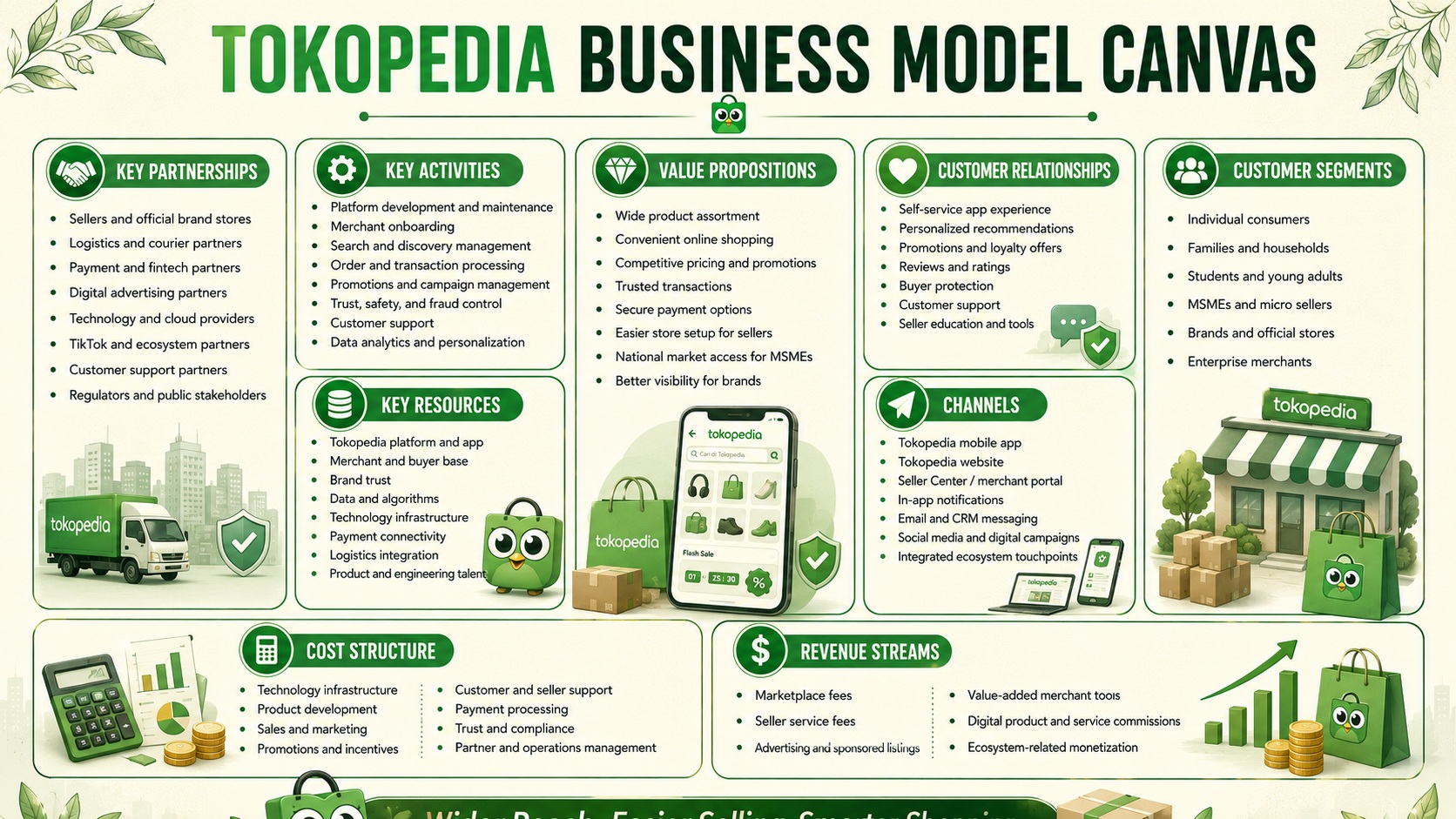
This Tokopedia BMC Analysis breaks down the company’s strategic components through the Business Model Canvas framework—unpacking how Tokopedia builds, delivers, and captures value in Indonesia’s competitive e-commerce market.
BMC Article No: BMC #059
Updated in 2026: This article has been refreshed with Tokopedia’s current ownership and ecosystem context after the TikTok partnership, newer operating developments around integrated seller tools, deeper analysis for all nine BMC blocks, an expanded Value Proposition Canvas section, revised competitive advantages and risks, added strategic recommendations, and a more refined article structure.
The Tokopedia Business Model Canvas explains how one of Indonesia’s most influential digital commerce platforms creates value for buyers, sellers, brands, and ecosystem partners. Tokopedia began as a marketplace that helped merchants move online, but its business model now extends far beyond simple listings and transactions.
Today, the platform operates in a more complex environment shaped by social commerce, logistics expectations, digital payments, creator-led discovery, and stronger competition. Integration with TikTok Shop and continued links with the wider GoTo ecosystem have changed how Tokopedia reaches customers, supports merchants, and monetises activity.
That combination makes Tokopedia an especially useful case for Business Model Canvas analysis. Rather than competing only on assortment or price, the company competes through ecosystem coordination, merchant access, trust features, fulfilment partnerships, and demand generation across multiple digital touchpoints.
Tokopedia operates a digital marketplace business model that connects buyers, merchants, brands, logistics providers, payment partners, and other commerce enablers through one platform. It earns by facilitating transactions, supporting seller growth, monetising visibility, and embedding additional services around commerce activity.
At its core, the Tokopedia Business Model Canvas shows a company that lowers the barriers to online selling while making online shopping easier, broader, and more trusted for consumers. Marketplace activity creates traffic and assortment, while merchant tools, payments, logistics integration, promotions, and ecosystem connectivity help increase transaction completion.
This design matters because Tokopedia is not only a website or shopping app. It is a multi-sided commerce system where buyer trust, seller productivity, platform governance, and partner performance all affect commercial outcomes.
Business Model Canvas, or BMC, is a practical framework used to explain how a company creates value, delivers that value, and captures revenue. Rather than focusing only on products, the framework maps the operating logic behind the entire organisation.
For Tokopedia, BMC is particularly useful because performance depends on more than product listings or traffic. Merchant onboarding, search quality, trust systems, logistics access, payments, promotions, advertising, and seller tools all influence platform strength.
That is why the Tokopedia Business Model Canvas is a useful lens. It shows how marketplace liquidity, merchant enablement, customer trust, and ecosystem coordination work together as one digital commerce system.
| BMC Block | Main Question |
|---|---|
| Customer Segments | Who does the business serve? |
| Value Propositions | What value does the business offer? |
| Channels | How does the business reach customers? |
| Customer Relationships | How does the business build loyalty? |
| Revenue Streams | How does the business make money? |
| Key Resources | What assets does the business need? |
| Key Activities | What must the business do well? |
| Key Partnerships | Who helps the business operate? |
| Cost Structure | What are the major costs? |
Tokopedia was founded in 2009 by William Tanuwijaya and Leontinus Alpha Edison as an Indonesian marketplace focused on helping individuals and small businesses sell online. Over time, it expanded beyond a simple marketplace into a wider commerce ecosystem supported by logistics connectivity, digital payments, merchant tools, advertising, and platform services.
Its strategic position changed materially after GoTo’s formation in 2021 and again after TikTok became Tokopedia’s controlling shareholder in early 2024, while GoTo remained a strategic partner. Those shifts matter because they changed how Tokopedia approaches growth, discovery, seller operations, and ecosystem coordination.
Scale matters here because a large marketplace creates stronger assortment, broader merchant participation, more buyer choice, and more monetisation opportunities across advertising, service tools, and transaction activity.
Tokopedia is strategically interesting because it combines the characteristics of a marketplace, merchant-enablement platform, digital infrastructure provider, and ecosystem commerce gateway.
A customer does not interact only with product listings. The complete experience includes discovery, trust evaluation, payment, seller communication, delivery, dispute handling, and post-purchase support. Sellers, meanwhile, depend on traffic, tools, fulfilment coordination, and conversion support.
That creates a more complex commercial position. Tokopedia must manage buyer trust, seller productivity, logistics access, payment flexibility, and platform neutrality at the same time, while competitors continue to pressure pricing, service levels, and traffic acquisition.
Another advantage comes from ecosystem leverage. Management can connect marketplace commerce with content-driven discovery, advertising, payments, merchant tooling, and partner services, which gives the model more depth than a basic transaction platform.
The Tokopedia Business Model Canvas in 2026 reflects a business that is no longer just a standalone marketplace story. Tokopedia’s operating context changed materially after TikTok became the controlling shareholder of Tokopedia in early 2024, while GoTo remained a strategic ecosystem partner. In 2025, the companies also launched an integrated Tokopedia and TikTok Shop Seller Center to help merchants manage products, orders, promotions, and cross-platform selling more efficiently.
Another visible shift is how discovery and commerce are moving closer together. Traditional search-based e-commerce still matters, but content-driven shopping, affiliates, live commerce, and creator influence now play a larger role in how demand is generated and converted. That matters because it changes Tokopedia’s channel strategy, customer acquisition model, and seller value proposition.
Regulatory scrutiny has also become more important. Competition authorities in Indonesia attached conditions to TikTok’s control of Tokopedia, including requirements related to open payment and logistics access and restrictions against self-preferencing and predatory pricing. As a result, growth is no longer only about scale. Governance, fairness, platform neutrality, and ecosystem trust now matter more to the long-term economics of the business.
Before examining each block in detail, the summary below provides a quick view of how Tokopedia’s business works. It offers a compact snapshot of the complete model before the deeper analysis, making it easier to see how the main building blocks connect.
This summary also helps readers understand why Tokopedia is more than a marketplace app and how buyers, merchants, partners, logistics, payments, and platform tools operate as one commercial system.
| BMC Block | Tokopedia Application |
|---|---|
| Customer Segments | Consumers, MSMEs, enterprise brands, merchants, and ecosystem partners |
| Value Propositions | Convenience, assortment, trust, seller access, merchant tools, and integrated commerce support |
| Channels | Mobile app, website, notifications, campaigns, social touchpoints, and ecosystem integrations |
| Customer Relationships | Self-service tools, support, seller education, promotions, and personalisation |
| Revenue Streams | Marketplace fees, advertising, merchant services, digital transactions, and ecosystem-linked monetisation |
| Key Resources | Platform technology, data, merchant base, brand trust, and partnerships |
| Key Activities | Platform development, merchant enablement, demand generation, trust and safety, and partner integration |
| Key Partnerships | Logistics firms, payment partners, merchants, TikTok-linked ecosystem channels, and regulators |
| Cost Structure | Technology, marketing, incentives, support, compliance, and ecosystem operations |
The Tokopedia Business Model Canvas can be understood through the nine standard BMC blocks below. Each block shows how Tokopedia connects marketplace liquidity, merchant enablement, consumer trust, and ecosystem partnerships into one scalable operating model.
The table below shows the main customer groups that Tokopedia serves and why each one matters to the strength of the platform.
Tokopedia serves a multi-sided market, so segmentation is central to its model. Buyers, small sellers, large brands, and ecosystem partners each use the platform differently, and Tokopedia must balance their priorities without weakening overall marketplace trust.
| Customer Segment | Tokopedia Application | Why It Matters |
|---|---|---|
| Consumers | Tokopedia serves everyday online shoppers who want product choice, convenience, competitive pricing, and trusted transactions. | This segment drives traffic, repeat purchases, and marketplace liquidity, which in turn attracts more sellers. |
| MSMEs and micro sellers | The platform helps small merchants open online stores, reach national demand, and operate digitally with fewer barriers. | This segment is strategically important because it expands assortment and strengthens Tokopedia’s relevance in Indonesia’s domestic commerce ecosystem. |
| Enterprise brands | Tokopedia supports larger brands through official stores, campaigns, and broader visibility across the marketplace. | Brand participation strengthens trust, improves category depth, and helps attract consumers who look for authenticity and consistency. |
| Ecosystem partners | Logistics providers, payment partners, advertisers, and other service providers operate around the platform. | These partners extend Tokopedia’s capabilities and make the marketplace more complete and scalable. |
From a strategy perspective, this broad segmentation is a strength because it builds marketplace depth. More buyers attract more sellers, while more sellers improve product variety and price competitiveness. That said, multi-sided platforms are difficult to manage because the experience must work for first-time merchants and sophisticated national brands at the same time.
A practical implication is that Tokopedia cannot optimise only for consumer growth. Merchant productivity, seller retention, and partner economics are equally important because each side reinforces the others.
The following table explains the main value that Tokopedia delivers to each side of the marketplace and why that value is strategically important.
The Tokopedia Business Model Canvas is built on a value proposition that differs for each side of the platform. Buyers receive assortment, convenience, and trust. Sellers receive access, tools, reach, and lower barriers to digital commerce.
| Audience | Tokopedia Value Proposition | Why It Matters |
|---|---|---|
| Buyers | Tokopedia offers broad product choice, price comparison, promotions, and a more trusted transaction environment. | Buyers are more likely to transact when shopping feels convenient, transparent, and less risky. |
| Small sellers | The platform lowers entry barriers by providing online storefronts, market access, and commerce tools without requiring merchants to build their own systems. | This makes digital selling more accessible and helps Tokopedia expand merchant participation at scale. |
| Brands | Tokopedia gives brands official storefronts, campaign visibility, and access to large online audiences. | Stronger brand participation improves trust, product authenticity, and category competitiveness. |
| Partners | Ecosystem participants gain scalable demand, transaction flow, and service integration opportunities. | Partner value is important because Tokopedia’s model works best when multiple external services reinforce the core marketplace. |
What makes this proposition powerful is not a single feature. Tokopedia’s real value comes from reducing frictions across the commerce journey, such as discovery, store setup, payments, promotions, shipping, and service recovery. Once those frictions fall, more sellers can participate and more buyers can transact with confidence.
Strategically, this means Tokopedia is not merely selling products. It is selling market access, operational simplification, and transaction trust at scale.
The table below shows how Tokopedia reaches users, re-engages them, and converts attention into marketplace activity.
Tokopedia reaches customers through app-based commerce, web traffic, ecosystem referrals, marketing campaigns, and increasingly content-driven digital touchpoints. Distribution in digital business is no longer only about owning an app. It is also about being discoverable wherever users spend attention.
| Channel | Tokopedia Application | Why It Matters |
|---|---|---|
| Mobile app | The app is the main channel for browsing, buying, selling, and campaign participation. | It concentrates most user activity and is central to transaction frequency and retention. |
| Website | Tokopedia’s website provides additional access for browsing, transactions, and merchant operations. | Web access supports wider reach and serves users who prefer desktop-based shopping or store management. |
| Notifications and CRM | The platform uses push notifications, messaging, and promotional communication to re-engage users. | These tools support retention, repeat purchases, and campaign effectiveness. |
| Social and content touchpoints | Discovery increasingly happens through social content, creator influence, and cross-platform traffic flows. | This matters because digital commerce is no longer driven only by direct search or app visits. |
| Ecosystem integrations | Tokopedia connects with payments, logistics, and other ecosystem services around the transaction journey. | Strong integration improves convenience and helps convert interest into completed orders. |
An important shift is that shopping discovery is becoming more distributed. Users may start with search, recommendations, short-form video, creator content, or promotional campaigns before they ever reach a product page. That changes the economics of customer acquisition and makes integrated channels more valuable.
For Tokopedia, channel strength is therefore not just reach. It is the ability to convert fragmented digital attention into trusted commerce activity.
The following table outlines how Tokopedia builds trust, supports users, and encourages repeat activity across the platform.
The Tokopedia Business Model Canvas depends on relationships that are partly automated and partly supported. The platform must maintain confidence at scale, which means combining self-service tools with help mechanisms when transactions fail or users need guidance.
| Relationship Type | Tokopedia Application | Why It Matters |
|---|---|---|
| Self-service tools | Tokopedia provides automated tools for order tracking, issue handling, and account management. | Self-service improves speed and supports scale without requiring high-touch service for every case. |
| Help center and support | The platform offers customer support when transactions fail or disputes need intervention. | Support is essential because trust can fall quickly when problems are unresolved. |
| Seller education | Tokopedia helps merchants improve store quality, product presentation, and operating discipline. | Better merchant execution raises customer satisfaction and platform credibility. |
| Promotions and loyalty mechanics | Campaigns, discounts, and repeat-purchase incentives help encourage transaction frequency. | These mechanisms support retention in a highly competitive market. |
| Personalisation | The platform can tailor recommendations, offers, and content using user and transaction data. | Better relevance improves conversion and increases the chance of repeat engagement. |
This block is more strategic than it first appears. In marketplaces, weak relationships can quickly damage trust because dissatisfaction affects both buyers and sellers. Refund speed, dispute handling, delivery visibility, and seller communication all shape repeat purchase behaviour.
A strong relationship model therefore does two things at once. It protects current transactions and improves the probability of future transactions.
The table below summarises the main ways Tokopedia earns revenue and why a diversified income structure matters.
Tokopedia monetises commerce activity through a mix of marketplace fees, seller services, advertising, and transaction-related services. Diversification matters because relying on one stream alone would make the model more vulnerable to pricing pressure or shifts in consumer demand.
| Revenue Stream | Tokopedia Application | Why It Matters |
|---|---|---|
| Marketplace fees | Tokopedia earns from seller activity and selected platform-related transaction services. | This creates direct monetisation from the core marketplace engine. |
| Advertising solutions | Sellers and brands can pay for greater visibility, traffic, and campaign placement. | Advertising becomes more valuable as marketplace traffic and competition increase. |
| Value-added merchant tools | Merchant-facing services help improve discoverability, conversion, and store performance. | These services diversify revenue while also supporting seller productivity. |
| Digital products and service transactions | Tokopedia can earn fees or margins from selected digital and service-based categories. | This broadens monetisation beyond physical product transactions alone. |
| Ecosystem-linked monetisation | Revenue can also come from payments and other connected commerce activities. | Ecosystem monetisation matters because the platform now operates inside a broader digital commerce system. |
The deeper logic is clear. The more Tokopedia helps sellers grow, the more monetisation options become viable. Advertising revenue rises when traffic is valuable. Merchant services gain traction when sellers need performance tools. Transaction-based monetisation becomes stronger when users trust the platform enough to use it repeatedly.
This revenue structure works best when Tokopedia increases both marketplace liquidity and merchant productivity rather than pushing fees too aggressively.
The following table highlights the core assets that support Tokopedia’s marketplace model and long-term competitiveness.
Tokopedia’s most important resources are digital rather than physical. Technology infrastructure, merchant and buyer data, brand trust, partner networks, and product talent are the assets that make the model operate at scale.
| Key Resource | Tokopedia Application | Why It Matters |
|---|---|---|
| Platform technology | Tokopedia relies on technology to run search, checkout, store management, and platform performance. | Technology is the operating backbone of the marketplace. |
| Data and algorithms | User data and platform intelligence support ranking, recommendations, fraud control, and ad performance. | Better data use improves conversion, efficiency, and trust. |
| Brand and trust assets | Tokopedia’s reputation helps buyers and sellers feel more confident using the platform. | Trust is one of the hardest marketplace resources to build and maintain. |
| Merchant base | A large seller community expands product variety, category coverage, and price competition. | Merchant depth improves marketplace relevance and user choice. |
| Partnerships and ecosystem links | External relationships extend fulfilment, payment, and broader service capability. | These links make the business more scalable than a standalone commerce platform. |
Among these, trust is especially critical. A marketplace can copy features, but rebuilding trust after service failure, poor quality control, or weak governance is much harder. Data is also a major strategic resource because it shapes recommendations, ad performance, fraud controls, and seller insights.
In practice, Tokopedia’s strongest resource is the interaction between technology, merchants, and trust rather than any single asset in isolation.
The table below explains the critical activities Tokopedia must perform well to keep the marketplace growing and functioning reliably.
The Tokopedia Business Model Canvas relies on activities that keep both sides of the marketplace active and productive. Tokopedia must continuously improve conversion, merchant success, transaction security, and ecosystem coordination.
| Key Activity | Tokopedia Application | Why It Matters |
|---|---|---|
| Platform development | Tokopedia continuously improves the app, website, search, and transaction systems. | Ongoing product improvement is necessary to stay competitive in digital commerce. |
| Merchant onboarding and enablement | The company recruits sellers, supports store setup, and improves merchant capability. | Strong seller enablement improves supply quality and platform depth. |
| Demand generation | Tokopedia runs campaigns, promotions, and traffic-building activities to attract buyers. | Demand generation is essential because marketplace growth depends on transaction volume. |
| Trust, safety, and compliance | The platform manages fraud control, user protection, policy enforcement, and regulatory requirements. | Trust and compliance protect the marketplace from breakdowns in confidence. |
| Partner integration | Tokopedia coordinates with logistics, payments, and ecosystem services around the commerce journey. | Integration quality directly affects convenience, fulfilment, and transaction completion. |
Several of these activities reinforce each other. Better merchant tools improve listings and service levels. Next, better demand generation makes the platform more attractive to sellers. Better trust and compliance reduce friction and protect long-term usage.
Execution quality matters here because e-commerce markets move quickly. Small weaknesses in search, fulfilment, pricing visibility, or customer protection can reduce conversion at scale.
The following table shows the main partner groups that extend Tokopedia’s capabilities and make the overall model more scalable.
Partnerships are not peripheral to Tokopedia. They are structural to the model. Without strong external partners, Tokopedia would struggle to deliver fulfilment reach, payment flexibility, merchant services, and cross-platform demand generation.
| Key Partner | Tokopedia Application | Why It Matters |
|---|---|---|
| Logistics providers | Delivery partners support fulfilment reach, shipping, and order completion across Indonesia. | Logistics quality strongly affects customer experience and repeat purchases. |
| Payment and financial service partners | Payment partners support checkout flexibility, transaction flow, and related services. | Payment access improves convenience and reduces transaction friction. |
| TikTok and ecosystem affiliates | Tokopedia benefits from integrated traffic, discovery, and broader commerce coordination. | Ecosystem links now play a larger role in acquisition and seller value creation. |
| Brands and merchants | Sellers and brands provide product supply, campaigns, and marketplace activity. | Without strong merchant participation, the platform loses relevance and assortment strength. |
| Regulators and public stakeholders | Tokopedia operates within regulatory frameworks that affect competition, neutrality, and governance. | Public legitimacy matters because regulatory trust shapes long-term operating freedom. |
The strategic importance of partnerships has increased after the integration period. Tokopedia’s performance now depends even more on how well content, commerce, logistics, payments, and seller systems work together across a broader ecosystem.
That also creates dependency risk. When a model relies on many partners, coordination quality becomes a source of competitive advantage as well as operational vulnerability.
The table below outlines Tokopedia’s main cost areas and why each one matters to growth, efficiency, and sustainability.
Tokopedia carries a cost structure typical of large-scale digital platforms, but the pressure points are distinctive. Growth requires continued spending on technology, marketing, support, incentives, compliance, and ecosystem coordination.
| Cost Area | Tokopedia Application | Why It Matters |
|---|---|---|
| Technology and infrastructure | The company invests in platform reliability, speed, and digital product development. | Technology spending is necessary to keep the marketplace functional and competitive. |
| Sales and marketing | Tokopedia spends on campaigns, promotions, and traffic generation. | Customer acquisition and engagement remain critical in a crowded market. |
| Customer and seller support | Support operations help resolve issues and maintain service quality. | Service recovery matters because poor support can weaken trust quickly. |
| Incentives and promotions | The platform uses discounts and commercial incentives to support demand and seller activity. | These costs can drive growth, but they also pressure margins. |
| Compliance, governance, and operations | Tokopedia must invest in regulation, risk management, and ecosystem coordination. | Governance costs are increasingly important in a more tightly scrutinised market. |
A key strategic tension sits inside this block. Tokopedia must remain attractive to buyers and sellers while also improving economics over time. That means management cannot rely indefinitely on subsidies, heavy discounting, or inefficient customer acquisition.
Sustainable performance comes from improving monetisation quality, seller productivity, repeat usage, and ecosystem efficiency, not just expanding gross transaction volume.
The Tokopedia Business Model Canvas becomes clearer when paired with Value Proposition Canvas. While BMC explains the full business system, VPC shows how Tokopedia matches its offer to the main needs, frictions, and expected benefits of its users.
Tokopedia serves both buyers and sellers, so the customer profile must reflect the needs of both sides of the marketplace.
| Customer Profile | Details |
|---|---|
| Customer Jobs | Buyers want to discover products quickly, compare options, pay securely, and receive orders reliably without unnecessary friction. Sellers want to open digital stores, reach customers, manage orders, and grow sales without building their own full e-commerce infrastructure. |
| Customer Pains | Buyers worry about fraud, misleading listings, inconsistent product quality, delivery uncertainty, and weak after-sales support. Sellers face traffic pressure, operational complexity, strong marketplace competition, platform dependence, and the difficulty of turning visibility into repeat sales. |
| Customer Gains | Buyers want convenience, broad choice, competitive pricing, trusted transactions, and smoother fulfilment. Sellers want wider reach, simpler operations, stronger visibility, better conversion, and scalable business growth. |
This profile shows why Tokopedia must solve problems on both sides at the same time. The marketplace becomes stronger when buyers trust the platform and sellers feel the system helps them operate and grow efficiently.
Tokopedia responds to those needs through marketplace infrastructure, merchant tools, transaction support, and ecosystem-linked commerce services.
| Value Map | Details |
|---|---|
| Products and Services | Tokopedia provides a large marketplace platform, seller storefront tools, product discovery functions, payment support, promotional features, campaign participation, and logistics-linked transaction workflows that make online commerce easier for buyers and sellers. |
| Pain Relievers | Tokopedia reduces friction through buyer protection mechanisms, reviews, seller ratings, customer support, order visibility, integrated seller tools, and platform governance that improve trust and reduce operating uncertainty. |
| Gain Creators | Tokopedia creates value by expanding market access, improving discoverability, simplifying store operations, supporting conversion, and connecting buyers and sellers through a more efficient digital commerce ecosystem. |
The value map matters because Tokopedia does not only host listings. It actively reduces transaction friction, supports seller productivity, and improves the conditions that make repeat commerce more likely.
| Customer Profile | Details | Matching Value Map | How Tokopedia Creates Fit |
|---|---|---|---|
| Customer Jobs | Buyers want convenient product discovery, smooth transactions, and reliable order fulfilment. Sellers want digital storefronts, customer access, and manageable day-to-day commerce operations. | Products and Services | Tokopedia provides a broad marketplace, seller tools, payment support, promotions, and logistics-linked workflows that support the complete online selling and buying journey. |
| Customer Pains | Buyers face fraud concerns, variable seller quality, delivery uncertainty, and after-sales issues. Sellers face high competition, traffic dependence, operational friction, and challenges in sustaining profitable growth. | Pain Relievers | Tokopedia reduces those frictions through trust features, platform governance, support systems, integrated order management, and transaction structures that make commerce more predictable. |
| Customer Gains | Buyers value choice, convenience, better prices, and trusted transactions. Sellers value reach, visibility, easier operations, and stronger growth potential. | Gain Creators | Tokopedia creates those gains through ecosystem scale, merchant enablement, better discoverability, operational support, and infrastructure that helps both sides participate more effectively. |
The fit is strongest because Tokopedia solves more than product search or online listing needs. It reduces transaction friction, improves trust, supports merchant growth, and makes digital commerce more manageable for both buyers and sellers.
The fit is strongest when Tokopedia helps buyers shop with less risk and less effort while helping sellers operate with less complexity and better market access. Buyers do not only want products. They want confidence that transactions will be safe, fulfilment will be reliable, and support will be available when problems happen.
Sellers do not only want traffic. They also need tools that simplify operations, improve visibility, and raise the probability that attention turns into repeatable sales. Tokopedia creates fit when it combines these needs into one coordinated platform experience rather than treating them as separate problems.
That is why the Tokopedia Business Model Canvas is strategically meaningful. The business works best when buyer trust and seller productivity reinforce each other, creating a marketplace that becomes more useful as participation grows.
A comparison with relevant peers helps clarify where Tokopedia is strong and where competitive pressure is highest. Shopee, TikTok Shop, and Lazada are useful benchmarks because each competes with Tokopedia on different but overlapping dimensions.
Shopee is the most direct comparison because it competes aggressively in core marketplace commerce through campaigns, promotions, and user activity. TikTok Shop matters because it is changing how commerce demand is created through content, creators, and social discovery. Lazada is relevant because it shows what a more regionally structured platform model can look like, especially in areas related to infrastructure, brand participation, and operating consistency.
The table below summarises how these competitors compare with Tokopedia and what each comparison reveals about Tokopedia’s strategic position.
| Competitor | Main Strength | Relevance to Tokopedia | What the Comparison Shows |
|---|---|---|---|
| Shopee | Strong promotional execution, high user activity, and broad marketplace scale | Shopee is Tokopedia’s closest marketplace rival in core e-commerce competition | This comparison shows how strongly Tokopedia must compete on traffic, campaigns, pricing intensity, and user frequency. |
| TikTok Shop | Content-led discovery, creator influence, and social commerce conversion | TikTok Shop matters because discovery and commerce are becoming more integrated | This comparison shows that Tokopedia’s future depends partly on how well it connects shopping with demand generation and content-led discovery. |
| Lazada | Regional infrastructure, structured platform capability, and stronger brand-oriented positioning in some categories | Lazada is relevant as a regional e-commerce benchmark with a different operating emphasis | This comparison shows that Tokopedia must balance local merchant strength with broader platform sophistication and execution discipline. |
These comparisons make the Tokopedia Business Model Canvas more useful. The company is not competing in a generic e-commerce environment. It is competing in a market where marketplace scale, content-driven discovery, ecosystem integration, and operational trust increasingly define strategic advantage.
The analysis shows several structural advantages that have helped the company remain relevant in a highly competitive market. These strengths matter because Tokopedia does not compete only through price or short-term promotions. Its position is supported by deeper operating advantages that can improve resilience over time.
The Tokopedia Business Model Canvas also highlights important risks that can weaken performance if they are not managed carefully. These issues are not minor because platform businesses can lose momentum quickly when trust, economics, or execution quality start to weaken.
The Tokopedia Business Model Canvas suggests that Tokopedia should now focus less on pure scale and more on quality of growth.
The following recommendations focus on how Tokopedia can strengthen long-term competitiveness while improving profitability, merchant productivity, and ecosystem trust. The next phase should improve monetisation, merchant productivity, and ecosystem trust without weakening platform neutrality.
First, Tokopedia should deepen seller segmentation so small merchants, rising brands, and enterprise sellers receive more tailored tools and support. Second, management should keep improving integrated seller workflows because operational simplicity can raise retention and reduce service failures. Third, the platform should strengthen trust signals around product quality, refunds, and dispute handling, since these directly influence repeat purchase behaviour.
Another priority is balanced monetisation. More revenue should come from high-value merchant services, advertising efficiency, and ecosystem-enabled conversion rather than from fee increases alone. Finally, Tokopedia should continue demonstrating open access to logistics and payments, because governance credibility will matter more in a tightly watched market.
The Tokopedia Business Model Canvas shows a company that wins by coordinating a large digital commerce ecosystem, not by acting as a simple online store. Its model combines marketplace liquidity, merchant access, fulfilment connectivity, and trusted transaction infrastructure.
Future success will depend on execution discipline. If Tokopedia can improve seller productivity, maintain fair platform governance, and convert content-driven discovery into profitable commerce, it can remain one of the most important digital commerce platforms in Indonesia.
This article is for educational and analytical purposes only. It is an independent business analysis based on publicly available information and does not represent official statements from Tokopedia, TikTok, GoTo, or their related entities. Market conditions, ownership structures, platform features, and competitive dynamics may change over time.
Explore the Tokopedia Business Model Canvas, nine BMC blocks, Value Proposition Canvas, competitive advantages, risks, recommendations, and 2026 business updates.
Explore the CARPUT Business Model Canvas, nine BMC blocks, Value Proposition Canvas, competitor comparison, competitive… Read More
Explore the Boost Business Model Canvas, nine BMC blocks, Value Proposition Canvas, competitor comparison, advantages,… Read More
Explore the Domino's Pizza Business Model Canvas, nine BMC blocks, Value Proposition Canvas, Pizza Hut… Read More
Explore the Mie Gacoan Business Model Canvas, including its customer segments, value propositions, revenue streams,… Read More
Restaurant Business Model Canvas: A Practical Guide to Designing, Evaluating, and Improving Restaurant Business Models… Read More
Learn how the Food and Beverage Business Model Canvas helps restaurants, cafés, beverage brands, and… Read More