Quipper Business Model Canvas
Explore the Quipper Business Model Canvas, nine BMC blocks, Value Proposition Canvas, Ruangguru and Pahamify comparison, competitive advantages, risks, and strategic recommendations.
Explore OldTown White Coffee’s nine BMC blocks, Value Proposition Canvas, Oriental Kopi comparison, competitive advantages, risks, and strategic recommendations.
BMC Article No: BMC #063
Updated in 2026: This OldTown White Coffee Model Canvas article has been comprehensively revised to include current corporate context, international product reach, recent market developments, deeper analysis of all nine BMC blocks, an expanded Value Proposition Canvas, a comparison with Oriental Kopi, revised competitive advantages and risks, and updated strategic recommendations.
OldTown White Coffee is one of Malaysia’s most recognisable heritage coffee brands. Established in Ipoh in 1999, the business began by commercialising instant white coffee before expanding into cafés, foodservice, franchising, retail distribution, and international markets.
Unlike a conventional coffee shop, OldTown operates through two connected commercial systems. Its cafés provide beverages, Malaysian meals, social spaces, and direct customer experiences. Packaged products allow consumers to enjoy the brand at home, at work, while travelling, or in markets where OldTown cafés are unavailable.
The OldTown White Coffee Business Model Canvas is strategically valuable because it demonstrates how cultural heritage can be converted into multiple revenue streams. Brand awareness created through retail products supports café demand, while physical outlets make the packaged coffee brand more visible and experiential.
OldTown states that its products are manufactured in Ipoh and exported to 21 countries. This international distribution extends Malaysian white coffee culture beyond its domestic market and gives the company a broader platform than a café-only business.
OldTown is therefore more than a restaurant chain. It is a Malaysian consumer brand operating across hospitality, food manufacturing, franchising, retail, and international distribution.
OldTown operates a hybrid café, restaurant, franchise, manufacturing, and fast-moving consumer goods business model. Customers may experience the brand through café meals and beverages or purchase instant coffee products through supermarkets, convenience stores, distributors, and online platforms.
At the centre of the OldTown White Coffee Business Model Canvas is one core idea: authentic Ipoh white coffee delivered in formats suited to modern lifestyles. Café outlets translate that heritage into a dine-in experience, whereas packaged products convert it into a convenient household beverage.
This structure creates commercial diversification. Restaurant sales generate recurring transactions, franchise arrangements extend physical presence, and packaged beverages provide distribution scale without requiring a café in every market.
OldTown must nevertheless manage two different operating environments. Foodservice depends on suitable locations, trained employees, kitchen productivity, service quality, and customer experience. FMCG performance relies more heavily on manufacturing, packaging, retail placement, logistics, distributor relationships, and consumer marketing.
The interaction between these environments strengthens the business when managed effectively. A positive café experience may encourage customers to purchase OldTown products for home consumption, while supermarket visibility can introduce the brand to people who have never visited an outlet.
The Business Model Canvas, or BMC, is a strategic framework used to explain how a company creates value, delivers that value to customers, and captures revenue.
Nine interconnected blocks are examined:
| BMC Block | Main Question |
|---|---|
| Customer Segments | Who does the company serve? |
| Value Propositions | What benefits does it offer? |
| Channels | How does it reach customers? |
| Customer Relationships | How does it attract and retain customers? |
| Revenue Streams | How does it generate income? |
| Key Resources | What assets support the model? |
| Key Activities | What must the company perform effectively? |
| Key Partnerships | Which external parties support the business? |
| Cost Structure | What are the principal operating costs? |
The OldTown White Coffee Business Model Canvas reveals that the company’s strength does not come from coffee alone. Its performance depends on connecting brand heritage, recipes, café operations, menu development, manufacturing, franchising, retail distribution, and international market access.
Examining these elements together provides a clearer understanding of how OldTown competes, where value is created, and which parts of the model require further improvement.
OldTown was established in Ipoh, Perak, in 1999. Its early business concentrated on manufacturing instant beverage products inspired by the traditional Ipoh white coffee recipe.
Café operations were subsequently introduced to create a more complete customer experience. These locations combined coffee, Malaysian food, kopitiam-inspired surroundings, and contemporary restaurant operating methods.
OldTown’s signature white coffee is associated with a blend of coffee beans and a controlled roasting process designed to produce a smooth and aromatic beverage. The company’s positioning continues to emphasise authentic Ipoh white coffee and Malaysian dining culture.
In December 2017, Jacobs Douwe Egberts Holdings Asia announced a conditional offer to acquire OldTown Berhad. The transaction reflected OldTown’s strategic value as both a coffee manufacturer and café operator.
Today, the company continues to operate across foodservice and packaged consumer products. Its wider corporate ownership may provide access to coffee-category expertise, procurement knowledge, governance capabilities, and international networks.
OldTown illustrates how a local cultural product can develop into a scalable commercial platform. Instead of abandoning its origins, the company uses Ipoh white coffee heritage as the common foundation for cafés, packaged beverages, gifts, franchises, and exports.
Another important feature is channel reinforcement. Products displayed in supermarkets introduce the brand to household consumers, while cafés deepen the relationship through freshly prepared drinks, meals, service, and physical atmosphere.
Several consumption occasions are addressed within the same model. Customers may visit for breakfast, lunch, tea, family meals, casual meetings, takeaway drinks, or delivery. Packaged products serve home consumption, workplace use, travel, gifting, and pantry stocking.
Brand heritage provides differentiation, but operational complexity creates a strategic challenge. Restaurant customers evaluate food quality, service speed, cleanliness, ambience, and price. Retail buyers compare taste, packaging, sugar content, convenience, availability, and value against competing products.
OldTown must therefore maintain consistency across environments where the customer journey is fundamentally different. A customer ordering a meal in a café has different expectations from someone selecting a coffee sachet from a supermarket shelf.
Several market developments in 2026 are shaping the OldTown White Coffee Business Model Canvas.
First, competition extends well beyond traditional kopitiams. OldTown now competes with international coffee chains, speciality cafés, modern kopitiam brands, value-focused beverage operators, independent restaurants, convenience stores, and food-delivery merchants.
Second, consumers are paying greater attention to affordability and perceived value. Coffee prices, ingredients, wages, property costs, packaging, and logistics may affect margins or require adjustments to menu prices and product sizes.
Third, customer expectations are changing. Faster service, visually appealing outlets, lower-sugar drinks, healthier meals, reliable delivery, and convenient digital ordering are becoming increasingly important.
OldTown continues to introduce new food and beverage offerings to maintain relevance. Product development, menu refinement, and outlet-level execution are therefore essential parts of its effort to compete with both established and emerging brands.
Finally, direct customer data is becoming strategically valuable. Loyalty programmes, mobile ordering, digital payments, and personalised promotions can help OldTown understand purchasing behaviour and reduce excessive dependence on external delivery platforms.
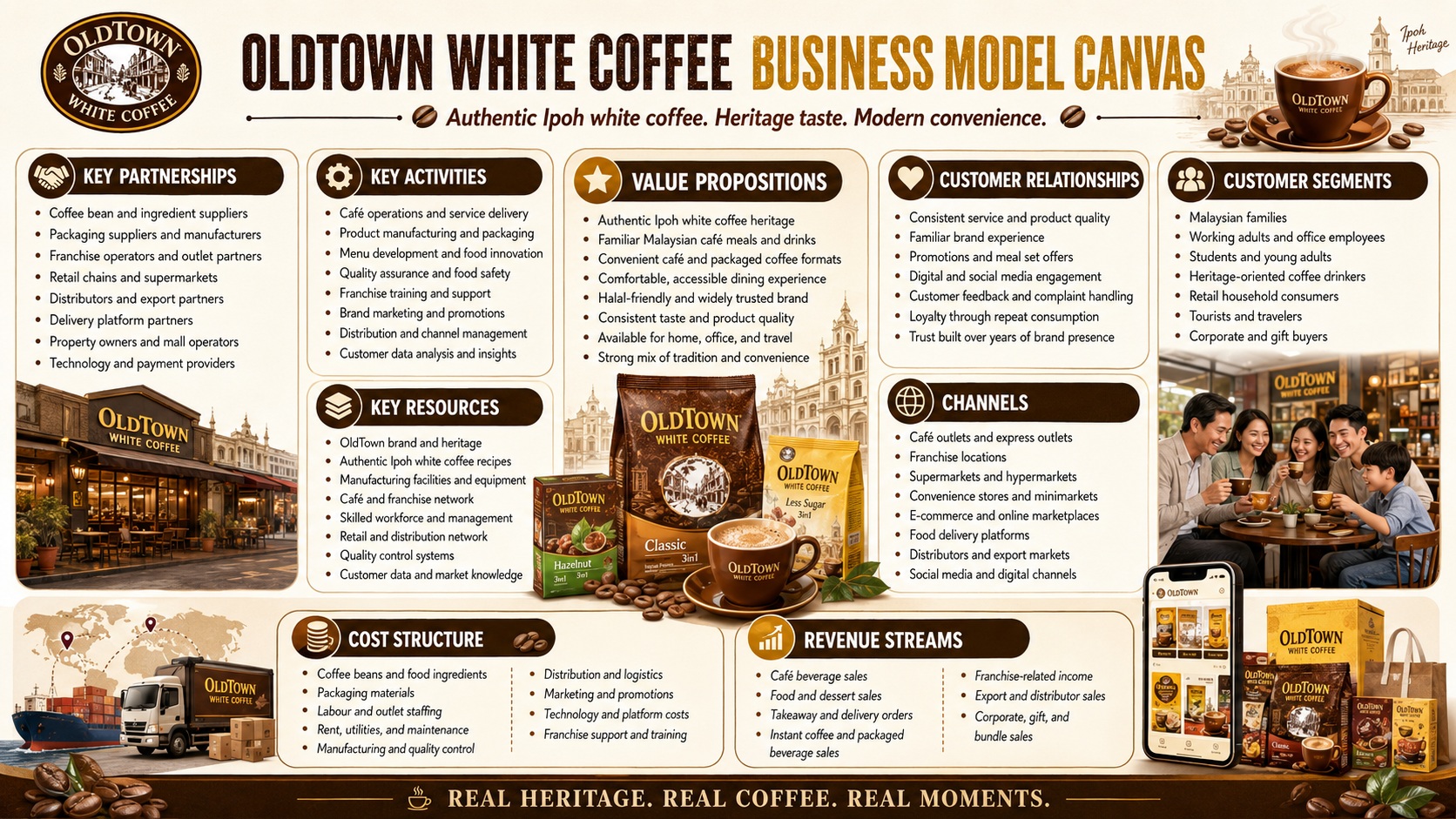
The nine blocks of the Business Model Canvas show how OldTown combines its heritage, foodservice operations, packaged-product business, franchise network, and international distribution capabilities.
Each block performs a different role, but none operates independently. Customer segments influence menu design and product formats, while value propositions determine which channels and relationships are required. Revenue streams depend on key resources, activities, and partnerships, whereas the cost structure reflects the complexity of operating both café and FMCG businesses.
The OldTown White Coffee Business Model Canvas is particularly distinctive because it connects physical customer experiences with scalable consumer products. Café outlets generate direct engagement, food and beverage sales, and brand visibility. Packaged coffee extends the same brand into homes, workplaces, supermarkets, online platforms, and overseas markets.
This integration creates significant growth potential. However, it also requires OldTown to coordinate multiple operating systems, maintain consistent quality, manage franchise partners, control manufacturing standards, and respond to changing consumer expectations.
The following analysis examines each BMC block in detail and explains how it contributes to OldTown’s overall business model.
OldTown serves a broad customer base across restaurant and retail environments. This diversity increases potential demand but requires the company to manage different expectations concerning price, taste, convenience, atmosphere, and product format.
| Customer Segment | Needs and Characteristics | Strategic Importance |
| Malaysian families | Familiar meals, reasonable prices, halal-friendly choices, and comfortable seating | Supports group orders and repeat visits |
| Working adults | Coffee, quick meals, takeaway, delivery, and informal meeting spaces | Generates weekday and office-related demand |
| Students and young adults | Accessible prices, convenient locations, social spaces, and digital offers | Builds future loyalty and social relevance |
| Heritage-oriented customers | Authentic white coffee and traditional Malaysian flavours | Reinforces cultural differentiation |
| Retail consumers | Convenient instant beverages for home or work | Extends the brand beyond café locations |
| Tourists and overseas buyers | Recognisable Malaysian products and cultural experiences | Supports exports, gifting, and destination appeal |
The OldTown White Coffee Business Model Canvas benefits from serving multiple occasions rather than one narrowly defined customer group. A family may visit for dinner, an office worker may purchase takeaway coffee, and the same customer may later buy instant sachets from a supermarket.
More precise segmentation could improve performance. Health-conscious consumers, premium-coffee buyers, digitally active younger customers, and corporate purchasers may require specialised products, messages, and channels.
Customer diversity should not lead to an unfocused proposition. OldTown must identify which segments generate the strongest frequency, transaction value, margin, and long-term loyalty.
OldTown’s principal value proposition combines cultural authenticity with modern accessibility. Customers receive a familiar Malaysian coffee experience without relying solely on traditional independent kopitiams.
| Value Proposition | Customer Benefit | Business Significance |
| Authentic Ipoh white coffee | Provides a recognisable taste connected to Malaysian heritage | Creates emotional and cultural differentiation |
| Malaysian café menu | Offers coffee, breakfast, rice, noodles, snacks, and desserts | Expands customer occasions and average spending |
| Familiar environment | Reduces uncertainty for families, workers, travellers, and groups | Encourages repeat visits |
| Packaged coffee convenience | Enables consumption at home, at work, or while travelling | Extends reach beyond restaurant locations |
| Halal-market accessibility | Provides confidence and relevance for Muslim consumers | Supports domestic and regional demand |
| Consistent branded experience | Offers recognisable products across café and retail formats | Strengthens trust and awareness |
The company is not simply selling a beverage. It packages Malaysian coffee heritage into a repeatable experience that can be delivered by café employees, franchise operators, retailers, or distributors.
Sustaining this proposition requires disciplined execution. Authenticity becomes less meaningful when food quality, outlet condition, service speed, or coffee preparation varies significantly between locations.
OldTown must also balance familiarity with innovation. Excessive change could weaken its traditional identity, but insufficient change could make the brand appear outdated.
OldTown uses physical, retail, digital, and partner channels to reach customers. Channel diversity reduces dependence on restaurant footfall and allows the brand to participate in different purchasing journeys.
| Channel | Role | Why It Matters |
| Café outlets | Provide dine-in, takeaway, menu sales, and brand experience | Creates direct interaction and visible market presence |
| Express outlets | Serve customers who prioritise speed and convenience | Supports smaller-format market access |
| Franchise locations | Extend the network through external operators | Uses partner capital and local market knowledge |
| Supermarkets and hypermarkets | Distribute instant coffee and packaged beverages | Generates high-volume household access |
| Convenience stores | Serve customers seeking quick purchases | Increases availability and consumption frequency |
| E-commerce platforms | Sell products beyond physical retail catchments | Supports bundles and wider geographic reach |
| Delivery platforms | Connect café menus with homes and offices | Captures off-premise demand |
| International distributors | Place packaged products in overseas markets | Enables export growth without opening cafés everywhere |
These channels can reinforce one another. Customers who recognise packaged coffee in supermarkets may be more willing to visit a café, while positive outlet experiences can encourage later retail purchases.
Direct digital channels remain a strategic opportunity. Greater control over ordering, loyalty, promotions, and customer data could reduce reliance on third-party marketplaces.
Channel effectiveness should be measured separately. High sales volume may be less attractive when a platform charges substantial commissions or requires deep promotional discounts.
Customer relationships are developed through café service, product familiarity, promotions, digital engagement, retail availability, and repeated consumption.
| Relationship Method | Description | Commercial Impact |
| Café hospitality | Employees provide ordering support, table service, and service recovery | Shapes satisfaction and repeat visits |
| Familiar products | Recognisable recipes reduce purchasing uncertainty | Encourages habitual consumption |
| Promotions and meal sets | Time-limited offers create urgency and value | Supports traffic and transaction growth |
| Digital communication | Social platforms promote products, offers, and brand stories | Maintains visibility among younger customers |
| Customer feedback | Reviews and complaints reveal quality or service problems | Supports operational improvement |
| Loyalty initiatives | Rewards encourage direct and repeated transactions | Improves retention and customer-data collection |
A strong relationship depends on consistency across every outlet. One poor service experience can weaken confidence built through years of brand familiarity.
Retail relationships operate differently because direct employee interaction is limited. Packaging, product quality, shelf visibility, advertising, and dependable availability must perform the relationship-building role normally handled by café teams.
Customer recovery also matters. Complaints should be treated as operational data rather than isolated incidents, particularly when similar issues appear across several outlets.
OldTown captures income through several connected sources. Diversification provides resilience because demand can shift between dine-in, takeaway, delivery, household consumption, and international retail.
| Revenue Stream | Description | Strategic Role |
| Café beverage sales | Coffee, tea, chocolate, and other drinks | Supports beverage margins and frequent purchases |
| Food and dessert sales | Malaysian meals, snacks, breakfast, and sweets | Raises transaction value |
| Takeaway and delivery | Orders consumed outside the outlet | Captures convenience-led demand |
| Packaged beverage sales | Instant white coffee and related retail products | Provides scalable FMCG revenue |
| Franchise-related income | Fees and commercial returns associated with franchises | Supports network expansion |
| Export and distributor sales | Products supplied through overseas partners | Extends international revenue |
| Corporate and gifting sales | Hampers, bundles, office products, and event orders | Creates seasonal and B2B opportunities |
The OldTown White Coffee Business Model Canvas is strengthened because the company can monetise the same brand across several formats. Revenue diversity, however, should not conceal meaningful differences in profitability.
Management must distinguish between sales growth and economic contribution. Heavily discounted meals, high delivery commissions, inefficient menu items, or expensive retail promotions may increase revenue without producing adequate margins.
Cross-selling represents another opportunity. Café customers could be encouraged to purchase retail packs, while online product buyers could receive incentives to visit physical outlets.
OldTown requires intellectual, physical, human, commercial, and organisational resources to operate its hybrid model.
| Key Resource | Role | Why It Matters |
| OldTown brand | Represents Malaysian white coffee heritage | Supports customer trust and differentiation |
| Coffee recipes and knowledge | Preserve characteristic taste and preparation methods | Protects product identity |
| Manufacturing capabilities | Produce instant beverages at commercial scale | Enables retail and export operations |
| Café and franchise network | Provides physical market access | Generates restaurant revenue and visibility |
| Food recipes and procedures | Guide menu preparation and operating consistency | Reduces variation between locations |
| Employees and franchise teams | Deliver products, service, and daily operations | Directly influence customer satisfaction |
| Retail and distribution relationships | Secure product availability across markets | Converts manufacturing output into sales |
| Customer and transaction data | Reveals demand, frequency, and buying patterns | Supports better decisions and personalisation |
Ownership within a larger coffee group may provide access to procurement expertise, category knowledge, governance practices, and international networks.
Nevertheless, brand equity remains vulnerable. Equipment and premises can be replaced, but customer confidence in authenticity and quality may be difficult to recover after sustained inconsistency.
Human resources are equally important. Recipes and procedures cannot produce a strong customer experience unless employees and franchise operators are properly trained, supported, and evaluated.
OldTown must perform restaurant and consumer-product activities effectively. Weak execution in either area can reduce the overall value of the brand.
| Key Activity | Description | Strategic Importance |
| Café operations | Preparing food and beverages, serving customers, and maintaining outlets | Determines daily customer experience |
| Product manufacturing | Producing, packaging, and inspecting instant beverages | Supports retail scale and export consistency |
| Menu development | Refreshing meals, beverages, bundles, and seasonal offers | Maintains relevance and transaction growth |
| Quality assurance | Monitoring ingredients, preparation, service, and product standards | Protects trust across locations and markets |
| Franchise management | Selecting, training, supporting, and evaluating operators | Enables controlled expansion |
| Brand marketing | Communicating heritage, products, and consumption occasions | Sustains awareness and differentiation |
| Distribution management | Coordinating retailers, warehouses, logistics providers, and exporters | Ensures product availability |
| Data analysis | Evaluating sales, margins, waste, service, and customer behaviour | Improves operational decisions |
Operational discipline is particularly important because a broad menu can increase preparation time, inventory complexity, food waste, and training requirements.
Data should guide simplification. Products that generate limited demand but require unique ingredients or complicated preparation may weaken kitchen productivity.
Continuous quality monitoring is also required across franchises. Standards must be measurable, supported by training, and connected to corrective action.
External partners enable OldTown to access ingredients, locations, technology, distribution, capital, and local operating capabilities.
| Partner | Contribution | Why It Matters |
| Franchise operators | Invest in and manage outlets under the brand | Accelerates expansion and provides local expertise |
| Ingredient suppliers | Provide coffee, food inputs, beverages, and packaging | Supports continuity, quality, and cost control |
| Retail chains | Allocate shelf space and sell packaged products | Connects OldTown with household consumers |
| Distributors and exporters | Move products through domestic and overseas markets | Extends geographic coverage |
| Delivery platforms | Provide ordering visibility and last-mile fulfilment | Captures off-premise demand |
| Property owners | Provide suitable café and kiosk locations | Influences traffic, visibility, and rental costs |
| Technology providers | Support POS, payments, loyalty, and analytics | Enables efficient and connected operations |
| Logistics providers | Transport products between factories, warehouses, retailers, and markets | Maintains availability and service levels |
Partnership quality determines whether brand standards translate into reliable customer experiences. A franchise agreement alone cannot guarantee consistency without training, monitoring, support, and clear accountability.
Supplier diversification is equally important. Coffee-price volatility, ingredient shortages, packaging costs, and logistics disruptions can affect availability and margins across café and retail operations.
Retail partnerships require careful management because shelf position, promotional activity, stock replenishment, and pricing can directly affect consumer-product performance.
OldTown carries costs associated with foodservice, manufacturing, franchising, retail distribution, and brand development.
| Cost Category | Main Components | Business Impact |
| Ingredients and coffee | Coffee, milk, sugar, food ingredients, beverages, and condiments | Directly affects gross margins |
| Labour | Café teams, managers, production staff, and support functions | Determines service capacity and operating quality |
| Property | Rent, renovations, maintenance, utilities, and equipment | Creates substantial fixed-cost exposure |
| Manufacturing | Machinery, production labour, quality control, and packaging | Enables scale but requires volume efficiency |
| Distribution and logistics | Warehousing, transportation, exports, and retailer servicing | Influences product availability and landed cost |
| Marketing and promotions | Advertising, discounts, campaigns, loyalty, and launches | Drives demand but may reduce margins |
| Technology and delivery | Systems, payment fees, commissions, and digital infrastructure | Supports convenience and coordination |
| Franchise support | Training, audits, operational assistance, and brand management | Protects network consistency |
The hybrid model creates cost-sharing opportunities because one brand supports several revenue streams. Marketing investment can benefit both cafés and packaged products.
Complexity remains a concern. Broad menus, outlet variations, multiple packaging formats, numerous partners, and international distribution can increase overhead and make profitability harder to evaluate.
Unit economics should therefore be monitored by outlet, product, channel, and customer segment. Consolidated sales growth can hide underperforming locations or low-margin products.
The Value Proposition Canvas examines how a company’s products and services correspond with what customers are trying to achieve.
For OldTown, the framework explains why heritage alone is insufficient. Customers also expect reasonable prices, convenient access, dependable quality, comfortable dining, suitable food choices, and easy home consumption.
The OldTown White Coffee Business Model Canvas becomes more commercially meaningful when these customer requirements are directly connected with OldTown’s café and retail offerings.
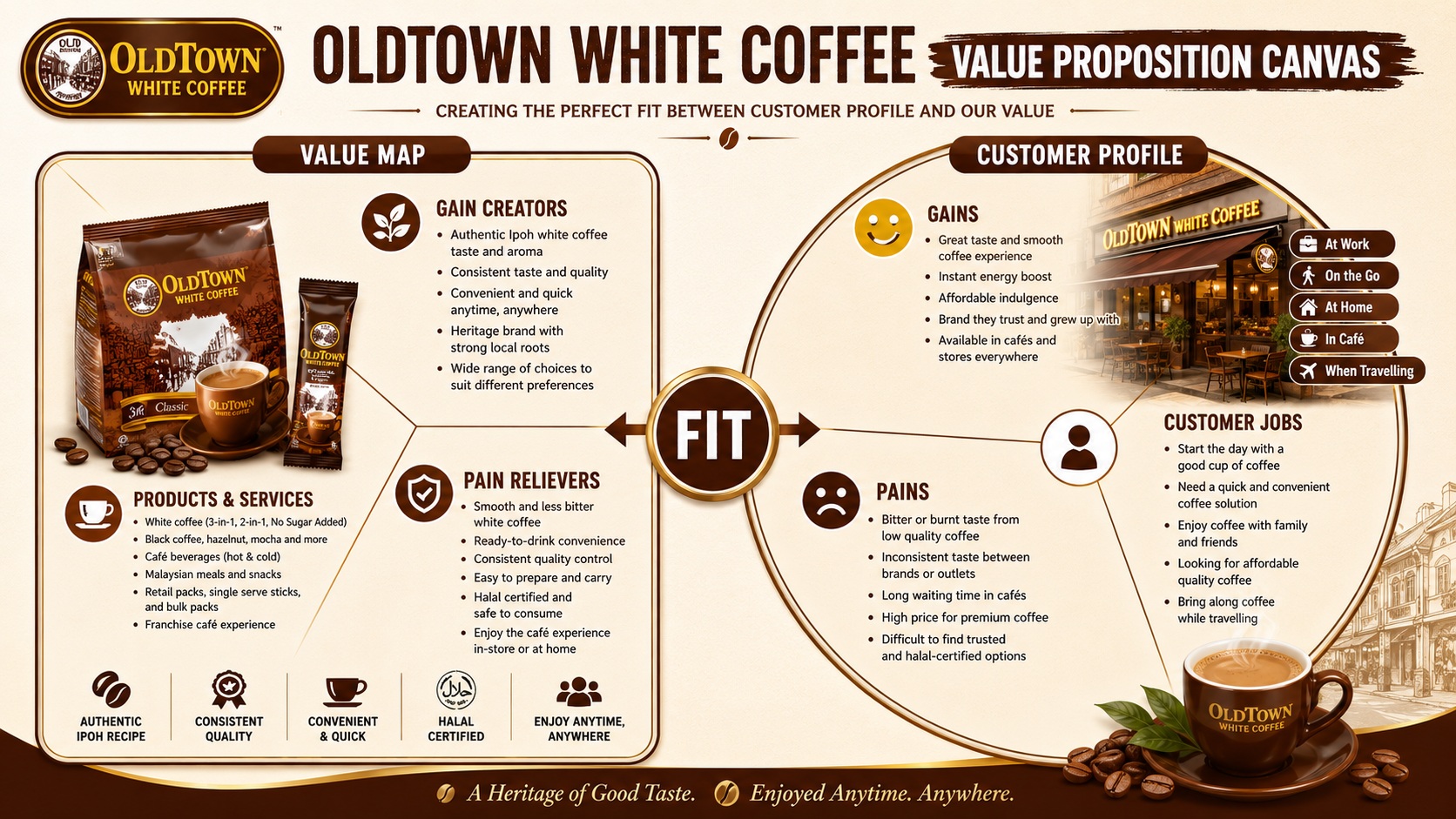
The customer profile identifies customer jobs, pains, and desired gains across café and packaged-product consumption.
| Customer Profile | Details |
| Customer Jobs | Obtain coffee or a convenient meal, meet family or colleagues, experience Malaysian flavours, avoid cooking, purchase beverages for home or work, and find suitable gifts |
| Customer Pains | Rising prices, crowded outlets, slow service, inconsistent food, high sugar content, limited healthy options, delivery delays, unavailable products, and uncomfortable dining environments |
| Customer Gains | Authentic taste, reliable quality, convenience, reasonable value, halal confidence, familiar meals, comfortable surroundings, product availability, and cultural connection |
Customers use OldTown for both functional and emotional purposes. Coffee may provide refreshment, while the brand’s Malaysian identity can generate nostalgia, familiarity, and pride.
Different occasions produce different priorities. A lunch customer may value speed, whereas a tourist could place greater importance on authenticity and cultural experience.
Retail buyers may prioritise convenience and shelf life. Café visitors are more likely to judge service, atmosphere, food presentation, and overall value.
The value map describes how OldTown responds through its products and services, pain relievers, and gain creators.
| Value Map Component | Details |
| Products and Services | White coffee, tea, meals, breakfast, snacks, desserts, dine-in service, takeaway, delivery, instant beverage sachets, retail packs, merchandise, and gifts |
| Pain Relievers | Familiar recipes, multiple channels, packaged products, meal combinations, standard operating procedures, and convenient outlet formats |
| Gain Creators | Ipoh heritage, authentic flavour, Malaysian dishes, comfortable café settings, halal accessibility, recognisable branding, convenient packaging, and international availability |
OldTown creates value by connecting one heritage platform with several forms of consumption. Customers can experience the brand socially in a café or privately through a beverage prepared at home.
Its value map could be strengthened through clearer nutritional choices, more personalised loyalty rewards, faster ordering, improved outlet design, and stronger service consistency.
Signature products also matter. Distinctive food or beverage items can create stronger reasons to visit and make the brand easier to recall.
The following table connects customer requirements directly with OldTown’s value offer.
| Customer Profile | Customer Requirement | Matching Value Map | How Fit Is Created |
| Customer Jobs | Customers want convenient coffee, meals, meeting spaces, and home-consumption products | Products and Services | Cafés, delivery, takeaway, packaged beverages, and retail distribution address several occasions |
| Customer Pains | Buyers face price concerns, limited time, inconsistent quality, and difficulty finding authentic white coffee | Pain Relievers | Familiar menus, standardised recipes, multiple channels, and product availability reduce uncertainty |
| Customer Gains | Customers value authenticity, comfort, convenience, predictable taste, and cultural relevance | Gain Creators | Ipoh heritage, recognised flavours, Malaysian food, accessible outlets, and branded products create functional and emotional value |
Fit is strongest when customers want a familiar Malaysian experience delivered with greater predictability than an independent coffee shop may provide.
The connection becomes weaker when service is slow, food quality varies, prices appear excessive, or digital convenience falls below expectations.
Value fit must consequently be managed at every customer touchpoint rather than assumed from brand recognition alone.
The strongest fit occurs during breakfast, lunch, tea, family dining, casual meetings, travel, office consumption, and situations where customers want familiar Malaysian food without preparing it themselves.
Café fit develops when customers value coffee, meals, seating, and social interaction in one place. Retail fit appears when buyers want the same brand experience in a faster, portable, or more economical format.
OldTown also creates fit for tourists and overseas consumers. Packaged white coffee provides access to a recognisable Malaysian product even where a café is unavailable.
Fit weakens when customers perceive the offer as neither sufficiently traditional nor modern enough. Maintaining relevance requires OldTown to preserve authenticity while improving food quality, speed, nutritional choice, digital convenience, and outlet experience.
A stronger connection between café and retail channels could deepen this fit. Customers who enjoy a beverage in-store could be encouraged to purchase the same product for home use.
The VPC diagram visually connects customer jobs, pains, and gains with OldTown’s products and services, pain relievers, and gain creators.
It should illustrate how the café experience and packaged-product business address different customer contexts while remaining united by the same heritage proposition.
The OldTown White Coffee Business Model Canvas can be compared with Oriental Kopi because both businesses modernise Malaysian kopitiam culture through branded outlets, signature beverages, local food, and packaged consumer products.
Although the two companies operate in a similar market, they represent different business approaches and stages of development. OldTown has a longer operating history, wider packaged-product distribution, and a stronger association with Ipoh white coffee.
Oriental Kopi is a rapidly expanding contemporary kopitiam operator. Its business places considerable emphasis on high-traffic restaurants, signature food, bakery products, retail merchandise, and visually distinctive customer experiences.
| Dimension | OldTown White Coffee | Oriental Kopi |
| Core identity | Established heritage brand centred on Ipoh white coffee | Contemporary Nanyang kopitiam and Malaysian dining brand |
| Primary value proposition | Authentic white coffee, familiar Malaysian meals, and convenient packaged beverages | Nanyang cuisine, signature coffee, egg tarts, bakery items, and experiential dining |
| Business model | Cafés, franchising, manufacturing, retail distribution, and international exports | Company-operated cafés, restaurant expansion, bakery products, merchandise, and growing FMCG sales |
| Product strength | Instant white coffee, café beverages, Malaysian meals, and retail drinks | Oriental Coffee, egg tarts, polo buns, nasi lemak, noodles, rice dishes, and packaged products |
| Market position | Mature brand with broad domestic and international recognition | Fast-growing challenger built around a modern kopitiam experience |
| Customer experience | Familiar, accessible, and functional café-restaurant environment | High-energy dining supported by distinctive interiors and promoted signature products |
| Expansion approach | Packaged products, distributors, cafés, and franchises | Primarily physical outlet expansion supported by consumer products |
| Strategic advantage | Integration between heritage, cafés, manufacturing, and distribution | Strong outlet traffic, contemporary branding, signature products, and rapid expansion |
OldTown’s primary advantage is the breadth of its commercial platform. The company can reach customers through cafés, supermarkets, convenience stores, e-commerce platforms, distributors, and international packaged-product markets.
This structure enables the brand to generate revenue in locations where opening a full restaurant may not be commercially practical. Packaged coffee can also establish awareness before a market is entered through physical outlets.
Oriental Kopi demonstrates the competitive power of a focused and contemporary restaurant experience. Signature products provide strong reasons to visit, while visually distinctive locations encourage social sharing and destination-based dining.
The comparison identifies an important strategic issue for OldTown. Heritage, distribution, and familiarity provide a strong foundation, but they do not automatically create excitement among younger consumers.
OldTown should complement its reputation with refreshed outlets, stronger signature products, improved food quality, faster service, and more engaging digital communication.
Rather than copying Oriental Kopi, the company should reinforce its differentiated position. Authentic Ipoh white coffee, international consumer-product distribution, long-standing recognition, and extensive operating experience are difficult for newer competitors to reproduce.
The OldTown White Coffee Business Model Canvas highlights five reinforcing advantages that distinguish the company from independent cafés, beverage chains, restaurants, and packaged-coffee competitors.
Together, these advantages create a more diversified and resilient model than one relying exclusively on restaurant traffic or supermarket sales.
Sustainable advantage nevertheless depends on execution. Heritage and distribution can attract customers, but product quality and service determine whether they return.
OldTown’s strengths also introduce operational, competitive, and strategic risks.
These challenges do not make the business model unattractive. Instead, they show that operational consistency, product relevance, and customer experience must improve alongside expansion.
Management should also avoid relying excessively on historical brand recognition. Younger consumers may evaluate OldTown based on their latest outlet visit rather than its long-standing heritage.
OldTown should modernise selectively without weakening the heritage that differentiates the brand. The following recommendations focus on improving competitiveness, customer value, outlet productivity, and unit-level economics.
OldTown should make its leadership in white coffee more visible through tasting experiences, origin storytelling, brewing education, premium variations, merchandise, and experience-based campaigns.
The objective is to prevent the brand from being perceived merely as another Malaysian restaurant.
Coffee heritage could also be incorporated more prominently into outlet design, packaging, digital content, and employee product knowledge.
Oriental Kopi’s growth illustrates the value of products that create clear customer recall and reasons to visit.
OldTown should identify a smaller collection of beverages, meals, snacks, or desserts that can become unmistakably associated with the brand.
Each signature product should be distinctive, operationally manageable, visually attractive, and suitable for digital promotion.
Management should assess menu items using demand, contribution margin, preparation time, waste, ratings, and ingredient complexity.
High-performing Malaysian favourites deserve greater emphasis. Low-value items that slow kitchen operations or create unnecessary inventory should be removed, consolidated, or redesigned.
Menu simplification could improve speed, consistency, employee training, procurement efficiency, and profitability.
A stronger application or membership platform could combine ordering, payment, loyalty rewards, personalised promotions, gifting, product subscriptions, and café-retail cross-selling.
Direct engagement would improve access to customer data and reduce excessive dependence on third-party delivery and marketplace platforms.
Customer information should be used to understand visit frequency, preferred products, purchase occasions, and promotion responsiveness.
Lower-sugar beverages, clearer nutritional information, smaller portions, plant-based alternatives, and lighter meals could attract consumers who limit traditional coffee or kopitiam food.
New products should remain consistent with OldTown’s heritage rather than appearing disconnected from the brand.
Product innovation should focus on preserving taste while addressing health concerns that may discourage frequent consumption.
Large cafés, neighbourhood outlets, shopping-centre locations, transport-hub kiosks, express counters, and delivery-oriented kitchens should use different investment and operating models.
Selected locations could be refreshed with more contemporary layouts, improved lighting, clearer heritage storytelling, faster ordering, and stronger product presentation.
Format discipline would reduce rental exposure and align each location with actual customer demand.
Franchise operators should receive structured training, clear performance standards, regular audits, and practical operational support.
Customer experience measures should cover food quality, service time, cleanliness, complaint handling, and brand presentation.
Corrective action must be applied consistently because franchise underperformance can damage the entire brand rather than one outlet alone.
The OldTown White Coffee Business Model Canvas explains how a Malaysian heritage product developed into a hybrid café, franchise, manufacturing, retail, and export business.
Its competitive strength comes from combining authentic Ipoh white coffee, Malaysian food, physical café experiences, packaged beverage convenience, extensive distribution, and strong brand recognition.
OldTown is therefore not simply operating coffee shops. It manages a cultural brand platform that connects foodservice, consumer products, franchise operators, retailers, distributors, and international customers.
The comparison with Oriental Kopi demonstrates that heritage and distribution remain valuable, but contemporary consumers also respond to signature products, attractive environments, digital visibility, and memorable restaurant experiences.
Future performance will depend on OldTown’s ability to protect authenticity while improving service reliability, menu economics, innovation, digital engagement, franchise consistency, and outlet productivity.
Strong execution could allow the company to remain a relevant Malaysian coffee institution while extending its influence across regional and international markets.
This article is provided for educational and business analysis purposes only. Its content is based on publicly available information, general market observations, and independent strategic interpretation.
It does not constitute financial advice, investment advice, legal advice, franchise advice, or an official statement from OldTown White Coffee, OldTown Berhad, Kopitiam Asia Pacific, Jacobs Douwe Egberts, JDE Peet’s, Oriental Kopi, or any related entity.
Readers should conduct independent research and obtain appropriate professional advice before making business, investment, partnership, or franchise decisions.
All trademarks, logos, copyrights, brand names, product names, and related materials mentioned or displayed belong to their respective owners.
Explore OldTown White Coffee’s nine BMC blocks, Value Proposition Canvas, Oriental Kopi comparison, competitive advantages, risks, and strategic recommendations.
Explore the Quipper Business Model Canvas, nine BMC blocks, Value Proposition Canvas, Ruangguru and Pahamify… Read More
Explore the CARPUT Business Model Canvas, nine BMC blocks, Value Proposition Canvas, competitor comparison, competitive… Read More
Explore the Boost Business Model Canvas, nine BMC blocks, Value Proposition Canvas, competitor comparison, advantages,… Read More
Explore the Domino's Pizza Business Model Canvas, nine BMC blocks, Value Proposition Canvas, Pizza Hut… Read More
Explore the Mie Gacoan Business Model Canvas, including its customer segments, value propositions, revenue streams,… Read More
Restaurant Business Model Canvas: A Practical Guide to Designing, Evaluating, and Improving Restaurant Business Models… Read More