FedEx Business Model Canvas
Explore the FedEx Business Model Canvas, nine BMC blocks, Value Proposition Canvas, UPS and DHL comparison, competitive advantages, risks, and strategic recommendations.
Explore the Kopi Kenangan Business Model Canvas and learn how the Indonesian coffee brand uses affordable pricing, local flavours, digital loyalty, and regional expansion to grow.
BMC Article No: BMC #060
Updated in 2026: This article has been rewritten with a stronger business story, clearer Business Model Canvas structure, latest developments, Value Proposition Canvas analysis, competitive advantages, risks, and strategic lessons from Kopi Kenangan’s growth journey.
Kopi Kenangan is an Indonesian coffee chain built around affordable premium coffee, fast service, local taste, digital ordering, and high store density. Founded in 2017, the brand entered a clear market gap between expensive international coffee chains and traditional low-cost coffee sellers.
Its signature idea was simple. Customers wanted good coffee that felt modern, tasted familiar, and remained affordable enough for regular purchase. Kopi Kenangan answered that need through palm sugar milk coffee, compact outlets, app-driven engagement, delivery access, and a brand name that carried emotional memory.
This makes the Kopi Kenangan Business Model Canvas useful for entrepreneurs and business strategists. It shows how a beverage company can turn a small-ticket product into a repeat-purchase system supported by technology, supply chain control, brand storytelling, and regional expansion.
Kopi Kenangan’s business model is built around grab-and-go coffee at scale. The company sells coffee, milk-based drinks, tea, snacks, bread, cookies, and related F&B products through physical outlets, mobile ordering, delivery platforms, and international stores under the Kenangan Coffee name.
Its core strength is frequency. A customer may buy one drink at a time, but the model becomes powerful when thousands of customers repeat the habit across many locations and digital touchpoints. This is why accessibility, speed, pricing, and consistency matter more than long café dwell time.
Growth also comes from brand architecture. Kopi Kenangan does not operate only as a coffee counter. It has extended into food and complementary products through brands such as Cerita Roti and other related F&B concepts.
The Kopi Kenangan Business Model Canvas therefore shows a business that looks simple from the customer side, but requires disciplined execution behind the counter. Store expansion, menu development, barista training, procurement, app performance, delivery economics, quality control, and customer data must work together.
Business Model Canvas, or BMC, is a practical tool used to understand how a company creates, delivers, and captures value. It breaks a business into nine connected building blocks.
| BMC Block | Main Question |
|---|---|
| Customer Segments | Who does the business serve? |
| Value Propositions | What value does the business offer? |
| Channels | How does the business reach customers? |
| Customer Relationships | How does the business build loyalty? |
| Revenue Streams | How does the business make money? |
| Key Resources | What assets does the business need? |
| Key Activities | What must the business do well? |
| Key Partnerships | Who helps the business operate? |
| Cost Structure | What are the major costs? |
For Kopi Kenangan, BMC is useful because the company is not only selling drinks. The Kopi Kenangan Business Model Canvas helps explain the operating system behind its pricing, store network, digital retention, supply chain, menu innovation, and international growth.
Kopi Kenangan was founded in Jakarta by Edward Tirtanata, James Prananto, and Cynthia Chaerunnisa. The brand became known for popularizing affordable palm sugar milk coffee for Indonesia’s urban consumers.
Its early growth came from a clear proposition: café-style coffee without café-style pricing. The company built a repeatable format that could be placed near offices, malls, commuter zones, residential areas, and other high-traffic locations.
By 2021, Kopi Kenangan reached unicorn status after a Series C funding round that valued the business at more than US$1 billion. Later expansion took the brand into several international markets under the Kenangan Coffee name, including Malaysia, Singapore, the Philippines, India, Australia, and Taiwan.
Recent reports also indicate that the group achieved its first full-year profit in 2025, supported by revenue growth, store expansion, and improving operational discipline. That matters because the story has moved beyond growth alone. Profitability, store productivity, margin control, and international execution are now central to the brand’s next phase.
Kopi Kenangan is interesting because it turns coffee into an accessible daily habit. The company does not need every customer to spend like a premium café customer. Instead, it needs many customers to buy often, order quickly, and return through familiar products and digital incentives.
Another strategic point is localization. The brand’s signature drinks use Indonesian taste cues, especially palm sugar milk coffee. This creates a stronger local identity than a generic global coffee menu.
Digital capability also strengthens the model. App ordering, loyalty rewards, customer data, promotions, and delivery partnerships help the company influence repeat purchases beyond the physical outlet.
Regional ambition adds another layer. A coffee chain that can standardize recipes, training, store formats, procurement, and brand experience may scale across markets with similar urban consumption patterns. From a strategy perspective, the Kopi Kenangan Business Model Canvas shows how affordable premium positioning, operating discipline, and cultural relevance can work together in a crowded F&B category.
Kopi Kenangan’s current story is no longer only about rapid store rollout. It is also about profitable growth, regional expansion, and stronger operating maturity.
Reports in early 2026 indicated that Kopi Kenangan recorded its first profitable year at group level for FY2025, with revenue growth supported by Indonesia’s performance, same-store sales, and customer acquisition. This shifts investor attention from pure expansion to sustainable economics.
The company has also expanded internationally under the Kenangan Coffee brand. Malaysia became its first overseas market in 2022, while later moves included Singapore, the Philippines, India, Australia, and Taiwan.
Scale brings pressure. More stores create stronger brand visibility, but they also increase exposure to rental, staffing, logistics, quality control, and market localization risk. New markets require local property access, menu adaptation, regulatory compliance, and partner capability.
Competition is also intensifying. Kopi Kenangan competes with global coffee chains, local coffee brands, convenience-store coffee, bubble tea chains, dessert drink players, and aggressive value-focused entrants. The next phase will depend on whether the company can protect affordability while improving margins.
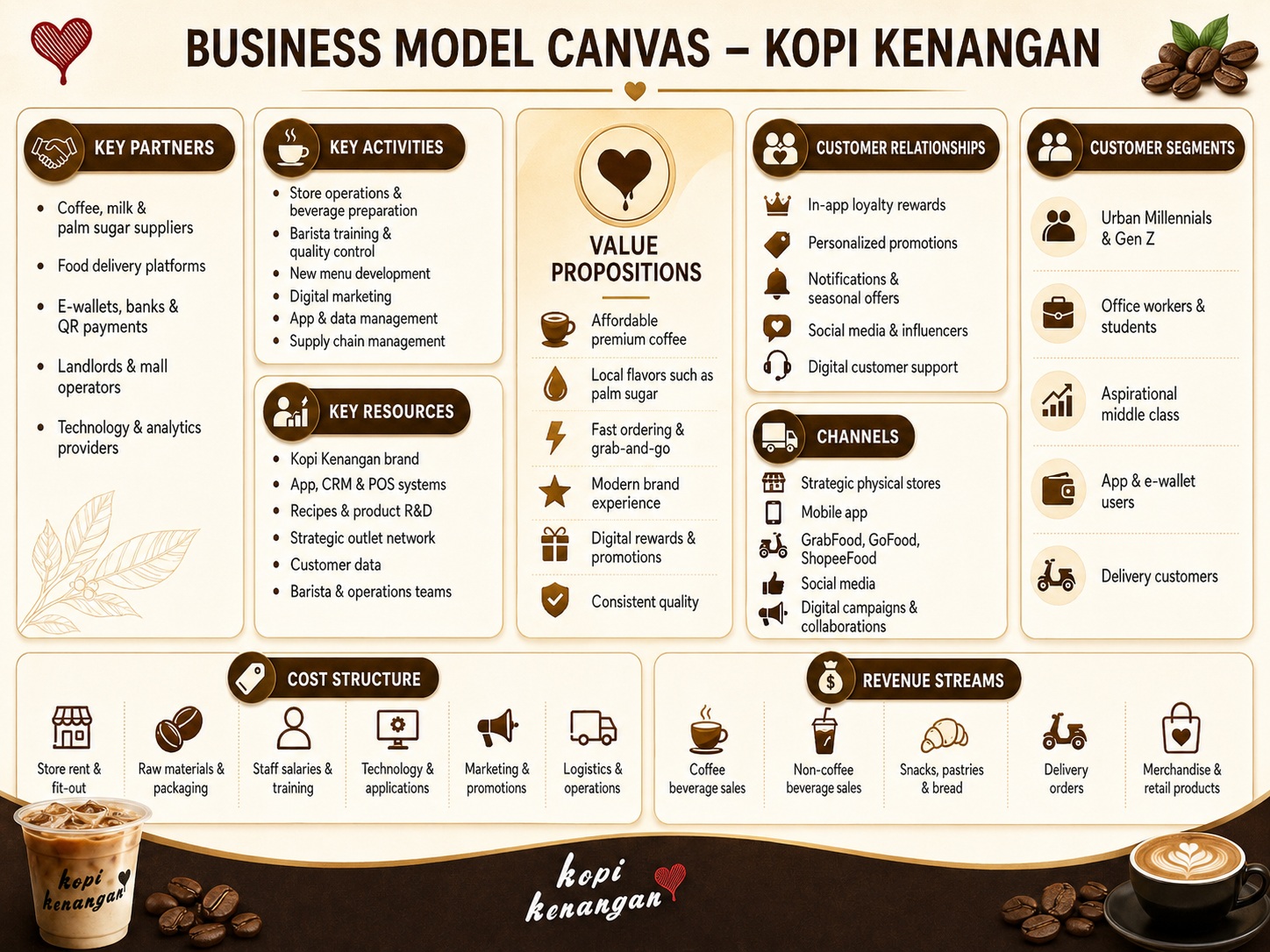
Before going into each block, the summary below gives a quick view of how the model works. It shows who the brand serves, what value it offers, how it reaches customers, how revenue is generated, and what capabilities keep the engine running.
| BMC Block | Kopi Kenangan Application |
| Customer Segments | Urban millennials, Gen Z, office workers, students, commuters, delivery users, families, and international coffee consumers. |
| Value Propositions | Affordable premium coffee, local flavours, fast service, digital convenience, consistent quality, and lifestyle relevance. |
| Channels | Physical outlets, mobile app, delivery platforms, malls, office districts, social media, and international stores. |
| Customer Relationships | Loyalty rewards, app promotions, personalized offers, social media engagement, product launches, and habit-based repeat buying. |
| Revenue Streams | Beverage sales, food add-ons, delivery orders, app-based sales, packaged products, merchandise, and international expansion. |
| Key Resources | Brand equity, recipes, store network, trained staff, supply chain, technology platform, customer data, and investor backing. |
| Key Activities | Coffee preparation, menu innovation, outlet operations, sourcing, training, marketing, app management, and quality control. |
| Key Partnerships | Ingredient suppliers, landlords, delivery platforms, payment partners, investors, logistics providers, and market-entry partners. |
| Cost Structure | Ingredients, labour, rent, packaging, equipment, delivery fees, marketing, technology, training, logistics, and compliance. |
The following is the overall BMC diagram for Kopi Kenangan:
Customer segments describe who the business serves. Kopi Kenangan serves a broad base, but its strongest appeal is among urban, mobile, value-conscious, and digitally active consumers.
Young professionals buy it for convenience during workdays. Students choose it as an affordable treat. Commuters want fast coffee before or between trips. Delivery users order it for home, office, and group consumption. International consumers may try it as an Indonesian coffee brand with a modern retail format.
This customer base is attractive because the purchase occasion is frequent. Coffee can be a morning habit, afternoon boost, social drink, delivery order, or small reward after work.
| Customer Segment | What They Need | How Kopi Kenangan Serves Them |
| Young professionals | Quick coffee at accessible prices. | Places stores near offices and supports app ordering. |
| Gen Z consumers | Trendy drinks with social appeal. | Offers local names, modern packaging, and digital campaigns. |
| Students | Affordable indulgence on a limited budget. | Provides lower-priced alternatives to premium cafés. |
| Commuters | Fast grab-and-go service. | Uses compact outlets and high-traffic locations. |
| Delivery users | Convenient ordering without store visits. | Works through delivery platforms and digital channels. |
| International customers | Southeast Asian coffee experience. | Expands through Kenangan Coffee in overseas markets. |
The Kopi Kenangan Business Model Canvas shows that the brand is not tied to one narrow audience. Its opportunity sits across many daily beverage occasions.
The value proposition explains why customers choose Kopi Kenangan. At the simplest level, the brand offers premium-style coffee at accessible prices, supported by speed, convenience, local flavour, and brand familiarity.
Its strongest proposition is affordable indulgence. Customers get a drink that feels more special than instant coffee, yet less expensive than global premium café chains. This middle position gives the brand mass-market reach.
Local taste is another advantage. Palm sugar milk coffee, creamy textures, and culturally familiar names make the products feel rooted in Indonesian preferences rather than imported café culture.
| Value Proposition | Customer Benefit | Business Impact |
| Affordable premium coffee | Customers enjoy café-style drinks more often. | Increases frequency and broadens the market. |
| Local flavour relevance | Products feel familiar and culturally resonant. | Differentiates the brand from global chains. |
| Fast service | Customers save time during busy routines. | Supports high outlet throughput. |
| Digital convenience | Orders, rewards, and promos are easier to access. | Improves retention and customer data capture. |
| Consistent quality | Customers know what to expect across outlets. | Builds trust and repeat purchase. |
| Lifestyle branding | Drinks feel shareable and modern. | Strengthens visibility among younger consumers. |
Kopi Kenangan’s value is not only coffee. It is the combination of taste, price, speed, convenience, memory, and habit.
Channels explain how Kopi Kenangan reaches customers. This is one of the most important parts of the Kopi Kenangan Business Model Canvas because coffee purchases are often convenience-driven.
The brand uses an integrated channel model. Physical outlets create visibility and capture walk-in demand. Delivery platforms extend access into homes and offices. Mobile ordering and loyalty channels support repeat purchases. Social media creates awareness for new products and promotions.
Location strategy matters because many customers choose the nearest acceptable option. A strong brand can lose a transaction if the store is not convenient, the queue is too long, or delivery is unavailable.
| Channel | Examples | Strategic Role |
| Physical outlets | Malls, office areas, high-street stores, and transit zones. | Captures walk-in and impulse purchases. |
| Mobile app | Ordering, rewards, promotions, and customer history. | Builds repeat engagement and data ownership. |
| Delivery platforms | Food delivery apps and marketplace ordering. | Serves home, office, and group orders. |
| Social media | Product launches, influencer content, and campaign posts. | Keeps the brand visible among digital customers. |
| International stores | Kenangan Coffee outlets outside Indonesia. | Extends the brand into new urban markets. |
Strong channels make the product easier to buy. In a low-switching-cost category, access can become as important as taste.
Customer relationships describe how Kopi Kenangan keeps people coming back. The model is built on familiarity, convenience, rewards, promotions, and product novelty.
The relationship is not luxury-led. Most customers do not return because they receive a highly personalized café experience. They return because the brand is visible, the product is predictable, the price feels fair, and the ordering process is easy.
Digital engagement strengthens this relationship. App-based rewards, customer history, targeted offers, and delivery promotions help the company create reasons for repeat purchase. Social media adds another layer by making new drinks, limited offers, and brand stories more visible.
| Relationship Driver | How It Works | Example |
| Loyalty rewards | Customers receive points, vouchers, or benefits. | A regular buyer returns to redeem app rewards. |
| Product novelty | New drinks create fresh reasons to try. | A seasonal palm sugar variant drives trial. |
| Convenience | Easy access reduces buying friction. | A worker orders before leaving the office. |
| Social engagement | Campaigns keep the brand in customer feeds. | A limited launch spreads through short-form content. |
| Consistency | Familiar taste supports trust. | Customers reorder the same favourite drink. |
Kopi Kenangan’s relationship model is based on repeat relevance. The brand must stay easy, familiar, rewarding, and interesting.
Revenue streams show how the business makes money. Kopi Kenangan earns mainly from beverage sales, supported by food add-ons, delivery orders, digital transactions, packaged products, and international expansion.
The main revenue engine is drink volume. A single order may be small, but scale changes the economics when repeated across many stores and platforms. Add-ons, snacks, and bundled purchases can increase average ticket size.
Delivery expands the addressable market, although platform fees must be controlled. App-based sales can improve customer retention and reduce reliance on third-party channels over time.
| Revenue Stream | Description | Why It Matters |
| Beverage sales | Coffee, milk drinks, tea, and specialty beverages. | Forms the core revenue base. |
| Food add-ons | Bread, cookies, snacks, and side products. | Increases basket size and consumption occasions. |
| Delivery orders | Sales through food delivery platforms. | Captures demand beyond walk-in traffic. |
| App-based sales | Orders, promotions, and loyalty-driven purchases. | Builds direct customer relationship. |
| Packaged products | Retail coffee or ready-to-consume items where available. | Extends the brand beyond stores. |
| International expansion | Overseas outlets under Kenangan Coffee. | Creates new market growth opportunities. |
The Kopi Kenangan Business Model Canvas shows a revenue model based on frequency, accessibility, add-ons, and network scale.
Key resources are the assets required to deliver the business model. For Kopi Kenangan, the most important resources are brand equity, recipes, outlet network, supply chain, digital platform, trained people, customer data, and financial backing.
Brand equity matters because customers often choose quickly. A familiar name reduces purchase risk and helps the company win impulse decisions.
Recipes and operating standards are equally important. Customers expect the same taste in different outlets, cities, and countries. Without consistency, the brand becomes harder to trust.
| Key Resource | Role in the Business Model | Strategic Value |
| Brand equity | Recognition, trust, and emotional memory. | Helps the brand stand out in a crowded market. |
| Recipes and menu IP | Drink formulas, local flavours, and product concepts. | Protects consistency and supports innovation. |
| Outlet network | Physical access across high-demand locations. | Improves visibility and convenience. |
| Supply chain | Coffee, milk, sugar, packaging, and logistics. | Supports quality, availability, and cost control. |
| Trained workforce | Baristas, managers, trainers, and support teams. | Maintains speed and service quality. |
| Digital platform | App, loyalty, customer data, and campaign tools. | Improves retention and personalization. |
| Investor backing | Capital, networks, and growth support. | Enables expansion and capability building. |
Together, these resources make Kopi Kenangan more than a drink seller. They create a repeatable coffee retail system.
Key activities are the things Kopi Kenangan must do well to remain competitive. These include beverage preparation, menu innovation, store operations, sourcing, training, marketing, app management, delivery coordination, and quality control.
The most important activity is execution consistency. Customers expect their favourite drink to taste the same across outlets. Training, recipes, equipment, preparation steps, and audits therefore matter.
Menu innovation is also critical. Coffee and lifestyle beverage trends move quickly. The brand must introduce new products without weakening its core identity around affordable premium coffee.
| Key Activity | What It Involves | Why It Matters |
| Beverage preparation | Making drinks according to recipe, speed, hygiene, and quality standards. | Protects customer satisfaction. |
| Menu innovation | Developing new flavours, formats, and limited-time products. | Keeps the brand fresh. |
| Store operations | Managing staffing, queues, cleanliness, inventory, and service. | Supports outlet productivity. |
| Sourcing | Securing ingredients, packaging, and equipment. | Protects quality and margin. |
| Training | Preparing baristas and store teams. | Maintains consistency across outlets. |
| Digital management | Improving app features, rewards, promos, and analytics. | Strengthens direct engagement. |
| Quality control | Audits, SOP checks, and customer feedback loops. | Reduces inconsistency as the network scales. |
The Kopi Kenangan Business Model Canvas makes one point clear: operational discipline is the engine behind affordable coffee at scale.
Key partnerships help Kopi Kenangan operate, scale, and reduce execution risk. These partners include ingredient suppliers, packaging suppliers, landlords, delivery platforms, payment providers, logistics partners, investors, technology providers, and overseas market partners.
The company cannot scale through internal capability alone. Good landlords improve store access. Reliable suppliers protect consistency. Delivery platforms increase reach. Payment partners reduce friction. Investors provide capital and strategic networks.
Partnership quality matters because weak partners can damage the customer experience. Poor ingredients affect taste, late deliveries hurt service, weak locations reduce sales, and underperforming market partners can slow international growth.
| Partner Type | Examples | Contribution to the Business Model |
| Ingredient suppliers | Coffee, milk, palm sugar, tea, and food inputs. | Support quality and availability. |
| Packaging suppliers | Cups, lids, bags, seals, and branded materials. | Protect presentation and convenience. |
| Landlords | Malls, commercial buildings, and transport-linked sites. | Provide customer access. |
| Delivery platforms | Food delivery marketplaces. | Extend demand beyond store visits. |
| Payment partners | E-wallets, QR payments, cards, and app payment tools. | Makes transactions faster and easier. |
| Technology providers | POS, analytics, CRM, and backend systems. | Support scale and data use. |
| Investors | Venture capital and strategic investors. | Provide funding, credibility, and networks. |
These partnerships allow Kopi Kenangan to focus on product, brand, store execution, and growth.
Cost structure explains where the money goes. Kopi Kenangan operates in a price-sensitive market, so cost control is critical.
The main costs include ingredients, packaging, labour, rental, utilities, equipment, logistics, delivery commissions, marketing, technology, training, compliance, and headquarters support. Some costs increase with store growth. Others rise when competition forces heavier promotions.
The company must manage a difficult balance. Customers expect good coffee, accessible pricing, fast service, attractive packaging, and convenient channels. At the same time, the business must protect margins from input inflation, rental pressure, wage costs, and international expansion complexity.
| Cost Category | Examples | Management Challenge |
| Ingredients | Coffee beans, milk, palm sugar, tea, and food inputs. | Quality must be maintained while controlling cost. |
| Packaging | Cups, lids, bags, seals, and printed materials. | Branding and convenience must remain affordable. |
| Labour | Baristas, store teams, trainers, and managers. | Service speed depends on staffing and training. |
| Rental and utilities | Store rent, electricity, water, and maintenance. | Good locations improve sales but raise fixed costs. |
| Equipment | Coffee machines, refrigeration, POS, and kitchen tools. | Reliability affects speed and product consistency. |
| Marketing | Campaigns, promotions, content, and influencer activity. | Visibility must generate measurable traffic. |
| Technology | App, loyalty, analytics, POS, and integrations. | Digital investment must improve retention or efficiency. |
| Logistics | Warehousing, replenishment, and delivery coordination. | Wider expansion increases complexity. |
Cost discipline determines whether scale becomes profit or pressure.
Kopi Kenangan offers several useful lessons for entrepreneurs, franchise owners, and business strategists.
The first lesson is that a clear price gap can create a large opportunity. Kopi Kenangan found space between premium café chains and low-cost traditional coffee. That gap gave the brand a simple reason to exist.
The second lesson is that local taste matters. Palm sugar milk coffee was not just a product. It was a culturally familiar anchor that made the brand feel relevant.
The third lesson is that small-ticket businesses need frequency. A coffee chain must create repeat buying through access, consistency, rewards, and product refreshment.
The fourth lesson is that digital channels can strengthen physical retail. App data, loyalty rewards, and delivery integrations make the outlet network more productive.
The fifth lesson is that expansion must be supported by control. More stores are valuable only when quality, speed, training, and margins remain healthy.
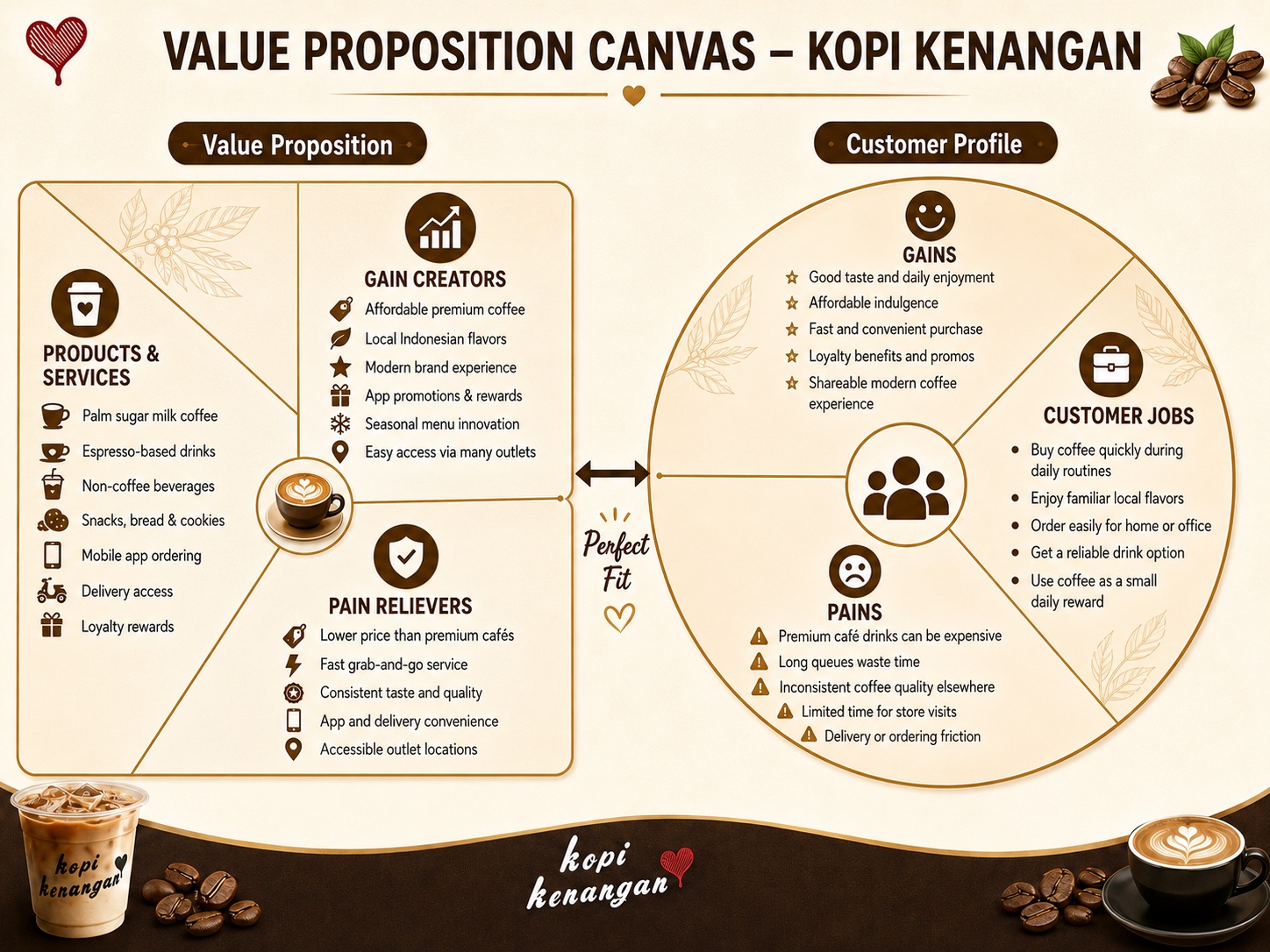
The Value Proposition Canvas helps explain the fit between Kopi Kenangan’s offer and customer needs. Customers are not only buying caffeine. They are buying convenience, affordability, taste familiarity, emotional branding, and a small daily reward.
This customer profile explains what Kopi Kenangan customers are trying to achieve, what problems they face, and what benefits they want.
For customer jobs, customers want quick coffee, affordable indulgence, familiar flavours, convenient ordering, social drinks, and reliable options during daily routines. These jobs happen frequently, especially among urban workers, students, and commuters.
For customer pains, customers face expensive premium cafés, inconsistent local coffee quality, long queues, limited time, delivery friction, and too many beverage choices. Kopi Kenangan reduces these pains through accessible pricing, digital ordering, store reach, and consistent recipes.
For customer gains, customers want good taste, speed, rewards, local identity, attractive packaging, cashback, and drinks they can share socially. The brand creates these gains through app features, promotions, signature products, and modern retail presentation.
The value proposition explains how Kopi Kenangan responds to those jobs, pains, and gains. Its core offer is affordable premium coffee that is fast, familiar, and easy to buy.
Products and services include palm sugar milk coffee, espresso-based drinks, non-coffee beverages, tea, milk drinks, snacks, bread, cookies, app ordering, delivery access, loyalty rewards, and seasonal menu launches.
Pain relievers include lower pricing than many premium café chains, faster grab-and-go formats, consistent drink recipes, digital ordering, delivery availability, and accessible outlet locations.
Gain creators include local flavour storytelling, rewards, social media-friendly packaging, product novelty, emotional drink names, and the convenience of turning coffee into a daily routine.
| Customer Profile | Details | Matching Value Proposition | How Kopi Kenangan Creates Fit |
| Customer Jobs | Customers want quick coffee, affordable treats, local flavours, social drinks, and easy ordering. | Products and Services | Coffee, milk drinks, tea, snacks, app ordering, delivery access, and loyalty rewards. |
| Customer Pains | Customers face high prices, long waits, inconsistent quality, limited time, and inconvenient locations. | Pain Relievers | Accessible pricing, grab-and-go outlets, standard recipes, app ordering, and delivery platforms. |
| Customer Gains | Customers want good taste, rewards, convenience, local identity, and shareable products. | Gain Creators | Signature flavours, loyalty benefits, modern packaging, promotions, and lifestyle branding. |
This fit explains why Kopi Kenangan can become habitual. The brand connects practical needs with emotional and social benefits.
Kopi Kenangan’s competitive advantage comes from five connected strengths:
Strategic implication: Kopi Kenangan competes through a system, not one drink. The stronger the system becomes, the harder it is for smaller players to match its mix of price, access, taste, loyalty, and brand memory.
Kopi Kenangan still faces five major business risks:
Strategic implication: These risks show that growth must be balanced with control. Kopi Kenangan has strong market momentum, but long-term success depends on quality, margins, relevance, and disciplined expansion.
The Kopi Kenangan Business Model Canvas shows how an Indonesian coffee brand turned affordable premium coffee into a scalable retail system. Its success is not based on coffee alone. The model combines local taste, accessible pricing, compact outlets, digital engagement, loyalty rewards, delivery access, operational discipline, and regional ambition.
Kopi Kenangan works because it solves a simple customer need with strong execution. People want coffee that tastes good, feels modern, arrives quickly, remains affordable, and fits their daily routine.
For business owners, the lesson is clear. A strong F&B business is not only about the recipe. It is about making the product easy to buy, easy to repeat, easy to remember, and easy to scale.
This article is for informational and educational purposes only. It is based on publicly available information and independent business analysis. No part of the analysis represents official information from Kopi Kenangan, Kenangan Coffee, PT Bumi Berkah Boga, or any related company. Readers should conduct their own research before making business, investment, or strategic decisions.
Explore the FedEx Business Model Canvas, nine BMC blocks, Value Proposition Canvas, UPS and DHL… Read More
Explore the Quipper Business Model Canvas, nine BMC blocks, Value Proposition Canvas, Ruangguru and Pahamify… Read More
Explore the CARPUT Business Model Canvas, nine BMC blocks, Value Proposition Canvas, competitor comparison, competitive… Read More
Explore the Boost Business Model Canvas, nine BMC blocks, Value Proposition Canvas, competitor comparison, advantages,… Read More
Explore the Domino's Pizza Business Model Canvas, nine BMC blocks, Value Proposition Canvas, Pizza Hut… Read More
Explore the Mie Gacoan Business Model Canvas, including its customer segments, value propositions, revenue streams,… Read More