Quipper Business Model Canvas
Explore the Quipper Business Model Canvas, nine BMC blocks, Value Proposition Canvas, Ruangguru and Pahamify comparison, competitive advantages, risks, and strategic recommendations.
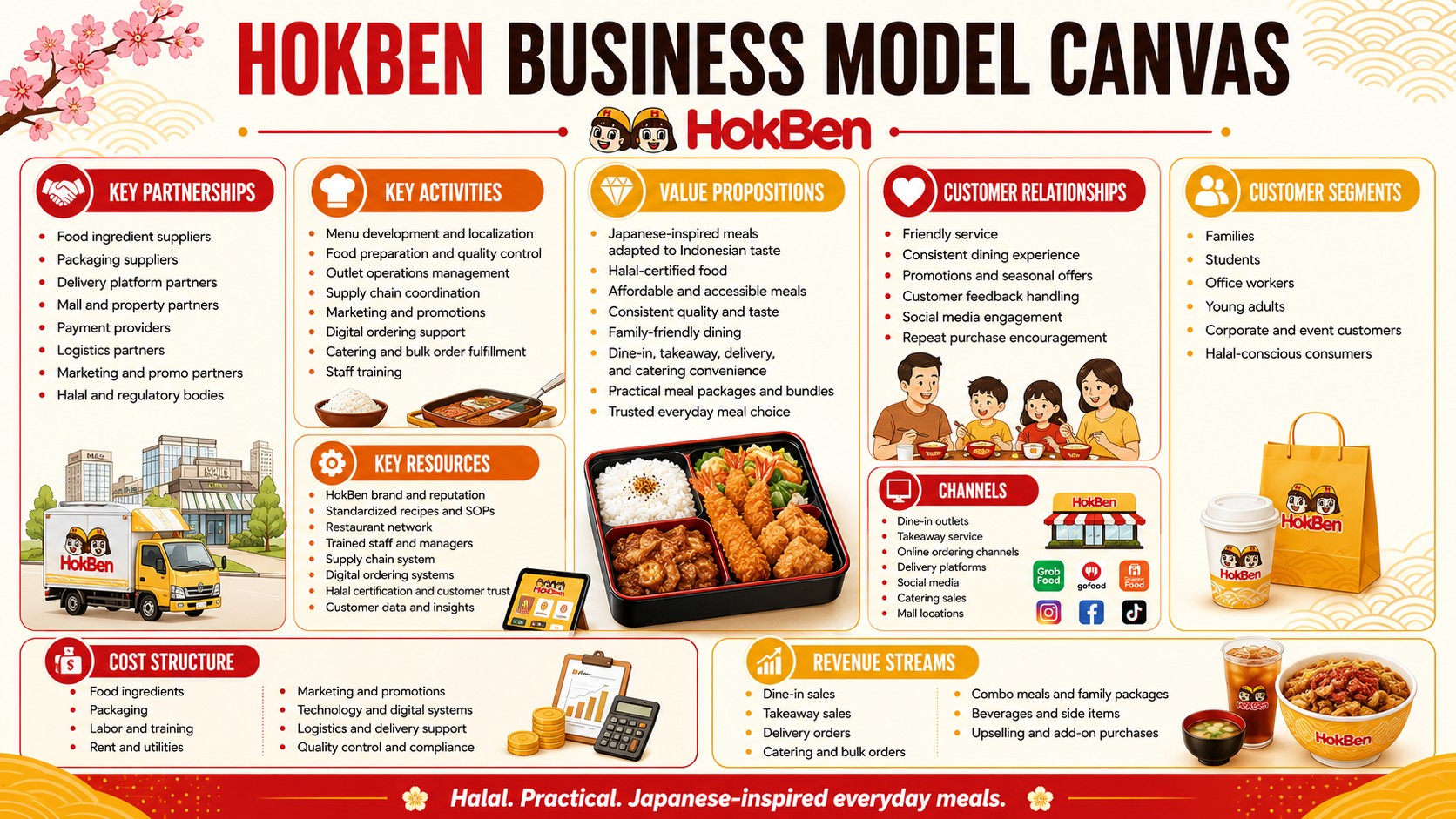
This BMC HokBen Indonesia analysis explores how the company has structured its business model to sustain growth while balancing innovation and tradition. It examines the strategic levers behind HokBen’s expansion and provides insights into how the brand continues adapting to Indonesia’s fast-changing food industry.
BMC Article No: BMC #061
Updated in 2026: This article now includes deeper analysis of all nine Business Model Canvas blocks, a clearer explanation of how HokBen creates value for families, office workers, and group buyers, a fuller Value Proposition Canvas section, sharper competitive analysis, updated strategic recommendations, and a cleaner conclusion to help readers understand why HokBen’s model works in the Indonesian market.
HokBen, previously known as Hoka Hoka Bento, is one of Indonesia’s best-known Japanese fast-food brands. Since its launch in 1985, the company has built its reputation by making Japanese-style meals more accessible to Indonesian consumers through affordable pricing, familiar flavours, halal assurance, and a family-friendly dining experience.
The HokBen Business Model Canvas is worth studying because the brand does not compete only through food. Its commercial strength comes from combining menu localisation, operational consistency, broad urban reach, delivery access, and strong customer trust within one coordinated restaurant model.
That combination makes HokBen strategically relevant. Unlike premium Japanese restaurant concepts, the brand positions itself as approachable and practical for everyday consumption. As a result, it appeals to families, students, office workers, and catering buyers across a broad range of meal occasions.
HokBen operates a quick-service restaurant model built around Japanese-inspired food adapted for Indonesian tastes. It generates revenue through dine-in sales, takeaway purchases, delivery transactions, catering, family meal bundles, and repeat orders supported by menu familiarity and convenient access.
At its core, the HokBen Business Model Canvas shows a business that turns a foreign cuisine category into a mass-market offering. Instead of positioning Japanese food as premium or niche, HokBen makes it feel routine, trusted, halal, and accessible for the Indonesian middle market.
This model works because it balances several priorities at once. The company must keep food quality consistent, maintain affordability, protect halal confidence, and remain convenient across restaurant, takeaway, and digital channels.
Business Model Canvas, or BMC, is a practical framework used to explain how a company creates value, delivers value, and captures revenue. Rather than looking only at products, it maps the operating logic behind the entire business.
For restaurant brands, BMC is especially useful because performance depends on more than menu appeal alone. Location strategy, pricing, kitchen productivity, digital ordering, delivery capability, customer loyalty, supply chain discipline, and cost control all affect commercial results.
That is why the HokBen Business Model Canvas is a useful lens. It helps explain how product adaptation, halal positioning, service convenience, and operational discipline reinforce one another as part of a single business system.
| BMC Block | Main Question |
|---|---|
| Customer Segments | Who does the business serve? |
| Value Propositions | What value does the business offer? |
| Channels | How does the business reach customers? |
| Customer Relationships | How does the business build loyalty? |
| Revenue Streams | How does the business make money? |
| Key Resources | What assets does the business need? |
| Key Activities | What must the business do well? |
| Key Partnerships | Who helps the business operate? |
| Cost Structure | What are the major costs? |
HokBen was founded in Jakarta in 1985 and became one of the earliest brands to popularise Japanese-style fast food in Indonesia. Over time, the business expanded into a nationally recognised restaurant chain with more than 170 outlets and a strong reputation among families and middle-income consumers.
Scale matters because a larger network improves brand visibility, purchasing leverage, and customer accessibility. It also allows HokBen to diversify beyond core dine-in activity through takeaway, delivery, and catering, which makes the brand more resilient than a single-format operator.
HokBen is strategically interesting because it combines the logic of a quick-service restaurant, a localised food brand, and a convenience-driven urban meal provider. Customers do not simply buy Japanese-inspired food. They buy a trusted, halal, practical solution for everyday lunch, dinner, family meals, and group orders.
That position creates a stronger market role than a typical niche Japanese restaurant. HokBen must manage affordability, menu familiarity, service speed, and operational consistency at the same time, while still maintaining a differentiated Japanese identity in a market full of local and international food brands.
Another strength comes from accessibility. The company reaches consumers through malls, takeaway orders, delivery channels, and catering solutions, which makes it relevant across both routine and planned consumption occasions.
This section explains how the nine building blocks support HokBen’s position in Indonesia’s quick-service food market. Each block contributes differently, but the real strength of the business comes from alignment across customer demand, menu design, delivery access, operating systems, partnerships, and financial discipline.
The HokBen Business Model Canvas is especially useful because the brand has to balance familiarity and innovation. It must keep loyal customers comfortable with the core menu while also adapting to digital ordering, changing health expectations, and stronger competition.
Customer segments explain who HokBen serves, which demand pools matter most, and why those groups are commercially valuable to the business. For HokBen, this block is especially important because the brand does not depend on one narrow user profile. Instead, it serves a broad customer base across different age groups, income situations, and meal occasions. Its strength comes from addressing several consumption needs within one brand, which increases relevance without forcing the company to reposition itself each time customer behaviour changes.
| Segment | Details | Why It Matters |
|---|---|---|
| Families | Parents and children seeking familiar, halal, and convenient meals | Supports larger baskets and repeat visits |
| Students and young adults | Price-aware customers attracted by affordable bundles and fast service | Builds traffic frequency and youth relevance |
| Office workers | Lunch buyers and teams needing practical meal solutions | Strengthens weekday demand |
| Corporate and event buyers | Customers ordering catering for meetings and gatherings | Creates larger ticket sizes |
| Health-conscious consumers | Buyers looking for lighter or more balanced meal choices | Opens room for menu evolution |
HokBen benefits because these segments do not all buy for the same reason, and that creates a more balanced demand profile across the week. Families value trust, comfort, and broader meal suitability, while office workers focus more on speed, practicality, and dependable lunchtime access. Younger consumers may respond more strongly to promotions, digital convenience, and affordable bundled meals. Corporate and event buyers, meanwhile, care more about reliability, order size, and ease of coordination. The HokBen Business Model Canvas is effective here because it shows how one food brand can serve multiple needs without losing coherence. It also demonstrates that HokBen is not only segmenting by demographics, but by usage context. That makes the business more adaptive and commercially resilient than a single-occasion restaurant model.
Value propositions explain why customers choose HokBen instead of other quick-service restaurants, casual dining options, or local food alternatives. This block matters because HokBen is competing in a crowded meal market where customers have many substitutes. The company therefore needs to offer more than food variety alone. Its value lies in combining Japanese-inspired meals with familiarity, halal assurance, affordability, and easy access. That combination makes the brand distinctive enough to stand out, but practical enough to remain part of everyday consumption.
| Value Proposition | Details | Why It Matters |
|---|---|---|
| Localised Japanese meals | Japanese-style menu adjusted to Indonesian taste preferences | Makes the cuisine approachable for mass consumers |
| Halal trust | Certified halal menu and strong customer confidence | Broadens appeal in a majority Muslim market |
| Consistent quality | Standardised operations and recognisable menu items | Encourages repeat purchase and reliability |
| Convenience | Dine-in, takeaway, delivery, and catering access | Supports everyday use across occasions |
| Family-friendly brand | Comfortable dining and shareable meal formats | Strengthens emotional loyalty |
This proposition works because HokBen reduces uncertainty at several points in the customer decision process. Customers do not need to wonder whether the food suits local taste, whether it is halal, whether portioning will feel acceptable, or whether service will be inconsistent. Those barriers are already addressed within the core offer. Instead, the brand presents a dependable version of Japanese fast food that feels safe, practical, and familiar. That is strategically powerful because many food choices fail not because the product is weak, but because customers are unsure about fit. HokBen removes that hesitation and turns a potentially niche cuisine category into a repeatable mainstream purchase.
Channels describe how HokBen reaches customers, makes the brand visible, and converts meal demand into completed transactions. In foodservice, this block is critical because even a strong menu proposition will underperform if access is inconvenient. Strong channels shape convenience, speed, and market coverage, but they also influence how often the brand appears in a customer’s consideration set. For HokBen, channels are not only routes to market. They are part of the value proposition itself, because convenience is one of the main reasons customers choose the brand.
| Channel | Details | Why It Matters |
|---|---|---|
| Dine-in outlets | Restaurants in malls and high-traffic urban locations | Builds brand presence and family dining appeal |
| Takeaway service | Quick collection for busy consumers | Improves convenience and reduces time friction |
| Delivery platforms | App-based and third-party order fulfilment | Expands access beyond physical traffic |
| Catering service | Group meals for offices and events | Adds higher-value orders and business clients |
| Promotional media | Social media and campaign-based marketing | Supports visibility and traffic generation |
Channel diversity makes HokBen more resilient because it spreads revenue opportunities across different customer behaviours and operating moments. Restaurant traffic, takeaway demand, delivery usage, and catering orders do not rise for the same reason or at the same time. Each channel responds to different triggers such as weekday lunch demand, family meal planning, digital convenience, or office events. A broader mix therefore reduces concentration risk and improves adaptability when the market changes. It also helps the company stay relevant as customer behaviour shifts more strongly toward convenience-led ordering. The HokBen Business Model Canvas highlights that channel strategy is not secondary. It is central to how the brand delivers value, protects accessibility, and supports transaction volume across both physical and digital environments.
Customer relationships explain how HokBen builds trust, repeat purchase, and long-term familiarity over time. This block is particularly important in restaurants because food purchases are frequent and habit-driven. Loyalty usually comes from both emotional comfort and reliable execution. Customers return not only because they liked a product once, but because the brand continues to feel dependable, easy to choose, and suitable for recurring use across different meal occasions.
| Relationship Type | Details | Why It Matters |
|---|---|---|
| Brand familiarity | Long-standing reputation and recognisable meal formats | Encourages habitual buying |
| Promotions | Bundles, limited offers, and special campaigns | Stimulates repeat visits and basket growth |
| Family-friendly service | Comfortable environment and broad menu appeal | Strengthens multi-generational loyalty |
| Digital engagement | App-based interaction, notifications, and offers | Improves retention and convenience |
| Feedback and service recovery | Complaint handling and customer support | Protects trust when service issues arise |
HokBen’s relationship model works because customers do not need to rediscover the brand each time they consider a meal purchase. They already know what to expect in terms of menu style, halal assurance, service pattern, and overall experience. That familiarity lowers decision friction and supports repeat purchase, especially in everyday consumption settings where customers want low-risk choices. As a result, the business can keep customers close through consistency, promotions, and service reliability rather than relying only on novelty. This matters strategically because habitual brands often outperform attention-driven brands in the long run. HokBen strengthens the relationship by making itself easy to remember, easy to trust, and easy to repeat.
Revenue streams explain how HokBen converts customer demand into income and how different purchasing occasions contribute to commercial performance. This block matters because restaurant revenue is rarely as simple as serving meals in-store. While in-store food sales remain the core source of revenue, HokBen’s model is more diversified than a basic dine-in chain. The business also monetises convenience, group demand, and bundled purchasing through complementary channels that make the revenue base broader and more flexible.
| Revenue Stream | Details | Why It Matters |
|---|---|---|
| Dine-in sales | Meals consumed at physical outlets | Remains a core revenue foundation |
| Takeaway purchases | Orders collected directly from outlets | Adds convenient off-premise demand |
| Delivery orders | Sales generated through digital fulfilment channels | Expands convenience-led revenue |
| Catering and bulk orders | Group meals for offices, events, and institutions | Produces larger order values |
| Promotions and bundles | Seasonal packages and family sets | Raises average transaction size |
Revenue diversification matters because demand patterns are not uniform and customer spending does not flow through one single behaviour. Family dining, delivery usage, takeaway purchases, and office catering all respond to different triggers such as time pressure, social occasions, work routines, and promotional activity. A broader mix helps HokBen absorb market changes more effectively because weakness in one area can be offset by strength in another. It also gives management more room to shape growth through pricing, bundles, and channel focus. The HokBen Business Model Canvas shows that the company does not depend on one purchase channel alone to sustain growth. Instead, it builds revenue through a portfolio of meal occasions, which makes the business model commercially stronger.
Key resources are the assets HokBen needs to deliver value consistently, reliably, and at scale. This block matters because a restaurant brand cannot sustain customer trust through branding alone. It needs the underlying assets that make repeatable execution possible across many outlets and meal occasions. For HokBen, these resources extend beyond kitchens and ingredients. They include intangible assets such as reputation and operating know-how, as well as physical and digital infrastructure that supports access and consistency.
| Key Resource | Details | Why It Matters |
|---|---|---|
| Brand equity | Established reputation since 1985 | Builds trust and recognition |
| Supply chain capability | Coordinated sourcing and quality control | Protects consistency across outlets |
| Human capital | Trained teams and managers | Supports service and execution quality |
| Restaurant network | Physical presence in key urban locations | Increases accessibility and visibility |
| Digital systems | Ordering, payment, and customer interaction tools | Supports convenience and retention |
These resources create operational advantages that are difficult for smaller competitors to match or replicate quickly. Strong brand recognition lowers customer hesitation. Repeatable kitchen execution supports consistent product experience. Reliable sourcing protects standardisation across the network. Digital systems improve convenience and customer interaction. Together, these resources allow HokBen to scale its offer without losing the familiarity customers expect. That resource base is a major reason the model remains durable. It gives the company both market-facing strength and internal operating stability, which is essential for a chain competing on trust, convenience, and everyday relevance.
Key activities describe what HokBen must do well every day in order to compete effectively and protect its market position. This block is crucial because restaurant value is created continuously through execution, not only through strategic intent. In HokBen’s case, success depends on both front-line service and back-end coordination. The company has to maintain food quality, service speed, availability, brand visibility, and menu relevance at the same time, which makes disciplined activity management central to the model.
| Key Activity | Details | Why It Matters |
|---|---|---|
| Food preparation | Consistent production and serving of menu items | Protects quality and speed |
| Menu development | Adjusting products to local taste and trends | Keeps the brand relevant |
| Supply management | Coordinating sourcing, inventory, and quality standards | Supports reliability and cost control |
| Marketing | Running campaigns, bundles, and brand communication | Drives awareness and traffic |
| Staff training | Developing service quality and operational discipline | Sustains customer experience |
Operational discipline matters here because restaurant performance is cumulative. Menu appeal may attract customers once, but speed, consistency, reliability, and service quality determine whether they return often enough to build a durable business. In other words, the brand promise must be reproduced through daily activity. The HokBen Business Model Canvas makes clear that restaurant performance is built through repeated execution, not only through product positioning. That is why activities such as training, supply management, menu adjustment, and campaign execution are not support functions alone. They are core drivers of customer experience and financial performance.
Key partnerships show which external relationships help HokBen operate, expand, and maintain service quality across its network. This block is important because even strong restaurant brands depend on outside coordination to deliver a seamless experience. A chain may own the brand and set the standards, but suppliers, landlords, logistics providers, payment partners, and platform operators all affect how well the model actually performs in the market.
| Partner Group | Details | Why It Matters |
|---|---|---|
| Ingredient suppliers | Providers of rice, proteins, sauces, vegetables, and packaging | Ensure continuity and quality |
| Delivery platforms | External fulfilment and ordering partners | Extend reach and convenience |
| Property partners | Mall operators and landlords | Support visibility and location access |
| Payment partners | Banks and digital wallets | Improve transaction convenience and promotion |
| Logistics and service partners | Distribution and support providers | Reinforce operational efficiency |
Partnership quality directly affects customer experience because many parts of the service chain depend on external reliability. A campaign loses value if ingredients are unavailable. Delivery demand weakens if fulfilment systems fail. Convenience suffers if payment processes are not smooth. Strategic coordination therefore matters not only for growth but also for daily execution. For HokBen, partnerships are part of the operating system. Good partners improve continuity, scale, and customer satisfaction, while weak partners create friction that customers may blame on the brand itself.
Cost structure explains the major expenses required to run HokBen’s business model and sustain its value proposition at scale. This block matters because restaurant economics are shaped by a constant tension between affordability, quality, convenience, and profitability. Foodservice economics depend on both variable costs and fixed operating commitments, and a chain like HokBen must manage both carefully to remain competitive without eroding margins.
| Cost Category | Details | Why It Matters |
|---|---|---|
| Ingredients and packaging | Food inputs, sauces, rice, meat, and containers | Directly affects gross margin |
| Labour | Kitchen, service, training, and supervision costs | Determines service capacity and consistency |
| Property costs | Rent, fit-out, maintenance, and utilities | Creates fixed-cost pressure |
| Marketing | Promotions, campaigns, and customer acquisition activity | Supports traffic and relevance |
| Technology and logistics | Ordering systems, delivery support, and data tools | Improves convenience but adds cost complexity |
HokBen must balance affordability with quality and convenience, and that balance is not easy to maintain over time. The challenge becomes harder when customers expect promotions, delivery access, comfortable service, and reliable food quality at the same time. Each of those expectations adds cost pressure somewhere in the model. Strong cost discipline is therefore essential to protect profitability without weakening the brand proposition. The company cannot simply cut spending aggressively, because doing so may harm consistency or trust. Instead, it needs selective efficiency so the economics improve while the customer experience remains intact.
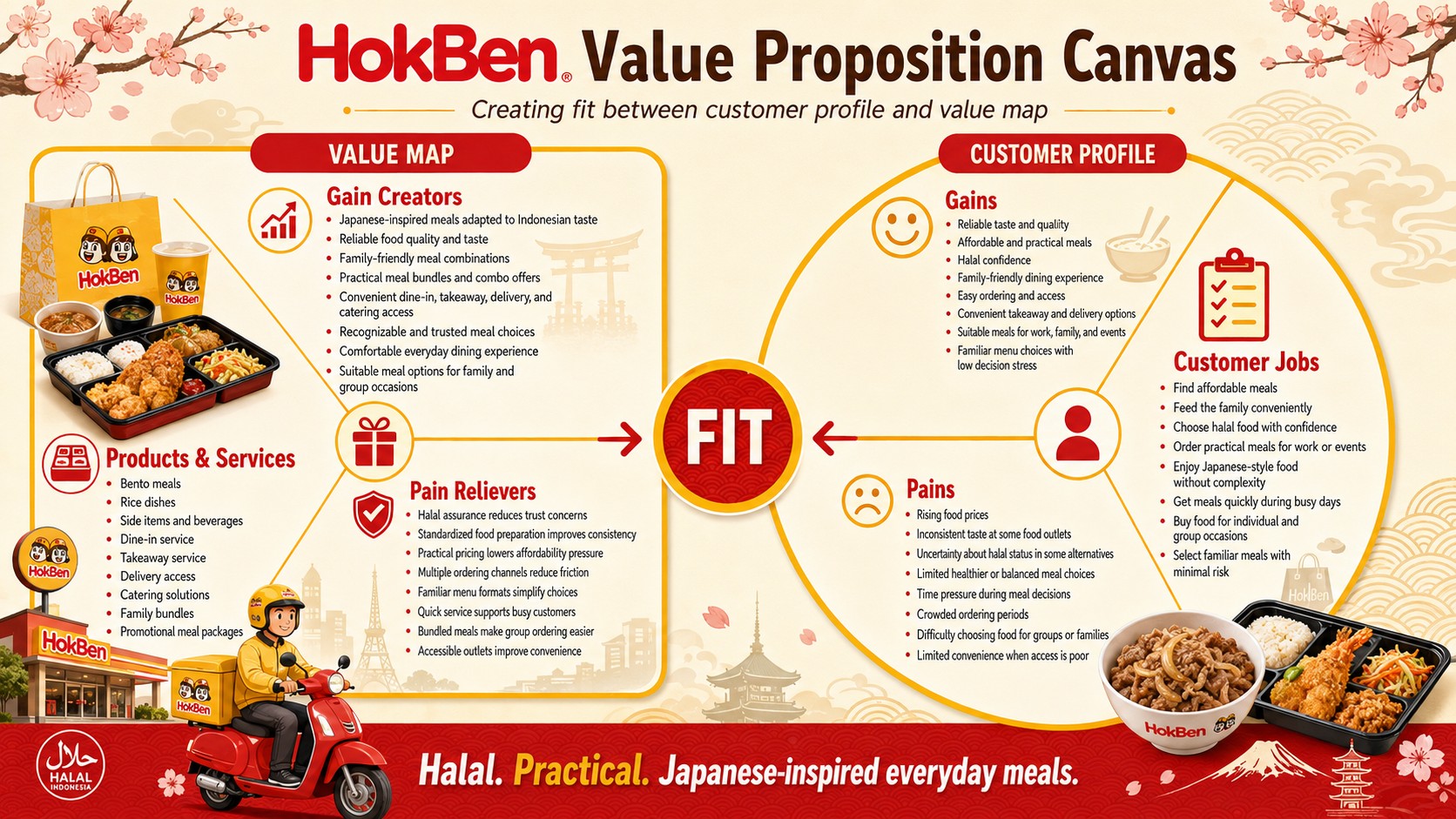
Before moving to HokBen’s competitive advantages, it is useful to examine how the brand creates fit between what customers need and what the company delivers. That is the purpose of Value Proposition Canvas, or VPC.
While Business Model Canvas explains the wider structure of HokBen’s business, VPC focuses more closely on the connection between customer requirements and the brand’s actual offer. This matters because HokBen does not compete only through menu items. It competes by reducing uncertainty around halal assurance, affordability, familiarity, and everyday convenience.
The customer profile explains what HokBen’s target customers are trying to accomplish, what makes meal decisions difficult, and what outcomes they value most. Since HokBen serves a broad urban market, the profile reflects common needs across dine-in, takeaway, delivery, and catering occasions.
| Customer Profile | Details |
|---|---|
| Customer Jobs | Find affordable meals, feed families conveniently, choose halal food with confidence, order practical meals for work or events, and enjoy Japanese-style food without unnecessary complexity |
| Customer Pains | Rising food prices, inconsistent taste, uncertainty about halal status, limited healthy options, crowded ordering periods, and inconvenient access when time is limited |
| Customer Gains | Reliable flavour, recognisable menu choices, halal assurance, family-friendly dining, practical bundles, dependable service, and convenient takeaway or delivery access |
This profile shows that HokBen does not win only through Japanese-inspired food. It also wins by making meal selection easier, reducing trust-related concerns, and giving customers a practical option for both individual and group dining occasions.
The value map explains what HokBen offers to customers through its products and services, pain relievers, and gain creators. This part should describe the company’s side of the fit, not combine both sides into one table.
| Value Map | Details |
|---|---|
| Products and Services | Bento meals, rice dishes, side items, takeaway service, dine-in service, delivery access, catering solutions, family bundles, and promotional meal packages |
| Pain Relievers | Halal assurance reduces trust concerns, standardised food preparation improves consistency, practical pricing lowers affordability pressure, multiple channels reduce ordering friction, and familiar menu formats simplify decision-making |
| Gain Creators | Japanese-inspired meals adapted to Indonesian taste, dependable quality, family-friendly meal combinations, convenient access across formats, and recognisable brand comfort for repeat customers |
This value map shows that HokBen creates value through more than menu variety. The brand reduces common purchase barriers while also giving customers a reliable and convenient dining option that fits everyday needs.
The fit becomes clearer when HokBen’s customer profile is matched directly with its value map. This is the point where customer jobs, pains, and gains connect with the brand’s actual offer.
| Customer Profile | Details | Matching Value Map | How HokBen Creates Fit |
|---|---|---|---|
| Customer Jobs | Customers want affordable, halal, and convenient meals for individuals, families, offices, and social occasions | Products and Services | HokBen provides bento meals, rice dishes, sides, takeaway, delivery, catering, and dine-in services designed for routine and group consumption |
| Customer Pains | Customers worry about high prices, inconsistent quality, unclear halal status, slow service, and limited healthier choices | Pain Relievers | HokBen reduces these concerns through halal assurance, standardised preparation, practical pricing, familiar menu structures, and several ordering channels |
| Customer Gains | Customers value dependable taste, easy ordering, family suitability, affordable bundles, and a Japanese-style meal adapted to Indonesian preferences | Gain Creators | HokBen creates these gains through localised menu design, recognisable meal combinations, family packages, promotional offers, and accessible restaurant and delivery formats |
The strongest fit appears during family meals, school and office lunch occasions, casual weekend dining, takeaway purchases, catering orders, and moments when customers want a halal meal without having to think too much about product suitability.
HokBen performs well when customers want food that feels familiar, practical, and socially acceptable across age groups. A meal can satisfy children, parents, and office teams at the same time, which increases the usefulness of the brand beyond a narrow cuisine niche.
The HokBen Business Model Canvas highlights several strengths that make the brand more defensible than smaller Japanese food operators and many single-format fast-food chains.
Together, these strengths give HokBen a balanced mix of relevance, trust, and operational scale.
The HokBen Business Model Canvas also reveals several pressures that management must handle carefully. Competition, changing preferences, and cost inflation can all affect performance.
These risks do not invalidate the business model, but they do require sharper execution and continuous adaptation.
The HokBen Business Model Canvas suggests several practical priorities for management. The business already has strong trust and brand familiarity, so the next step is to improve relevance and economic quality without losing what made the brand successful.
First, HokBen should continue developing lighter and healthier menu options so that it can respond to changing consumer expectations without weakening its core identity.
Second, management should strengthen digital ordering and loyalty mechanics to improve repeat purchase, reduce friction, and make promotions more targeted.
Third, the company should refine its channel strategy by treating dine-in, takeaway, delivery, and catering as distinct growth levers with different operational priorities.
Fourth, HokBen should keep investing in service consistency because reliability remains one of its strongest differentiators in a crowded market.
Finally, the business should review sustainability opportunities in packaging, sourcing, and waste management to protect long-term brand relevance.
A clearer comparison can be made between HokBen and Yoshinoya because both compete in the Japanese-inspired fast-food space in Indonesia. However, they do not win in the same way. HokBen is broader, more family-oriented, and more occasion-flexible, while Yoshinoya is more focused on bowl-based meals and a narrower core proposition.
| Comparison Area | HokBen | Yoshinoya |
|---|---|---|
| Core positioning | Japanese-inspired fast food adapted for Indonesian consumers | Japanese beef bowl and rice-meal specialist |
| Menu breadth | Broader menu with bento sets, fried items, side dishes, family meals, and catering-friendly options | Narrower menu built more strongly around gyudon and related rice bowl formats |
| Customer appeal | Families, students, office workers, and group buyers | Individual meal buyers and customers seeking simple Japanese rice meals |
| Consumption occasions | Dine-in, takeaway, delivery, family meals, office orders, and catering | Faster individual meals, takeaway, and delivery-led everyday dining |
| Strategic strength | Combines halal trust, localisation, convenience, and broad menu accessibility | Benefits from menu clarity, specialisation, and strong single-category recognition |
The table shows why HokBen occupies a slightly broader strategic space. Yoshinoya is more specialised, which can create sharper product identity. HokBen, by contrast, offers a more flexible model that works across family dining, group orders, and routine everyday consumption.
That difference matters because it explains why HokBen competes not only with Japanese-inspired chains but also with mainstream quick-service brands such as KFC and McDonald’s. Its position sits between a cuisine specialist and a mass fast-food operator, which gives the brand a distinctive but accessible market role.
Overall, HokBen remains a strong example of how a restaurant brand can localise an international cuisine concept successfully for a national market. Its strength does not come from novelty alone. It comes from combining halal trust, menu familiarity, operational consistency, and everyday convenience into one coordinated system.
The company is not simply selling Japanese-inspired food. It is managing a practical restaurant and meal-access platform built for Indonesian consumers across families, workplaces, and urban routines. That is why the HokBen Business Model Canvas remains a useful framework for understanding how the brand competes and why it continues to matter.
This article is provided for educational and business analysis purposes only. The content is based on publicly available information, market interpretation, and strategic analysis. It does not constitute financial advice, investment advice, legal advice, franchise advice, or an official statement from HokBen or PT Eka Bogainti.
Readers should conduct their own research and seek appropriate professional advice before making business, commercial, franchise, or investment decisions.
All trademarks, logos, copyrights, brand names, product names, and related materials mentioned in this article belong to their respective owners.
Explore the HokBen Business Model Canvas, including its nine BMC blocks, Value Proposition Canvas, competitive advantages, risks, recommendations, and updated 2026 analysis.
Explore the Quipper Business Model Canvas, nine BMC blocks, Value Proposition Canvas, Ruangguru and Pahamify… Read More
Explore the CARPUT Business Model Canvas, nine BMC blocks, Value Proposition Canvas, competitor comparison, competitive… Read More
Explore the Boost Business Model Canvas, nine BMC blocks, Value Proposition Canvas, competitor comparison, advantages,… Read More
Explore the Domino's Pizza Business Model Canvas, nine BMC blocks, Value Proposition Canvas, Pizza Hut… Read More
Explore the Mie Gacoan Business Model Canvas, including its customer segments, value propositions, revenue streams,… Read More
Restaurant Business Model Canvas: A Practical Guide to Designing, Evaluating, and Improving Restaurant Business Models… Read More