Apple Business Model Canvas
Read this Apple Business Model Canvas analysis to understand how Apple creates value through premium devices, services, ecosystem loyalty, retail control, and recurring revenue.
Hermes Business Model Canvas explained in depth, including customer segments, value proposition, channels, revenue, competitive advantages, risks, recommendations, and strategy analysis.
BMC Article No: BMC #069
Hermes is more than a luxury fashion house that sells Birkin and Kelly bags, silk scarves, belts, jewellery, watches, fragrance, and ready-to-wear. It is a premium luxury system built around craftsmanship, heritage, scarcity, controlled retail, brand trust, and long-term customer desire.
The Hermes Business Model Canvas is interesting because Hermes combines product excellence with controlled rarity. A customer may buy a silk scarf, belt, or fragrance first, then later move into leather goods, watches, jewellery, homeware, and other categories as trust and aspiration deepen.
This makes Hermes different from many luxury brands. Its strength does not come from products alone. Real power comes from how craftsmanship, exclusivity, distribution control, and symbolic value work together to make the brand highly desirable and difficult to imitate.
In this article, we will break down how Hermes creates value, reaches customers, earns revenue, manages costs, and protects its competitive position.
Hermes’s business model is built around ultra-premium products, artisanal craftsmanship, selective distribution, and long-term brand equity. The company designs, produces, and sells luxury goods across categories such as leather goods, saddlery, silk, ready-to-wear, accessories, watches, jewellery, fragrance, beauty, and homeware.
It earns revenue mainly through direct sales of high-value products, supported by a tightly controlled boutique network and selective digital channels. This creates a model where product scarcity and brand heritage attract customers, while repeat purchasing across categories increases long-term customer value.
A major strength is control. Hermes controls product design, craftsmanship standards, store experience, pricing discipline, and brand presentation across markets. That control allows the company to preserve rarity and protect prestige more effectively than brands that rely heavily on wholesale expansion or aggressive visibility.
However, the model is not risk-free. Premium pricing depends on continued trust in craftsmanship, desirability, and exclusivity. Growth also brings pressure around capacity, geographic expansion, digital accessibility, and customer expectations.
The Hermes Business Model Canvas shows a company that uses craftsmanship to attract customers, scarcity to intensify demand, and disciplined control to protect long-term value.
Business Model Canvas, or BMC, is a practical tool used to explain how a company works. It helps readers understand how a business creates value, delivers that value to customers, and captures revenue from the market.
Instead of looking only at products, BMC looks at the full business system behind those products. It connects customers, value propositions, channels, relationships, revenue, resources, activities, partners, and costs in one simple view.
This makes BMC useful for analysing companies like Hermes because it shows how craftsmanship, scarcity, boutique control, customer relationships, and premium pricing work together. Rather than treating Hermes as only a luxury product brand, BMC helps explain the wider strategy behind its durability and prestige.
Instead of looking only at products, BMC divides a company into nine operating blocks.
| BMC Block | Main Question |
|---|---|
| Customer Segments | Who does the business serve? |
| Value Propositions | What value does the business offer? |
| Channels | How does the business reach customers? |
| Customer Relationships | How does the business build loyalty? |
| Revenue Streams | How does the business make money? |
| Key Resources | What assets does the business need? |
| Key Activities | What must the business do well? |
| Key Partnerships | Who helps the business operate? |
| Cost Structure | What are the major costs? |
For Hermes, BMC is useful because the company is not only selling luxury items. The Hermes Business Model Canvas helps explain the link between craftsmanship, scarcity, retail control, brand mythology, category expansion, and long-term customer retention.
Hermes International is a global luxury company headquartered in Paris, France. It is best known for leather goods, silk, saddlery, ready-to-wear, accessories, watches, jewellery, fragrance, beauty, and homeware.
The company was founded in 1837 by Thierry Hermès. Over time, Hermes moved from equestrian equipment into a broader luxury house while keeping craftsmanship, artisanal discipline, and rarity at the centre of the brand.
In 2025, Hermes reported revenue of about €16.0 billion and recurring operating income of about €6.6 billion, with a recurring operating margin of 41.0%. Leather goods and saddlery remained the largest category, while ready-to-wear, accessories, silk, jewellery, watches, fragrance, beauty, and homeware added further breadth.
This revenue mix matters because Hermes is no longer simply a maker of iconic bags. It is a diversified luxury platform with strong category economics, direct retail control, and one of the most disciplined brand systems in the market.
Hermes is strategically interesting because it turns restraint into demand. Many luxury brands try to grow through visibility, celebrity exposure, broader product access, and frequent launches. Hermes relies more on scarcity, craftsmanship, selective access, and long-term desirability.
The bag category acts as the emotional centre of this model. Once customers begin with a scarf, belt, fragrance, or shoes, they may later move into leather goods, watches, jewellery, home products, and other categories. Each additional purchase increases engagement and strengthens the relationship with the maison.
Brand trust also plays a major role. Hermes sells at premium prices because customers associate the brand with craftsmanship, timelessness, discretion, prestige, and durability. That perception gives Hermes pricing power that many competitors struggle to match.
From a strategy perspective, the Hermes Business Model Canvas shows how a company can use quality, scarcity, retail control, symbolic value, and emotional loyalty to protect long-term value.
Hermes’s business model is changing in three important ways.
First, the global luxury market is becoming more uneven. Aspirational demand is softer in some regions, while ultra-premium luxury remains more resilient. That dynamic tends to favour Hermes because its core customer base is less price-sensitive and more exclusivity-driven.
Second, digital influence is becoming more important. Customers increasingly discover products, compare resale value, follow launches, and shape brand perception through online channels, even if final purchase decisions still depend heavily on boutiques and personal relationships.
Third, geopolitical and supply-side pressures are rising. Currency volatility, regional slowdowns, trade friction, and artisan-capacity limits can affect growth, pricing consistency, and product availability.
These changes make the Hermes Business Model Canvas more important. Hermes still depends heavily on craftsmanship and scarcity, but its future growth also depends on careful capacity expansion, digital discipline, and continued protection of brand prestige.
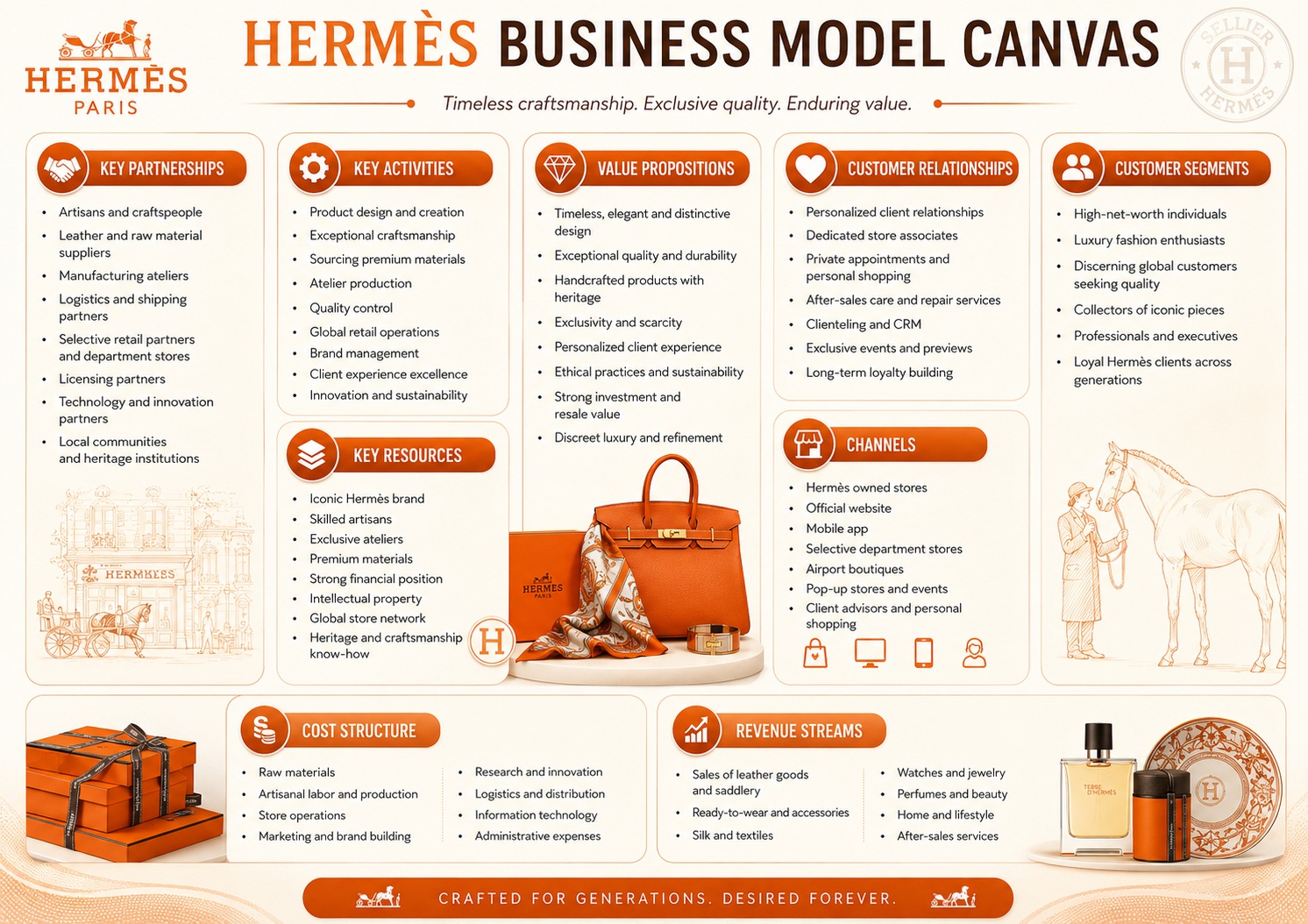
Before going into each block in detail, the summary below gives a quick view of how Hermes’s business model works. It shows who Hermes serves, what value it offers, how it reaches customers, how revenue is generated, and what resources and activities keep the model running.
| BMC Block | Hermes Application |
| Customer Segments | Ultra-affluent buyers, collectors, loyal clients, aspirational luxury customers, and gift buyers who value heritage, rarity, and craftsmanship. |
| Value Propositions | Exceptional craftsmanship, scarcity, timeless design, high-status ownership, long product life, and strong symbolic value. |
| Channels | Company-owned boutiques, flagship stores, selected digital commerce, private appointments, events, and after-sales service. |
| Customer Relationships | High-touch clienteling, personalised service, trust building, invitation-led experiences, and long ownership support. |
| Revenue Streams | Leather goods, ready-to-wear, accessories, silk, jewellery, watches, fragrance, beauty, homeware, and related services. |
| Key Resources | Brand equity, artisans, heritage, iconic designs, premium materials, controlled retail network, and financial strength. |
| Key Activities | Product design, artisanal production, sourcing, retail execution, brand stewardship, clienteling, and inventory discipline. |
| Key Partnerships | Material suppliers, specialist workshops, logistics partners, landlords, technology providers, and selected creative collaborators. |
| Cost Structure | Skilled labour, premium materials, store operations, real estate, marketing, training, logistics, and support functions. |
Customer segments explain who the business serves. Hermes is selective by design. The company does not target the broad fashion market. Instead, it serves buyers who value quality, prestige, restraint, and long-term ownership.
Its core audience includes ultra-high-net-worth individuals, established affluent consumers, collectors, and loyal repeat clients. Another layer includes aspirational luxury buyers who enter through silk, fragrance, belts, shoes, or small leather goods before moving into higher-value categories.
The Hermes Business Model Canvas shows that the brand sells to customers with high willingness to pay and low sensitivity to discount absence. Buyers are often motivated by social distinction, emotional reward, personal identity, and the belief that certain products retain value over time.
| Customer Segment | What They Want | How Hermes Serves Them |
| Ultra-affluent clients | Rarity, prestige, service, and discretion. | Offers limited products, private service, and boutique-led access. |
| Collectors | Iconic items with scarcity and long-term desirability. | Maintains controlled availability and strong product mythology. |
| Loyal repeat clients | Trust, continuity, and relationship-based buying. | Builds long-term clienteling through stores and advisors. |
| Aspirational luxury buyers | Entry into the brand through more accessible categories. | Provides silk, fragrance, accessories, and small leather goods. |
| Gift buyers | High-status products for personal or ceremonial occasions. | Delivers premium presentation, symbolism, and brand prestige. |
Hermes benefits because these segments support premium pricing and repeat purchasing. They also give the company a customer base that values prestige, discretion, and long-term ownership more than broad accessibility. The trade-off is clear. Growth must be managed without making the brand feel ordinary or reducing the sense of selectivity that makes these segments so attractive in the first place.
The value proposition explains why customers choose Hermes over other luxury houses. The company offers more than products. It offers crafted scarcity, cultural prestige, and ownership with lasting emotional value.
Craftsmanship sits at the centre. A Hermes item is meant to signal careful human making, superior materials, and product integrity. Design also matters. Many products feel timeless rather than seasonal, which increases durability of demand and reduces dependence on fashion volatility.
Within the Hermes Business Model Canvas, the value proposition is powerful because it combines function, symbolism, and scarcity in one offer. A bag, scarf, watch, or belt can serve practical use, personal expression, and status communication at the same time.
| Value Proposition | Customer Benefit | Business Impact |
| Exceptional craftsmanship | Buyers trust the quality and finishing. | Supports pricing power and brand prestige. |
| Scarcity and exclusivity | Ownership feels rare and socially meaningful. | Increases desirability without mass promotion. |
| Timeless design | Products stay relevant beyond one season. | Reduces trend dependence and extends product life. |
| Heritage and authenticity | Customers buy into a long luxury tradition. | Strengthens brand depth and cultural credibility. |
| Long-term ownership value | Products can be maintained, repaired, and collected. | Encourages loyalty and premium justification. |
This block is the heart of the model. Scarcity alone would not work without quality. Heritage alone would not work without modern desirability. Hermes wins because the offer is coherent and because each value element reinforces the others. Customers are not simply buying a luxury item. They are buying a credible mix of function, symbolism, rarity, and long-term emotional value.
Channels describe how the business reaches customers. Hermes uses a tightly controlled distribution model centred on direct retail. That is a strategic choice, not a legacy habit.
Most of the important customer journey happens through company-owned boutiques, major flagship stores, selective e-commerce, private appointments, and curated brand events. This gives Hermes stronger control over pricing, presentation, product access, service standards, and storytelling.
The Hermes Business Model Canvas makes clear that channel control is one reason the brand protects exclusivity so well. When distribution is limited and brand-managed, desirability is less likely to be diluted by discount culture or inconsistent retail treatment.
| Channel | Role | Strategic Value |
| Company-owned boutiques | Main sales and relationship channel. | Protects experience, price discipline, and client data. |
| Flagship stores | Showcase the full brand universe. | Reinforces prestige and cultural presence. |
| Selective e-commerce | Extends access to curated categories. | Adds convenience without full mass availability. |
| Private appointments | Supports top clients and collectors. | Deepens personalisation and loyalty. |
| Events and exhibitions | Build awareness and storytelling. | Strengthens emotional and cultural connection. |
| After-sales service | Supports repair and maintenance. | Extends trust and product life. |
A controlled channel model helps Hermes remain consistent across markets. It also allows the brand to protect pricing, storytelling, and service standards with far more discipline than a widely distributed luxury label could achieve. The challenge is balancing digital expectations with luxury restraint so that convenience improves access to the brand experience without weakening exclusivity.
Customer relationships explain how the company builds loyalty over time. Hermes relies on trust, patience, service, and repeated interaction rather than mass loyalty mechanics.
Boutique staff and client advisors play a central role. They educate customers, understand preferences, manage expectations, and create a more personal buying journey. For many clients, the relationship with the store becomes part of the product experience.
In the Hermes Business Model Canvas, this block is especially important because access itself can shape loyalty. Customers who feel known, respected, and gradually included in the brand universe are more likely to stay engaged across categories and over many years.
| Relationship Type | How It Works | Why It Matters |
| Personalised boutique service | Staff guide product discovery and purchase decisions. | Makes the experience refined and consultative. |
| Clienteling | Advisors track preferences and purchase history. | Improves retention and cross-category sales. |
| Invitation-led experiences | Selected clients access events or private previews. | Increases emotional attachment and prestige. |
| After-sales care | Repair, maintenance, and support continue after purchase. | Builds trust in long-term ownership. |
| Brand storytelling | Heritage and craftsmanship are explained over time. | Deepens appreciation beyond fashion appeal. |
This relationship model suits luxury well. It turns transactions into a long-term journey where trust, memory, and personal recognition become part of the value delivered to the customer. That is especially important for a house like Hermes, where the experience can matter almost as much as the product itself. The risk is that inconsistent service or opaque access rules can create frustration and weaken the emotional bond the brand is trying to build.
Revenue streams explain how the business makes money. Hermes earns from a portfolio of luxury categories, but not all categories have equal strategic weight.
Leather goods and saddlery remain the economic engine because they combine high desirability, strong margins, and iconic status. Ready-to-wear and accessories add scale and style relevance. Silk, jewellery, watches, fragrance, beauty, and homeware widen the customer relationship and create more entry points into the brand.
The Hermes Business Model Canvas shows that category breadth matters because it allows Hermes to grow wallet share without losing identity. One client can start with silk, move into footwear, then buy leather goods, watches, jewellery, and home products over time.
| Revenue Stream | Description | Strategic Role |
| Leather goods and saddlery | Bags and core leather products. | Main profit engine and prestige anchor. |
| Ready-to-wear and accessories | Fashion, shoes, belts, and related items. | Broadens lifestyle relevance and spend. |
| Silk and textiles | Scarves, ties, and textile accessories. | Creates brand entry points and gifting demand. |
| Watches and jewellery | High-value adjacent luxury categories. | Expands status appeal and craftsmanship narrative. |
| Fragrance and beauty | Lower-ticket recurring luxury purchases. | Supports broader reach and repeat engagement. |
| Home and lifestyle | Decorative and functional luxury products. | Extends the brand into everyday living. |
A diversified revenue base improves resilience. It also allows Hermes to deepen customer lifetime value without relying on one category alone for growth. Still, the model depends heavily on keeping the top categories desirable and scarce, because those flagship categories shape the prestige that lifts the rest of the portfolio.
Key resources are the assets the company must control to make the model work. For Hermes, those assets are not just physical. They are symbolic, organisational, and human.
Brand equity is one core resource. Heritage is another. Artisanship, iconic designs, premium materials, trusted workshops, a controlled boutique network, and a very strong balance sheet also matter. Unlike many consumer businesses, Hermes depends on intangible prestige as much as it depends on factories or inventory.
The Hermes Business Model Canvas highlights that these resources reinforce each other. Skilled artisans are more valuable because the brand is prestigious. The brand is more powerful because craftsmanship remains credible. Retail control becomes stronger because customers trust the maison.
| Key Resource | Why It Matters |
| Brand equity | Supports premium pricing and global recognition. |
| Heritage and iconic designs | Give the brand authenticity and continuity. |
| Artisans and savoir-faire | Protect quality, rarity, and product credibility. |
| Premium materials | Reinforce tactile excellence and trust. |
| Boutique network | Enables channel control and direct relationships. |
| Financial strength | Supports long-term investment without urgency for volume. |
This resource base is difficult to replicate. Competitors can imitate products faster than they can recreate heritage, trust, and artisanal depth. That is why Hermes remains structurally strong even when other luxury brands produce similar-looking items. The deeper advantage sits in accumulated credibility, disciplined capability, and a brand system built over decades.
Key activities describe what Hermes must do exceptionally well. The answer goes far beyond making luxury products.
The company must design products with long-term desirability, train artisans, secure premium materials, manage limited production, run boutique operations, maintain pricing discipline, and preserve brand narrative across markets. Inventory decisions are also critical because oversupply would weaken scarcity.
Seen through the Hermes Business Model Canvas, the operating model is as important as the creative model. Many brands can create attractive products. Fewer can align design, production, distribution, and client experience with such discipline.
| Key Activity | Why It Is Critical |
| Product design and development | Keeps the offer timeless, desirable, and differentiated. |
| Artisanal production | Maintains quality and supports scarcity. |
| Material sourcing | Secures premium inputs and consistency. |
| Retail execution | Delivers the full brand experience directly. |
| Clienteling | Builds loyalty and repeat purchasing. |
| Brand stewardship | Protects prestige across touchpoints and markets. |
| Inventory discipline | Prevents overexposure and discount pressure. |
Execution quality is central here. A luxury brand loses power quickly when product, service, or distribution discipline slips. For Hermes, these activities are not back-end operations alone. They are the mechanisms that protect rarity, preserve trust, and turn brand promise into a consistently premium customer experience across markets.
Key partnerships explain who helps the company operate. Hermes controls more of its value chain than many fashion players, but partnerships still matter.
The business relies on suppliers of leather, silk, precious materials, hardware, packaging, and specialised inputs. It also depends on selected workshops, logistics providers, property partners, digital technology firms, and creative collaborators. These relationships must support quality, reliability, and confidentiality.
In the Hermes Business Model Canvas, partnerships are not mainly about outsourcing scale. They are about protecting standards and supporting a tightly managed luxury system.
| Partner Type | Contribution |
| Material suppliers | Provide premium leather, silk, metals, and specialty inputs. |
| Specialist workshops | Support craft capacity and technical excellence. |
| Logistics partners | Enable secure global delivery and store replenishment. |
| Real estate partners | Provide access to prime luxury retail locations. |
| Technology providers | Support e-commerce, CRM, and operational systems. |
| Creative collaborators | Add cultural relevance while protecting brand fit. |
Strong partnerships improve resilience, but Hermes must remain selective. In a luxury business, upstream and downstream partners influence not only operational performance but also perceived quality, reliability, and brand integrity. A weak partner can damage quality perception faster than a strong campaign can repair it, which is why partnership choice is a strategic issue rather than a procurement detail.
Cost structure explains where the business spends money. Hermes is premium not only in pricing, but also in operating requirements.
Major costs include skilled labour, artisan training, premium raw materials, workshops, product development, real estate for flagship stores, boutique operations, logistics, technology, support functions, and brand-building activities. Unlike mass fashion, Hermes does not chase low cost as the main objective. It spends to protect quality, control, and prestige.
The Hermes Business Model Canvas shows that this cost structure works because customers are willing to pay for the value embedded in the offer. High costs are acceptable when they support strong margins, low discount dependence, and durable brand equity.
| Cost Area | Why It Matters |
| Skilled labour and training | Preserves craftsmanship and future capacity. |
| Premium materials | Supports product quality and brand promise. |
| Retail network | Maintains direct control and service standards. |
| Real estate | Secures presence in prime luxury locations. |
| Logistics and operations | Ensures reliable global delivery and support. |
| Marketing and events | Builds prestige without mass-market tactics. |
| Corporate support | Enables finance, legal, digital, and governance functions. |
This is a high-cost but high-discipline model. The key is not cost minimisation. It is cost productivity in service of brand strength. Hermes spends heavily where spending reinforces quality, control, and prestige, then relies on pricing power and customer loyalty to justify that structure. In that sense, the cost base is not a weakness. It is part of the architecture that supports the brand’s long-term position.
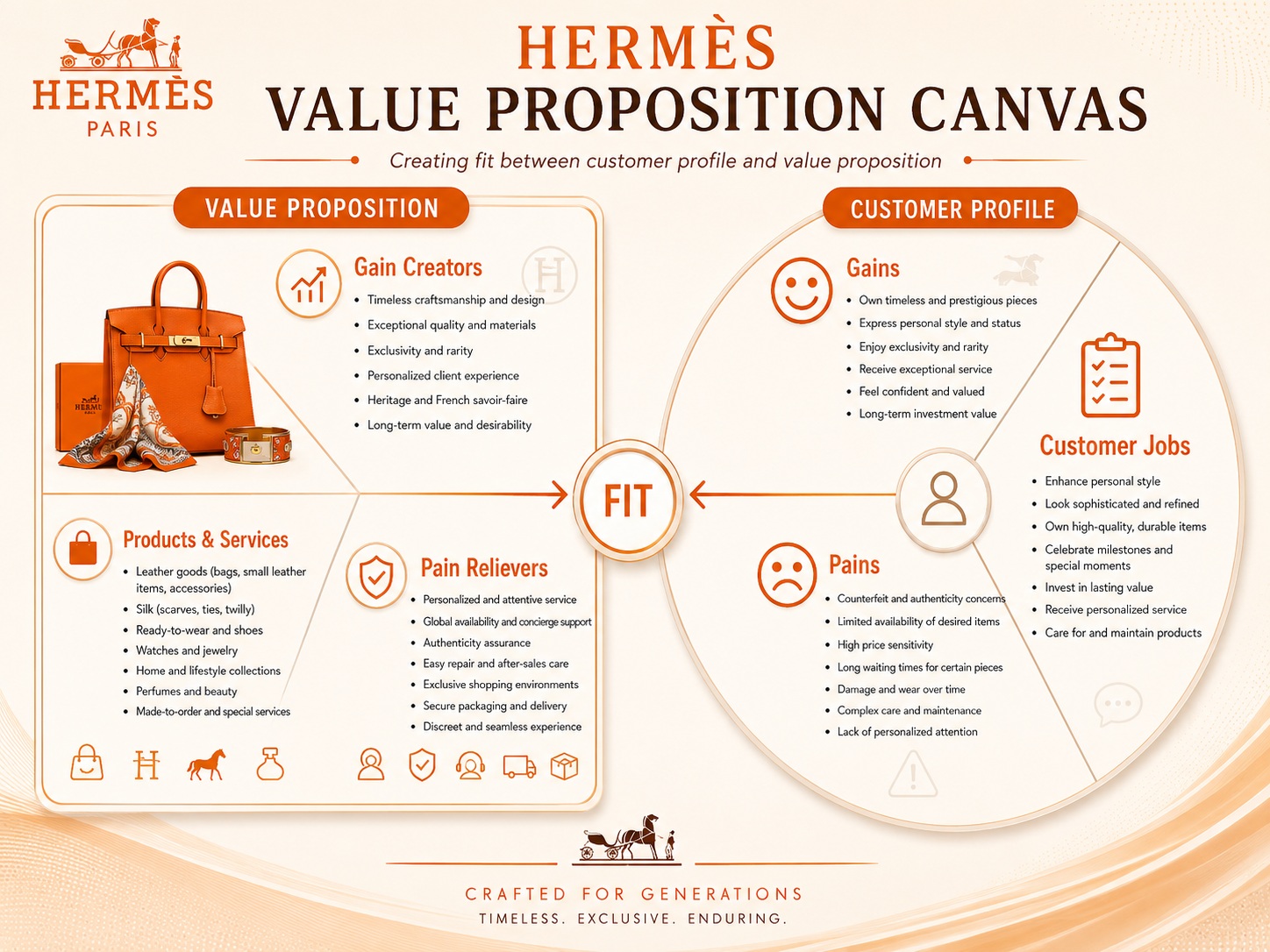
The Value Proposition Canvas is a useful tool for showing how well a company’s offer matches what customers actually want. It connects two sides. The first is the customer profile, which explains customer jobs, pains, and gains. The second is the value proposition, which explains the products and services, pain relievers, and gain creators offered by the business.
For Hermes, this section matters because customers do not buy only for utility. They buy for quality, symbolism, emotional reward, social signaling, and long-term ownership value. The fit is strong when Hermes turns those expectations into a product and buying experience that feels rare, credible, and deeply personal.
The customer profile explains what Hermes customers are trying to achieve, what frustrations they want to avoid, and what benefits they hope to gain from the brand. This matters because Hermes does not compete as a broad fashion label. It competes by helping customers express taste, status, identity, and confidence through products that feel exceptional and enduring.
Many Hermes customers want to own items that signal refinement without looking disposable or trend-dependent. Some want a product that lasts for years and can be repaired. Others want a luxury experience that feels private, selective, and culturally respected. A collector may also want scarcity and resale strength, while a loyal client may want continuity across categories and over time.
This means the Hermes customer profile includes both functional and emotional needs. Buyers want quality, but they also want recognition, reassurance, prestige, and a sense of belonging to a rarefied world.
| Customer Profile Element | Explanation |
| Customer Jobs | Customers want to own luxury products, express identity, signal status, give memorable gifts, build collections, and buy items that last. |
| Pains | They face fake luxury, overexposed brands, declining product quality, weak service, uncertain authenticity, and trend-driven items that lose appeal fast. |
| Gains | They want craftsmanship, exclusivity, trust, timelessness, resale confidence, personal attention, and emotional satisfaction. |
Hermes Value Proposition explains how Hermes responds to the customer profile above. It shows what Hermes offers, how those offers reduce customer concerns, and how they create extra value beyond product ownership.
In simple terms, this section answers one question: why do customers choose Hermes instead of another luxury brand? The answer is not only a Birkin, Kelly, scarf, watch, belt, or fragrance. It is the full experience that combines artisanal quality, controlled rarity, heritage, boutique service, after-sales support, and symbolic value.
Hermes reduces customer pains by making luxury feel credible and durable. Products are crafted with strong materials, quality control is high, repairs and maintenance support long-term use, and distribution remains tightly controlled. These factors reduce the risk of buying something that feels overly commercial, inconsistent, or short-lived.
The brand also creates gains by offering more than prestige. Hermes gives customers emotional reward, social distinction, collecting appeal, and confidence that the product will remain desirable over time. A customer may start with a silk scarf or belt, later add leather goods, watches, jewellery, or homeware, and gradually build a broader relationship with the maison.
This is why Hermes has a strong value proposition. It is not built on one product feature. It is built on a luxury system that makes customers feel selective, confident, and connected to lasting excellence.
| Value Proposition Element | Explanation |
| Products and Services | Leather goods, saddlery, silk, ready-to-wear, shoes, belts, watches, jewellery, fragrance, beauty, homeware, after-sales care, and boutique-led service. |
| Pain Relievers | Exceptional craftsmanship, strict quality control, controlled availability, heritage credibility, repair services, curated retail experience, and trusted authenticity. |
| Gain Creators | Prestige, rarity, timeless design, collecting appeal, emotional satisfaction, gifting value, strong symbolic meaning, and long-term ownership pride. |
The fit happens when Hermes turns customer desire for status, quality, and meaning into a product experience that feels authentic and hard to replace. Customers want luxury that is refined, lasting, and selective. Hermes creates that fit by combining craftsmanship, scarcity, heritage, service, and long-term product care into one coherent system.
This fit becomes visible when a customer buys a silk scarf for elegance, returns for a belt or shoes, then develops a boutique relationship that later leads to leather goods, watches, jewellery, or home products. Each purchase solves a different customer job, but the stronger value appears when the customer feels that Hermes consistently delivers rarity, trust, and prestige across the relationship.
That is where Hermes moves beyond product ownership and becomes part of personal identity and lifestyle. The item is important, but the deeper fit comes from what the brand represents and how consistently it delivers that promise.
| Customer Profile | Details | Matching Value Proposition | How Hermes Creates Fit |
| Customer Jobs | Customers want to express taste, signal status, buy lasting luxury, give premium gifts, build collections, and own products that carry prestige over time. | Products and Services | Leather goods, silk, ready-to-wear, shoes, belts, watches, jewellery, fragrance, beauty, homeware, after-sales care, and boutique-led service support these luxury and lifestyle jobs. |
| Pains | Customers face fake exclusivity, uncertain authenticity, inconsistent service, low durability, overexposed brands, and products that lose emotional value quickly. | Pain Relievers | Exceptional craftsmanship, strict quality control, controlled availability, heritage credibility, repair services, curated retail experience, and trusted authenticity reduce these frustrations. |
| Gains | Customers want rarity, prestige, timeless design, emotional reward, collecting appeal, personal recognition, resale confidence, and long-term ownership pride. | Gain Creators | Hermes creates gains through iconic products, symbolic brand power, selective access, timeless design language, boutique relationships, and long-term desirability across categories. |
The Hermes Business Model Canvas becomes more powerful when viewed together with this fit. Hermes wins when customers feel that the brand delivers more than luxury objects. It delivers confidence, distinction, and continuity in a way that few competitors can match.
The Hermes Business Model Canvas reveals a set of advantages that reinforce one another and help explain why the brand stays distinctive even in a crowded global luxury market. These strengths do not operate in isolation. They work together as a system that supports pricing power, desirability, customer loyalty, and long-term strategic control:
Together, these advantages make Hermes hard to imitate. Rivals may copy shapes, materials, or campaigns. Recreating the full system is far more difficult.
Even a strong luxury model carries pressure points, and those pressure points become more important as the brand grows larger, more visible, and more globally exposed:
These risks do not make the model fragile. They show that luxury leadership depends on continuous discipline, operational patience, and strategic consistency rather than on brand fame alone.
Hermes should keep expanding carefully, especially in capacity and geography, without turning growth into easy availability. Additional artisanal capacity is useful only when quality and scarcity remain intact.
The company should make the client journey more transparent without making the brand feel transactional. Better communication around categories, service, appointments, and after-sales support can improve trust while preserving exclusivity.
Digital investment should continue in a restrained way. Online channels should support discovery, education, appointment-setting, repair requests, and client service rather than broad product access that weakens the in-store experience.
Management should also strengthen resilience in sourcing, logistics, and regional demand planning. A strong luxury house needs not only desirability, but also operational flexibility.
Finally, Hermes should keep expanding adjacent categories where craftsmanship and prestige still fit the brand. Growth is strongest when new revenue deepens the maison universe rather than stretching it.
Hermes has built one of the most disciplined luxury business models in the world. The company does not compete through volume, promotion, or broad accessibility. Instead, it competes through craftsmanship, heritage, scarcity, channel control, and trust.
That is why the Hermes Business Model Canvas remains so useful. It shows that the business is not powered by handbags alone. It is powered by a tightly aligned system where customer segments, value proposition, channels, relationships, resources, and activities all reinforce one another.
Future success will depend on keeping that system balanced. Hermes needs enough growth to stay relevant, enough restraint to stay exclusive, and enough operational strength to support both. When those elements stay aligned, the Hermes Business Model Canvas remains one of the strongest examples of luxury strategy in practice.
This article is for educational and business analysis purposes only. It is based on publicly available information, general market observation, and strategic interpretation. It is not financial advice, investment advice, legal advice, or an official statement from Hermes International. Readers should conduct their own research before making business, investment, or strategic decisions.
Read this Apple Business Model Canvas analysis to understand how Apple creates value through premium… Read More
This Business Model Canvas AWS analysis explains how the company creates, delivers, and captures value… Read More
This article explores the Canva Business Model and provides an in-depth review of each BMC… Read More
Many people think they understand McDonald’s business model. Sell burgers. Sell fries. Sell drinks. It… Read More
Explore the Mixue Business Model Canvas and learn how Mixue uses affordability, franchising, supply chain… Read More
The BMC Loacker demonstrates how disciplined premium positioning can endure for more than a century… Read More