Business Model Canvas (BMC) Analysis of MIXUE
Introduction
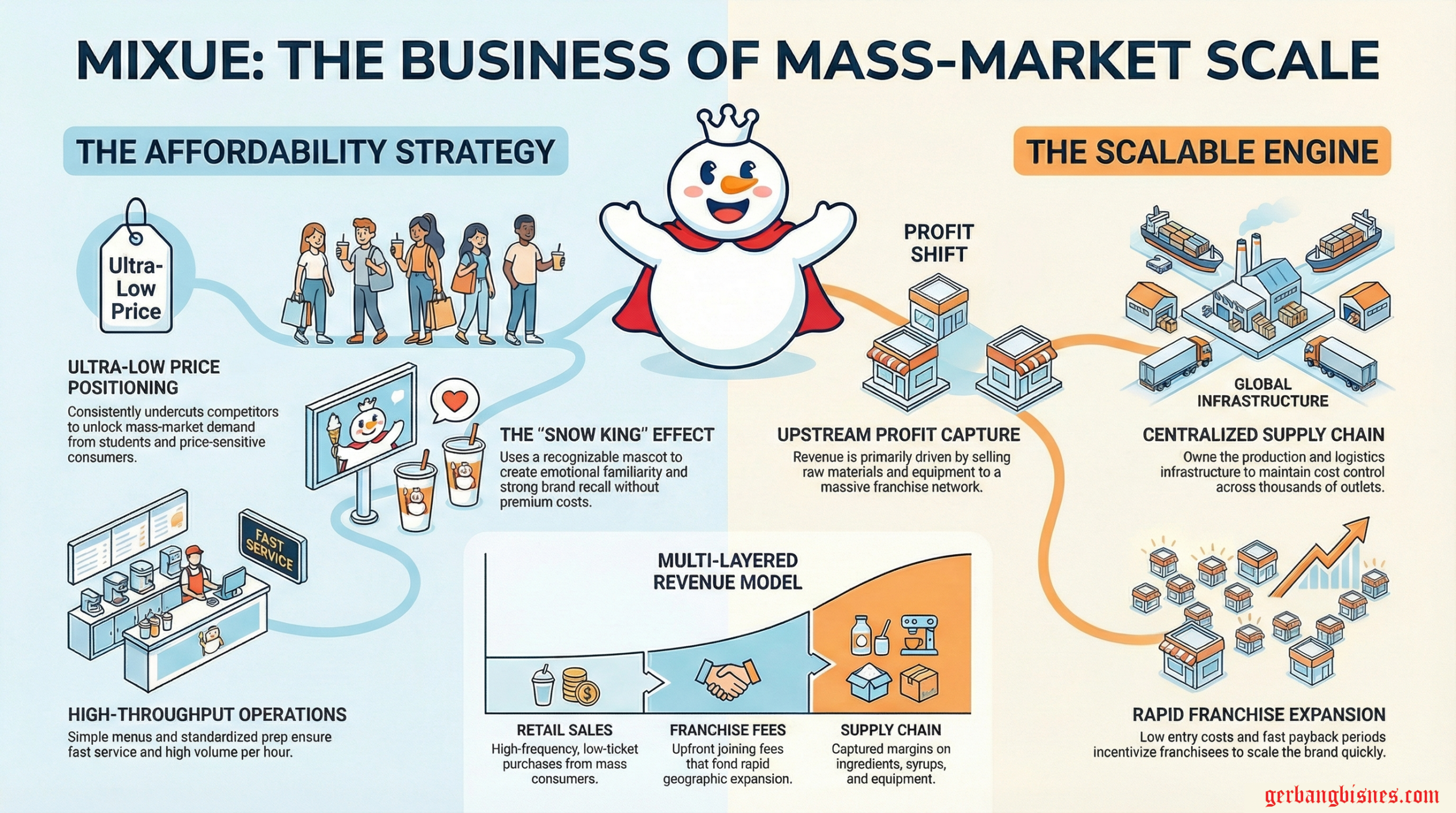
This BMC Mixue Analysis explains how Mixue built one of the largest beverage networks globally. Mixue was founded in 1997 in Zhengzhou, China. The founder focused on affordability as a core principle. Ice cream and tea were positioned as everyday products. Prices remained consistently lower than competitors. This positioning unlocked mass-market demand. Mixue expanded rapidly using a franchising model. The brand scaled across China and Southeast Asia. Revenue comes mainly from supply chain control. Franchise fees and ingredient sales drive profitability. Operational discipline supports thin margins. The mascot-driven brand creates strong recall. This BMC Mixue Analysis shows how scale replaces premium pricing.
Customer Segments
This block explains who Mixue serves and why scale matters. Customer definition drives pricing and location strategy.
Mixue targets mass-market consumers with high price sensitivity. Customers include students, young workers, and families. They purchase frequently and spend small amounts per visit. Impulse buying plays a strong role. Climate and urban density increase demand. The brand also serves franchisees as key partners. Franchisees seek low entry cost and fast payback. This dual-customer structure shapes Mixue’s model. The brand avoids niche or premium segments deliberately. Volume matters more than margin per customer.
Customer Segments Analysis:
- Students near schools and colleges with daily discretionary spending habits, limited budgets, and high frequency purchase behavior
- Office workers in dense urban zones seeking affordable breaks during workdays without committing to premium-priced beverages
- Families seeking affordable treats for children and group consumption that fit regular household spending patterns
- Price-sensitive daily consumers influenced strongly by visible pricing cues, promotions, and ease of access
- Franchise operators as business customers seeking fast breakeven, predictable returns, and scalable outlet expansion
Value Propositions
This block defines why customers consistently choose Mixue. The value proposition focuses on affordability and consistency.
Mixue delivers extremely low-priced ice cream and tea. Products remain standardized across all outlets. Customers know what to expect every visit. Simple menus reduce decision fatigue. Fast service supports high throughput. The Snow King mascot creates emotional connection. Perceived value exceeds price paid. The brand avoids premium positioning intentionally. Consistency builds trust over time. Value is reinforced through repetition and habit.
Value Proposition Analysis:
- Ultra-low price positioning that consistently undercuts most competitors, making Mixue an accessible choice for mass-market consumers
- Consistent taste and portion size maintained across thousands of franchised outlets, reducing uncertainty for repeat customers
- Fast and simple ordering experience deliberately designed to support high customer throughput and quick decision-making
- Friendly and recognizable brand mascot that creates emotional familiarity and strengthens everyday brand attachment
- High value perception for daily consumption despite low absolute pricing, encouraging frequent and habitual purchases
Channels
This block explains how Mixue reaches its customers. Channels prioritize visibility and convenience.
Physical stores remain the primary channel. Locations target high pedestrian traffic. Stores cluster near schools and transit areas. Small footprints reduce rental costs. Social media amplifies brand awareness. Promotions rely on price signaling. Word-of-mouth spreads quickly due to affordability. The mascot enhances storefront visibility. Digital presence supports offline sales. Channels reinforce habitual purchasing behavior.
Channels Analysis:
- Street-level franchise outlets designed for walk-in and impulse purchases, particularly from pedestrians and nearby communities
- High-density urban locations near schools, transit hubs, and residential zones that generate consistent daily foot traffic
- Social media platforms reinforcing brand awareness and price perception, supporting offline visits rather than direct sales
- In-store signage and mascot branding enhancing visual recognition and instant brand recall at the point of purchase
- Customer word-of-mouth driven by affordability, consistent experience, and frequent repeat visits
Customer Relationships
This block defines how Mixue interacts with customers. Relationships focus on efficiency rather than personalization.
Mixue uses a transactional relationship model. Customers order at counters with minimal interaction. Speed and consistency matter most. There are no loyalty programs in most markets. Habit replaces formal engagement tools. The mascot provides emotional familiarity. Brand trust develops through repetition. Service design supports high-volume flow. Relationships remain low-cost to maintain. This supports scalability across thousands of outlets.
Customer Relationships Analysis:
- Self-service counter ordering that minimizes staffing requirements while keeping service flow simple and predictable
- Fast transaction cycles supporting high customer volume per hour, especially during peak traffic periods
- Consistent product delivery that builds trust through repetition and reinforces customer expectations
- Emotional branding via mascot replacing formal loyalty mechanisms and creating everyday familiarity
- Habit-based repeat visits driven by low prices, ease of access, and routine consumption behavior
Revenue Streams
This block explains how Mixue generates income. Revenue design supports scalability and predictability.
Customers pay per item at low prices. High transaction volume offsets low margins. Franchisees pay joining fees. Ongoing royalties provide recurring income. Core revenue comes from ingredient supply. Mixue controls raw material distribution. Equipment and logistics sales add income. This structure shifts profit upstream. Franchisees bear retail risk. Mixue benefits from system-wide scale.
Revenue Streams Analysis:
- Retail ice cream and beverage sales generating high transaction volume through frequent, low-ticket purchases across thousands of outlets
- Franchise joining fees providing upfront expansion funding and reducing capital strain on the central business
- Ongoing franchise royalties creating predictable recurring income tied to network growth and outlet performance
- Ingredient and syrup sales capturing margin upstream in the value chain where Mixue maintains pricing power
- Equipment and logistics supply supporting standardized store operations, quality consistency, and operational control
Key Resources
This block identifies assets enabling the business model. Resources focus on efficiency and control.
Mixue owns centralized supply chains. Proprietary recipes ensure consistency. Bulk purchasing reduces unit cost. The franchise system is a key asset. Brand trademarks support rapid expansion. The mascot strengthens recall and loyalty. IT systems support franchise management. Logistics infrastructure enables scale. Resources prioritize replication over customization. This supports aggressive expansion.
Key Resources Analysis:
- Centralized ingredient production enabling cost control and consistency across thousands of outlets, while reducing variability in quality
- Proprietary formulations protecting taste standardization and preventing dilution of product experience as the network expands
- Franchise management systems supporting large-scale coordination, monitoring, and enforcement of operational standards
- Strong brand and mascot assets driving recognition across markets and building emotional familiarity among mass consumers
- Logistics and distribution infrastructure enabling rapid expansion, timely replenishment, and reliable supply at scale
Key Activities
This block describes essential daily operations. Execution quality defines success.
Mixue focuses on supply chain management. Ingredient sourcing and production remain critical. Logistics coordination ensures timely delivery. Franchise onboarding supports expansion. Training ensures operational consistency. Quality audits protect brand standards. Marketing sustains brand visibility. Menu management remains intentionally simple. Activities prioritize scale and efficiency. Complexity is actively avoided.
Key Activities Analysis:
- Ingredient production and sourcing at scale to support thousands of outlets while ensuring stable supply, cost efficiency, and consistent quality
- Logistics and distribution ensuring timely and consistent delivery across regions, even as the network expands rapidly
- Franchise training and onboarding to maintain operational standards, service consistency, and compliance with brand guidelines
- Quality control and audits protecting brand reputation by detecting issues early and enforcing standardized processes
- Brand marketing execution focused on affordability and visibility, reinforcing price perception and mass-market appeal
Key Partnerships
This block explains who supports Mixue’s operations. Partners reduce cost and operational risk.
Suppliers provide raw materials at scale. Packaging partners support branding consistency. Logistics firms ensure distribution reach. Equipment vendors supply standardized tools. Landlords provide access to strategic locations. Partnerships focus on reliability and cost. Long-term relationships support scale economics. Partners grow alongside the franchise network. Dependency risk is managed through diversification.
Key Partnerships Analysis:
- Raw material suppliers providing stable volume-based pricing, long-term supply assurance, and predictable input costs at scale
- Packaging manufacturers ensuring uniform branding presentation across all outlets and reinforcing visual consistency
- Logistics providers supporting nationwide and regional distribution with timely delivery and broad geographic coverage
- Equipment suppliers delivering standardized store machinery to ensure operational consistency and efficiency
- Property owners and landlords enabling access to high-traffic locations that maximize daily footfall and visibility
Cost Structure
This block outlines major cost drivers. Cost discipline underpins the entire model.
Ingredient production forms the largest cost. Logistics and warehousing add variable expenses. Franchise support requires ongoing investment. Marketing costs remain controlled. IT systems support operations. Scale reduces per-unit costs steadily. Variable costs dominate fixed costs. This supports flexibility during expansion. Cost leadership enables low pricing. Efficiency protects margins.
Cost Structure Analysis:
- Ingredient sourcing and production as the primary variable cost driver, driven by high volume requirements and centralized supply chain operations
- Logistics and warehousing expenses scaling with network growth as distribution coverage expands across cities and regions
- Franchise support operations including training, audits, and ongoing operational assistance to maintain standardization
- Marketing and branding costs focused on awareness rather than campaigns, emphasizing price visibility and brand recall
- IT and systems maintenance supporting large franchise networks through coordination, monitoring, and data management
Value Proposition Canvas (VPC) Analysis
Customer Profile
The customer profile explains what Mixue customers are trying to achieve. It clarifies jobs, pains, and gains that shape demand.
Mixue customers want affordable, fast, and predictable treats. They consume ice cream and tea as part of daily routines. Purchases are often impulsive and repeated frequently.
Jobs:
- Buy affordable snacks and drinks on a daily basis as part of routine consumption without straining personal budgets
- Cool down quickly in hot urban environments using products that are easily accessible and fast to obtain
- Socialize casually with friends or family in informal settings without the pressure of high spending
- Make fast purchase decisions without complexity, especially during busy or time-constrained moments
Pains:
- Beverage prices that feel too high for daily consumption and discourage frequent repeat purchases
- Inconsistent taste across different brands or outlets that reduces trust and satisfaction
- Long waiting times during peak hours that conflict with the need for speed and convenience
- Confusing menus with too many options that slow down decision-making and ordering
Gains:
- Very low prices that enable frequent purchases and support habitual daily consumption
- Consistent taste and portion size that meet expectations on every visit
- Fast service with minimal waiting even during busy periods
- Familiar brand experience across locations that feels predictable and reassuring
Value Map
The value map explains how Mixue addresses these needs.
Products and Services:
- Ice cream cones and cups designed for fast consumption, low price points, and frequent repeat purchases across all customer segments
- Milk tea and fruit tea beverages formulated for daily drinking, simple preparation, and consistent taste at scale
- Seasonal limited-time offerings introduced selectively to add novelty without increasing operational complexity
Pain Relievers:
- Ultra-low pricing that removes price resistance and makes frequent purchases financially comfortable for mass consumers
- Standardized preparation processes to ensure consistent taste, portion size, and quality across all outlets
- Simple menus that reduce ordering time, minimize decision fatigue, and speed up customer flow
- Efficient workflows that shorten queues, especially during peak hours in high-traffic locations
Gain Creators:
- High perceived value relative to price paid, reinforcing the feeling of getting more than what customers spend
- Habit-forming consumption through wide accessibility, dense store networks, and predictable pricing
- Strong brand recall through mascot and visuals that create emotional familiarity and instant recognition
- Reliable experience across thousands of outlets, building trust and confidence in every visit
Strategic Recommendations
1. Strengthen Digital Ordering and Payments
Related BMC Blocks: Channels, Customer Relationships
Digital ordering can reduce queue time during peak hours. Cashless payments can improve transaction speed and data capture. This supports higher throughput without increasing labor costs.
2. Introduce Limited Tiered Pricing Carefully
Related BMC Blocks: Value Propositions, Revenue Streams
Selective premium variants can increase average order value. Core low-price positioning must remain unchanged. Tiering should be limited and operationally simple.
3. Enhance Franchise Performance Analytics
Related BMC Blocks: Key Activities, Key Resources
Data-driven monitoring can identify underperforming outlets early. Standard dashboards can improve consistency across regions. This strengthens franchise governance at scale.
4. Localize Seasonal Products by Market
Related BMC Blocks: Customer Segments, Value Propositions
Localized flavors can increase relevance in different countries. Seasonal launches create excitement without menu complexity. Supply chain control should remain centralized.
Conclusion
This BMC Mixue Analysis highlights a scale-driven model. Mixue competes through affordability and discipline. The brand avoids premium positioning deliberately. Franchising enables rapid geographic expansion. Centralized supply chains protect consistency. Low prices drive habitual consumption. Profit shifts upstream to ingredients and logistics. The mascot humanizes a low-cost brand. Risks include cost inflation and franchise control. Digital tools can strengthen oversight. Menu expansion must remain simple. Overall, Mixue proves scale can outperform premium strategies.