Quipper Business Model Canvas
Explore the Quipper Business Model Canvas, nine BMC blocks, Value Proposition Canvas, Ruangguru and Pahamify comparison, competitive advantages, risks, and strategic recommendations.
Established in 1959 by Tjhai Sioe and Loei Kwai Fong, Bakmi GM started as a small noodle stall on Gajah Mada Street, Jakarta. Over the decades, it has grown into one of Indonesia’s most iconic restaurant chains, specializing in bakmi (noodle) dishes. As of 2022, Bakmi GM operates over 50 outlets across Greater Jakarta, Bandung, Surabaya, and Bali, serving approximately 30,000 customers daily.
BMC Article No: BMC #049
Updated in 2026: This article has been refreshed with the 2024 Djarum ownership context, the latest Bakmi GM digital app and membership updates, current service-channel information from the live website, a more relevant Indonesia-based comparison with Mie Gacoan, deeper analysis for each BMC block, expanded recommendations, and a sharper risk discussion.
Bakmi GM is one of Indonesia’s most recognisable restaurant brands. What began as a small noodle business in Jakarta has become a scaled casual dining chain built on consistency, familiarity, and operational reach.
The Bakmi GM Business Model Canvas matters because this company does not compete only on taste. Its advantage comes from combining heritage, trusted menu favourites, strategic locations, delivery access, and repeat-purchase behaviour through membership and promotions.
That combination makes Bakmi GM strategically interesting. Unlike many trend-driven F&B brands, it sits between legacy trust and modern convenience. This is precisely why the brand deserves closer business analysis. A company like Bakmi GM shows how an F&B player can stay commercially relevant even when consumer attention shifts toward newer and more viral brands.
A deeper look also helps explain a bigger point. Restaurant success rarely comes from food alone. In practice, long-term winners usually align brand memory, location economics, customer frequency, service consistency, and channel expansion into one coherent operating model.
This article therefore goes beyond a surface summary. It uses the Bakmi GM Business Model Canvas to show how the company creates value, where its resilience comes from, and what strategic pressures will likely shape its next phase.
Bakmi GM operates a branded casual dining and quick-service restaurant model. Revenue is generated through dine-in, takeout, delivery, catering, and selected packaged or frozen products.
At the core, the Bakmi GM Business Model Canvas shows a company monetising everyday meal occasions. Customers do not visit only for a special event. They come for lunch, dinner, family meals, office orders, and convenient repeat consumption.
This structure matters because frequency is critical in restaurant economics. A brand that can serve both routine and occasion-based demand usually becomes more resilient. Bakmi GM is not positioned as a luxury destination or a limited novelty brand. Instead, it is built around repeatable, mass-market relevance.
That operating logic is important. A business that wins frequent everyday decisions can often outperform one that depends on occasional excitement. In Bakmi GM’s case, the model works by turning comfort, accessibility, and consistency into stable revenue across multiple channels.
Business Model Canvas, or BMC, is a practical framework used to explain how a company creates value, delivers that value, and captures revenue. Rather than focusing only on products, it maps the full commercial logic behind the business.
For restaurant chains, this is useful because success depends on more than menu quality. Site selection, supply consistency, channel mix, customer loyalty, service speed, and cost control all affect performance.
That is why the Bakmi GM Business Model Canvas is a strong lens for analysis. It helps explain how a noodle chain can scale while preserving familiarity and repeat demand.
| BMC Block | Main Question |
|---|---|
| Customer Segments | Who does the business serve? |
| Value Propositions | What value does the business offer? |
| Channels | How does the business reach customers? |
| Customer Relationships | How does the business build loyalty? |
| Revenue Streams | How does the business make money? |
| Key Resources | What assets does the business need? |
| Key Activities | What must the business do well? |
| Key Partnerships | Who helps the business operate? |
| Cost Structure | What are the major costs? |
Founded in 1959, Bakmi GM grew from a Jakarta noodle outlet into a large multi-branch Indonesian restaurant chain. The brand is widely associated with reliable noodle dishes, fast service, and accessible urban locations.
Recent developments also matter. Bakmi GM’s controlling stake was acquired by Djarum Group in late 2024, while its live website and mobile app now show a stronger push into delivery, online ordering, catering, food trucks, promotions, and membership-based engagement.
Taken together, the Bakmi GM Business Model Canvas reflects a brand that is no longer just a traditional dine-in chain. It is increasingly a hybrid restaurant platform with offline scale and digital support.
That shift deserves attention because it changes how the business can grow. Earlier, store presence was the main growth engine. Today, digital touchpoints, customer data, off-premise demand, and ecosystem partnerships also play a larger role in how Bakmi GM captures value.
Bakmi GM is strategically interesting because it competes with a trust-based model in an industry often driven by novelty. Many restaurant brands rise quickly on trend appeal, but Bakmi GM has endured through standardisation, recognisable menu anchors, and broad family acceptance.
Another factor is channel flexibility. The business serves customers through physical outlets, takeout, delivery, catering, and branded promotions rather than relying on one traffic source.
This matters because mature F&B winners usually combine brand memory with operational repeatability. The Bakmi GM Business Model Canvas is therefore not only about food. It is about converting familiarity into dependable recurring revenue.
A further reason the company stands out is its middle-market positioning. Bakmi GM is neither a premium specialist nor an ultra-low-price disruptor. That middle position gives it broad consumer reach, but it also means the company must work harder to defend relevance as competitors become sharper in either price or identity.
In 2026, four shifts shape the company’s direction. First, new ownership context may support stronger expansion discipline and institutional scale. Second, digital convenience is becoming more important through app-led loyalty, order history, store search, and smoother login features. Third, service variety now extends beyond dine-in into delivery, catering, food trucks, and online channels. Fourth, competition is intensifying as younger noodle chains push more aggressive pricing and stronger viral appeal.
Those changes make the Bakmi GM Business Model Canvas more dynamic than before. The company still benefits from heritage, but future growth will depend on how well it modernises without diluting the core brand.
The implication is strategic, not cosmetic. If Bakmi GM uses these updates only as tactical add-ons, the impact may stay limited. If management treats them as part of a broader operating model upgrade, the company could strengthen frequency, improve retention, and create new growth paths beyond traditional store traffic.
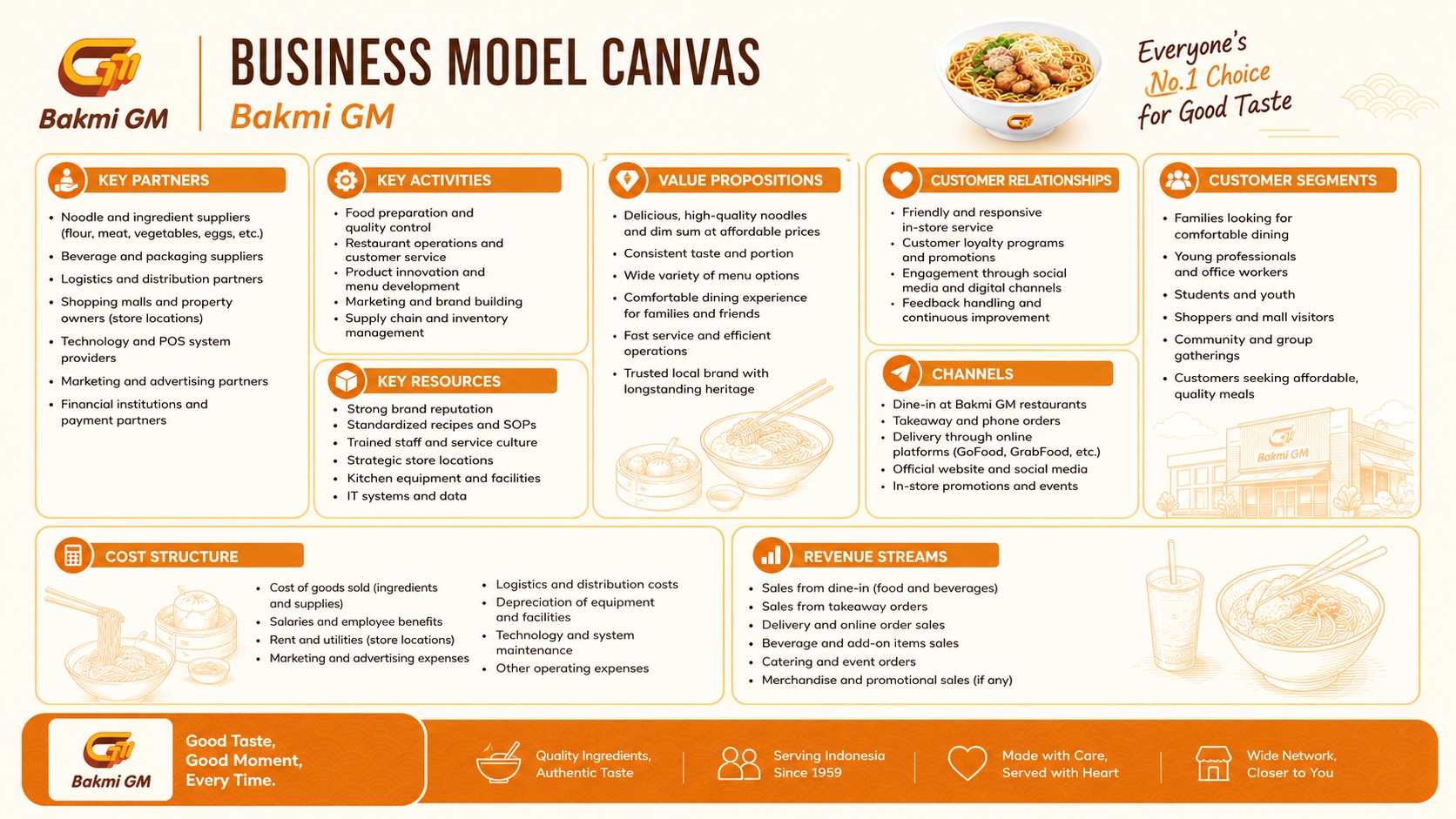
Before going block by block, the summary below gives a compact view of how the business works. It shows how Bakmi GM combines brand legacy, urban access, repeat menu demand, and multi-channel service into one operating system.
| BMC Block | Bakmi GM Application |
|---|---|
| Customer Segments | Urban workers, families, students, delivery users, group buyers, and loyal repeat customers. |
| Value Propositions | Trusted taste, menu consistency, convenient locations, quick service, and affordable familiarity. |
| Channels | Dine-in outlets, takeout, own digital touchpoints, online ordering, delivery partners, catering, and food trucks. |
| Customer Relationships | Membership rewards, promotions, service reliability, social media engagement, and repeat-visit habits. |
| Revenue Streams | Dine-in sales, takeout, delivery orders, catering, events, and selected frozen or packaged products. |
| Key Resources | Brand equity, recipes, supply network, branch footprint, trained staff, app ecosystem, and operating know-how. |
| Key Activities | Food preparation, quality control, procurement, branch operations, marketing, and channel management. |
| Key Partnerships | Suppliers, landlords, delivery platforms, payment partners, technology providers, and marketing collaborators. |
| Cost Structure | Ingredients, labour, rent, utilities, logistics, packaging, marketing, and technology. |
The diagram below can be inserted here to provide a visual summary of the nine blocks before the detailed analysis.
The detailed review below shows how each block supports the larger commercial system. Instead of treating Bakmi GM as only a restaurant brand, this section explains how the model works as a coordinated mix of menu design, channel reach, operating discipline, and customer retention.
The logic is similar to the Pepsi article format: each block should not be read in isolation. Customer segments influence channel design. Value propositions shape loyalty expectations. Resources and partnerships determine whether the brand can actually deliver its promise at scale. In other words, the strength of the model lies in how the blocks reinforce one another.
Customer segments explain who Bakmi GM serves and why those groups matter commercially. The company reaches broad urban consumers, but its strength lies in serving multiple meal occasions rather than one narrow niche.
Office workers use Bakmi GM for practical weekday meals. Families choose it because the brand is familiar, acceptable across age groups, and easy to access in malls or city nodes. Students and younger consumers add traffic through affordable menu appeal. Delivery users and catering buyers widen demand beyond outlet footfall.
That breadth strengthens the Bakmi GM Business Model Canvas because the company is not dependent on one customer tribe or one time slot. A balanced customer base also reduces concentration risk. When lunch traffic weakens, family demand, delivery demand, or group orders can help cushion performance.
| Segment | Details | Why It Matters |
|---|---|---|
| Urban workers | Need quick, dependable meals in convenient locations | Supports weekday volume and lunch traffic |
| Families | Seek familiar food in an accessible setting | Builds broad household relevance |
| Students and younger buyers | Value affordable, recognisable menu choices | Adds frequency and volume potential |
| Delivery and group buyers | Order for homes, offices, or events | Extends demand beyond store visits |
From a strategic perspective, this is a portfolio approach to demand. Bakmi GM is strongest when it serves not only one lifestyle segment, but a full range of everyday eating occasions. That breadth gives the company more resilience than a narrowly targeted restaurant concept. It also creates room to balance weekday and weekend traffic, individual and group orders, and on-premise versus off-premise consumption.
Another implication is that customer segmentation at Bakmi GM is less about sharp exclusivity and more about commercial coverage. The business wins when it becomes broadly useful to many types of customers across many situations. In practical terms, this expands revenue opportunities while reducing the risk that one customer segment or one consumption habit will dominate the brand’s performance too heavily.
Seen this way, the segment block is not just about who buys Bakmi GM. It is about how the company protects stability through diversified demand.
The value proposition explains why people repeatedly choose Bakmi GM over alternatives. Taste matters, but the full offer is broader than flavour alone.
Bakmi GM gives customers trusted noodle dishes, consistent quality, accessible pricing, and confidence that the experience will feel familiar across branches. Speed also matters because many visits are functional rather than leisurely. Delivery, membership perks, and menu variety further strengthen convenience.
That combination creates practical value. Customers are not only buying noodles; they are buying reduced decision risk. In crowded restaurant markets, that is more powerful than it looks. Many consumers return to a known brand because it lowers the chance of disappointment.
| Value Proposition | Details | Why It Matters |
|---|---|---|
| Brand trust | Long heritage and strong recognition | Lowers trial barriers and supports repeat visits |
| Consistent menu quality | Standardised preparation across outlets | Protects customer expectations |
| Convenience | Strategic outlets plus digital ordering access | Fits modern urban consumption habits |
| Affordable familiarity | Comfort-food positioning at accessible prices | Encourages everyday purchase frequency |
This is where Bakmi GM’s model becomes defensible. Its proposition is not built on being the newest option. It is built on being the safer and easier choice for repeated consumption. That positioning may sound simple, but it is strategically powerful because everyday dining decisions are often driven by confidence, speed, and familiarity rather than novelty alone.
A customer who already trusts the menu, understands the price point, and expects reliable service is easier to retain than one constantly chasing new experiences. That lowers demand volatility and gives the company a stronger base for recurring revenue. It also means Bakmi GM can compete on reliability even when rivals compete more loudly on trendiness or pricing.
In effect, the value proposition works as a risk-reduction mechanism for consumers. That is one reason the Bakmi GM Business Model Canvas remains commercially relevant despite a rapidly changing restaurant landscape.
Channels explain how Bakmi GM reaches customers and converts demand into revenue. In restaurant chains, channels are not just a distribution issue; they shape traffic mix, basket size, and resilience.
Physical stores remain central because they create visibility, impulse visits, and dine-in revenue. At the same time, digital ordering, delivery aggregation, takeout, catering, and food truck services broaden the brand’s reach. This mix matters because meal demand now flows across physical and digital touchpoints.
A stronger channel system makes the business less dependent on mall traffic alone. It also improves strategic flexibility. When one channel becomes more expensive or less efficient, management can shift emphasis toward higher-yield routes.
| Channel | Details | Why It Matters |
|---|---|---|
| Dine-in and takeout outlets | Core branch network in strategic urban areas | Drives visibility and routine traffic |
| Online and app touchpoints | Support ordering, membership, promos, and store search | Improves convenience and data capture |
| Delivery partners | Expand access to home and office demand | Adds off-premise revenue |
| Catering and food trucks | Serve events and special demand pockets | Diversifies sales occasions |
In Pepsi-style strategic terms, the channel system is not just how Bakmi GM sells. It is how the brand stays present in more consumption moments than a store-only chain can reach. That presence matters because modern food demand is fragmented. Consumers may want dine-in convenience one day, delivery from home the next, and catering for a group occasion later in the week.
A multi-channel structure allows Bakmi GM to participate in those different moments without forcing customers into a single mode of purchase. This makes the business more accessible, but it also makes it more adaptive. When store traffic softens, digital or catering demand can help offset the gap. When delivery economics tighten, dine-in and takeout can still support healthy throughput.
The larger point is that channels are part of strategy, not just logistics. A stronger channel mix increases reach, strengthens resilience, and helps Bakmi GM remain relevant as customer behaviour keeps shifting.
Customer relationships describe how Bakmi GM keeps demand recurring. In this category, loyalty is built less through deep personal interaction and more through habitual relevance, smooth service, and reward mechanisms.
Membership is increasingly important because it adds points, birthday rewards, exclusive promotions, and tiered benefits. Social media and promo campaigns keep the brand visible, while operational consistency reinforces trust. Once a restaurant becomes a default option, retention costs can be lower than constant reacquisition.
That matters because repeat purchase economics are central to restaurant profitability. Relationship strength is therefore not measured only by emotional attachment. It is also measured by how often customers return without needing heavy persuasion.
| Relationship Type | Details | Why It Matters |
|---|---|---|
| Membership rewards | Points, tiers, birthday rewards, and exclusive offers | Increases repeat purchase motivation |
| Brand familiarity | Customers know what to expect from the menu | Builds habitual return behaviour |
| Promotional engagement | Campaigns and seasonal offers | Stimulates traffic and trial |
| Service reliability | Consistent speed and order fulfilment | Protects satisfaction and trust |
Strategically, Bakmi GM’s relationship model is about building default status. The more often consumers think of it automatically, the stronger the commercial moat becomes. In restaurant markets, this kind of habitual relevance is often more valuable than occasional excitement because it supports stable traffic and lowers the cost of repeat conversion.
Membership mechanics strengthen that logic by turning familiarity into measurable retention. Promotions, rewards, and recurring engagement help move customers from passive awareness to active repetition. At the same time, reliable service ensures that the promise behind those incentives is actually fulfilled when the customer returns.
This means customer relationships at Bakmi GM are not only about communication. They are about engineering repeat behaviour. The stronger that behaviour becomes, the more the brand shifts from being one option among many to being a routine part of the consumer’s dining pattern.
Revenue streams explain how Bakmi GM turns customer demand into cash flow. The business is still driven primarily by restaurant food sales, but the model now has more than one monetisation layer.
Dine-in remains important because it supports full-price meals and brand experience. Takeout and delivery capture convenience-led demand. Catering and event services create larger ticket opportunities. Frozen or packaged products can extend monetisation beyond immediate consumption if scaled carefully.
A more diversified revenue base gives management room to smooth outlet-level volatility. This matters because restaurant chains become more resilient when they can monetise the same brand across several formats instead of relying on one transaction type.
| Revenue Stream | Details | Why It Matters |
|---|---|---|
| Dine-in sales | Core restaurant transactions | Anchor of brand experience and volume |
| Takeout and delivery | Convenience-based off-premise orders | Captures changing consumer habits |
| Catering and events | Bulk and group orders | Improves average order value |
| Packaged extensions | Frozen or retail-adjacent products | Creates growth beyond outlet traffic |
From a strategy standpoint, the best version of this model is not bigger store count alone. It is a broader monetisation engine built on the same trusted brand asset. That distinction matters because pure outlet expansion can increase scale, but it can also increase complexity, capital needs, and execution pressure.
A more sophisticated revenue structure allows Bakmi GM to extract more value from the brand across different occasions and formats. Dine-in supports experience and visibility. Delivery and takeout capture convenience demand. Catering raises ticket size in group settings. Packaged extensions can potentially stretch the brand into adjacent consumption spaces.
Taken together, these streams show that future growth does not have to rely only on opening more branches. The stronger long-term opportunity is to deepen monetisation around a brand that consumers already know and trust.
Key resources are the assets Bakmi GM must protect to keep the model working. Brand equity is the first major resource because decades of trust reduce customer hesitation. Recipes, operational standards, and supply consistency are equally important because trust collapses quickly if taste becomes uneven.
Branch footprint also matters. Good locations create convenience and brand visibility at the same time. Trained staff, digital infrastructure, and supplier relationships strengthen execution further.
Without these resources, the Bakmi GM Business Model Canvas would lose repeatability. More importantly, not all resources are equally easy to copy. Competitors can imitate menu items or store formats faster than they can replicate long-built trust and system discipline.
| Key Resource | Details | Why It Matters |
|---|---|---|
| Brand equity | Legacy and market recognition | Supports traffic and trust |
| Recipes and SOPs | Standardised operating know-how | Preserve consistency at scale |
| Store network | Presence in strategic urban areas | Makes access convenient |
| People and systems | Staff capability, POS, app, and membership tools | Enable smooth operations |
This block shows why Bakmi GM still has structural strengths. The core asset is not a single product. It is the company’s ability to deliver familiarity at scale. That ability depends on resources that reinforce one another, including brand memory, operational know-how, location reach, trained staff, and digital systems.
Importantly, these are not assets that can be replicated overnight. A competitor may be able to imitate menu ideas or promotional tactics, but rebuilding decades of trust and operational discipline is far more difficult. This is why legacy brands can remain powerful when their systems stay strong.
In strategic terms, Bakmi GM’s key resources are valuable because they make consistency repeatable. They allow the company to serve large volumes without turning the brand into an unpredictable experience. That repeatability is a major source of commercial durability.
Key activities describe what Bakmi GM must do well every day. Food preparation and quality control sit at the centre because the model depends on a reliable experience, not a one-off wow factor.
Procurement and inventory management are also critical. Ingredient consistency affects food quality, margins, and branch reliability. In parallel, the company must manage outlet operations, promotions, digital ordering flows, and customer feedback. Expansion decisions need discipline as well, especially under changing ownership expectations.
Execution quality is therefore a major competitive variable. In operational businesses like restaurants, strategy is only as strong as daily execution. A weak process on speed, cleanliness, or stock planning can damage customer trust faster than a good marketing campaign can rebuild it.
| Key Activity | Details | Why It Matters |
|---|---|---|
| Food preparation and QC | Maintain taste and hygiene standards | Protect the brand promise |
| Supply and inventory management | Control ingredients, stock, and wastage | Support margin and availability |
| Outlet and channel operations | Run stores, delivery, and service workflows | Ensure customer convenience |
| Marketing and promotions | Drive traffic and retention | Sustain demand momentum |
Pepsi-style depth here means looking beyond the task list. These activities are the mechanism through which Bakmi GM turns brand promise into actual customer experience. A brand can make strong claims about taste, convenience, and trust, but those claims only matter if the daily operating model delivers them consistently.
That is why execution should be viewed as strategic infrastructure rather than back-end routine. Quality control protects brand credibility. Procurement discipline protects both consistency and margin. Operational coordination across stores and channels protects customer satisfaction. Marketing and promotion then amplify what operations make possible.
This block therefore sits at the centre of commercial performance. When key activities are strong, Bakmi GM can scale with confidence. When they weaken, even a respected brand can lose momentum surprisingly quickly.
Key partnerships help Bakmi GM scale efficiently without doing everything alone. Suppliers are essential because ingredient quality and continuity directly affect the brand. Landlords matter because location quality influences both traffic and economics.
Delivery platforms expand reach. Payment and technology providers support digital convenience, while campaign partners help promotions perform more effectively. In practice, a chain restaurant is only as strong as the ecosystem that supports it.
Strong partnerships reduce friction and increase execution speed. They also determine how scalable the model really is. A restaurant brand may have demand, but without dependable partners, expansion often creates inconsistency instead of growth.
| Partner Type | Details | Why It Matters |
|---|---|---|
| Ingredient suppliers | Provide noodles, protein, vegetables, and condiments | Sustain quality and availability |
| Landlords and site partners | Enable access to high-traffic locations | Shape footfall and commercial viability |
| Delivery and payment partners | Support digital order and payment flows | Improve customer reach and convenience |
| Technology and promo partners | Enable apps, loyalty, and campaigns | Strengthen retention and efficiency |
The strategic lesson is clear. Bakmi GM does not grow through internal strength alone. It grows through a coordinated operating ecosystem. That ecosystem matters because restaurants rely on many external parties to deliver a smooth experience, from ingredients and locations to payment flows and digital ordering functionality.
A strong partnership network improves reliability, speed, and scalability. It can also reduce execution friction as the company expands or adapts to new channels. By contrast, weak partners often create inconsistency that customers experience directly, even if the core brand remains strong.
In other words, partnerships are not peripheral support functions. They are part of the delivery model itself. The quality of Bakmi GM’s ecosystem will continue to shape how efficiently it can grow and how reliably it can maintain customer trust.
Cost structure explains where Bakmi GM spends most heavily and where margin pressure can emerge. Ingredients and labour are unavoidable cost anchors in foodservice. Rent is another major factor because strong locations usually come at a premium.
Packaging and delivery-related costs become more important as off-premise sales grow. Marketing, technology, utilities, and maintenance also shape profitability. A chain with high brand trust can sometimes price slightly better, but operational discipline still determines whether revenue converts into durable earnings.
That makes cost control a strategic issue, not just an accounting issue. As competition intensifies, the winning model will not simply be the one with more traffic. It will be the one that manages channel mix, menu engineering, and operating efficiency more intelligently.
| Cost Area | Details | Why It Matters |
|---|---|---|
| Ingredients and supply chain | Raw materials and distribution costs | Directly affect gross margin |
| Labour and operations | Store staff and support teams | Essential for service delivery |
| Rent and utilities | Location and facility costs | Influence outlet profitability |
| Packaging, marketing, and tech | Off-premise support and brand investment | Required for modern channel competitiveness |
This final block completes the logic of the Bakmi GM Business Model Canvas. Growth only creates value when the business can scale revenue without losing control of margin. That is especially important in foodservice, where volume can rise while profitability still weakens if labour, rent, delivery fees, or input costs are not managed well.
A healthy cost structure does more than protect earnings. It gives management room to invest in better locations, stronger systems, promotions, innovation, and customer retention. When cost discipline is weak, even a well-loved brand may struggle to turn market presence into durable financial performance.
This is why cost structure should be read as a strategic block rather than a passive accounting outcome. It determines whether Bakmi GM’s operating model is merely busy or genuinely sustainable. In the long run, the brands that endure are usually the ones that combine demand strength with disciplined economics.
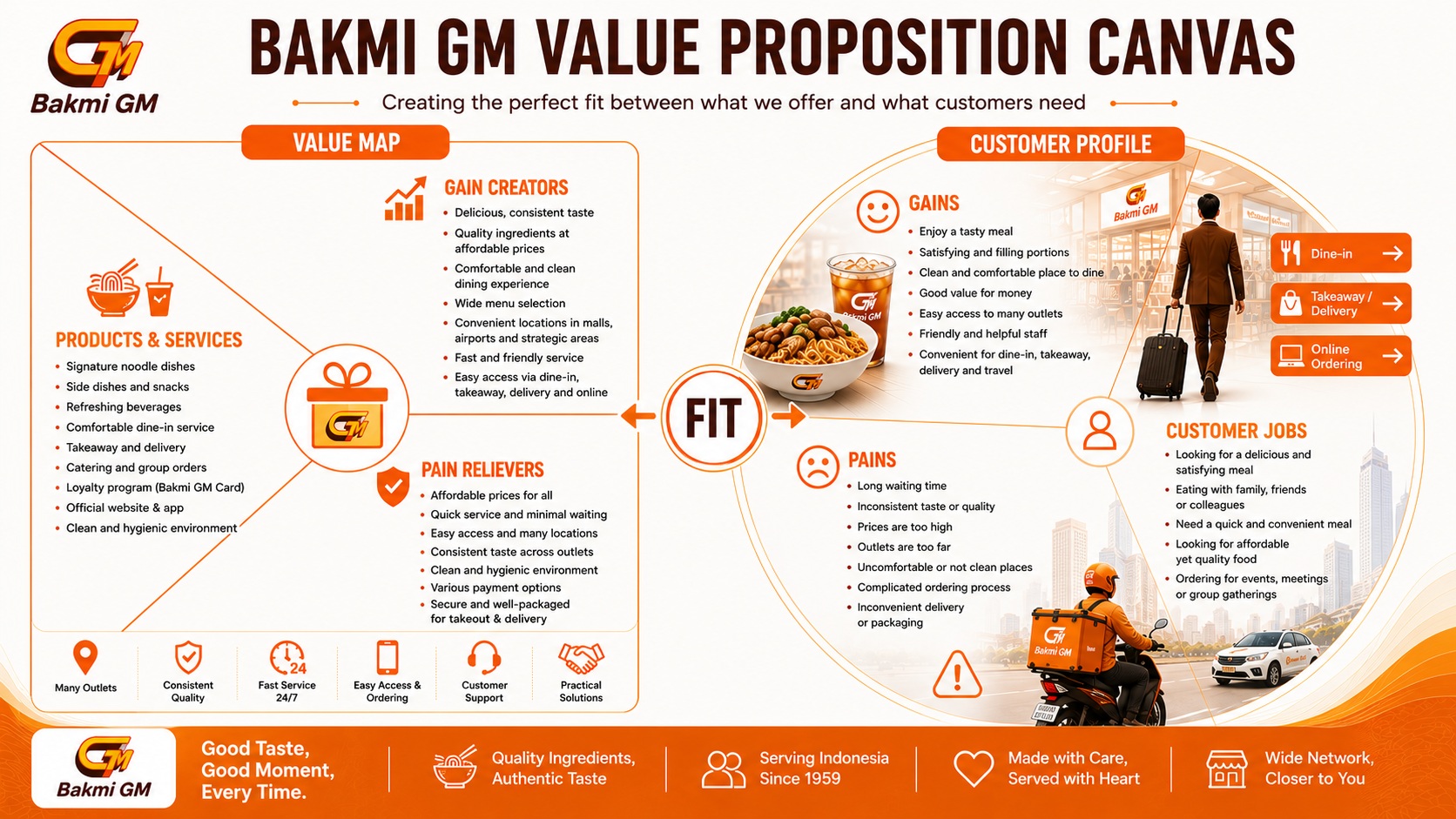
The Value Proposition Canvas adds another layer to the Bakmi GM Business Model Canvas by showing how Bakmi GM’s offers fit specific customer jobs, pain points, and desired gains. This is useful because not every successful restaurant wins only through menu quality. Many win because they reduce friction in everyday meal decisions while creating enough comfort, convenience, and trust to encourage repeat orders.
For Bakmi GM, the fit is built around familiarity, dependable taste, practical access, and service flexibility. Customers are not simply buying noodles. They are choosing a brand that helps them solve everyday dining needs with less uncertainty. That is why the value proposition should be read not only as product appeal, but as a response to recurring consumer jobs and frustrations.
| Customer Profile | Details | Matching Value Map | How Bakmi GM Creates Fit |
|---|---|---|---|
| Customer Jobs | Find a convenient meal for lunch, dinner, family dining, office orders, or casual gatherings. Choose food that feels familiar, reliable, and easy to order through store, takeaway, or delivery. | Wide menu range, strategic outlets, dine-in and takeout, delivery service, online channels, catering, event support, and food truck services. | Bakmi GM makes the buying decision easier by serving multiple meal occasions through several channels. Customers can use the same trusted brand whether they need a quick individual meal, a family visit, or a larger group order. |
| Pains | Customers may worry about inconsistent taste, slow service, inconvenient access, limited ordering options, or uncertainty when choosing where to eat with family or colleagues. Price sensitivity and delivery friction can also affect choice. | Standardised menu quality, familiar products, accessible locations, app and online ordering paths, membership rewards, and service extensions that reduce effort. | Bakmi GM reduces decision risk by offering a known experience. Familiar dishes, repeatable quality, and several ordering routes help lower friction for customers who want confidence and convenience rather than trial-and-error dining. |
| Gains | Customers want tasty and dependable food, quick service, broad acceptability across age groups, promotional value, and a smoother experience across dine-in and off-premise channels. | Trusted brand, comfort-food positioning, promotions, membership benefits, broad menu selection, and multi-channel availability. | Bakmi GM creates gain by combining emotional comfort with practical ease. Customers receive not only food, but also speed, familiarity, flexibility, and reassurance that the experience will likely meet expectations. |
The strategic value of this fit is significant. Bakmi GM does not need to be the boldest or most disruptive restaurant brand to remain relevant. Its strength lies in solving common dining jobs in a way that feels low risk and widely acceptable. For many consumers, especially families, workers, and repeat buyers, that can be more compelling than novelty.
Another important point is that the fit works best when all parts of the system reinforce one another. Menu reliability supports the pain reliever role. Delivery, catering, and online channels strengthen the customer jobs fit. Promotions and membership benefits increase the gain side by making the experience feel more rewarding over time. This is why the Value Proposition Canvas should not be read separately from the rest of the article. It shows in more practical terms how the larger business model connects with everyday customer behaviour.
A more relevant comparison for Indonesian readers is Mie Gacoan, a fast-growing Indonesian noodle restaurant brand under PT Pesta Pora Abadi that is widely known for affordable spicy noodle dishes, strong youth appeal, long queues at many outlets, and rapid expansion across Indonesia. Both operate in Indonesia’s noodle restaurant space, but they play different strategic games.
Bakmi GM is built on heritage, family familiarity, and dependable standardisation. Mie Gacoan is built more aggressively on youth energy, affordability, rapid expansion, and high-traffic viral demand. One sells trusted comfort and broad acceptability. The other sells excitement, value perception, and stronger youth-led cultural momentum.
The comparison clarifies positioning. Bakmi GM protects long-term trust, while Mie Gacoan pushes growth through sharper price-value energy and stronger mass buzz. Neither model is automatically superior. Each one fits a different path to scale.
| Dimension | Bakmi GM | Mie Gacoan |
|---|---|---|
| Core identity | Legacy noodle institution | Fast-growing youth-focused challenger |
| Demand driver | Familiarity and consistency | Price appeal and social buzz |
| Customer mix | Broader household appeal | Stronger concentration in younger segments |
| Strategic risk | Looking too traditional | Protecting consistency at high speed |
The real insight is this: Bakmi GM’s path to winning is not copying Mie Gacoan directly. Its stronger move is to modernise selectively while preserving the trust and broad acceptability that already differentiate the brand.
This business model shows several defensible strengths. Together, these advantages explain why the brand remains commercially relevant even in a noisier and more crowded restaurant market:
These advantages are especially valuable because they reinforce one another. Brand trust supports traffic, scale supports visibility, and consistent execution supports repeat behaviour. Channel breadth then makes that trust easier to monetise across dine-in, takeout, delivery, and occasion-based demand. In other words, Bakmi GM’s advantage does not come from one dramatic differentiator. It comes from a system of mutually reinforcing strengths.
Another reason these advantages matter is that they are relatively difficult to reproduce in full. Competitors may replicate menu ideas, pricing tactics, or digital promotions, but it is harder to replicate long-term trust, operational consistency, and broad family acceptance at the same time. That combination gives Bakmi GM a stronger base than trend-driven brands that rely heavily on temporary buzz.
This model also reveals several risks. Each one matters because a mature restaurant chain can lose relevance not through one dramatic failure, but through slow erosion across demand, perception, and margins:
The main challenge is balance. Bakmi GM needs enough change to stay contemporary, but not so much change that it weakens the familiarity customers already trust. That balancing act is more demanding than it may first appear. A company that updates too slowly risks looking dated, while one that changes too aggressively may damage the very consistency that built its customer base.
There is also a strategic perception risk. Because Bakmi GM is already established, consumers may judge it by a higher standard on service speed, app usability, or product freshness than they judge a smaller challenger brand. This means the company must defend not only its economics, but also its relevance in the minds of increasingly comparison-driven consumers.
Several priorities could strengthen Bakmi GM over the next phase. These recommendations follow directly from the logic of the Bakmi GM Business Model Canvas and focus on sharpening, not reinventing, the model:
Management should treat these moves as linked priorities rather than separate initiatives. The strongest outcome will come from aligning brand refresh, channel strategy, and customer data into one coordinated growth agenda. That coordination matters because isolated improvements often produce only short-term gains. By contrast, a connected strategy can lift traffic, retention, and monetisation at the same time.
The practical recommendation is therefore not transformation for its own sake. Bakmi GM should modernise in targeted ways that strengthen convenience, relevance, and repeat behaviour while preserving the trust and consistency that remain central to the brand’s advantage.
Bakmi GM remains one of the clearest examples of how a local restaurant brand can scale through consistency, trust, and operating discipline. Its model is not built on novelty alone. Instead, it converts familiarity into repeat demand across multiple channels and meal occasions.
The Bakmi GM Business Model Canvas shows a business with durable strengths, but also with a clear strategic challenge. Bakmi GM must modernise fast enough to stay relevant while preserving the dependable qualities that made it successful in the first place.
That is the central takeaway from this analysis. Bakmi GM’s next phase will likely be defined not by whether it changes, but by whether it can change in ways that strengthen the core logic of the business rather than distract from it.
This article is provided for educational and business analysis purposes only. It is based on publicly available information, general market observations, and strategic interpretation. It does not constitute financial advice, investment advice, legal advice, or an official statement from Bakmi GM, Djarum Group, PT Pesta Pora Abadi, or any related entity. Business conditions, ownership structures, service offerings, and market dynamics may change over time. Readers should conduct their own research and verification before making any business, investment, or strategic decisions. All trademarks, logos, brand names, copyrights, and related materials mentioned in this article belong to their respective owners.
Bakmi GM Business Model Canvas analysis updated in 2026. Explore Bakmi GM’s 9 BMC blocks, strategy, comparison with Mie Gacoan, risks, recommendations, and key growth insights.
Explore the Quipper Business Model Canvas, nine BMC blocks, Value Proposition Canvas, Ruangguru and Pahamify… Read More
Explore the CARPUT Business Model Canvas, nine BMC blocks, Value Proposition Canvas, competitor comparison, competitive… Read More
Explore the Boost Business Model Canvas, nine BMC blocks, Value Proposition Canvas, competitor comparison, advantages,… Read More
Explore the Domino's Pizza Business Model Canvas, nine BMC blocks, Value Proposition Canvas, Pizza Hut… Read More
Explore the Mie Gacoan Business Model Canvas, including its customer segments, value propositions, revenue streams,… Read More
Restaurant Business Model Canvas: A Practical Guide to Designing, Evaluating, and Improving Restaurant Business Models… Read More