CARPUT Business Model Canvas
Explore the CARPUT Business Model Canvas, nine BMC blocks, Value Proposition Canvas, competitor comparison, competitive advantages, risks and strategic recommendations.
Discover the AirAsia Business Model Canvas and learn how AirAsia uses low fares, digital booking, route networks, ancillary revenue, fleet strategy, and cost discipline to grow as a leading low-cost airline brand.
BMC Article No: BMC #022
Updated in 2026: This article has been rewritten with a stronger business story, clearer Business Model Canvas structure, latest developments, Value Proposition Canvas analysis, competitive advantages, risks, and strategic lessons from AirAsia’s low-cost airline model.
AirAsia is more than a low-cost airline. The company is a Malaysian travel brand built around affordable fares, high aircraft utilization, online booking, ancillary revenue, route density, and a powerful promise: “Now Everyone Can Fly.” That is why the AirAsia Business Model Canvas is interesting. This model shows how an airline can grow by simplifying air travel, removing unnecessary cost, and making flying accessible to mass-market customers.
The strength of AirAsia does not come from cheap tickets alone. Its real advantage comes from low operating cost, point-to-point routes, strong brand recall, digital self-service, aggressive promotions, add-on services, regional subsidiaries, and customer familiarity across Southeast Asia. A student may choose AirAsia for a short weekend trip. Migrant workers may use it to return home. Families may use it for a holiday. Business travelers may choose it for short regional meetings.
This makes AirAsia different from a traditional full-service airline. It does not compete mainly through free meals, premium lounges, complex connecting itineraries, or high-touch service. It competes through price, frequency, convenience, route access, and unbundled choices.
In this article, we will break down the AirAsia Business Model Canvas and examine how AirAsia creates value, reaches passengers, generates revenue, manages cost, and protects its position in the competitive airline market.
AirAsia’s business model is built around low-cost air travel. The company sells affordable flight tickets and allows passengers to pay separately for additional services such as checked baggage, seat selection, meals, priority boarding, insurance, travel bundles, and other ancillary products.
Its main strength is cost discipline. AirAsia is designed to keep base fares low by using high-density aircraft seating, fast aircraft turnaround, digital booking, self-service check-in, direct sales channels, standardized operations, and efficient route planning. The airline reduces unnecessary complexity so it can serve more passengers at lower fares.
Its second strength is demand creation. AirAsia does not only wait for people who already plan to fly. It stimulates demand through promotions, low fares, new routes, and regional connectivity. A customer who may not have considered flying from Kuala Lumpur to Krabi, Penang to Jakarta, or Kota Kinabalu to Manila may decide to travel because the fare feels affordable.
Its main challenge is volatility. Airlines face fuel price movements, currency risk, aircraft leasing cost, airport charges, maintenance requirements, regulatory constraints, weather disruptions, geopolitical risks, and strong competition. A low-cost model gives AirAsia cost advantage, but it does not remove these external pressures.
The AirAsia Business Model Canvas therefore shows a business that looks simple from the passenger side, but requires strong operating discipline behind the scenes. Aircraft utilization, route economics, revenue management, digital systems, ground operations, fleet planning, safety compliance, and ancillary monetization must work together.
Business Model Canvas, or BMC, is a simple tool used to understand how a business works. It helps readers see the logic behind how a company creates value, delivers that value to customers, and turns it into revenue. Instead of looking only at products or sales, BMC breaks the business into practical operating parts. It divides a company into nine key building blocks:
| BMC Block | Main Question |
|---|---|
| Customer Segments | Who does the business serve? |
| Value Propositions | What value does the business offer? |
| Channels | How does the business reach customers? |
| Customer Relationships | How does the business build loyalty? |
| Revenue Streams | How does the business make money? |
| Key Resources | What assets does the business need? |
| Key Activities | What must the business do well? |
| Key Partnerships | Who helps the business operate? |
| Cost Structure | What are the major costs? |
For AirAsia, the BMC is useful because the business is not only about flying aircraft. It involves aircraft financing, route planning, digital distribution, revenue management, ground handling, airport partnerships, aviation safety, regulatory approvals, crew management, maintenance, marketing, and customer service.
AirAsia is a Malaysian low-cost airline group associated with the wider Capital A and AirAsia ecosystem. The airline began as a small Malaysian carrier and became widely known after Tony Fernandes and his partners took over the business in 2001. From that point, AirAsia repositioned itself around low fares and mass-market air travel.
The brand became famous for its slogan “Now Everyone Can Fly.” This message captured the strategic logic of the business. AirAsia did not only sell seats. It sold access. More importantly, the brand helped turn air travel from an occasional luxury into a more frequent and affordable transport option for millions of passengers.
AirAsia’s model expanded across Southeast Asia through airline operations and affiliated airlines in markets such as Malaysia, Thailand, Indonesia, the Philippines, and Cambodia. The broader AirAsia network connects passengers across more than 150 destinations and has served over 900 million guests since its low-cost repositioning.
The brand also expanded beyond basic flight sales. AirAsia developed digital travel channels, loyalty programs, insurance offers, in-flight meals, cargo services, aircraft maintenance capabilities, and travel-related services. This wider model helps the company capture more value around the customer journey.
The AirAsia Business Model Canvas helps explain why the brand is strategically important. AirAsia is not only an airline with red aircraft. It is a repeatable low-cost travel system supported by aircraft, airports, technology, people, route economics, customer data, partnerships, and strong brand memory.
AirAsia is interesting because it changed the economics of flying for mass-market customers in Southeast Asia. Before low-cost carriers became common, many passengers depended on buses, trains, ferries, or expensive full-service airlines. AirAsia made short-haul flying more accessible by reducing the base fare and charging separately for optional services.
This model works because many passengers do not need a full-service bundle. They want to reach their destination safely, quickly, and affordably. A passenger traveling for two hours may not value a free meal, lounge access, or flexible ticket rules. AirAsia uses this insight to strip the product down to the essentials and sell extras only to passengers who want them.
The airline also benefits from regional travel demand. Southeast Asia has many islands, secondary cities, tourism destinations, migrant worker routes, family visit routes, and business corridors. AirAsia turns these travel needs into a scalable route network.
Another strategic point is brand trust. Low fares are attractive, but passengers still need to trust the airline. AirAsia’s strong brand visibility, long operating history, wide network, and large customer base help reduce perceived risk when customers book budget flights.
From a strategy perspective, the AirAsia Business Model Canvas shows how a low-cost airline can use cost discipline, digital distribution, ancillary revenue, and regional scale to compete against full-service airlines and other low-cost carriers.
AirAsia’s current story is not only about low fares. It is also about restructuring, recovery, fleet renewal, digital travel, and long-haul ambition.
One major development is corporate restructuring. In January 2026, Capital A completed the disposal of its aviation business to AirAsia X, creating a more consolidated aviation structure. This matters because airline groups require balance sheet clarity, fleet planning discipline, and stronger operational focus after the disruption caused by the pandemic years.
Another development is operating recovery. AirAsia Group reported stable operating performance in the first quarter of 2026, with EBITDA of RM1.009 billion and positive Net Operating Profit of RM199 million. This shows that the airline model is recovering, but still operates in a difficult environment with fuel, maintenance, aircraft availability, and demand volatility.
AirAsia also continues to strengthen its network position. Official company materials describe AirAsia as a leading low-cost carrier with licenses to operate in five ASEAN countries, connecting more than 150 destinations and having served more than 900 million guests. Network scale remains central to the airline’s value proposition.
Fleet renewal is another important theme. In May 2026, AirAsia announced a major order for 150 Airbus A220-300 aircraft, with deliveries expected from 2028. The strategic logic is clear: smaller and more fuel-efficient aircraft can support thinner secondary routes, improve route flexibility, and help the airline serve high-growth markets with better economics.
Long-haul expansion is also changing the AirAsia story. AirAsia X announced a Kuala Lumpur-Bahrain-London route starting in June 2026, marking its return to London and using Bahrain as a strategic link between Southeast Asia, the Middle East, Europe, and potentially Africa. This expands the low-cost model beyond short-haul regional flying.
Recent developments change the way we read the AirAsia Business Model Canvas. The company has brand scale, regional reach, and cost advantage. However, growth alone is not enough. Management must control aircraft availability, fuel exposure, customer service quality, digital reliability, route profitability, and balance sheet discipline.
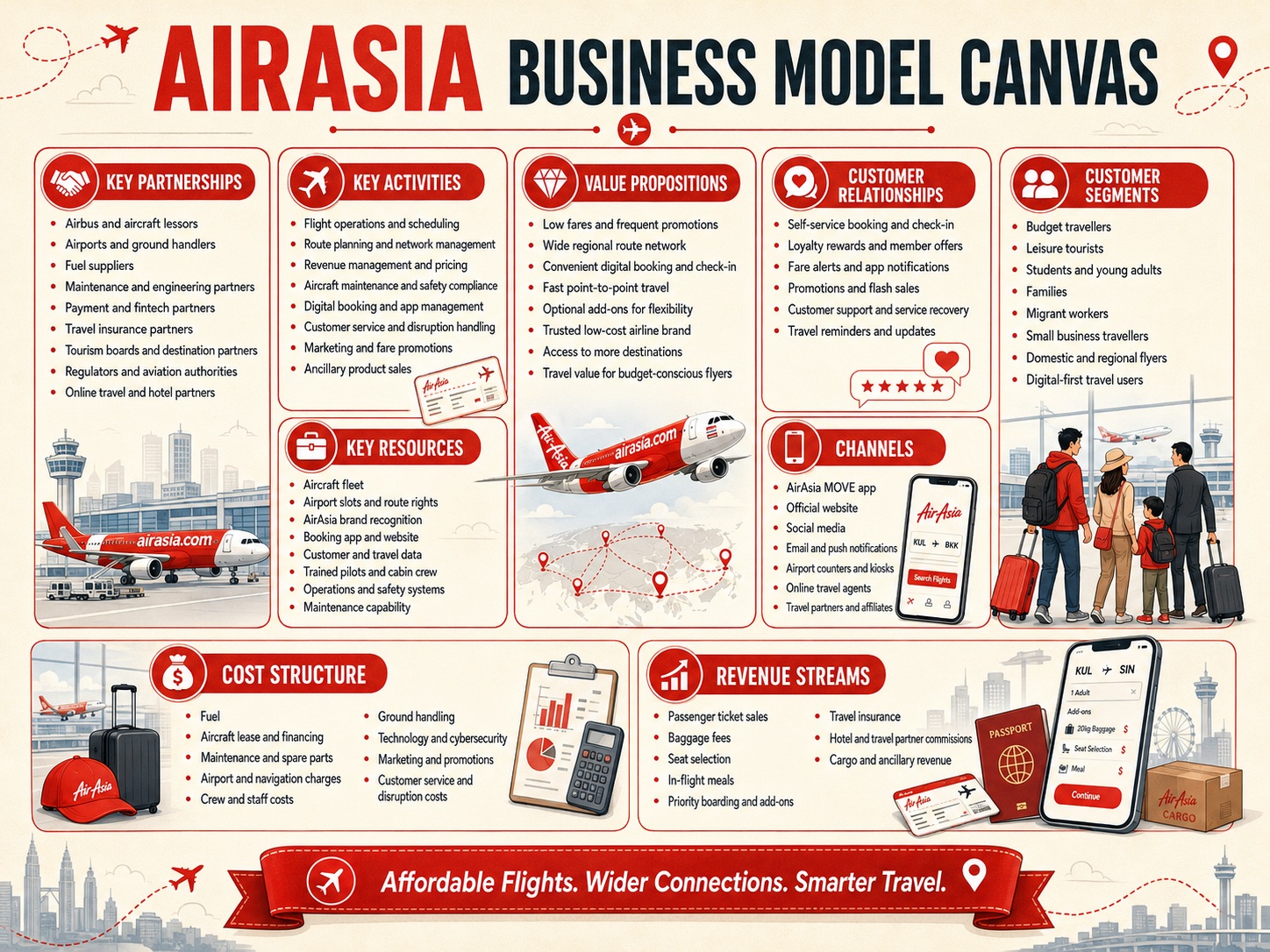
Before going into each block in detail, the summary below gives a quick view of how AirAsia’s business model works. It shows who the airline serves, what value it offers, how it reaches customers, how revenue is generated, and what resources and activities keep the model running.
| BMC Block | AirAsia Application |
| Customer Segments | Budget travelers, students, families, migrant workers, leisure travelers, small business travelers, digital travel users, and regional passengers across Southeast Asia and beyond. |
| Value Propositions | Low fares, wide route access, online booking convenience, optional add-ons, frequent promotions, reliable point-to-point travel, and regional connectivity. |
| Channels | AirAsia MOVE app, website, airport counters, online travel agents, travel agents, social media, digital campaigns, and partner platforms. |
| Customer Relationships | Self-service booking, loyalty rewards, promotions, digital engagement, customer support, travel reminders, and repeat purchase through low fares. |
| Revenue Streams | Ticket sales, baggage fees, seat selection, meals, priority services, insurance, advertising, commissions, loyalty-linked income, cargo, and travel-related services. |
| Key Resources | Aircraft fleet, brand equity, route rights, airport slots, digital platforms, customer data, operating licenses, trained crew, maintenance capability, and revenue management systems. |
| Key Activities | Flight operations, route planning, aircraft maintenance, crew scheduling, safety compliance, digital sales, pricing, marketing, customer support, and ancillary product management. |
| Key Partnerships | Aircraft manufacturers, lessors, airports, regulators, fuel suppliers, maintenance providers, ground handlers, technology providers, travel partners, and payment partners. |
| Cost Structure | Fuel, aircraft leasing, maintenance, crew cost, airport charges, ground handling, technology, sales and marketing, distribution, regulatory compliance, and financing costs. |
AirAsia BMC Diagram:
Customer segments describe who the business serves. AirAsia serves a broad passenger base, but its strongest appeal is among price-sensitive, digitally active, regional, and short-haul travelers.
AirAsia’s customers are not all flying for the same reason. Leisure travelers may fly because a promotion makes a weekend trip affordable. Students may choose AirAsia to travel home or attend events. Migrant workers may use it to reconnect with family across borders. Families may book early to manage holiday costs. Small business travelers may choose low fares for short regional meetings. Digital users may compare fares and book directly through the app.
This broad customer base gives AirAsia room to grow. The airline is not limited to one narrow travel occasion. A customer can use AirAsia for tourism, family visits, education, work, religious travel, events, domestic trips, and regional travel.
| Customer Segment | What They Need | How AirAsia Serves Them |
| Budget travelers | Affordable flights that allow them to travel more often. | Offers low base fares, promotions, and unbundled services. |
| Leisure tourists | Access to holiday destinations without high travel cost. | Connects major cities, island destinations, and tourism routes. |
| Students and young travelers | Low-cost travel for study, events, and personal trips. | Provides digital booking, low fares, and promotional campaigns. |
| Families | Affordable group travel for holidays and family visits. | Supports early booking, add-on baggage, seat selection, and route variety. |
| Migrant workers | Practical cross-border travel to return home. | Serves regional routes with price-sensitive demand. |
| Small business travelers | Cost-efficient flights for meetings and short work trips. | Offers frequent routes, online booking, and optional upgrades. |
| Digital travel users | Fast search, booking, payment, and itinerary management. | Uses AirAsia MOVE, website booking, app promotions, and digital self-service. |
The AirAsia Business Model Canvas shows that the airline does not depend on one customer group. Its market is wide, frequent, and route-based.
The value proposition explains why customers choose AirAsia. At the simplest level, AirAsia offers affordable air travel with the ability to customize the journey.
AirAsia’s value proposition is built around access. The airline gives customers the chance to fly when full-service airline pricing may be too expensive. This is important in Southeast Asia, where air travel can save time across islands, borders, and long road distances.
The strongest part of AirAsia’s value proposition is the unbundled model. Customers can buy a basic seat and add only what they need. A passenger traveling light can avoid checked baggage fees. Families may pay for baggage and seat selection. Business travelers may pay for priority services. This model gives customers more control over total cost.
| Value Proposition | Customer Benefit | Business Impact |
| Low base fares | Customers can fly at a lower entry price. | Drives passenger volume and stimulates new travel demand. |
| Unbundled travel options | Customers choose baggage, meals, seats, and services based on need. | Generates ancillary revenue while keeping base fares attractive. |
| Regional connectivity | Customers can reach many cities and tourism destinations. | Strengthens network value and repeat travel. |
| Digital convenience | Customers can search, book, check in, and manage trips online. | Reduces distribution cost and improves customer access. |
| Frequent promotions | Customers get reasons to book earlier or travel more often. | Supports load factor, route stimulation, and brand attention. |
| Recognizable low-cost brand | Customers know what AirAsia stands for. | Builds trust and reduces booking hesitation. |
AirAsia’s value proposition is not only the ticket. It is the full promise of cheaper access, practical choices, regional reach, and digital convenience.
Channels explain how AirAsia reaches customers. This is one of the most important parts of the AirAsia Business Model Canvas.
AirAsia uses a digital-first distribution model. The official website and AirAsia MOVE app allow customers to search fares, book flights, buy add-ons, check in, manage bookings, receive promotions, and access travel-related services. This reduces reliance on expensive third-party distribution and gives AirAsia more control over the customer relationship.
The airline also reaches customers through online travel agents, traditional travel agents, airport counters, social media, email campaigns, paid advertising, partner platforms, and promotional events. These channels help AirAsia serve different customer behaviors. Some customers prefer full self-service. Others still need assistance through agents or airport service points.
| Channel | Examples | Strategic Role |
| AirAsia MOVE app | Flight booking, hotels, rides, activities, deals, and travel management. | Builds direct customer access and supports cross-selling. |
| Official website | Fare search, booking, check-in, add-ons, and customer information. | Provides low-cost direct distribution. |
| Online travel agents | Travel marketplaces and booking platforms. | Extends reach to customers comparing multiple airlines. |
| Travel agents | Offline or assisted booking channels. | Serves customers who prefer human support or bundled travel help. |
| Airport counters and kiosks | Check-in support, service recovery, and selected transactions. | Handles operational needs and passenger exceptions. |
| Social media and digital campaigns | Promotions, route launches, fare campaigns, and travel content. | Creates awareness and drives booking urgency. |
| Partner channels | Hotels, tourism boards, payment partners, and travel platforms. | Expands visibility and supports bundled demand. |
Strong channels make AirAsia easier to book. In the airline industry, visibility at the point of travel planning can strongly influence purchase decisions.
Customer relationships describe how AirAsia keeps passengers coming back. AirAsia’s relationship model is built on self-service, price trust, loyalty incentives, digital engagement, and repeat travel needs.
The airline does not depend on a luxury service relationship. Its customer relationship is more practical. Customers return because AirAsia is often affordable, visible, familiar, and available on routes they need. Promotions and loyalty features add extra reasons to book again.
AirAsia also uses digital engagement to stay in the customer’s planning cycle. Route launches, big sales, app notifications, email offers, and social media campaigns keep the brand visible before customers decide where to travel.
| Relationship Driver | How It Works | Example |
| Self-service relationship | Customers manage booking, check-in, add-ons, and changes online. | A passenger adds baggage through the app before departure. |
| Price-led loyalty | Customers return because they associate AirAsia with affordable fares. | A family waits for promotional fares before booking a holiday. |
| Rewards and loyalty | Customers collect points or benefits linked to repeat travel and spending. | A frequent traveler redeems points or receives targeted offers. |
| Promotional engagement | Campaigns create urgency and encourage early booking. | A customer books during a big sale after seeing a digital ad. |
| Customer support | Support channels handle booking, refund, disruption, and service issues. | A passenger uses help channels during a schedule change. |
| Travel ecosystem engagement | Customers interact with flights, hotels, rides, and other travel services. | A user books a hotel after purchasing a flight through the app. |
AirAsia’s relationship with customers is not built on premium exclusivity. Instead, it is built on practical repeat relevance. The brand needs to remain affordable, reliable, visible, and easy to use.
Revenue streams show how the business makes money. AirAsia generates revenue mainly through ticket sales, supported by ancillary services and travel-related income.
The core revenue engine is seat sales. AirAsia sells a large volume of seats across domestic, regional, and selected long-haul routes. However, low base fares alone are not enough. The airline also earns from add-ons such as baggage, meals, seat selection, priority boarding, insurance, travel bundles, and other optional services.
This is central to the low-cost airline model. AirAsia can advertise attractive base fares while capturing additional revenue from passengers who want more convenience, comfort, or flexibility. A passenger who travels light may pay only for the seat. Others may add baggage, meals, seat choice, and insurance.
| Revenue Stream | Description | Why It Matters |
| Base ticket sales | Revenue from selling flight seats. | Forms the main revenue base of the airline. |
| Checked baggage | Fees for baggage allowance beyond cabin luggage. | Creates high-value ancillary revenue. |
| Seat selection | Paid selection for preferred seats, hot seats, or extra convenience. | Monetizes passenger preference and comfort. |
| In-flight meals and products | Food, drinks, merchandise, and selected onboard purchases. | Increases spend per passenger. |
| Priority and convenience services | Priority boarding, fast-track options, travel protection, and related services. | Helps passengers customize the travel experience. |
| Insurance and travel add-ons | Travel insurance, hotel booking, rides, activities, and partner offers. | Extends revenue beyond the flight itself. |
| Cargo and logistics-related income | Belly cargo and logistics activity where applicable. | Uses aircraft capacity beyond passenger seats. |
| Advertising and partnerships | Digital ads, onboard media, brand campaigns, and commercial partnerships. | Monetizes passenger attention and platform reach. |
The AirAsia Business Model Canvas shows a revenue model based on volume, ancillary monetization, direct digital sales, and travel ecosystem expansion.
Key resources are the assets required to deliver the business model. For AirAsia, the most important resources are aircraft, brand equity, operating licenses, route rights, digital platforms, customer data, trained staff, and operational systems.
Aircraft are the most visible resource. Without aircraft availability, the airline cannot operate schedules or capture demand. AirAsia’s historical use of Airbus narrow-body aircraft has helped support fleet commonality, training efficiency, maintenance simplicity, and operating scale.
Brand is another major resource. Customers must trust an airline before booking. AirAsia’s red identity, slogan, regional recognition, and long operating history help it stand out in a crowded market.
Digital capability is also critical. Airlines sell time-sensitive inventory. Seats expire once the flight departs. Pricing, booking, check-in, ancillary sales, disruption handling, and customer communication depend heavily on technology.
| Key Resource | Role in the Business Model | Strategic Value |
| Aircraft fleet | Enables scheduled flights across domestic, regional, and long-haul routes. | Creates capacity, network reach, and revenue potential. |
| Brand equity | Supports customer trust, recall, and price-led preference. | Helps AirAsia compete in a crowded travel market. |
| Route rights and airport slots | Allow the airline to operate specific routes and airport timings. | Provides access to valuable travel corridors. |
| Operating licenses | Authorize airline operations in multiple markets. | Supports regional expansion and legal market access. |
| Digital platforms | Website, app, booking engine, check-in, payments, and customer tools. | Reduces cost and improves direct customer reach. |
| Revenue management systems | Manage fares, seat inventory, demand forecasting, and promotions. | Improves yield and load factor. |
| Trained workforce | Pilots, cabin crew, engineers, ground staff, operations teams, and support teams. | Protects safety, service delivery, and operating reliability. |
| Maintenance capability | Aircraft maintenance, repair, engineering processes, and technical support. | Supports safety, aircraft availability, and cost control. |
| Customer data | Booking behavior, travel patterns, add-on purchases, and loyalty activity. | Supports personalization, route planning, and targeted selling. |
Together, these resources make AirAsia more than a ticket seller. They make it a low-cost aviation operating system.
Key activities are the things AirAsia must do well to stay competitive. These include flight operations, route planning, pricing, aircraft maintenance, crew scheduling, safety compliance, digital sales, marketing, customer support, and ancillary product management.
The most important activity is operational reliability. Customers may accept fewer frills, but they still expect safe flights, clear communication, reasonable punctuality, and effective disruption handling. Low cost cannot come at the expense of safety or basic trust.
Route planning is also critical. Every flight must justify its aircraft time, crew time, fuel burn, airport charges, and maintenance impact. A route may look attractive from a branding perspective, but it must work commercially through load factor, yield, ancillary revenue, and cost control.
| Key Activity | What It Involves | Why It Matters |
| Flight operations | Operating scheduled flights safely and efficiently. | Protects the core service and customer trust. |
| Route planning | Selecting destinations, frequencies, timings, and aircraft allocation. | Determines network profitability and demand capture. |
| Revenue management | Pricing seats, managing promotions, forecasting demand, and optimizing load factor. | Balances low fares with yield discipline. |
| Aircraft maintenance | Inspections, repairs, engineering support, and regulatory compliance. | Protects safety, reliability, and aircraft availability. |
| Crew scheduling | Managing pilots, cabin crew, rostering, training, and duty limits. | Ensures flights operate within safety and labor rules. |
| Digital sales and service | Managing website, app, payments, booking flows, and customer communications. | Lowers distribution cost and improves customer access. |
| Ancillary management | Designing and selling baggage, meals, seats, insurance, and travel add-ons. | Increases revenue per passenger. |
| Marketing and promotions | Fare campaigns, route launches, app campaigns, and brand communications. | Stimulates demand and keeps AirAsia visible. |
| Customer support and disruption handling | Refunds, schedule changes, service recovery, and passenger assistance. | Protects customer confidence in a high-friction industry. |
The AirAsia Business Model Canvas shows that operational discipline is the hidden engine behind low fares.
Key partnerships help AirAsia operate, expand, and serve customers more efficiently. These partnerships include aircraft manufacturers, aircraft lessors, airports, regulators, fuel suppliers, maintenance providers, technology vendors, payment providers, tourism bodies, online travel agents, and ground handling companies.
AirAsia cannot scale through internal effort alone. Aircraft manufacturers and lessors provide fleet access. Airports provide slots, facilities, and ground infrastructure. Regulators provide operating permissions. Fuel suppliers affect one of the largest cost items. Technology partners support booking, payments, customer communication, and data systems.
Partnership quality matters because aviation is highly interdependent. A delay in aircraft delivery can affect route plans. Airport congestion can affect turnaround times. Weak ground handling can damage customer experience. Fuel price shocks can pressure margins.
| Partner Type | Examples | Contribution to the Business Model |
| Aircraft manufacturers | Airbus and related aircraft suppliers. | Support fleet renewal, aircraft efficiency, training, and long-term capacity. |
| Aircraft lessors and financiers | Leasing companies, banks, and financing partners. | Provide access to aircraft without full upfront ownership cost. |
| Airports | Domestic, regional, and international airports. | Provide slots, gates, passenger facilities, and operational access. |
| Regulators and aviation authorities | Civil aviation authorities and safety regulators. | Enable legal operations and safety oversight. |
| Fuel suppliers | Aviation fuel providers and fuel logistics partners. | Support flight operations and cost management. |
| Maintenance providers | Engineering, repair, component, and technical service providers. | Protect aircraft reliability and compliance. |
| Ground handlers | Check-in, baggage, ramp, and airport operations partners. | Support fast turnaround and passenger handling. |
| Technology and payment partners | Booking systems, cybersecurity, payment gateways, analytics, and app infrastructure. | Enable digital self-service and direct sales. |
| Tourism and commercial partners | Tourism boards, hotels, ride providers, insurers, advertisers, and travel merchants. | Stimulate demand and create add-on revenue opportunities. |
These partnerships reduce friction. They allow AirAsia to focus on low-cost operations, network development, revenue management, and customer reach.
Cost structure explains where the money goes. AirAsia operates in a capital-intensive and cost-sensitive industry, so cost discipline is critical.
The main costs include fuel, aircraft leasing, maintenance, crew salaries, airport charges, ground handling, technology, distribution, marketing, regulatory compliance, insurance, financing, and disruption-related costs. Some costs are fixed or semi-fixed, which means weak demand can quickly hurt profitability.
AirAsia must manage a difficult balance. Customers expect low fares, frequent promotions, safe operations, reliable service, and convenient digital tools. At the same time, the airline must protect margins against fuel cost, foreign exchange movements, aircraft downtime, maintenance inflation, and airport charges.
| Cost Category | Examples | Management Challenge |
| Fuel | Jet fuel for scheduled operations. | One of the largest and most volatile airline cost items. |
| Aircraft leasing and financing | Lease payments, aircraft financing, and ownership-related commitments. | Capacity must match demand and route profitability. |
| Maintenance | Aircraft checks, repairs, spare parts, engineering, and component support. | Safety and aircraft availability cannot be compromised. |
| Crew and staff | Pilots, cabin crew, engineers, ground staff, operations, and support teams. | Staffing must balance safety, service, productivity, and labor rules. |
| Airport and navigation charges | Landing fees, parking, air traffic charges, passenger service charges, and airport facilities. | Charges vary by airport and affect route economics. |
| Ground handling | Baggage handling, ramp services, check-in support, and turnaround operations. | Fast turnaround supports aircraft utilization. |
| Technology | Website, app, booking engine, payments, cybersecurity, analytics, and operations systems. | Digital reliability is essential for sales and service. |
| Marketing and promotions | Fare campaigns, brand campaigns, route launches, and digital advertising. | Demand stimulation must not destroy yield. |
| Customer disruption costs | Refunds, rebooking, accommodation, service recovery, and delay-related costs. | Poor disruption handling can damage trust and create financial leakage. |
The AirAsia Business Model Canvas makes one point clear: low fares require disciplined cost design. More passengers are valuable only when aircraft utilization, ancillary revenue, and cost control remain healthy.
AirAsia offers several useful lessons for entrepreneurs, airline leaders, platform builders, and business strategists.
The first lesson is that affordability can expand the market. AirAsia did not only compete for existing airline passengers. More importantly, the airline created new flyers by making air travel accessible to people who previously saw flying as too expensive.
The second lesson is that a simple promise can build a powerful brand. “Now Everyone Can Fly” is not only a slogan. That line explains the business model in one sentence. Customers understand the brand before they study the details.
The third lesson is that unbundling can improve both price appeal and revenue. AirAsia keeps base fares low while allowing customers to buy extras. This helps the airline serve both price-sensitive travelers and passengers who want added convenience.
The fourth lesson is that digital distribution changes economics. Direct booking through app and website reduces dependence on costly intermediaries, improves customer data capture, and creates more chances to sell add-ons.
The fifth lesson is that scale requires discipline. A bigger route network, larger fleet, and wider customer base can create advantage. However, scale can also increase risk if routes are weak, aircraft are unavailable, service quality drops, or debt becomes too heavy.
The sixth lesson is that low cost does not mean low complexity. AirAsia’s public offer looks simple, but the operating model depends on safety systems, maintenance planning, scheduling precision, pricing algorithms, airport coordination, and regulatory compliance.
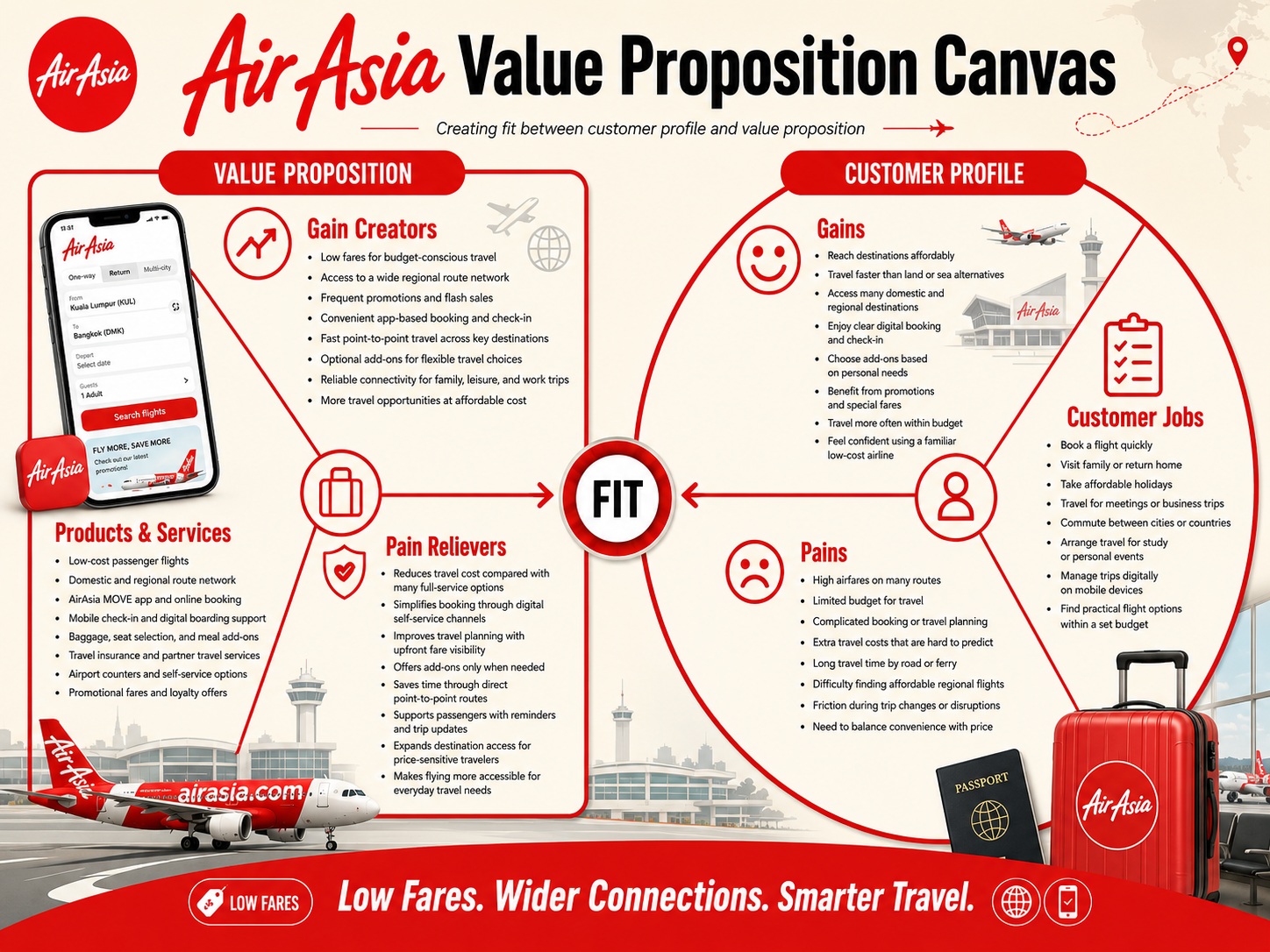
The Value Proposition Canvas helps explain the fit between AirAsia’s offer and passenger needs. This view explains why customers choose AirAsia not only because it sells cheap tickets, but because it solves practical, financial, and emotional travel needs.
The customer profile explains what AirAsia passengers are trying to achieve, what problems they face, and what benefits they want. AirAsia customers are often price-sensitive, digitally active, time-conscious, and flexible in their travel decisions.
For customer jobs, AirAsia helps passengers travel affordably, reach destinations faster than land or sea transport, visit family, take holidays, attend meetings, study away from home, and explore new places. These jobs may look simple, but they occur across millions of travel decisions.
For customer pains, passengers face expensive fares, limited travel options, long road journeys, complicated booking processes, hidden travel costs, schedule disruptions, baggage uncertainty, and customer service friction. AirAsia reduces these pains through low fares, online booking, route access, self-service tools, and optional add-ons.
For customer gains, passengers want savings, destination choice, booking convenience, promotional deals, travel flexibility, control over add-ons, and confidence in a familiar airline brand. AirAsia creates these gains through digital channels, fare campaigns, regional network coverage, and unbundled travel options.
The value proposition explains how AirAsia responds to those customer jobs, pains, and gains. Its core offer is simple: affordable flights with optional services that customers can choose based on need and budget.
AirAsia’s products and services include domestic flights, regional flights, selected long-haul routes through AirAsia X, online booking, mobile check-in, baggage add-ons, seat selection, in-flight meals, travel insurance, loyalty rewards, hotels, rides, activities, and travel partner offers.
Pain relievers include lower base fares, direct digital booking, self-service check-in, route frequency, transparent add-on selection, promotional campaigns, and familiar brand presence. These benefits reduce friction in the customer’s travel decision.
Gain creators include access to more destinations, lower trip cost, app-based convenience, loyalty benefits, travel bundles, new routes, and the emotional benefit of being able to travel more often.
| Customer Profile | Details | Matching Value Proposition | How AirAsia Creates Fit |
| Customer Jobs | Passengers want affordable flights, faster travel, family visits, holidays, work trips, education travel, and regional mobility. | Products and Services | Domestic and regional flights, AirAsia X routes, app booking, website booking, check-in tools, baggage, seats, meals, insurance, and travel add-ons. |
| Customer Pains | Passengers face high fares, long journeys, limited route access, booking friction, baggage uncertainty, disruption risk, and budget pressure. | Pain Relievers | AirAsia provides low base fares, online booking, self-service check-in, optional add-ons, promotional fares, and broad route access. |
| Customer Gains | Passengers want savings, convenience, destination choice, control, loyalty rewards, travel confidence, and the ability to fly more often. | Gain Creators | AirAsia creates gains through promotions, direct digital channels, loyalty features, add-on choices, route expansion, and a recognizable low-cost brand. |
The table shows that AirAsia fits the customer profile because it responds to three needs at the same time: affordability, access, and control. Customers are not only buying a flight seat. They are buying the ability to travel with fewer financial barriers.
This fit explains why AirAsia can remain relevant despite competition. The brand must continue to match changing customer jobs, pains, and gains. If passengers demand better reliability, easier refunds, greener travel, improved app performance, or more flexible bundles, AirAsia needs to adapt without losing its low-cost identity.
AirAsia’s competitive advantage comes from several layers working together. It is not protected by one factor alone. The airline is strengthened by brand recognition, cost discipline, route network, digital distribution, ancillary revenue capability, fleet strategy, and regional operating experience.
Brand recognition gives AirAsia an advantage in a crowded travel market. Customers are more likely to consider an airline they already know, especially when booking low-cost travel. Its red aircraft, strong slogan, and repeated fare campaigns make the brand easy to remember.
The low-cost operating model is the core advantage. AirAsia focuses on simple service, high aircraft utilization, direct sales, fast turnaround, high-density seating, and optional add-ons. This structure allows the airline to offer attractive base fares while generating revenue from ancillary services.
Regional network is one of AirAsia’s strongest assets. The airline connects major cities, secondary cities, tourist destinations, and cross-border routes. More routes increase customer usefulness and make the brand part of regular travel planning.
Digital distribution strengthens AirAsia’s economics. Direct sales through app and website reduce distribution cost, increase customer data ownership, and create more opportunities to sell baggage, seats, meals, insurance, hotels, rides, and other services.
AirAsia’s ability to monetize add-ons is strategically important. The airline can keep fares attractive while increasing revenue per passenger through baggage, seats, meals, priority services, and travel-related products. This makes the model more flexible than ticket sales alone.
Fleet commonality and operating standardization can improve training, maintenance, scheduling, and procurement efficiency. A simpler fleet structure reduces operational complexity and supports the low-cost model.
AirAsia understands Southeast Asian travel behavior. Its teams track price-sensitive demand, tourism flows, family visit patterns, migrant worker routes, and secondary city opportunities. This helps the airline design routes and campaigns that fit real customer needs.
The AirAsia Business Model Canvas is powerful because it shows a system, not just an airline. AirAsia competes through low cost, route access, digital reach, brand familiarity, ancillary monetization, and operational execution. The stronger these elements work together, the harder it becomes for competitors to copy the full model.
AirAsia still faces real business risks. These risks do not mean the model is weak. They show where management discipline is required.
Fuel is one of the largest cost items in aviation. When fuel prices rise, low-cost airlines face margin pressure because customers remain price-sensitive. AirAsia must manage this through fuel efficiency, pricing discipline, hedging strategy where appropriate, and route economics.
Aircraft leases, fuel, maintenance, and financing obligations may be affected by foreign exchange movements. A weaker local currency can increase cost pressure. This is important because AirAsia earns revenue in multiple regional currencies but may incur major costs in US dollars.
AirAsia competes with full-service airlines, other low-cost carriers, regional airlines, online travel platforms, buses, ferries, and trains on selected routes. Competition can force fare discounts and reduce yields.
Low fares attract customers, but poor customer experience can damage trust. Delays, cancellations, refund issues, app problems, and weak disruption communication can create frustration. AirAsia must protect reliability while maintaining low cost.
Aircraft downtime affects capacity, revenue, and route planning. Maintenance cost, spare parts availability, engine issues, and delivery delays can disrupt growth plans. Strong technical planning is essential.
Airlines depend on aviation regulators, airport slots, safety approvals, bilateral rights, and local operating conditions. Regulatory changes or airport congestion can affect expansion.
Not every route can be profitable. New routes may need time to mature. Some destinations may suffer from weak demand, seasonality, or excessive competition. AirAsia must constantly review load factor, yield, ancillary revenue, and operating cost.
Aviation faces increasing scrutiny over carbon emissions. AirAsia may need to invest in fuel-efficient aircraft, operational efficiency, sustainability reporting, and future carbon-related compliance. These requirements may increase cost but also become important for long-term competitiveness.
These risks do not weaken the AirAsia Business Model Canvas automatically. Instead, they show that the low-cost model must be managed carefully. Long-term success depends on how well AirAsia protects cost advantage, operational reliability, customer trust, and financial discipline.
The AirAsia Business Model Canvas shows how a Malaysian airline built one of Southeast Asia’s most recognizable low-cost travel brands. Its success is not based on cheap tickets alone. It is built on cost discipline, digital booking, route access, high passenger volume, ancillary revenue, promotional strength, and a clear brand promise.
AirAsia works because it solves a simple customer need very well. Passengers want to travel safely, quickly, and affordably. The airline turns that need into a repeatable business system supported by aircraft, airports, staff, technology, partners, pricing systems, and regional demand.
For business owners, the lesson is clear. A strong low-cost business is not only about cutting prices. It is about redesigning the entire operating model so the company can profitably serve customers at a lower price point.
That is how AirAsia turned low fares into a scalable regional travel business.
This article is for informational and educational purposes only. It is based on publicly available information and independent business analysis. It does not represent official information from AirAsia, Capital A Berhad, AirAsia X Berhad, or any related company. Readers should conduct their own research before making business, investment, or strategic decisions.
Explore the CARPUT Business Model Canvas, nine BMC blocks, Value Proposition Canvas, competitor comparison, competitive… Read More
Explore the Boost Business Model Canvas, nine BMC blocks, Value Proposition Canvas, competitor comparison, advantages,… Read More
Explore the Domino's Pizza Business Model Canvas, nine BMC blocks, Value Proposition Canvas, Pizza Hut… Read More
Explore the Mie Gacoan Business Model Canvas, including its customer segments, value propositions, revenue streams,… Read More
Restaurant Business Model Canvas: A Practical Guide to Designing, Evaluating, and Improving Restaurant Business Models… Read More
Learn how the Food and Beverage Business Model Canvas helps restaurants, cafés, beverage brands, and… Read More