



Share This Article


Restaurant Business Model Canvas: A Practical Guide to Designing, Evaluating, and Improving Restaurant Business Models
Learn how the Restaurant Business Model Canvas helps restaurants design stronger models, improve operations, manage costs, and align value with customer needs across dine-in, takeaway, delivery, and hybrid formats.
1. Introduction
This Restaurant Business Model Canvas article should be read as a focused extension of the broader Food and Beverage Business Model Canvas framework, which explains how restaurants, cafés, beverage brands, catering businesses, and other F&B formats can be analysed through the same strategic structure. Within that wider context, this article narrows the discussion specifically to restaurant business models so readers can examine restaurant economics, service design, channels, and operating logic in greater depth.
The restaurant industry remains one of the most visible and competitive parts of food and beverage. It includes quick-service chains, casual dining brands, family restaurants, premium concepts, specialist menu operators, cloud kitchens, and hybrid formats that combine dine-in, takeaway, and delivery. Demand may look strong from the outside, yet restaurant success is rarely determined by food quality alone. Strong performance usually depends on whether the business has a clear model for creating value, delivering it consistently, and turning demand into sustainable profit.
A clear business model matters because restaurants operate under constant pressure from rising ingredient costs, labour challenges, rental commitments, changing customer preferences, digital delivery expectations, and heavy competition. A busy outlet may still struggle financially if pricing, menu design, service style, staffing, and channels are not aligned. In the same way, a strong dining concept may fail if the target segment is unclear or if delivery economics weaken margins.
Why Restaurant Business Model Canvas?
The Restaurant Business Model Canvas helps restaurant operators design, evaluate, and improve the full business model in a practical way. It provides a structured view of how a restaurant serves customers, earns revenue, controls cost, coordinates resources, and builds competitive advantage. Rather than treating menu design, service, operations, marketing, and finance as separate issues, the canvas shows how they work together as one integrated system.
Examples from Malaysia, Indonesia, and global markets make this easier to understand. McDonald’s wins through speed, consistency, and operational discipline. Secret Recipe combines broad menu appeal with casual dining familiarity. Bakmi GM builds strength through focused category relevance. Marugame Udon shows the power of product specialisation and high-throughput execution. Chili’s and TGI Fridays depend more heavily on dine-in experience and service-led value. Each uses a different restaurant model, even though all operate in the same broad sector.
2. What Is the Business Model Canvas?
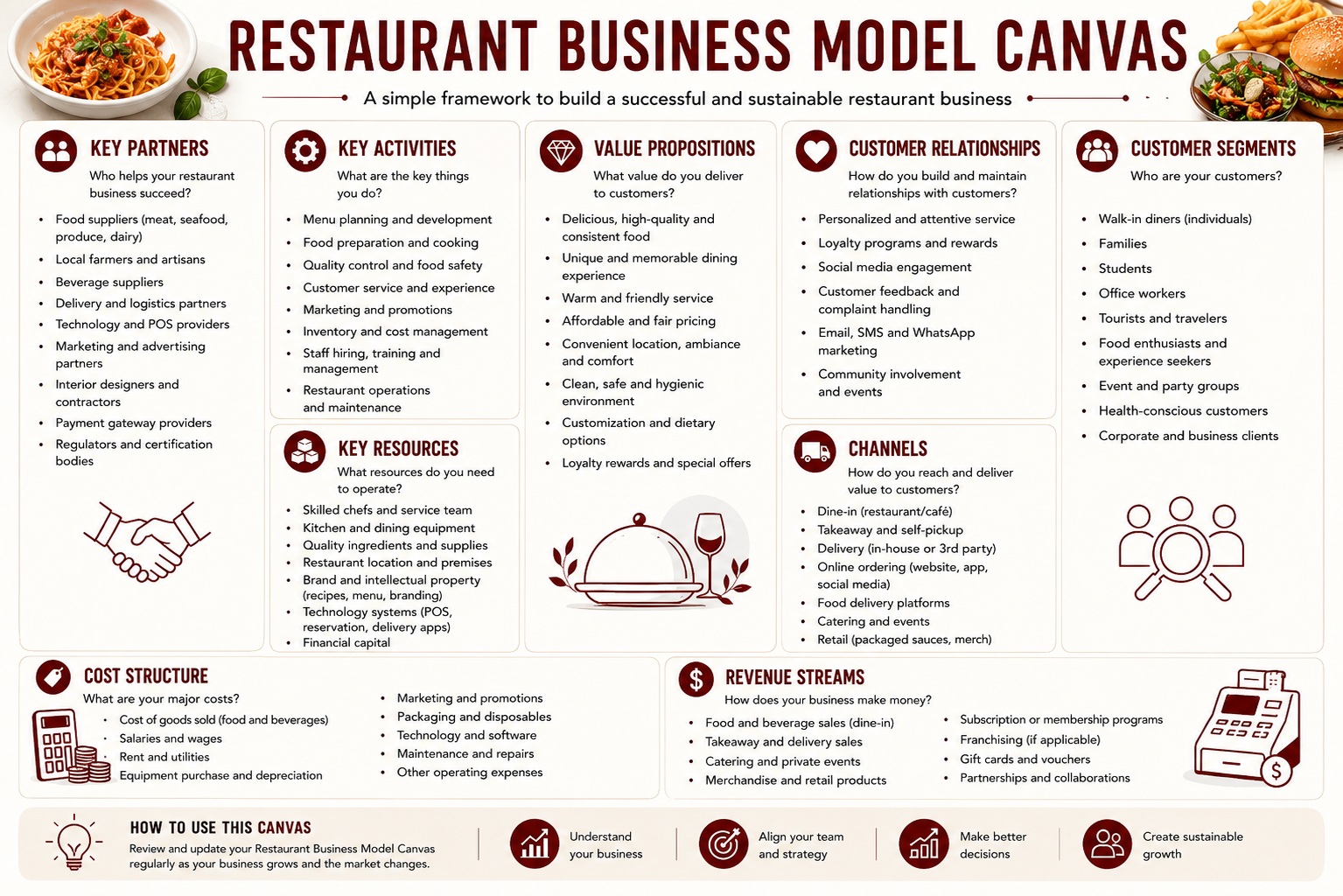
The Restaurant Business Model Canvas is a strategic management framework that shows how a restaurant creates, delivers, and captures value. Nine interrelated blocks form the framework and explain how the business serves customers, operates effectively, and remains commercially viable.
For restaurant businesses, the canvas is especially useful because performance depends on balancing customer experience, food quality, speed, consistency, location, labour, supply chain reliability, and cost discipline at the same time. A quick-service chain, a premium dining concept, and a noodle specialist may all sell meals, but they rely on very different combinations of value proposition, resources, activities, channels, and economics.
The purpose of the Restaurant Business Model Canvas is not only to describe an existing outlet or chain. Restaurants can also use it to test new concepts, compare service formats, identify strategic gaps, evaluate channel decisions, support expansion, and clarify operating priorities. A casual dining brand can use it to refine its dine-in and takeaway mix. A delivery-first operator can use it to assess platform dependence and packaging economics. A franchise restaurant can use it to compare outlet consistency, site economics, and partner support.
The nine blocks are Customer Segments, Value Propositions, Channels, Customer Relationships, Revenue Streams, Key Resources, Key Activities, Key Partnerships, and Cost Structure. Each block answers a critical question. Who is the customer? What value does the restaurant offer? How is that value delivered? How is loyalty built? Where does revenue come from? What assets, processes, partners, and costs are involved? Together, these blocks provide an integrated view of the full restaurant business model.
3. The Nine Blocks of the Restaurant Business Model Canvas
To understand how a restaurant business works in practice, it is useful to examine each block of the canvas individually. Every block represents a different part of the business model, but none works in isolation. Customer choices influence value propositions, channels affect margins, resources shape execution, and cost structure determines whether the restaurant remains sustainable.
Looking at the nine blocks one by one makes the framework easier to apply while also showing how strategic and operational decisions connect across the business. A quick-service restaurant, a family dining concept, and a specialist noodle chain may all serve meals, yet they do not use the same commercial logic. That is why each block should be analysed carefully rather than filled in as a simple checklist.
3.1 Customer Segments
Customer Segments define the groups of diners the restaurant aims to serve. In restaurant businesses, segment choice shapes almost every strategic decision, including menu design, pricing, service style, table layout, outlet location, operating hours, and channel mix. A premium dining concept serves very different needs from a lunch-focused urban outlet or a family-oriented casual dining chain.
Before building the rest of the model, a restaurant needs to know which customers matter most. Many operators struggle because they try to serve too many audiences with one concept. Clear segmentation helps the restaurant match its value proposition to specific demand patterns instead of relying on a generic offer.
Table 1: Customer Segments
The following table is a practical summary of typical customer segments found in restaurant business models.
| Typical Segment | Description | Why It Matters |
|---|---|---|
| Families | Diners seeking convenience, variety, affordability, and child-friendly options | Influences menu breadth, seating design, promotions, and service pace |
| Office workers | Customers needing quick meals, lunch bundles, and reliable turnaround during working hours | Drives weekday demand, peak-time operations, and lunch-focused offers |
| Students | Price-sensitive diners looking for affordable meals and social-friendly spaces | Affects pricing, bundle strategy, and outlet location near campuses |
| Casual social diners | Customers looking for relaxed dine-in occasions with friends or colleagues | Supports ambience, shareable menus, and average spend growth |
| Premium diners | Guests seeking quality ingredients, presentation, ambience, and attentive service | Requires stronger service capability and a more differentiated proposition |
| Delivery customers | Convenience-driven customers prioritising speed, packaging quality, and order reliability | Makes dispatch discipline, digital ordering, and menu portability more important |
| Tourists and occasional visitors | Infrequent diners seeking recognisable food, local relevance, or easy brand trust | Shapes brand visibility, menu clarity, and location strategy |
| Corporate or group buyers | Organisations or organisers purchasing event meals, catering, or group packages | Expands revenue sources beyond individual walk-in traffic |
Analysis of Customer Segments
A strong segmentation strategy improves strategic focus. Restaurants targeting office workers may prioritise fast lunch service, simplified menus, and digital pre-ordering. Casual dining brands serving families often need broader menus, larger tables, and stronger service recovery because group dining expectations are different. A specialist concept targeting delivery customers may need fewer dine-in features but stronger packaging and dispatch control.
Customer segments also affect the cost structure. Serving premium diners often requires higher ingredient quality, stronger front-of-house capability, and more labour per table. Serving students may depend more on tighter portion control, affordable bundles, and high seat turnover. Segment choice therefore affects both the customer-facing offer and the economics behind it.
Examples make this clearer. In Malaysia, Secret Recipe serves families, casual social diners, and office workers who want a familiar dine-in option with broad menu choice and cake-led add-ons. In Indonesia, Bakmi GM appeals strongly to everyday urban diners who want dependable noodle-based meals at accessible price points. At the global level, McDonald’s targets a much broader mix that includes families, commuters, students, and convenience-led customers across dine-in, takeaway, and drive-thru occasions.
Common mistakes include targeting broad audiences without clear priorities, assuming all diners value the same things, or copying competitor segments without validating local demand. Practical analysis should consider visit frequency, transaction size, time-of-day patterns, price sensitivity, channel preference, and service expectations. In restaurant businesses, segment clarity is one of the earliest signs of business model strength.
3.2 Value Propositions
Value Propositions explain why diners choose one restaurant over another. In restaurant businesses, value extends far beyond food itself. Customers may be paying for taste, convenience, speed, consistency, ambience, affordability, comfort, social relevance, or trust in hygiene and service quality. The strongest restaurants do not compete on everything. Instead, they define the specific value they deliver best.
A value proposition should reflect the needs of the chosen customer segments. A lunch-focused quick-service restaurant may win through speed and affordability. A casual dining chain may win through variety, familiarity, and a comfortable dine-in environment. A specialised noodle or udon concept may win through product focus, operational efficiency, and repeatable taste.
Table 2: Value Propositions
The following table is a practical overview of the value propositions commonly used in restaurant business models.
| Typical Value | Description | Why It Matters |
|---|---|---|
| Great taste | Strong flavour quality and an enjoyable food experience | Remains a core reason for repeat visits and word-of-mouth |
| Convenience | Easy ordering, accessible location, and time-saving service | Important for busy customers and hybrid channel models |
| Affordability | Competitive pricing, combos, and strong value for money | Attracts price-sensitive diners and supports volume |
| Consistency | Reliable quality across visits, shifts, and locations | Builds trust and strengthens brand loyalty |
| Speed | Fast preparation, service, and checkout | Critical during peak hours and weekday meal occasions |
| Experience and ambience | Comfortable environment, memorable dining, and pleasant service | Supports premium or social dining occasions |
| Product specialisation | Strong category focus around a signature cuisine or menu type | Improves brand memorability and operating clarity |
| Familiarity and trust | Recognisable brand standards, cleanliness, and predictable service | Reduces purchase hesitation and supports habit-based demand |
Analysis of Value Propositions
The value proposition must be operationally supportable. A restaurant promising speed cannot depend on slow kitchen workflows. A concept positioned on premium quality cannot compromise sourcing, plating discipline, or staff capability. Strategic fit matters because weak alignment between promise and execution damages both reputation and margin.
One common mistake is offering conflicting propositions, such as premium experience at mass-market pricing without the scale or cost discipline to support it. Another is relying only on taste while ignoring convenience, digital access, or service consistency.
Examples from leading brands show how value propositions differ. In Malaysia, Pelita Nasi Kandar builds its proposition around familiar local taste, accessibility, and late-hour convenience. In Indonesia, Mie Gacoan competes with affordability, bold flavour, and strong appeal to younger mass-market diners. Globally, Marugame Udon combines product specialisation, freshness cues, and fast service to create a proposition that feels both focused and efficient.
The sharper the proposition, the easier it becomes to align the rest of the model. Restaurants with clear value logic usually make better decisions on menu design, staffing, channels, and pricing because they know what customers are truly paying for.
3.3 Channels
Channels describe how a restaurant reaches customers and delivers its products or services. These channels may be physical, digital, direct, or intermediary-based. In restaurant businesses, channel choices are highly influential because they affect customer convenience, brand experience, cost to serve, data ownership, and revenue mix.
A restaurant may rely on dine-in, takeaway, self-pickup, delivery platforms, and direct app ordering at the same time. Each channel comes with different economics, customer expectations, and operating requirements. That is why channel design should be treated as a strategic choice rather than a simple add-on.
Table 3: Channels
The following table is a summary of the main channels restaurants use to reach customers and deliver value.
| Typical Channel | Description | Why It Matters |
|---|---|---|
| Dine-in outlet | Physical location where customers eat on site | Shapes customer experience, service style, and location economics |
| Takeaway | Orders collected directly by customers | Improves convenience and throughput with lower seating dependency |
| Self-pickup via digital order | Customers order in advance and collect with minimal waiting | Supports speed and reduces queue friction |
| Delivery platforms | Third-party apps and marketplaces | Expands reach quickly but may weaken margins and customer ownership |
| Own website or app | Direct digital ordering controlled by the restaurant | Supports better customer data, branding, and margin retention |
| Kiosks or QR ordering | Self-service systems used inside the outlet | Improves efficiency and reduces service bottlenecks |
| Catering or bulk order channel | Direct fulfilment for meetings, events, or group dining | Creates larger order opportunities and scheduling visibility |
| Social media commerce | Orders or enquiries driven through digital content and messaging | Helps discovery, promotion, and local engagement |
Analysis of Channels
Channel strategy must balance reach, control, and profitability. Delivery platforms can accelerate sales, yet overdependence may reduce margin and weaken direct customer relationships. Dine-in offers stronger brand control and upselling potential, but it also creates heavier rent and labour obligations. Direct digital ordering improves data visibility and contribution margin, but it requires investment in systems and customer adoption.
Examples show how channel emphasis changes by brand. In Malaysia, KFC uses dine-in, takeaway, drive-thru, and delivery to cover both everyday convenience and family meal occasions. In Indonesia, HokBen has long benefited from a mix of dine-in, takeaway, and delivery that suits urban family and office demand. Globally, Domino’s Pizza is one of the clearest examples of a restaurant brand built around delivery, pickup, and digital ordering as core channels rather than secondary add-ons.
Typical mistakes include expanding into too many channels without operational readiness, using the same pricing across channels despite different costs, or relying heavily on platforms while neglecting direct ordering. Practical channel analysis should include fulfilment speed, average order value, packaging impact, commission cost, channel-specific complaints, and customer retention by channel. Strong restaurant channel design is not about being everywhere. It is about being effective where the concept can serve consistently and profitably.
3.4 Customer Relationships
Customer Relationships explain how the restaurant attracts, serves, retains, and grows its diner base. In this sector, relationships are built through service quality, consistency, trust, convenience, responsiveness, and emotional familiarity with the brand. Some relationships are highly personal, especially in premium or neighbourhood dining. Others are more automated, such as app-based loyalty in quick-service formats.
The chosen customer segment and restaurant format determine the right relationship model. A neighbourhood café may build loyalty through familiarity and community presence. A quick-service chain may rely more on speed, habit, rewards, and digital reminders. A family dining brand may depend on repeat trust and dependable service recovery.
Table 4: Customer Relationships
The following table is an outline of the relationship approaches often used to attract, retain, and grow restaurant customers.
| Typical Approach | Description | Why It Matters |
|---|---|---|
| Friendly in-store service | Human interaction that makes customers feel welcomed and valued | Encourages repeat visits and positive perception |
| Loyalty programmes | Points, rewards, or repeat-purchase incentives | Increases retention and customer lifetime value |
| Personalised promotions | Offers tailored to purchase history or timing | Improves conversion and relevance |
| Responsive complaint handling | Fast resolution of service or food-related issues | Protects trust and reduces reputational damage |
| Community engagement | Social media interaction, local events, and storytelling | Builds deeper emotional connection to the brand |
| Self-service ordering support | Digital systems that reduce friction in ordering and payment | Improves convenience and operational flow |
| Membership or subscription logic | Recurring meal plans, coffee plans, or repeat-visit rewards | Strengthens habitual consumption and revenue stability |
| B2B relationship follow-up | Account management for corporate or event buyers | Supports repeat bulk orders and client retention |
Analysis of Customer Relationships
Strong relationships increase retention and reduce the cost of constantly replacing lost diners. For restaurants, this matters because repeat purchase often drives profitability more reliably than one-time trial. Relationship strength also affects review quality, referral behaviour, tolerance during service recovery, and long-term brand trust.
Examples can be seen across markets. In Malaysia, Secret Recipe strengthens customer relationships through familiar service, broad family appeal, and strong association with celebrations and repeat cake purchases. In Indonesia, Solaria benefits from being a dependable everyday dining option where consistency and accessibility support repeat traffic. Globally, Starbucks shows how loyalty programmes, personalisation, and digital engagement can turn routine visits into a durable customer relationship system.
Weak relationship models often appear when operators focus only on transactions. A restaurant may attract traffic through promotions but fail to retain customers because service quality is inconsistent or feedback is ignored. Over time, the strongest relationship models become competitive assets rather than simple front-line service activities.
3.5 Revenue Streams
Revenue Streams describe how the restaurant earns money from its customer segments. Many operators think only in terms of meal sales. In reality, restaurants often have multiple revenue streams that improve resilience, increase average spend, and reduce dependence on one demand source.
A restaurant may earn from dine-in meals, takeaway, delivery, catering, desserts, beverages, bundles, private events, branded merchandise, and in some cases franchise-related fees. Revenue design matters because margin profiles differ across products, customer groups, and channels.
Table 5: Revenue Streams
The following table is a summary of the revenue streams commonly found in restaurant business models.
| Typical Stream | Description | Why It Matters |
|---|---|---|
| Dine-in sales | Revenue from meals and beverages consumed on site | Often supports stronger brand experience and higher spend |
| Takeaway sales | Revenue from direct pickup orders | Improves volume without needing extra seating |
| Delivery sales | Revenue from third-party or direct delivery channels | Expands access to convenience-driven customers |
| Add-ons and upselling | Drinks, desserts, sides, premium toppings, and combos | Raises average transaction value |
| Group meals or family sets | Bundled offers designed for shared dining occasions | Supports volume and clearer menu engineering |
| Catering or event revenue | Bulk sales for meetings, celebrations, or corporate functions | Increases order size and planning visibility |
| Merchandise or retail items | Packaged sauces, snacks, coffee beans, or branded products | Extends the brand beyond outlet-only transactions |
| Franchise fees or royalties | Income from franchised restaurant operations where relevant | Creates scale with lower direct operating load |
Analysis of Revenue Streams
A healthy revenue model requires balance between volume, pricing, margin, and predictability. High sales do not automatically mean strong business performance if the mix is dominated by low-margin channels or heavy discounting. Operators should assess revenue by channel, daypart, customer type, and menu category rather than relying only on topline growth.
Examples illustrate how revenue design differs. In Malaysia, Secret Recipe benefits from dine-in meals plus strong cake and dessert attachment purchases. In Indonesia, Bakmi GM strengthens revenue through core meal sales, beverages, side dishes, and packaged products that extend spend beyond a single noodle order. Globally, McDonald’s combines high-volume meal sales with upselling through fries, beverages, desserts, breakfast items, and family bundles.
Common mistakes include weak upselling design, overreliance on promotional pricing, and failing to develop complementary revenue streams. Revenue becomes stronger when restaurants know which streams build profit and which merely add complexity.
3.6 Key Resources
Key Resources are the assets a restaurant needs to operate and deliver its value proposition. In restaurant businesses, these resources include physical assets, people capabilities, brand strength, recipes, supplier access, technology systems, and compliance readiness. Without the right resources, even a promising concept will struggle to execute consistently.
The resource base varies by format. A quick-service chain needs standardised equipment, trained staff, and dependable sourcing. A premium restaurant may depend more on chef talent, service capability, and ambience. A specialist concept may rely heavily on signature recipes, workflow design, and repeatable preparation systems.
Table 6: Key Resources
The following table is an overview of the key resources that typically support restaurant operations and growth.
| Typical Resource | Description | Why It Matters |
|---|---|---|
| Location | Outlet visibility, accessibility, and catchment relevance | Strongly influences traffic, convenience, and rental economics |
| Kitchen equipment | Ovens, refrigeration, cooking tools, and preparation systems | Supports quality, speed, and capacity |
| Skilled staff | Chefs, servers, supervisors, baristas, and outlet managers | Essential for execution, consistency, and service experience |
| Brand and reputation | Customer trust, recognition, and perceived quality | Drives trial, repeat visits, and pricing power |
| Recipes and menu know-how | Proprietary formulations and preparation methods | Create differentiation and support standardisation |
| Supplier network | Reliable access to ingredients and packaging | Reduces disruption and maintains consistency |
| Digital systems | POS, inventory tools, ordering systems, and CRM capabilities | Improve control, data visibility, and efficiency |
| Licences and compliance capability | Food handling approvals, hygiene systems, and operating permits | Protect the business from regulatory and reputational risk |
Analysis of Key Resources
Resource analysis should focus on scarcity, reliability, and strategic importance. Not every resource is equally valuable. Some are easy to replace, while others, such as a trusted brand, a prime site, a disciplined operating system, or a strong kitchen team, are much harder to replicate.
Examples across markets highlight this clearly. In Malaysia, Nando’s depends heavily on brand strength, recognisable flavour positioning, trained staff, and outlet ambience to support its dine-in proposition. In Indonesia, Bakmi GM relies on brand familiarity, standardised recipes, kitchen discipline, and strong urban site selection. Globally, McDonald’s depends on systems, supply chain strength, digital infrastructure, and site network scale as core strategic resources.
Typical mistakes include underinvesting in staff capability, treating systems as optional, or assuming sourcing access will remain stable without active supplier management. Resource strength matters because weak assets can undermine an otherwise attractive concept.
3.7 Key Activities
Key Activities are the most important actions the restaurant must perform to make the model work. In restaurant businesses, these activities go well beyond cooking or serving. They include menu planning, procurement, food preparation, quality control, order fulfilment, hygiene management, staff scheduling, training, marketing, and performance monitoring.
Activity design matters because many restaurants fail not because the concept is weak, but because execution is inconsistent. A strong business model translates into repeatable activities that maintain quality, speed, cleanliness, and customer satisfaction across shifts, channels, or outlets.
Table 7: Key Activities
The following table is a practical breakdown of the main activities that keep a restaurant business running effectively.
| Typical Activity | Description | Why It Matters |
|---|---|---|
| Menu planning | Designing menu mix, pricing, and product architecture | Influences demand, margin, and kitchen complexity |
| Food preparation | Cooking, assembly, plating, and beverage production | Directly affects taste, speed, and consistency |
| Procurement | Sourcing ingredients, packaging, and operating supplies | Supports continuity, quality, and cost control |
| Inventory management | Monitoring stock, shelf life, and usage levels | Reduces spoilage, stockouts, and margin leakage |
| Quality control | Maintaining food standards, hygiene, and service consistency | Protects brand trust and customer confidence |
| Order fulfilment | Managing dine-in, takeaway, delivery, and group orders | Determines convenience and service reliability |
| Marketing and promotion | Campaigns, launches, and customer engagement efforts | Drive traffic, awareness, and repeat purchase |
| Training and supervision | Developing staff capability and enforcing SOPs | Improve consistency and support scale |
Analysis of Key Activities
Well-chosen activities create operational discipline. A quick-service restaurant must excel in speed, order accuracy, and repeatable kitchen execution. A casual dining concept must pay closer attention to table service, pacing, and guest recovery. A delivery-first model requires stronger packaging, dispatch management, and digital coordination.
Examples help show the difference. In Malaysia, Marrybrown depends on efficient food preparation, order fulfilment, menu consistency, and campaign execution across multiple outlets. In Indonesia, Mie Gacoan relies on rapid kitchen throughput, queue handling, and tight control of high-volume service. Globally, Marugame Udon depends on visible preparation, product consistency, and streamlined service activity that reinforces its focused value proposition.
Frequent mistakes include overcomplicated menus, weak stock planning, poor SOP compliance, and reactive scheduling. These issues usually affect both quality and profitability at once. Effective restaurant operators simplify where possible, standardise what matters, and monitor the activities that have the strongest effect on customer experience and margin. A restaurant scales only when its key activities can be repeated without losing control.
3.8 Key Partnerships
Key Partnerships describe the external parties that help the restaurant operate, grow, or reduce risk. In this sector, partners often play a major role because food service depends on timely supply, logistics coordination, technology support, compliance, property access, and sometimes franchise expansion.
Partnership choices should support the broader business model. A delivery-heavy restaurant needs dependable platform and logistics support. A dine-in concept depends more heavily on landlords, site quality, and ingredient sourcing. A franchise restaurant requires partners that can replicate standards consistently.
Table 8: Key Partnerships
The following table is a summary of the partnerships that often strengthen restaurant performance and resilience.
| Typical Partner | Description | Why It Matters |
|---|---|---|
| Ingredient suppliers | Providers of produce, meat, dairy, dry goods, and beverages | Critical for quality, price stability, and continuity |
| Packaging suppliers | Providers of takeaway and delivery packaging materials | Support presentation, food safety, and portability |
| Delivery platforms | Third-party marketplaces and logistics partners | Expand customer reach and convenience |
| Technology vendors | POS, ordering, loyalty, and analytics system providers | Improve efficiency and decision quality |
| Landlords or site owners | Property partners providing restaurant premises | Affect cost structure, visibility, and operating terms |
| Franchise partners | Operators or support parties helping brand expansion | Enable scale but require strong control systems |
| Event organisers or corporate clients | Partners generating recurring group or event demand | Support predictable revenue and brand exposure |
| Cleaning, maintenance, and service contractors | External providers supporting day-to-day outlet readiness | Improve reliability and operational continuity |
Analysis of Key Partnerships
Partnerships can strengthen resilience, but they also create dependency. A restaurant that relies too heavily on one supplier or one platform becomes vulnerable to disruption, price pressure, or service deterioration. Strategic analysis should therefore assess partner concentration, switching cost, service quality, and long-term bargaining position.
Examples differ by market and format. In Malaysia, Secret Recipe depends on ingredient suppliers, mall landlords, and logistics support to maintain consistency across a broad outlet network. In Indonesia, HokBen relies on supply chain partners, packaging providers, and property relationships that support standardised operations. Globally, Domino’s Pizza depends on technology partners, franchise partners, ingredient suppliers, and delivery-related systems to sustain scale and fulfilment efficiency.
A common mistake is treating suppliers as purely transactional vendors without performance management. Another is using third-party channels for growth without building direct customer access. The strongest partnerships improve reliability, flexibility, and commercial performance rather than simply filling operational gaps.
3.9 Cost Structure
Cost Structure describes the major costs required to operate the restaurant business model. In restaurants, cost discipline is essential because margins can be tight and volatility is common. Food prices, labour expense, rental, utilities, packaging, technology subscriptions, marketing, and waste all affect profitability directly.
Cost analysis becomes more useful when linked to the rest of the model. Premium concepts may accept higher costs in exchange for stronger pricing power. Value-driven concepts must tightly manage efficiency because pricing flexibility is limited. The right question is not only how to reduce cost, but how to align cost with the chosen customer segment and value proposition.
Table 9: Cost Structure
The following table is a practical view of the main cost categories that shape restaurant profitability.
| Typical Cost | Description | Why It Matters |
|---|---|---|
| Ingredients and raw materials | Food, condiments, beverages, and preparation inputs | Usually one of the most significant variable cost drivers |
| Labour | Kitchen staff, servers, supervisors, cleaners, and managers | Strongly affects service quality and operating capacity |
| Rental | Outlet lease, service charges, and common area fees | Important fixed cost, especially in high-traffic locations |
| Utilities | Electricity, water, gas, and waste handling | Can materially affect production-heavy operations |
| Packaging | Containers, bags, cups, labels, and protective materials | Essential for takeaway and delivery economics |
| Technology costs | POS, ordering systems, subscriptions, and maintenance | Support control but add recurring expenditure |
| Marketing spend | Promotions, content, campaigns, and local partnerships | Needed for traffic generation and brand awareness |
| Wastage and spoilage | Expired stock, damaged items, and preparation waste | Reduce margin and often reflect weak process control |
Analysis of Cost Structure
A well-managed cost structure distinguishes between fixed costs, variable costs, and avoidable inefficiencies. Ingredient inflation may be unavoidable, but excessive spoilage often reflects poor forecasting or menu design. Labour cost may be high, yet still justified if it supports a differentiated service model and stronger average spend.
Examples show how cost pressure varies by concept. In Malaysia, Pelita Nasi Kandar has to balance ingredient cost, labour, and high-traffic location expense while preserving affordability and round-the-clock relevance. In Indonesia, Mie Gacoan must manage high-volume operations, labour efficiency, and price-sensitive positioning without weakening margin. Globally, Chili’s carries a heavier labour and occupancy burden than quick-service formats because dine-in experience and broader menu execution require more front-of-house and kitchen support.
Common mistakes include underestimating delivery-related costs, ignoring hidden waste, and setting prices without understanding contribution margin by item or channel. Casual dining formats often carry heavier labour and occupancy cost than kiosk or quick-service models. Delivery-led restaurants may reduce front-of-house burden but face higher packaging and platform commission pressure. Strong cost management does not mean cutting quality blindly. It means spending intentionally on the areas that reinforce the restaurant’s chosen model.
4. How the Nine Blocks of the Restaurant Business Model Canvas Work Together
The nine Business Model Canvas blocks are interconnected, which means a decision in one block often changes the economics or requirements of several others. In restaurant businesses, this interdependence is highly visible because customer expectations, service design, menu architecture, labour, channels, and cost structure are tightly linked. A restaurant model becomes effective only when the blocks reinforce one another rather than pull in different directions.
Consider a restaurant that chooses premium diners as its main customer segment. That decision shifts the value proposition toward quality ingredients, service attention, ambience, and presentation. Channels may focus more on dine-in, reservations, and curated digital branding rather than delivery-heavy traffic. Customer relationships may require personalised service and stronger service recovery. Revenue may support higher pricing, but key resources must include trained staff, capable kitchen leadership, and a strong location. Partnerships may move toward specialty suppliers, while the cost structure rises because labour, rent, and ingredient standards are higher.
A different example is a quick-service or delivery-oriented restaurant serving convenience-driven customers. The value proposition emphasises speed, affordability, order accuracy, and low-friction fulfilment. Channels depend more heavily on takeaway, app ordering, and delivery platforms. Customer relationships become more habit-based and data-driven. Key resources focus on kitchen efficiency, packaging suitability, and digital systems. Cost structure may include lower dine-in overhead, but packaging and platform commissions become more important.
For that reason, restaurant operators should avoid optimising one block in isolation. Sustainable performance comes from designing a model in which customer choice, value delivery, operating capability, revenue logic, partnerships, and cost discipline work as one coherent system.
5. Value Proposition Canvas and the Restaurant Business Model Canvas
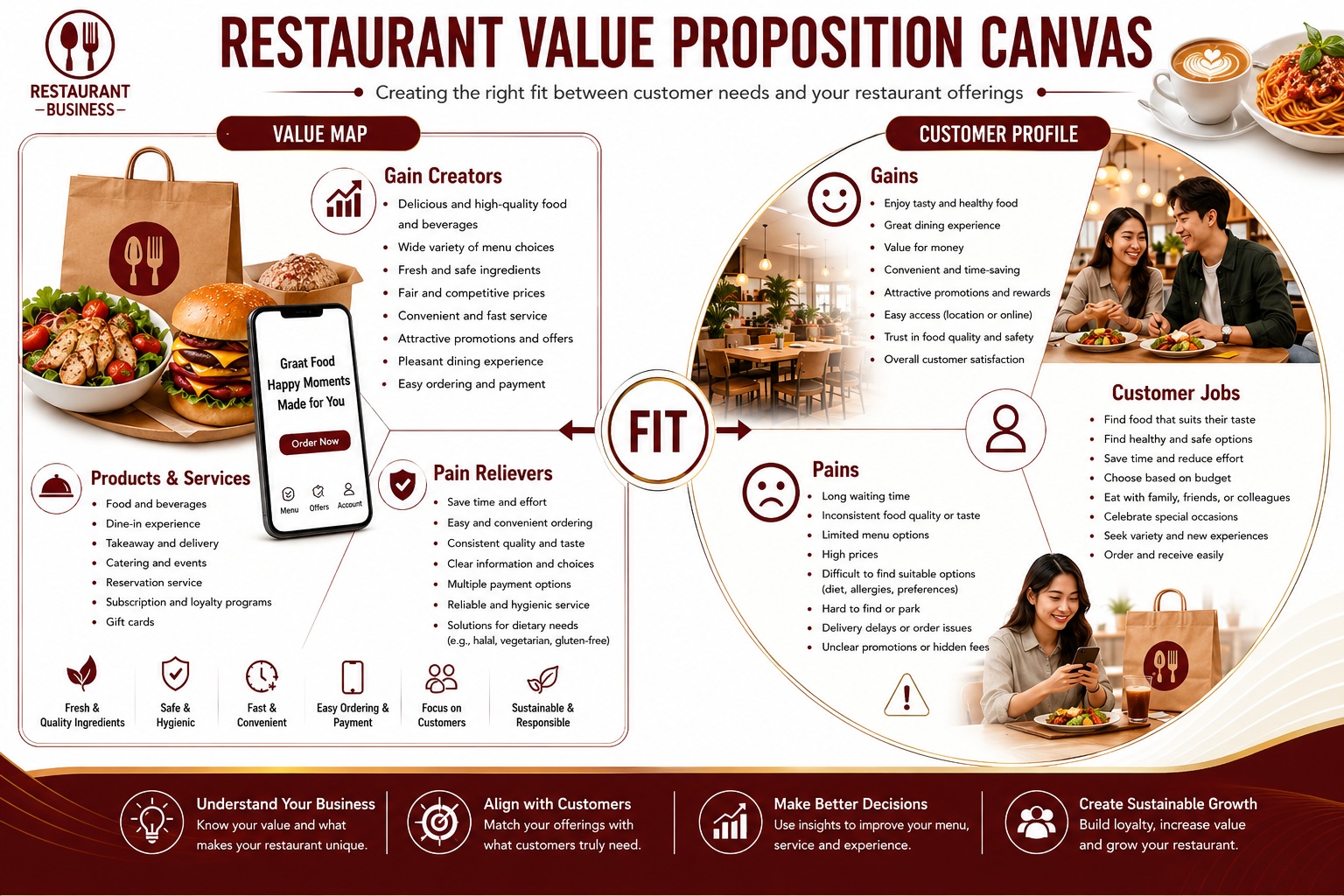
The Restaurant Business Model Canvas becomes stronger when paired with the Value Proposition Canvas. While the Business Model Canvas gives a broad view of the full operating model, the Value Proposition Canvas focuses more closely on the fit between what diners need and what the restaurant offers.
For restaurants, this is especially useful because customer choice is shaped by both functional and emotional drivers. Diners do not visit a restaurant only to satisfy hunger. They may also be seeking convenience, comfort, familiarity, social interaction, enjoyment, speed, quality assurance, or an experience worth repeating.
The Value Proposition Canvas has two main components. The first is the Customer Profile, which examines what customers are trying to get done, what frustrates them, and what they hope to gain. The second is the Value Map, which describes the products and services offered, how the restaurant relieves pain, and how it creates positive outcomes for diners. When used well, this framework helps restaurants move beyond assumptions and build offers that match real customer priorities.
5.1 Customer Profile
The Customer Profile helps restaurant operators understand what matters most to their diners. It is organised around three elements: customer jobs, customer pains, and customer gains. Customer jobs refer to what diners are trying to do, solve, or achieve. Then, Customer pains capture the frustrations, risks, or obstacles they experience. Customer gains refer to the positive outcomes they want, expect, or would be pleased to receive.
Across restaurant businesses, these elements vary by segment, occasion, and context. A family dining on the weekend has different jobs and pains from an office worker buying lunch during a short break. A delivery customer may care more about order accuracy and packaging than about ambience. A premium diner may value atmosphere, presentation, and service confidence more heavily.
Table 10: Customer Jobs
The following table is a summary of common customer jobs in restaurant settings.
| Typical Customer Need or Behaviour | Description | Restaurant Example |
|---|---|---|
| Eat quickly during a short break | Customer needs a fast and reliable meal solution | Office worker buying lunch between meetings |
| Socialise in a comfortable setting | Customer wants food and beverages in a pleasant environment | Friends meeting at a casual dining outlet after work |
| Feed a group efficiently | Customer needs meals that suit several people at once | Family ordering shared dishes and set meals |
| Choose a familiar and low-risk option | Customer wants predictable quality and minimal disappointment | Parent choosing a trusted chain restaurant |
Table 11: Customer Pains
The following table is a summary of the common frustrations and obstacles restaurant customers experience.
| Typical Customer Need or Behaviour | Description | Restaurant Example |
|---|---|---|
| Long waiting times | Delay reduces satisfaction and may prevent purchase | Queue building during lunch rush |
| Poor delivery condition | Food arrives late, cold, or damaged | Spilled drink and soggy fries in a delivery order |
| Inconsistent quality | Repeat visits do not deliver the same experience | Signature dish tasting different across visits |
| Unclear pricing or menu options | Customer struggles to understand value or choice | Overcomplicated menu with confusing bundles |
Table 12: Customer Gains
The following table is a summary of the outcomes and benefits diners most often value.
| Typical Customer Need or Behaviour | Description | Restaurant Example |
|---|---|---|
| Consistent quality | Customer wants the same good experience every time | Repeat diner ordering a trusted signature meal |
| Good value for money | Customer wants strong perceived benefit relative to price | Combo meal that feels worthwhile |
| Easy and convenient ordering | Customer values low-friction access and payment | App-based pre-order for pickup |
| Enjoyable dining experience | Customer wants more than simple food consumption | Casual dining visit chosen for ambience and comfort |
Customer Profile analysis should be evidence-based. Restaurants can identify jobs, pains, and gains through interviews, review analysis, order data, service observation, complaint logs, and repeat-purchase patterns. Prioritisation matters because not all needs carry the same weight. Some are core purchase drivers, while others are secondary.
One common mistake is focusing only on obvious jobs such as hunger while ignoring emotional and situational needs. In reality, many restaurant purchases are also about time pressure, convenience, mood, social context, and confidence in consistent delivery. Strong operators validate which pains reduce conversion and which gains strengthen loyalty, then use that insight to improve both the offer and the operating model.
5.2 Value Map
The Value Map explains how the restaurant responds to customer needs identified in the Customer Profile. It includes three elements: products and services, pain relievers, and gain creators. Products and services are the actual offerings the restaurant provides. Pain relievers describe how the business reduces frustration or risk. Gain creators explain how it generates added value and positive outcomes.
In restaurants, the Value Map should go beyond listing menu items. It should show how the total offer solves real customer problems and improves the full dining experience. Fast service, clear menu design, reliable packaging, comfortable seating, and repeat-purchase rewards can all be important parts of the value map.
Table 13: Products and Services
The following table is an overview of the core products and services that make up the restaurant offer.
| Typical Offering or Action | Description | Restaurant Example |
|---|---|---|
| Core menu items | Main food and beverage products sold to diners | Signature burgers, noodles, rice meals, and drinks |
| Dine-in experience | On-site seating, ambience, and service interaction | Family-friendly casual dining environment |
| Delivery and pickup options | Access channels that improve convenience | Scheduled self-pickup and same-day delivery |
| Loyalty programme | Structured repeat-purchase benefit system | Buy-and-earn rewards in a mobile app |
Table 14: Pain Relievers
The following table is a summary of the features and actions that reduce customer pain points.
| Typical Offering or Action | Description | Restaurant Example |
|---|---|---|
| Fast preparation process | Reduces waiting frustration and improves reliability | Express lunch set for office workers |
| Better packaging | Protects food quality during transport | Sealed containers and insulated drink holders |
| Clear menu and pricing | Reduces confusion and speeds decisions | Simple combo structure with visible prices |
| SOP-based quality control | Reduces inconsistency across visits | Standardised preparation for signature meals |
Table 15: Gain Creators
The following table is an overview of the elements that create additional value and positive outcomes for diners.
| Typical Offering or Action | Description | Restaurant Example |
|---|---|---|
| Signature dishes | Increase memorability and product preference | Famous noodle bowl or signature fried chicken meal |
| Comfortable ambience | Creates emotional value beyond food utility | Warm lighting and seating suited for groups |
| Personalised promotions | Make the offer more relevant to the customer | Birthday vouchers or app-based offers |
| Menu variety for different needs | Expands appeal across dining occasions | Kids’ meals, family sets, and lighter options |
A strong value map addresses the most important customer pains and gains rather than trying to offer everything. Some restaurants overbuild menus or features without solving the core reasons customers buy. Others provide decent food but fail to remove friction in ordering, waiting, or delivery.
Effective restaurants connect the value map to operational capability. There is little benefit in promising fast service, reliable delivery, or personalised offers if systems and staff cannot support them consistently. The best value maps are not only attractive in theory. They are also repeatable, commercially viable, and sustainable in daily operation.
5.3 Achieving Fit Between the Customer Profile and Value Map
Fit in the Value Proposition Canvas happens when the restaurant offering meaningfully matches what diners are trying to achieve, what frustrates them, and what they value most. In restaurant businesses, fit exists when products and services support important customer jobs, pain relievers reduce significant friction, and gain creators deliver outcomes that customers genuinely appreciate.
Fit matters because many restaurants fail not from lack of effort, but from weak alignment. A restaurant may launch attractive dishes yet still miss the real purchase driver. Customers may care more about speed, convenience, price clarity, or reliability than about menu creativity. In other cases, a premium audience may prefer a more curated experience instead of broad menu variety.
Table 16: Achieving Fit Between the Customer Profile and Value Map
The following table is a practical illustration of how diner needs can be matched with the value map.
| Customer Job, Pain, or Gain | Matching Value Map Element | How the Fit Is Created | Restaurant Example |
|---|---|---|---|
| Need a quick weekday meal | Express menu and rapid preparation | Reduces waiting time and supports time-sensitive purchase decisions | Quick-service lunch set for office workers |
| Frustration with poor delivery quality | Protective packaging and stronger dispatch process | Preserves food condition and improves satisfaction | Delivery-oriented outlet using sealed containers and timed dispatch |
| Want consistent quality | SOP-based production and staff training | Improves repeatability across visits or outlets | Franchise restaurant standardising signature meals |
| Want better value for money | Combo pricing and loyalty rewards | Increases perceived benefit relative to spending | Student meal bundle with repeat-purchase points |
| Want an enjoyable social occasion | Ambience, seating comfort, and friendly service | Creates emotional value beyond food consumption | Casual dining restaurant designed for group meetups |
Restaurants should test fit through repeat visits, review patterns, item performance, complaint trends, and channel-specific feedback. Assumed fit is not enough. Validated fit is what supports stronger retention, better economics, and more focused decision-making.
6. Competitive Advantages of Strong Restaurant Business Models
A well-designed restaurant model can build several competitive advantages that improve market position, support operational consistency, and strengthen long-term profitability. When these advantages are developed deliberately, they help restaurants compete more effectively, respond better to market pressure, and create a business model that is harder for competitors to copy:
- Clear customer targeting improves menu design, pricing, and site decisions, while also helping the restaurant shape promotions, service style, and channel choices with greater precision.
- Strong operational routines increase consistency, speed, and service confidence, which makes the customer experience more reliable across different shifts, locations, and demand periods.
- Focused value propositions make the restaurant easier to remember and easier to choose, especially in crowded markets where many brands compete for similar dining occasions.
- Balanced channel design expands reach without creating unnecessary complexity, allowing the restaurant to serve dine-in, takeaway, and delivery demand more effectively while protecting margin.
- Better alignment between revenue logic and cost structure strengthens profitability by ensuring that growth comes from commercially sustainable demand rather than from volume that adds pressure without enough return.
7. Risks and Challenges in Restaurant Business Models
The Restaurant Business Model Canvas also makes it easier to identify the main risks and challenges restaurants face across operations, customer demand, and financial performance:
- Food cost inflation can erode gross margin quickly and make pricing decisions more difficult, especially for concepts competing on affordability.
- Labour shortages can reduce service quality, slow operations, and create inconsistency across shifts, outlets, or customer touchpoints.
- Delivery dependence can weaken customer ownership, reduce direct brand control, and pressure margins through commissions and packaging costs.
- Menu complexity can create waste, slower service, training difficulty, and weaker execution during peak operating periods.
- High rent and fixed costs can create pressure during periods of weaker demand, especially for dine-in concepts with heavy occupancy commitments.
8. Recommendations for Restaurant Operators
The Restaurant Business Model Canvas is most useful when it leads to action. Restaurant operators should review the model regularly and strengthen the areas that most affect customer value and operating discipline.
First, sharpen the target segment rather than trying to serve every diner. Next, simplify the menu where complexity weakens speed, consistency, or margin. After that, review channel economics carefully, especially for delivery and platform-heavy demand. Operators should also protect the parts of the experience that customers value most, whether that is taste, speed, ambience, convenience, or trust. Finally, track repeat purchase, item-level margin, service consistency, labour productivity, and cost-to-serve by channel so the model can be refined using evidence rather than assumption.
9. Related Restaurant Business Model Canvas Examples
The Restaurant Business Model Canvas becomes easier to understand when viewed through real company examples. McDonald’s and KFC are useful for quick-service scale, standardisation, and throughput efficiency. Chili’s and TGI Fridays help explain casual dining logic built around dine-in experience and service interaction. Secret Recipe shows how broad casual dining can be combined with dessert attachment and brand familiarity. Marugame Udon and Bakmi GM highlight the benefits of focused category execution and operational clarity. Pelita Nasi Kandar and Satay Kajang Haji Samuri show how local familiarity and strong cultural relevance can support restaurant demand in Malaysia.
These examples matter because they show that restaurants do not all succeed in the same way. Some win through speed. Others win through experience, category focus, or everyday familiarity. The canvas becomes more practical when readers can see how the same framework applies across different restaurant formats.
10. Conclusion
The Restaurant Business Model Canvas provides a practical way to understand how restaurants create, deliver, and capture value. It helps founders, operators, consultants, and analysts move beyond food quality alone and examine the full system behind restaurant performance. Customer segments, value proposition, channels, relationships, revenue, resources, activities, partnerships, and cost structure all need to work together if the model is to remain commercially strong. When these elements are aligned, the restaurant is usually better positioned to build consistency, improve profitability, and respond more effectively to changing market conditions.
Restaurants succeed when the offer fits the customer, the operations support the promise, and the economics remain workable under real market conditions. That is why the canvas is useful not only for designing a new concept, but also for reviewing and improving an existing restaurant business over time. In practice, it gives decision-makers a clearer way to identify what is working, what is weakening performance, and where the next improvements should be made.
Disclaimer: This article is provided for educational and business analysis purposes only. Its content is based on general business concepts, market observations, and strategic interpretation. It does not constitute financial, legal, tax, investment, or professional advisory advice. Any brand names, trademarks, logos, and related materials mentioned remain the property of their respective owners.

