



Share This Article


Gojek Business Model Canvas: How Indonesia’s Super App Built a Daily-Use Digital Ecosystem
BMC Article No: BMC #055
Updated in 2026: This article has been rewritten with a stronger business story, clearer Business Model Canvas structure, current GoTo context, Value Proposition Canvas analysis, competitive advantages, risks, and strategic lessons from Gojek’s platform journey.
Introduction
Gojek is one of Southeast Asia’s most important digital platform stories. It began in Indonesia in 2010 as a motorcycle ride-hailing call centre. Later, it became a mobile app that connected consumers, drivers, merchants, logistics partners, and financial services into one daily-use platform.
This brand is interesting because it does not sell only one service. Users can book a ride, order food, send a parcel, pay digitally, or access partner services inside the same ecosystem. Driver-partners can earn through mobility and delivery demand. Merchants can use GoFood and merchant tools to reach more customers.
The Gojek Business Model Canvas helps explain how this platform works. It shows how Gojek creates value from convenience, scale, trust, partner supply, digital payments, and ecosystem integration.
Today, Gojek operates under GoTo Group, which combines on-demand services, financial technology, and digital commerce exposure. That structure gives Gojek a wider strategic role. Gojek is not only a transport app. The platform is part of Indonesia’s broader digital economy infrastructure.
What Is Gojek’s Business Model?
Gojek’s business model is built around a multi-service platform. The company connects demand and supply across transport, food delivery, logistics, merchant services, and payments. Customers use the app to solve daily problems. Drivers, restaurants, shops, and business partners use the platform to access demand.
The core idea is simple. Gojek reduces friction in urban life. Users no longer need to call a driver, visit a restaurant, carry cash, or arrange courier delivery manually.
Its main strength is network effect. More users attract more drivers and merchants. A wider partner base improves service availability. Better availability increases user trust and frequency. That cycle supports growth across multiple services.
Its main challenge is profitability. Platform businesses often require incentives, technology spending, partner support, customer acquisition, regulatory work, and operational monitoring. This canvas therefore shows a business where scale is powerful, but discipline is essential.
What Is Business Model Canvas?
Business Model Canvas, or BMC, is a practical tool used to understand how a company creates, delivers, and captures value. It breaks the business into nine linked building blocks. Instead of looking only at products or revenue, BMC helps readers understand the operating logic behind the company.
| BMC Block | Main Question |
|---|---|
| Customer Segments | Who does the business serve? |
| Value Propositions | What value does the business offer? |
| Channels | How does the business reach customers? |
| Customer Relationships | How does the business build loyalty? |
| Revenue Streams | How does the business make money? |
| Key Resources | What assets does the business need? |
| Key Activities | What must the business do well? |
| Key Partnerships | Who helps the business operate? |
| Cost Structure | What are the major costs? |
For Gojek, the BMC is useful because the company is more than a ride-hailing provider. It involves mobile technology, real-time matching, driver supply, merchant onboarding, payments, customer support, regulatory engagement, and partner economics.
Quick Overview of Gojek and GoTo Group
Gojek was founded by Nadiem Makarim in 2010. The early model helped customers book motorcycle taxi services through a call centre. In 2015, Gojek launched its mobile app and expanded into services such as GoRide, GoFood, GoSend, and GoShop.
The company became one of Indonesia’s most recognised technology brands because it solved daily urban problems at scale. Transport, food delivery, and logistics became easier for consumers. At the same time, drivers and small merchants gained access to digital demand.
In 2021, Gojek merged with Tokopedia to form GoTo Group. This created a larger Indonesian technology group covering on-demand services, financial technology, and e-commerce exposure.
The 2026 context makes this business model more important. GoTo reported its first quarterly net profit in Q1 2026, showing that the group has shifted its focus from growth at all costs toward better operating leverage, cost discipline, and healthier monetisation.
Why Gojek Is Strategically Interesting
Gojek is strategically interesting because it turns fragmented daily activities into one connected platform. Transport, food delivery, parcel delivery, payments, and merchant tools may look like separate services. Inside the app, they reinforce one another.
A customer who uses GoRide may later use GoFood. Merchants may use digital payments and promotions. Driver-partners may serve ride-hailing demand during peak commute hours and delivery demand at other times. This creates a wider usage loop than a single-service app.
Another important feature is local relevance. Indonesia has dense cities, traffic congestion, a large informal economy, many small food merchants, and strong mobile internet adoption. Gojek’s model fits these market conditions.
From a strategy perspective, the Gojek Business Model Canvas shows how a local platform can scale by solving practical problems repeatedly. The business is not built on one dramatic purchase. It is built on many small, frequent transactions across everyday life.
Latest Developments: What Is Changing Around Gojek?
The latest story around Gojek is about profitability, competition, and sharper platform economics. GoTo Group reported a net profit of Rp171 billion in Q1 2026, its first quarterly net profit since the Gojek and Tokopedia merger. Net revenue also grew year on year, supported by stronger user and transaction growth.
This matters because platform companies are often judged by their path to sustainable profit. For years, the sector depended heavily on incentives, discounts, and aggressive expansion. Recent performance suggests GoTo is moving toward better cost control and stronger monetisation.
Competition remains intense. Grab remains a major rival in mobility, food delivery, and digital services. Local players, fintech companies, banks, logistics platforms, and merchant technology providers also compete for parts of the same value chain.
Regulation is another key development. Ride-hailing, driver welfare, digital payments, data protection, lending, and competition policy can all affect Gojek’s operating model. This analysis must therefore be read as a live model, not a static diagram.
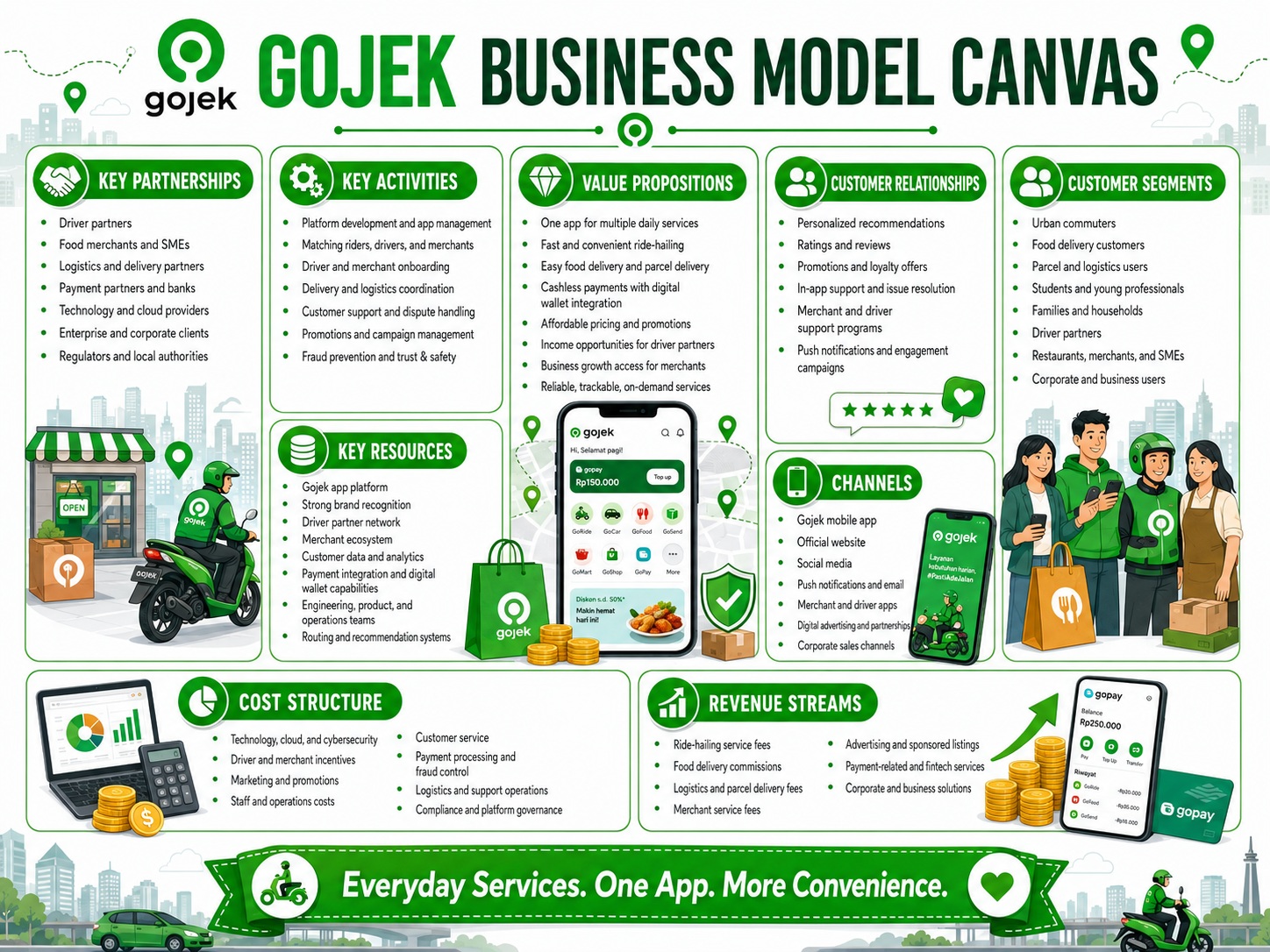
Gojek Business Model Canvas Summary
Before going into each block, the summary below gives a quick view of how Gojek’s business model works. It shows who the platform serves, what value it offers, how it reaches users, and what resources keep the system running.
| BMC Block | Gojek Application |
| Customer Segments | Consumers, drivers, food merchants, SMEs, enterprise clients, payment users, and advertisers. |
| Value Propositions | Convenience, speed, affordability, income access, digital payments, merchant reach, and daily-use integration. |
| Channels | Gojek app, driver app, GoFood merchant tools, GoPay, social media, partner networks, and corporate channels. |
| Customer Relationships | App personalisation, ratings, loyalty, promotions, help centre, partner support, and community engagement. |
| Revenue Streams | Commissions, delivery fees, mobility fees, merchant services, ads, payment fees, fintech income, and B2B solutions. |
| Key Resources | Brand, app platform, data, algorithms, driver network, merchant base, GoPay integration, and technology talent. |
| Key Activities | Matching demand and supply, onboarding partners, engineering, fraud control, support, marketing, and compliance. |
| Key Partnerships | Drivers, merchants, banks, regulators, payment partners, technology providers, advertisers, and enterprise clients. |
| Cost Structure | Technology, incentives, driver support, marketing, staff, compliance, customer service, cloud, and operational costs. |
This summary shows why Gojek cannot be analysed as only a transport company. Gojek is a platform business with many connected demand and supply loops.
1. Customer Segments
Customer segments describe who the business serves. Gojek serves several groups at the same time, and each group has different needs.
Consumers use Gojek for mobility, food delivery, logistics, shopping help, and cashless payments. Driver-partners use it to access flexible earning opportunities. Merchants use GoFood and related tools to get orders, manage menus, run promotions, and improve visibility. Business customers use corporate and logistics solutions to manage transport or delivery needs.
| Customer Segment | What They Need | How Gojek Serves Them |
| Urban consumers | Fast transport, food, delivery, and payments. | Offers one app for multiple daily services. |
| Driver-partners | Flexible work and order access. | Connects them to ride and delivery demand. |
| Food merchants | More orders and digital visibility. | Provides GoFood listing, promotions, and merchant tools. |
| SMEs and sellers | Delivery and payment support. | Offers logistics, wallet, and business services. |
| Corporate clients | Managed transport and fulfilment. | Supports business travel and delivery workflows. |
| Advertisers | Access to high-intent users. | Enables sponsored visibility inside the ecosystem. |
The Gojek Business Model Canvas shows a multi-sided market. Growth depends on balancing value for users, partners, and businesses.
2. Value Propositions
The value proposition explains why users choose Gojek. At the simplest level, Gojek offers convenience across daily urban needs. Users can move, eat, send, pay, and manage small tasks without switching between many offline providers.
Its value is different for each stakeholder. Consumers gain speed and simplicity. Driver-partners gain earning access. Merchant partners gain demand and digital tools. Businesses gain operational support for transport, delivery, and payments.
| Value Proposition | Customer Benefit | Business Impact |
| Multi-service convenience | Users solve many daily tasks in one app. | Increases frequency and cross-service usage. |
| Fast fulfilment | Rides, food, and parcels can be arranged quickly. | Builds habit and trust. |
| Income access | Drivers receive flexible work opportunities. | Strengthens partner supply. |
| Merchant growth | Restaurants and SMEs reach more customers. | Expands platform inventory. |
| Cashless payment | GoPay reduces payment friction. | Supports retention and transaction data. |
| Safety and transparency | Tracking, ratings, and support improve confidence. | Reduces trust barriers. |
Gojek’s value proposition is not only digital convenience. It is also the conversion of informal services into structured, trackable, and repeatable transactions.
3. Channels
Channels explain how Gojek reaches users and delivers value. The platform is app-first, but its channel system is wider than the consumer app alone.
Its consumer app is the main customer channel. Driver apps, merchant platforms, GoPay interfaces, push notifications, social media, and corporate sales channels extend reach across different stakeholders. Offline presence also matters because driver communities, merchant onboarding, brand campaigns, and local partnerships support trust.
| Channel | Examples | Strategic Role |
| Consumer app | GoRide, GoCar, GoFood, GoSend, GoPay access. | Central gateway for daily transactions. |
| Driver app | Job matching, earnings, incentives, and support. | Manages supply-side participation. |
| Merchant tools | GoFood Merchant app and promotion features. | Helps merchants manage orders and visibility. |
| Digital marketing | Push notifications, social media, and campaigns. | Drives usage and service discovery. |
| Corporate channels | GoCorp and enterprise relationship teams. | Supports business adoption. |
| Local activations | Driver hubs, merchant outreach, and campaigns. | Builds physical trust in key markets. |
Strong channels make Gojek easy to access. In platform markets, the easiest service often wins the next transaction.
4. Customer Relationships
Customer relationships describe how Gojek attracts, retains, and supports users. The relationship model is largely digital, but it also depends on trust, partner support, and community management.
Consumers return because the app is useful, familiar, and frequently relevant. Drivers continue when earnings, incentives, safety, and platform rules remain attractive. Merchants stay when the platform delivers orders and provides practical tools.
| Relationship Driver | How It Works | Example |
| Personalisation | App data improves recommendations and offers. | A frequent GoFood user sees relevant restaurants. |
| Ratings and reviews | Users rate drivers, merchants, and service quality. | Poor experiences become visible and manageable. |
| Promotions | Discounts and bundles stimulate repeat usage. | A GoFood voucher encourages another order. |
| Partner support | Drivers and merchants receive help and guidance. | A merchant adjusts menus through the merchant app. |
| Help centre | In-app support handles refunds, complaints, and queries. | A delayed order can be reported through the app. |
| Community engagement | Partner programs support trust and retention. | Driver initiatives improve platform attachment. |
The relationship model is based on repeat relevance. Gojek must stay useful often enough to become part of daily behaviour.
5. Revenue Streams
Revenue streams show how Gojek makes money. The platform earns from transactions, commissions, fees, advertising, payment activities, and business services.
Mobility and food delivery remain important revenue engines. Logistics and merchant services add more usage occasions. GoPay and financial services increase ecosystem stickiness, although fintech activities require careful risk and compliance management.
| Revenue Stream | Description | Why It Matters |
| Ride-hailing fees | Platform fees or commissions from GoRide and GoCar trips. | Monetises daily mobility demand. |
| Food delivery commissions | Merchant commissions and delivery-related charges. | Converts food demand into recurring revenue. |
| Logistics fees | Income from GoSend, GoBox, and delivery services. | Extends the platform into fulfilment. |
| Merchant services | Promotions, tools, and visibility solutions. | Helps monetise merchant growth needs. |
| Advertising | Sponsored listings and platform media products. | Uses user traffic for higher-margin income. |
| Payments and fintech | GoPay and related financial service income. | Deepens transaction capture and retention. |
| Corporate solutions | Business transport and delivery services. | Builds recurring enterprise usage. |
The Gojek Business Model Canvas shows a revenue model that depends on volume, frequency, partner economics, and careful take-rate management.
6. Key Resources
Key resources are the assets Gojek needs to operate. These resources include technology, data, brand, partner networks, talent, and payment infrastructure.
The app is the visible resource, but the deeper assets sit behind the interface. Matching algorithms, fraud detection, routing, pricing, customer data, merchant systems, driver supply, and payment integration make the platform work.
| Key Resource | Role in the Business Model | Strategic Value |
| Brand equity | Recognition and trust in Indonesia. | Reduces adoption barriers. |
| Mobile platform | Main interface for users, drivers, and merchants. | Enables scalable service delivery. |
| Driver network | Supply for mobility and logistics demand. | Improves availability and speed. |
| Merchant base | Restaurants and SMEs on GoFood. | Creates choice and frequency. |
| Data and algorithms | Matching, routing, fraud control, and personalisation. | Improves efficiency and user experience. |
| GoPay integration | Payment layer across services. | Reduces friction and captures transaction value. |
| Technology talent | Engineers, data teams, product teams, and operations specialists. | Supports continuous improvement. |
Together, these resources create a platform that is difficult to copy quickly. The visible app is simple, but the operating system behind it is complex.
7. Key Activities
Key activities are the things Gojek must do well to remain competitive. These include platform engineering, partner onboarding, demand generation, service quality monitoring, risk control, payments support, and regulatory management.
The most critical activity is balancing marketplace liquidity. Users want fast service. Drivers and merchants want enough demand. Gojek must ensure that supply and demand meet at the right time, location, price, and service standard.
| Key Activity | What It Involves | Why It Matters |
| Platform engineering | Building and improving app features, systems, and APIs. | Keeps services reliable and scalable. |
| Demand-supply matching | Routing orders to available drivers and merchants. | Reduces waiting time and cancellations. |
| Partner onboarding | Recruiting, verifying, and training drivers and merchants. | Maintains service coverage. |
| Fraud and risk control | Detecting abuse, fake orders, and payment risk. | Protects trust and profitability. |
| Marketing and promotions | Campaigns, vouchers, bundles, and user engagement. | Drives traffic and retention. |
| Customer support | Handling complaints, refunds, and service issues. | Protects user confidence. |
| Compliance management | Managing transport, fintech, data, and labour-related rules. | Reduces legal and operating risk. |
The Gojek Business Model Canvas shows that marketplace quality is an operational discipline, not only a technology feature.
8. Key Partnerships
Key partnerships help Gojek scale, reduce friction, and strengthen trust. The platform cannot operate effectively without drivers, merchants, banks, payment partners, technology providers, regulators, advertisers, and enterprise customers.
Partnership quality matters because each partner affects the customer experience. A poor restaurant experience affects GoFood. Weak driver supply affects mobility reliability. Payment disruption affects transaction completion. Regulatory issues can affect market access.
| Partner Type | Examples | Contribution to the Business Model |
| Driver-partners | Motorcycle and car drivers. | Provide mobility and delivery capacity. |
| Merchants | Restaurants, cafés, shops, and SMEs. | Supply food and product variety. |
| Payment partners | Banks, wallet providers, and fintech partners. | Support transactions and financial services. |
| Regulators | Transport, labour, fintech, and data authorities. | Shape legal operating conditions. |
| Technology partners | Cloud, cybersecurity, analytics, and infrastructure providers. | Improve reliability and scale. |
| Advertisers | Brands and merchants seeking platform visibility. | Create monetisation beyond transaction fees. |
| Enterprise clients | Companies using GoCorp or logistics services. | Add B2B demand and recurring usage. |
These partnerships allow Gojek to focus on platform orchestration while partners provide supply, reach, infrastructure, and market legitimacy.
9. Cost Structure
Cost structure explains where the money goes. Gojek has major costs across technology, incentives, marketing, people, support, compliance, infrastructure, and partner operations.
Some costs are needed to keep the platform reliable. Other costs are used to stimulate demand or retain supply. The challenge is to spend in ways that improve long-term usage rather than buying short-term transactions through excessive discounts.
| Cost Category | Examples | Management Challenge |
| Technology infrastructure | Cloud, systems, cybersecurity, data, and app maintenance. | Reliability must scale without waste. |
| Driver and merchant incentives | Bonuses, promotions, and partner support. | Supply must be retained profitably. |
| Marketing | Brand campaigns, vouchers, referrals, and partnerships. | Growth spending must improve retention. |
| People costs | Engineers, operations, product, support, and corporate teams. | Talent is expensive but critical. |
| Customer support | Help centre, refunds, dispute handling, and service recovery. | Trust requires responsive support. |
| Compliance | Transport, fintech, data, tax, and labour-related obligations. | Rules can increase operating complexity. |
| Payment and fraud control | Risk monitoring, chargebacks, and security systems. | Financial trust must be protected. |
The Gojek Business Model Canvas makes one point clear: scale is valuable only when cost-to-serve improves over time.
Strategic Lessons from Gojek’s Business Model
Gojek offers useful lessons for founders, platform builders, and business strategists.
One lesson is that frequent problems create strong platforms. Gojek did not start by solving rare needs. It focused on daily mobility, food, delivery, and payments. These needs happen often, which supports repeat usage.
The second lesson is that supply matters as much as demand. A platform can attract many users, but it fails if drivers and merchants are not available, reliable, and motivated. Gojek’s partner network is therefore part of its product.
Another lesson is that local context can create advantage. Indonesia’s traffic, informal services, food culture, and mobile-first behaviour made Gojek’s model highly relevant.
The fourth lesson is that growth must eventually convert into better economics. Incentives can create adoption, but long-term value comes from habit, efficiency, data, trust, and disciplined monetisation.
A final lesson is that ecosystems are powerful when services reinforce one another. The Gojek Business Model Canvas shows how transport, food, logistics, payments, and merchant tools can support stronger platform frequency.
Value Proposition Canvas View of Gojek
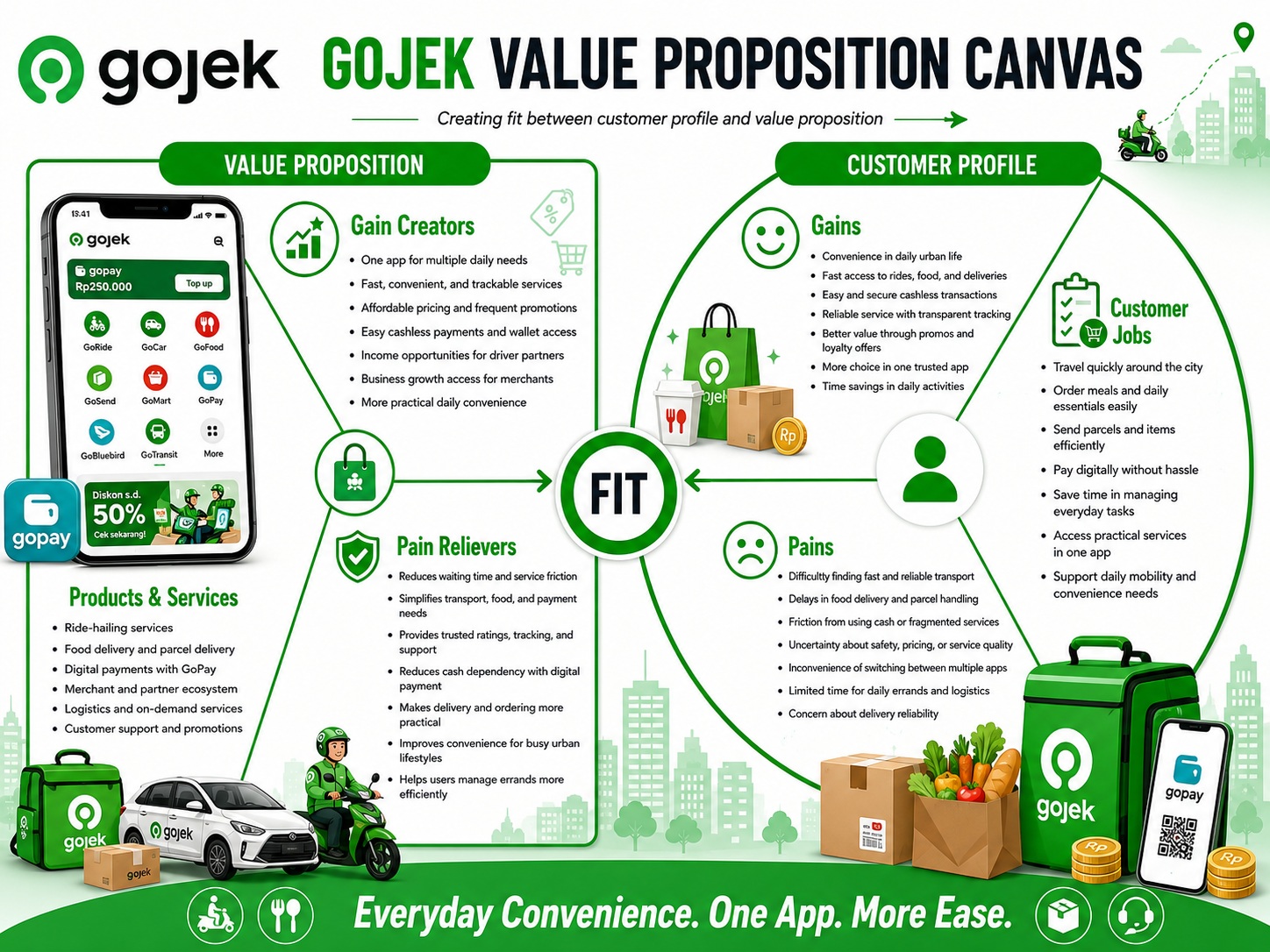
The Value Proposition Canvas explains the fit between Gojek’s offer and customer needs. Users choose it because it solves daily problems with speed, convenience, and trust.
Customer Profile
Consumers want transport, food, delivery, payments, and daily convenience. Drivers want income opportunities and predictable demand. Merchants want orders, visibility, payments, and tools.
For pains, consumers face traffic, waiting time, fragmented services, cash dependency, and safety concerns. Drivers face income volatility. Merchants face limited reach and promotional pressure.
For gains, users want fast fulfilment, transparent pricing, tracking, easy payment, variety, rewards, and reliable service. Partners want demand access and practical tools.
Value Proposition
Gojek’s products and services include GoRide, GoCar, GoFood, GoSend, GoBox, GoPay, GoFood Merchant tools, GoCorp, and related platform services.
Pain relievers include real-time matching, route visibility, cashless payment, ratings, customer support, merchant dashboards, and integrated logistics. These features reduce uncertainty and make daily services easier to manage.
Gain creators include one-app convenience, service variety, promotions, loyalty, partner income access, merchant visibility, digital payments, and business solutions. Usage becomes more valuable as customers and partners use more services.
Customer Profile and Value Proposition Fit
| Customer Profile | Details | Matching Value Proposition | How Gojek Creates Fit |
| Customer Jobs | Users want rides, food, delivery, payments, and business support. | Products and Services | Gojek combines mobility, food, logistics, payments, and merchant tools. |
| Customer Pains | Users face traffic, waiting, cash friction, uncertainty, and limited reach. | Pain Relievers | Matching, tracking, GoPay, ratings, support, and merchant tools reduce friction. |
| Customer Gains | Users want speed, convenience, transparency, rewards, and income access. | Gain Creators | Service variety, partner supply, promotions, and digital integration create practical value. |
This fit explains why Gojek became a daily-use platform. Gojek does not only offer convenience. The platform matches practical urban jobs with scalable digital infrastructure.
Competitive Advantage of Gojek
Gojek’s competitive advantage comes from several layers working together. This advantage is not protected by one feature alone.
- Strong local brand: Gojek has deep recognition in Indonesia, which helps customers and partners trust the platform faster.
- Multi-service ecosystem: Transport, food, logistics, payments, and merchant tools create more reasons to use the app repeatedly.
- Large partner network: Drivers and merchants improve availability, fulfilment speed, and service choice.
- GoPay and fintech integration: Digital payments reduce friction and increase transaction capture across the ecosystem.
- Operational data: Usage data supports pricing, matching, fraud control, personalisation, and campaign targeting.
- GoTo ecosystem position: The wider group structure gives Gojek stronger links to financial technology, digital commerce, and enterprise opportunities.
The strategic implication is clear. Gojek competes through system strength. A rival can copy one service, but matching brand, supply, data, payments, and partner depth is much harder.
Risks and Challenges
Gojek still faces real business risks. These risks do not mean the model is weak. They show where management discipline is required.
- Intense competition: Grab and other digital platforms compete in mobility, food delivery, payments, and merchant solutions. Gojek must defend relevance without depending too heavily on discounts.
- Margin pressure: Incentives, delivery costs, customer acquisition, compliance, and technology spending can reduce profitability. Better cost-to-serve is essential.
- Driver welfare and regulation: Rules on platform workers, transport pricing, safety, and benefits can affect operating flexibility and cost.
- Merchant economics: Restaurants and SMEs may resist high commissions if platform orders do not generate sufficient margin.
- Payment and fintech risk: GoPay and financial products increase value, but they also add credit, fraud, compliance, and data protection risk.
- Service quality consistency: A bad driver, late order, poor merchant experience, or failed refund can damage trust quickly.
- Low switching cost: Users can move to another app when prices, promotions, availability, or service quality are better elsewhere.
- Ecosystem complexity: More services create more operational dependencies. Weak execution in one vertical can affect the broader brand.
The strategic implication is that Gojek must balance growth, partner welfare, user experience, regulation, and profitability at the same time.
Conclusion
The Gojek Business Model Canvas shows how an Indonesian ride-hailing idea became a broader digital platform. Its success is not based on transport alone. It is built on daily convenience, partner supply, merchant access, digital payments, customer trust, and ecosystem frequency.
Gojek works because it solves practical problems that happen often. People need to move, eat, send items, pay, and manage daily tasks. Drivers need earning opportunities. Merchants need customers. Businesses need reliable fulfilment. The platform connects these needs through technology.
For business owners, the lesson is direct. A strong platform is not only about launching an app. It is about building trust, liquidity, partner economics, service consistency, and repeat behaviour.
That is the real power behind Gojek.
Disclaimer:
This article is for informational and educational purposes only. It is based on publicly available information and independent business analysis. The analysis does not represent official information from Gojek, GoTo Group, or any related company. Readers should conduct their own research before making business, investment, or strategic decisions.

