Apple Business Model Canvas
Read this Apple Business Model Canvas analysis to understand how Apple creates value through premium devices, services, ecosystem loyalty, retail control, and recurring revenue.
Learn the YouTube Business Model Canvas with detailed analysis of customer segments, value propositions, revenue streams, key resources, risks, and strategy.
BMC Article No: BMC #022
YouTube is more than a video-sharing website. It is a global media platform, creator economy engine, advertising network, subscription business, music platform, learning channel, search destination, and entertainment ecosystem.
The YouTube Business Model Canvas is interesting because YouTube serves several groups at the same time. Viewers watch content. Creators produce videos. Advertisers pay for attention. Media companies distribute licensed content. Subscribers pay for premium viewing, music, live TV, and other services.
This model is powerful because every side strengthens the other. More creators attract more viewers. Larger audiences attract more advertisers. Higher revenue helps YouTube pay creators, invest in technology, and improve the platform.
In this article, we will break down how YouTube creates value, reaches users, earns revenue, manages costs, protects its competitive position, and faces future risks.
YouTube’s business model is built around digital attention, user-generated content, advertising, subscriptions, and creator monetisation. The platform allows users to watch videos for free, while advertisers pay to reach targeted audiences.
Creators are central to the model. They upload videos, build audiences, and keep viewers engaged. YouTube then shares part of advertising and subscription revenue with eligible creators through the YouTube Partner Program.
A second revenue layer comes from subscriptions. YouTube Premium, YouTube Music, YouTube TV, channel memberships, Super Chat, Super Stickers, Super Thanks, and paid content options allow YouTube to earn beyond advertising.
Scale is the main advantage. YouTube has billions of monthly logged-in users, large daily video uploads, strong search behaviour, and growing short-form consumption through Shorts.
However, the model also carries pressure. YouTube must manage content moderation, copyright, advertiser safety, creator dissatisfaction, regulatory scrutiny, AI-generated content, and competition from TikTok, Netflix, Spotify, Instagram, and other platforms.
The YouTube Business Model Canvas shows a platform that monetises attention by connecting viewers, creators, advertisers, rights holders, and subscribers in one operating system.
Business Model Canvas, or BMC, is a practical tool used to explain how a company works. It helps readers understand how a business creates value, delivers value, and captures revenue.
Instead of looking only at products, BMC looks at the full business system. It connects customers, value propositions, channels, relationships, revenue, resources, activities, partners, and costs in one simple view.
For YouTube, BMC is useful because the company is not only a video platform. It is an advertising business, subscription business, creator marketplace, entertainment network, music platform, education resource, and search engine.
| BMC Block | Main Question |
|---|---|
| Customer Segments | Who does the business serve? |
| Value Propositions | What value does the business offer? |
| Channels | How does the business reach customers? |
| Customer Relationships | How does the business build loyalty? |
| Revenue Streams | How does the business make money? |
| Key Resources | What assets does the business need? |
| Key Activities | What must the business do well? |
| Key Partnerships | Who helps the business operate? |
| Cost Structure | What are the major costs? |
The YouTube Business Model Canvas helps explain how content, attention, data, creators, advertising tools, subscriptions, and technology infrastructure work together.
YouTube was founded in February 2005 by Chad Hurley, Steve Chen, and Jawed Karim. The platform started as a simple place for people to upload, watch, and share videos.
Google acquired YouTube in 2006 for USD1.65 billion in stock. That acquisition gave YouTube access to Google’s search, advertising technology, infrastructure, data capability, and global engineering scale.
Over time, YouTube expanded from user-uploaded videos into music, live streaming, creator monetisation, television streaming, education, podcasts, Shorts, shopping, and subscription services.
Recent public updates show how large the platform has become. Alphabet reported that YouTube revenue across ads and subscriptions exceeded USD60 billion for the full year 2025. YouTube also states that Shorts now averages over 200 billion daily views.
This scale matters because YouTube is no longer just a website. It competes with television, social media, streaming platforms, music apps, learning platforms, and search engines.
YouTube is strategically interesting because it combines media, technology, advertising, community, and creator economics. Traditional media companies usually produce or license content. YouTube enables millions of creators to produce content for the platform.
That structure gives YouTube a large content supply without owning every production asset. Creators carry much of the creative risk, while YouTube provides infrastructure, distribution, monetisation tools, analytics, and audience access.
Search also makes YouTube different from many entertainment platforms. Users do not only scroll passively. They search for tutorials, reviews, music, news, product comparisons, education, and solutions to practical problems.
Advertisers value this behaviour because YouTube can capture both entertainment attention and high-intent discovery. A viewer watching a product review may be closer to purchase than someone watching general entertainment.
From a strategy perspective, the YouTube Business Model Canvas shows how a platform can turn user-generated content into global reach, advertising inventory, creator income, and recurring subscription revenue.
YouTube’s business model is changing in five important ways.
First, Shorts has become a major growth engine. Short-form video helps YouTube compete with TikTok, Instagram Reels, and mobile-first entertainment habits.
Second, subscriptions are becoming more important. YouTube Premium, YouTube Music, YouTube TV, channel memberships, and paid fan features reduce dependence on advertising cycles.
Third, connected TV viewing is strengthening YouTube’s position against traditional television and streaming services. Larger-screen viewing helps YouTube compete for brand advertising budgets.
Fourth, AI is changing content production, discovery, translation, moderation, advertising, and creator tools. This can increase output, but it also raises quality, trust, and copyright concerns.
Fifth, regulation is increasing. Governments are paying closer attention to child safety, misinformation, copyright, data privacy, platform accountability, and online advertising.
These changes make the YouTube Business Model Canvas more important. YouTube must protect creator trust, advertiser confidence, viewer engagement, and regulatory credibility while expanding into new video formats.
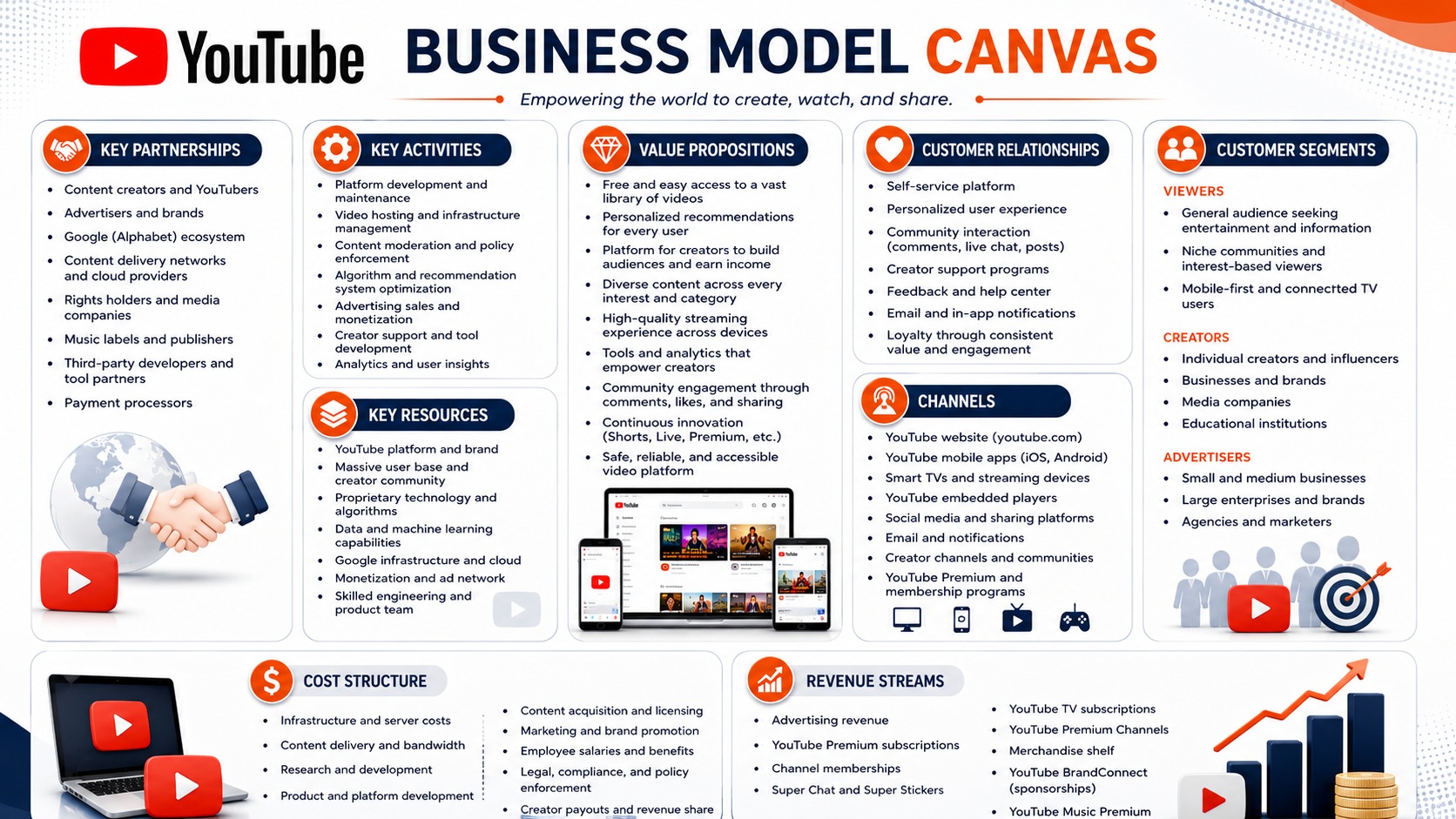
Before going into each block, the summary below gives a quick view of how YouTube’s business model works. It shows who YouTube serves, what value it offers, how it reaches users, how revenue is generated, and what resources keep the platform running.
| BMC Block | YouTube Application |
|---|---|
| Customer Segments | Viewers, creators, advertisers, subscribers, media companies, artists, educators, and brands. |
| Value Propositions | Free video access, creator monetisation, targeted advertising, global distribution, learning, entertainment, and subscriptions. |
| Channels | Website, mobile app, smart TVs, embedded videos, search, notifications, social sharing, YouTube Studio, and Google ecosystem. |
| Customer Relationships | Personalised recommendations, creator communities, subscriptions, comments, live chats, memberships, support, and analytics. |
| Revenue Streams | Ads, Premium, Music, TV, channel memberships, Super Chat, Super Stickers, Super Thanks, shopping, and content partnerships. |
| Key Resources | Platform technology, data, algorithms, creators, content library, brand, infrastructure, advertiser tools, and copyright systems. |
| Key Activities | Hosting videos, recommending content, selling ads, paying creators, moderating content, managing rights, and developing products. |
| Key Partnerships | Creators, advertisers, music labels, media companies, device makers, telecoms, sports leagues, rights owners, and Google. |
| Cost Structure | Infrastructure, creator payouts, R&D, moderation, licensing, sales, marketing, legal, compliance, and support costs. |
YouTube BMC Diagram:
Customer segments describe who the business serves. YouTube serves multiple customer groups that depend on one another. Viewers need content. Creators need audiences. Advertisers need reach. Subscribers need better experiences. Rights holders need distribution and monetisation.
This multi-sided structure is the heart of YouTube’s model. A normal media company may focus mainly on viewers and advertisers. YouTube must serve viewers, creators, advertisers, brands, music labels, media owners, educators, developers, and paying subscribers.
The platform also serves different viewing needs. Some users come for entertainment. Others watch tutorials, product reviews, lectures, music videos, podcasts, live streams, news, gaming, or children’s content.
| Customer Segment | What They Need | How YouTube Serves Them |
|---|---|---|
| Viewers | Free, useful, and entertaining videos. | Offers search, recommendations, playlists, Shorts, and subscriptions. |
| Creators | Audience reach and income potential. | Provides uploads, analytics, monetisation, Studio tools, and community features. |
| Advertisers | Targeted attention and measurable campaigns. | Offers video ads, audience targeting, brand safety tools, and performance reporting. |
| Subscribers | Better viewing and paid entertainment. | Provides Premium, Music, TV, ad-free viewing, and exclusive paid features. |
| Rights holders | Distribution and copyright protection. | Uses Content ID, licensing tools, monetisation, and rights management. |
The YouTube Business Model Canvas shows that YouTube’s customer base is not one-dimensional. Its advantage comes from managing several groups at once and keeping incentives aligned.
The value proposition explains why each customer group uses YouTube. Viewers get free access to massive video content. Creators get global distribution and monetisation. Advertisers get targeted reach. Subscribers get convenience and fewer interruptions.
YouTube’s strongest value is accessibility. A person can learn how to cook, repair a device, understand a business concept, follow a creator, watch music videos, compare products, or attend a live stream from one platform.
Creators value YouTube because it offers long-term content discovery. A good tutorial, review, lecture, or explainer can continue attracting views months or years after publication. That makes YouTube different from many social feeds where content disappears quickly.
Advertisers benefit because YouTube combines scale, data, attention, and measurable outcomes. Brands can run broad awareness campaigns, while smaller businesses can target specific audiences.
| Value Proposition | Customer Benefit | Business Impact |
|---|---|---|
| Free video access | Viewers get entertainment, learning, and information. | Builds massive audience scale. |
| Creator monetisation | Creators can earn from ads, memberships, and fan payments. | Expands content supply. |
| Targeted advertising | Advertisers reach relevant audiences. | Drives core revenue. |
| Subscription experience | Users get ad-free viewing, music, and TV options. | Adds recurring revenue. |
| Searchable content library | Videos remain discoverable over time. | Increases long-term engagement. |
YouTube’s value proposition is strong because it serves practical, emotional, commercial, and entertainment needs in one platform.
Channels explain how YouTube reaches users and delivers value. The platform is available through its website, mobile apps, smart TVs, gaming consoles, embedded players, Google Search, Android devices, browser search, and social sharing.
Mobile access is critical because much video consumption happens on smartphones. Connected TV is also important because it moves YouTube into the living room, where it competes with television networks and streaming platforms.
Search is another major channel. Many users discover YouTube videos through Google Search or YouTube’s own search bar. This makes YouTube both an entertainment platform and a practical answer engine.
Creators use YouTube Studio as their operating channel. They upload videos, check analytics, manage comments, monitor monetisation, edit metadata, and understand audience behaviour.
| Channel | Examples | Strategic Role |
|---|---|---|
| YouTube app | Mobile, tablet, and smart TV apps. | Drives daily engagement and viewing convenience. |
| Website | YouTube.com and browser access. | Supports search, viewing, uploads, and account use. |
| Google ecosystem | Google Search, Android, Chrome, and Google Ads. | Expands discovery and advertiser access. |
| Embedded videos | Websites, blogs, online courses, and news pages. | Extends reach beyond YouTube. |
| Creator tools | YouTube Studio and Creator Academy. | Supports content creation and monetisation. |
Strong channels help YouTube capture attention across devices, situations, and user intentions.
Customer relationships describe how YouTube keeps viewers, creators, advertisers, and subscribers engaged. The platform builds relationships through personalisation, subscriptions, communities, notifications, comments, creator loyalty, and data-driven recommendations.
For viewers, the relationship is built around habit. Users return because YouTube understands their interests and recommends videos that match their behaviour. Watch history, subscriptions, likes, comments, and playlists make the experience more personal.
For creators, the relationship is more complex. YouTube provides monetisation, analytics, education, support, copyright tools, community features, and access to audiences. Creators stay when they believe the platform helps them grow.
Advertisers maintain relationships through campaign tools, targeting, measurement, brand safety controls, and integration with Google Ads. Subscribers stay when Premium, Music, TV, and memberships provide enough value.
| Relationship Driver | How It Works | Example |
|---|---|---|
| Personalisation | Recommendations adapt to viewing behaviour. | Users see videos based on interests. |
| Creator communities | Comments, memberships, live chats, and posts build loyalty. | Fans support favourite channels. |
| Subscriptions | Users follow channels and paid services. | Viewers subscribe to creators or Premium. |
| Analytics support | Creators study watch time, retention, and revenue. | Channels improve content strategy. |
| Advertiser tools | Brands manage targeting and campaign results. | Marketers adjust budgets by performance. |
YouTube’s relationship model is based on repeated engagement. The more users watch, create, subscribe, and advertise, the stronger the platform becomes.
Revenue streams show how YouTube makes money. Advertising remains the core engine, but subscriptions and creator commerce features have become more important.
YouTube earns from video ads, display ads, Shorts ads, sponsored placements, YouTube Premium, YouTube Music, YouTube TV, channel memberships, Super Chat, Super Stickers, Super Thanks, shopping features, and licensing arrangements.
Advertising works because YouTube has large audience scale and rich intent signals. A brand can run mass campaigns, while performance advertisers can target specific interests, behaviours, locations, and content contexts.
Subscriptions reduce reliance on advertising. Premium removes ads and bundles music access. YouTube TV competes in live television. Fan payments allow viewers to support creators directly.
| Revenue Stream | Description | Why It Matters |
|---|---|---|
| Advertising | Video, display, Shorts, and performance ads. | Main monetisation engine. |
| Premium | Paid ad-free viewing and background play. | Builds recurring revenue. |
| YouTube Music | Music subscription and listening features. | Competes with audio platforms. |
| YouTube TV | Paid live TV streaming service. | Expands into television budgets. |
| Fan payments | Memberships, Super Chat, Stickers, and Thanks. | Strengthens creator monetisation. |
The YouTube Business Model Canvas shows a revenue model that monetises attention, subscriptions, community payments, and content distribution.
Key resources are the assets YouTube needs to operate and compete. The most important resources are platform technology, global infrastructure, recommendation algorithms, user data, content library, creator network, advertiser relationships, brand trust, and copyright systems.
Infrastructure is critical because YouTube must host, process, store, and stream massive volumes of video. Uploads must be transcoded into different formats and delivered smoothly across devices and internet conditions.
Algorithms are also central. They help recommend videos, rank search results, detect policy violations, match ads, personalise feeds, and support moderation.
The creator base is one of YouTube’s strongest resources. Millions of creators produce content across niches that no traditional media company could fully cover on its own.
| Key Resource | Role in the Business Model | Strategic Value |
|---|---|---|
| Technology infrastructure | Hosts, processes, and streams videos globally. | Enables scale and reliability. |
| Recommendation algorithms | Match viewers with relevant content. | Drives engagement and watch time. |
| Creator network | Supplies videos across many categories. | Expands content variety. |
| Content library | Builds a searchable archive of videos. | Creates long-term discovery value. |
| Advertiser platform | Connects brands with audiences. | Supports revenue generation. |
| Content ID | Manages copyright claims and monetisation. | Protects rights holders and platform trust. |
Together, these resources make YouTube difficult to copy. Competitors need scale, creators, infrastructure, data, advertisers, and trust at the same time.
Key activities are the things YouTube must do well to keep the business model working. These include video hosting, content recommendation, advertising sales, creator monetisation, product development, moderation, copyright management, subscription management, and platform safety.
Recommendation is one of the most important activities. YouTube must help users find relevant videos quickly, whether they want entertainment, education, music, product reviews, or news.
Content moderation is equally important. The platform must reduce harmful content, misinformation, copyright abuse, spam, scams, and advertiser-unsafe material without alienating creators or limiting legitimate expression.
Creator monetisation is another core activity. YouTube must keep creators motivated by offering income opportunities, transparent policies, analytics, and tools for growth.
| Key Activity | What It Involves | Why It Matters |
|---|---|---|
| Video operations | Uploading, transcoding, storing, and streaming. | Keeps the platform reliable. |
| Recommendations | Search, home feed, Shorts feed, and suggested videos. | Increases engagement. |
| Ad monetisation | Ad serving, targeting, measurement, and sales. | Drives core revenue. |
| Creator support | Studio tools, analytics, monetisation, and education. | Retains content supply. |
| Moderation | Policy enforcement, safety reviews, and appeals. | Protects trust and advertisers. |
| Rights management | Content ID, licensing, and copyright claims. | Reduces legal and partner risk. |
The YouTube Business Model Canvas highlights that YouTube’s simple viewing experience depends on complex operations behind the scenes.
Key partnerships help YouTube scale content, monetisation, distribution, and credibility. These partnerships include creators, advertisers, media companies, music labels, sports leagues, device manufacturers, telecom companies, payment providers, rights holders, and Google ecosystem teams.
Creators are the most visible partners because they supply the content that attracts viewers. Advertisers provide revenue. Music labels and media companies supply licensed content and manage rights.
Device makers also matter. YouTube needs strong app performance on smartphones, smart TVs, tablets, browsers, gaming consoles, and streaming devices.
Telecom and internet providers indirectly support access. Faster networks, data bundles, and better broadband improve video consumption.
| Partner Type | Examples | Contribution to the Business Model |
|---|---|---|
| Creators | Individuals, influencers, educators, and studios. | Produce content and build communities. |
| Advertisers | Brands, agencies, SMEs, and performance marketers. | Fund the advertising model. |
| Rights holders | Music labels, media firms, and sports owners. | Provide licensed content and claims management. |
| Device partners | Smart TV, mobile, console, and browser platforms. | Expand viewing access. |
| Google ecosystem | Google Ads, Search, Cloud, Android, and AI teams. | Strengthen discovery, infrastructure, and monetisation. |
Partnership management is strategic because YouTube’s value depends on trust across creators, advertisers, users, and rights owners.
Cost structure explains the major costs required to run YouTube. The platform carries high costs in infrastructure, bandwidth, storage, engineering, creator payouts, content moderation, licensing, sales, product development, legal compliance, and customer support.
Infrastructure is a major cost because video is data-heavy. YouTube must support uploads, streaming, recommendations, live events, Shorts, smart TV viewing, and global availability.
Creator payouts are also significant. Revenue sharing is necessary because creators supply much of the content that keeps viewers engaged.
Moderation and compliance costs continue to rise. YouTube must invest in policy teams, AI detection tools, human review, appeals processes, child safety, copyright, election integrity, and advertiser safety.
| Cost Area | Examples | Business Impact |
|---|---|---|
| Infrastructure | Servers, storage, bandwidth, transcoding, and streaming. | Supports global scale. |
| Creator payouts | Ad revenue sharing and subscription-related payments. | Retains creator supply. |
| R&D | Product, AI, recommendations, Studio, and ad tools. | Protects innovation. |
| Moderation | Human review, AI tools, safety systems, and appeals. | Protects trust. |
| Licensing | Music, media, sports, and rights agreements. | Supports premium content. |
| Sales and support | Advertiser sales, creator support, and customer service. | Strengthens commercial relationships. |
YouTube’s costs are large, but many are strategic investments. Infrastructure, creators, trust, safety, and technology keep the platform valuable.
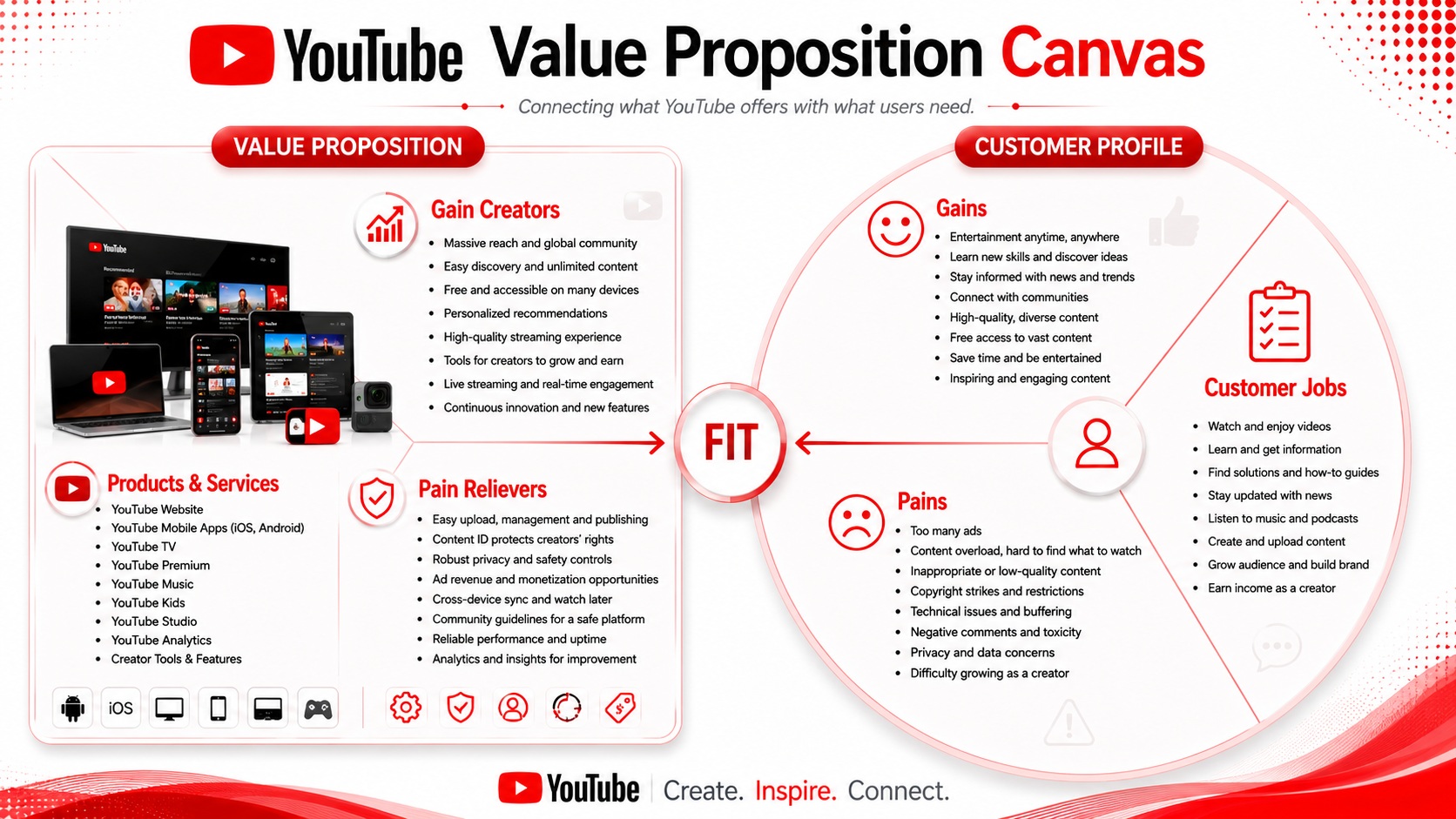
The Value Proposition Canvas helps explain how well YouTube’s offer fits what users need. It connects the customer profile with the value proposition.
For YouTube, the fit is strong because different users come with different jobs. Viewers want entertainment, learning, search answers, music, news, product reviews, and community. Creators want reach, income, tools, and audience feedback. Advertisers want attention, targeting, and measurable performance.
YouTube responds with free videos, recommendations, subscriptions, creator tools, advertising products, analytics, monetisation features, and rights management systems.
This fit is important because YouTube competes across several categories at once. It competes with TV for attention, TikTok for short-form video, Spotify for music, Google Search for answers, Netflix for viewing time, and online courses for learning.
The YouTube Business Model Canvas becomes stronger when viewed with this fit. YouTube wins when it helps viewers find useful content, helps creators earn, and helps advertisers reach audiences efficiently.
The customer profile explains what YouTube users are trying to achieve, what problems they face, and what benefits they expect.
Viewers want videos that are relevant, easy to find, entertaining, useful, and accessible across devices. They also want fewer poor recommendations, fewer unsafe videos, and better control over their viewing experience.
Creators want audience growth, monetisation, analytics, creative tools, fair policies, and predictable income. Advertisers want brand-safe reach, measurable results, and flexible campaign formats.
| Customer Profile | Analysis |
|---|---|
| Customer Jobs | Watch, learn, search, compare, entertain, create, promote, and monetise. |
| Pains | Ad overload, poor recommendations, copyright issues, unsafe content, income uncertainty, and policy confusion. |
| Gains | Free access, global reach, income potential, community, convenience, discovery, and measurable advertising. |
YouTube’s value proposition explains how the platform responds to these jobs, pains, and gains. The platform offers free viewing, creator monetisation, audience discovery, targeted advertising, fan engagement, subscriptions, and content protection.
Viewers benefit from an enormous content library. They can search for a tutorial, watch a podcast, follow news, compare products, listen to music, or relax with entertainment.
Creators benefit from global distribution. A small creator can reach audiences without owning a TV network, cinema chain, publishing company, or advertising sales team.
Advertisers benefit from measurable campaigns. They can target audiences by interest, intent, geography, behaviour, and content context.
| Value Proposition Element | Analysis |
|---|---|
| Products and Services | YouTube, Shorts, Studio, Premium, Music, TV, live streaming, memberships, ads, and analytics. |
| Pain Relievers | Recommendations, search, moderation, Content ID, creator tools, ad controls, and subscription options. |
| Gain Creators | Global reach, monetisation, discovery, community, entertainment, learning, and measurable marketing. |
The fit happens when YouTube matches content supply with user demand at scale. Viewers want relevant videos. Creators want audiences. Advertisers want attention. YouTube connects all three through search, recommendations, monetisation, and analytics.
This fit is visible when a viewer searches for a product review, watches a creator’s tutorial, subscribes to the channel, sees a relevant ad, and later watches related videos. Each action creates value for the viewer, creator, advertiser, and platform.
| Customer Profile | Details | Matching Value Proposition | How YouTube Creates Fit |
|---|---|---|---|
| Customer Jobs | Users want to watch, learn, search, create, promote, and monetise. | Products and Services | YouTube, Shorts, Studio, Premium, Music, TV, ads, and live streaming support these jobs. |
| Pains | Users face irrelevant content, ad fatigue, copyright issues, unsafe content, and monetisation uncertainty. | Pain Relievers | Search, recommendations, moderation, Content ID, creator tools, ad settings, and policy systems reduce friction. |
| Gains | Users want free access, global reach, income, community, convenience, and measurable results. | Gain Creators | YouTube creates gains through discovery, monetisation, fan tools, subscriptions, analytics, and advertiser reporting. |
Fit also happens when YouTube improves daily habits. A viewer learns faster. A creator earns from expertise. An advertiser reaches the right audience. That is where YouTube turns video into a multi-sided business model.
VPC Diagram:
YouTube has several competitive advantages that support its long-term position. These advantages work together across viewers, creators, advertisers, subscribers, and rights holders.
These advantages reinforce each other. Scale attracts creators, creators attract viewers, viewers attract advertisers, and revenue funds better tools.
YouTube also faces major risks. These risks matter because the platform operates at global scale and influences media, advertising, culture, education, politics, and creator income.
These risks do not mean YouTube’s model is weak. They show that scale creates responsibility, operating complexity, and public scrutiny.
YouTube should protect creator trust as a strategic priority. Clearer monetisation rules, better appeals, more predictable policy enforcement, and improved creator communication can reduce frustration.
The platform should also improve ad experience. Revenue growth must not come at the cost of viewer satisfaction. Better ad load management, more relevant targeting, and stronger controls can protect long-term engagement.
Shorts monetisation should continue to mature. Creators need stronger incentives to produce high-quality short-form content while still supporting long-form videos, live streams, and educational content.
YouTube should strengthen AI governance. Labelling, detection, copyright safeguards, synthetic media policies, and creator tools need to grow together.
Subscription growth deserves more focus. Premium, Music, TV, memberships, and fan payments can reduce dependence on advertising and build recurring income.
Educational content is another growth opportunity. YouTube can invest more in credible learning channels, structured playlists, certification partnerships, and safer learning environments.
Brand safety must remain central. Advertisers need confidence that campaigns will not appear beside harmful or unsuitable content.
The YouTube Business Model Canvas suggests one clear priority: keep the platform valuable for viewers, creators, advertisers, and rights holders without allowing one group’s needs to damage the others.
YouTube’s business model is powerful because it connects content, attention, creators, advertisers, subscriptions, data, and technology infrastructure into one platform.
Viewers receive free and paid video experiences. Creators receive tools, reach, analytics, and monetisation opportunities. Advertisers receive targeted access to large audiences. Rights holders receive distribution and copyright management.
The strongest part of YouTube’s model is its multi-sided network effect. More creators bring more content. More content attracts more viewers. Larger audiences attract more advertisers. Higher revenue supports creators, product development, and platform expansion.
Future growth will depend on how well YouTube manages Shorts, AI, subscriptions, connected TV, creator trust, content safety, and regulation.
If YouTube balances these areas well, it can remain one of the world’s most important digital media platforms. Its challenge is not only to grow. The bigger challenge is to grow while keeping viewers, creators, advertisers, and society confident in the platform.
This article is for educational and business analysis purposes only. It is based on publicly available information, general market observation, and strategic interpretation. It is not financial advice, investment advice, legal advice, or an official statement from YouTube, Google, or Alphabet Inc. Readers should conduct their own research before making business, investment, or strategic decisions.
Read this Apple Business Model Canvas analysis to understand how Apple creates value through premium… Read More
This Business Model Canvas AWS analysis explains how the company creates, delivers, and captures value… Read More
Hermes Business Model Canvas explained in depth, including customer segments, value proposition, channels, revenue, competitive… Read More
This article explores the Canva Business Model and provides an in-depth review of each BMC… Read More
Many people think they understand McDonald’s business model. Sell burgers. Sell fries. Sell drinks. It… Read More
Explore the Mixue Business Model Canvas and learn how Mixue uses affordability, franchising, supply chain… Read More